
In Texas, a husband's involvement is legally required on a car loan application for his wife, even if his credit history negatively impacts her approval.
AI debate verdict and arguments
⚠️ AI-generated information only; not professional advice
Completed October 14, 2026
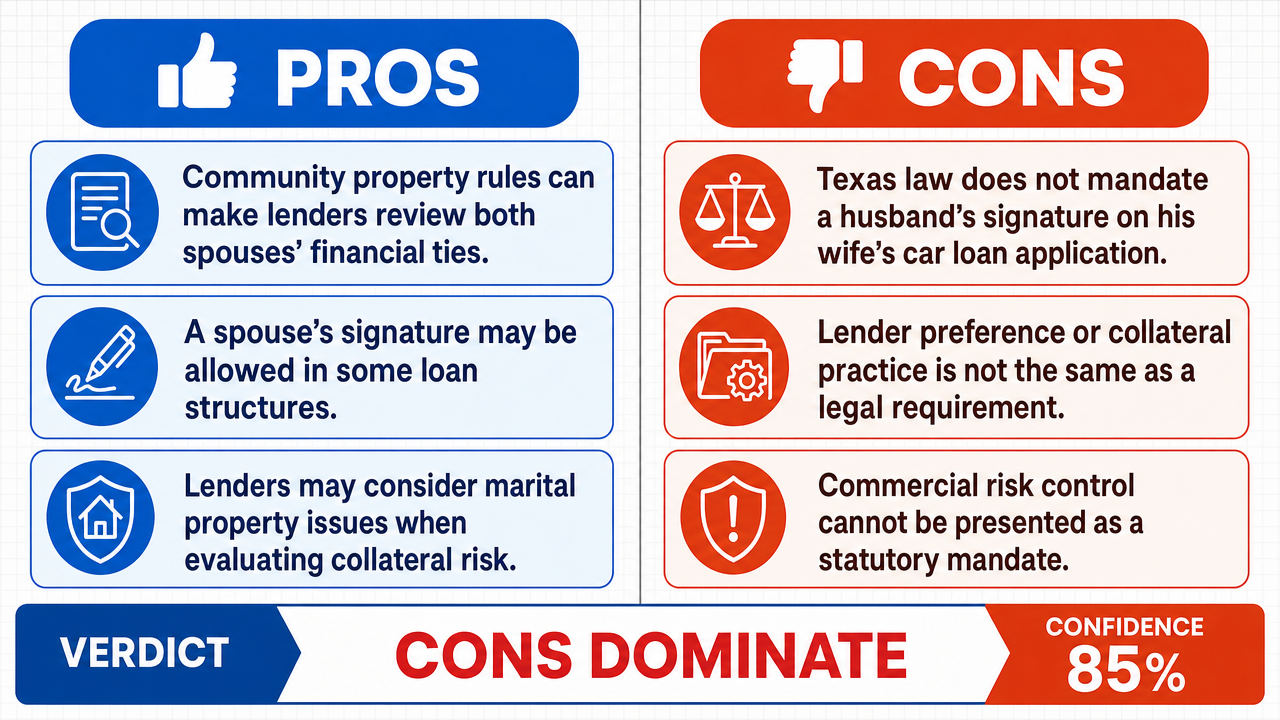
Verdict
Verdict: likely FALSE (85%)
Web Report: https://solsice.com/public/debates/in-texas-a-husband-s-involvement-is-legally-required-on-a-ca-e269283043c2
This section provides a brief overview of the key arguments. You do not need to read the full detailed report below.
✅ Key PRO arguments:
- ■Texas is a community property state, and under Texas Family Code Section 3.003 , property possessed by either spouse during marriage is presumed to be community property. This presumption extends to liabilities , meaning creditors frequently require the non-applicant spouse 's signature on loan documents for major assets like vehicles to ensure the debt is enforceable against the community estate .
- ■The legal status of a husband's signature has only three possible branches: legally mandated, legally permitted but not required, or legally prohibited/irrelevant. Under Sections 3.002 and 3.003, the community property presumption creates a legal condition for creditors: to secure a valid, enforceable lien against community property, the non-applicant spouse 's signature is effectively required.
❌ Key ANTI arguments:
- ■The affirmative's argument suffers from a fundamental confusion between legal possibility and legal mandate. While Texas is a community property state and lenders 'frequently require' a spouse's signature to protect their interests, there is a profound distinction between a creditor 's risk-mitigation strategy and a statutory requirement . The Texas Family Code governs the characterization of property and debt but does not impose a blanket mandate on individual consumer credit contracts requiring a non-applicant spouse to sign.
- ■The opponent conflates the desirability of a perfected security interest with a legal mandate for the contract itself. The argument that a lender cannot easily reach community property without a second signature does not equate to a legal requirement. The Texas Family Code (e.g., Section 3.002 ) defines the nature of property but does not dictate the specific contractual formalities required for a single loan application.
- ■A lender's preference for a spouse's signature is a commercial decision, not a legal one. Texas law does not compel a wife to obtain her husband's signature on a car loan; she may apply independently, and any lender requirement is contractual/policy-based rather than statutorily mandated.
💭 Conclusion: False. The assertion that Texas law legally requires a husband's involvement on his wife's car loan application is not supported by statutory text. The winning side correctly distinguished between a lender's commercial risk-mitigation preference and a true legal mandate imposed by the Texas Family Code . While Texas community property principles characterize property and debts acquired during marriage, they do not dictate the contractual formalities of individual consumer credit applications. The affirmative's argument conflated the practical desirability of obtaining a non-applicant spouse 's signature to perfect a security interest with a statutory requirement , which is a fundamental error in legal reasoning. Confidence is set at 85% rather than higher because the second sub-claim regarding the husband's negative credit history impacting approval was not directly addressed in the debate evidence.
🔬 DeepResearch Result: likely FALSE ❌ (85%)
Assertion: In Texas, a husband's involvement is legally required on a car loan application for his wife, even if his credit history negatively impacts her approval.
Participating models: deepseek-v3.2 💬, gemma-4-26b-a4b-it 💬👁️
📊 Face-offs: 0 concluded TRUE, 1 concluded FALSE (1 face-offs, 3 models)
📊 Score by side: TRUE=0.00, FALSE=0.90
🏅 Model score changes:
minimax-m3 💬👁️: +9
✅ PRO Arguments:
- ■Texas is a community property state, and under Texas Family Code Section 3.003 , property possessed by either spouse during marriage is presumed to be community property. This presumption extends to liabilities , meaning creditors frequently require the non-applicant spouse 's signature on loan documents for major assets like vehicles to ensure the debt is enforceable against the community estate . deepseek-v3.2 💬
- ■The legal status of a husband's signature has only three possible branches: legally mandated, legally permitted but not required, or legally prohibited/irrelevant. Under Sections 3.002 and 3.003, the community property presumption creates a legal condition for creditors: to secure a valid, enforceable lien against community property, the non-applicant spouse's signature is effectively required. deepseek-v3.2 💬
❌ ANTI Arguments:
- ■The affirmative's argument suffers from a fundamental confusion between legal possibility and legal mandate. While Texas is a community property state and lenders 'frequently require' a spouse's signature to protect their interests, there is a profound distinction between a creditor 's risk-mitigation strategy and a statutory requirement . The Texas Family Code governs the characterization of property and debt but does not impose a blanket mandate on individual consumer credit contracts requiring a non-applicant spouse to sign. gemma-4-26b-a4b-it 💬👁️
- ■The opponent conflates the desirability of a perfected security interest with a legal mandate for the contract itself. The argument that a lender cannot easily reach community property without a second signature does not equate to a legal requirement. The Texas Family Code (e.g., Section 3.002 ) defines the nature of property but does not dictate the specific contractual formalities required for a single loan application. gemma-4-26b-a4b-it 💬👁️
- ■A lender's preference for a spouse's signature is a commercial decision, not a legal one. Texas law does not compel a wife to obtain her husband's signature on a car loan; she may apply independently, and any lender requirement is contractual/policy-based rather than statutorily mandated. gemma-4-26b-a4b-it 💬👁️
💭 Reasoning: False. The assertion that Texas law legally requires a husband's involvement on his wife's car loan application is not supported by statutory text. The winning side correctly distinguished between a lender's commercial risk-mitigation preference and a true legal mandate imposed by the Texas Family Code. While Texas community property principles characterize property and debts acquired during marriage, they do not dictate the contractual formalities of individual consumer credit applications. The affirmative's argument conflated the practical desirability of obtaining a non-applicant spouse's signature to perfect a security interest with a statutory requirement, which is a fundamental error in legal reasoning. Confidence is set at 85% rather than higher because the second sub-claim regarding the husband's negative credit history impacting approval was not directly addressed in the debate evidence.
📋 PRO Facts:
• Texas is a community property state.
• Texas community property law creates a presumption that property possessed by either spouse during marriage is community property.
• Texas community property law addresses the characterization of community property.
📋 ANTI Facts:
• The Texas Family Code does not impose a blanket statutory mandate requiring a non-applicant spouse to sign individual consumer credit contracts.
• A lender's requirement for a spouse's signature is a risk-mitigation strategy, not a legal mandate.
• The Texas Family Code governs property characterization but does not dictate specific contractual formalities for single loan applications.
| Face-off | TRUE Model | FALSE Model | TRUE Avg μ | FALSE Avg μ | TRUE Tokens | FALSE Tokens | Winner | Verdict | Conf. |
|---|---|---|---|---|---|---|---|---|---|
| #1 | deepseek-v3.2 💬 | gemma-4-26b-a4b-it 💬👁️ | 0.451 | 0.567 | 8 | 2 | FALSE | FALSE | 90% |
The following technical terms, abbreviations, and domain-specific concepts are referenced throughout this debate transcript. Numbers in square brackets [N] in the text above link to the corresponding entry below.
[1] capacity to contract — The legal ability of a person to enter into a binding agreement. The debate discusses whether a married woman has full capacity to enter into a credit agreement without spousal involvement.
[2] commercial prudence — The standard of reasonable business judgment exercised by lenders and other commercial parties. The negative side argues that a lender's preference for a spouse's signature is a matter of commercial prudence, not a legal mandate.
[3] community estate — The combined pool of property and debts owned jointly by both spouses under a community property regime. The affirmative argues that a security interest perfected against only one spouse is defective against the community estate.
[4] community property — A legal property regime in which most assets and debts acquired during marriage are jointly owned by both spouses. Texas is identified in the debate as a community property state.
[5] community property presumption — The legal presumption under the Texas Family Code that property possessed by either spouse during marriage is community property. The debate discusses whether this presumption extends to liabilities and creditor requirements.
[6] consumer credit contracts — Contracts for credit extended to individual consumers, such as car loans. The negative side argues that the Texas Family Code does not impose blanket mandates on individual consumer credit contracts.
[7] credit profile — A summary of an individual's creditworthiness based on their credit history. The debate notes that a husband's involvement may be required even if his credit profile negatively impacts approval.
[8] creditor — A party to whom money is owed, such as a lender. The affirmative argues that creditors require spousal signatures to protect their interest in the community estate.
[9] default — Failure to meet a legal or financial obligation, particularly the failure to repay a loan as agreed. The affirmative uses this term to illustrate creditor risk if only one spouse signs.
[10] enforceability — The legal quality of being able to be upheld or enforced in court. The affirmative argues that a loan signed by only one spouse may not be enforceable against the community estate.
[11] industry guidance — Non-binding recommendations and best practices issued by industry associations. The negative side criticizes the affirmative's reliance on industry guidance as insufficient to establish a legal mandate.
[12] joinder — The legal act of joining or being joined as a party to a contract or legal proceeding. The debate discusses whether joinder of the non-applicant spouse is legally required for the loan.
[13] liabilities — Financial obligations or debts owed by a person or entity. The affirmative argues that the community property presumption extends to liabilities, influencing creditor requirements.
[14] lien — A legal claim or encumbrance on property as security for a debt. The debate discusses whether a lien against community property requires both spouses' signatures to be valid.
[15] marital estate — The combined property and financial interests of a married couple. The affirmative argues that the Texas Family Code creates a direct link between a spouse's credit application and the marital estate.
[16] model forms — Standardized legal or contractual templates provided by industry associations. The negative side criticizes the affirmative's reliance on model forms as inadequate to establish a legal mandate.
[17] non-applicant spouse — The spouse who is not the primary applicant on a credit application. The debate centers on whether the non-applicant spouse's signature is legally required on a car loan.
[18] perfection — The legal process by which a security interest is made fully enforceable against third parties. The affirmative argues that perfection against community property requires both spouses' consent.
[19] private contract — An agreement between private parties governed by their negotiated terms rather than imposed by statute. The negative side argues that spousal signature requirements are matters of private contract, not legal mandate.
[20] property characterization — The legal classification of property as either community or separate under family law. The debate discusses whether the Texas Family Code's property characterization rules dictate contractual formalities.
[21] risk mitigation — Strategies employed by lenders to reduce the risk of financial loss. The affirmative argues that requiring spousal signatures is a creditor risk mitigation strategy driven by community property law.
[22] Section 3.002 — Texas Family Code Section 3.002 — A provision of the Texas Family Code cited in the debate regarding the definition and nature of community property.
[23] Section 3.003 — Texas Family Code Section 3.003 — A provision of the Texas Family Code cited in the debate establishing the presumption that property possessed by either spouse during marriage is community property.
[24] security interest — A legal interest in collateral granted by a debtor to a creditor as security for a debt. The debate discusses whether a security interest in a vehicle requires both spouses' signatures.
[25] statutory requirement — A requirement imposed by enacted legislation (statute) rather than by private agreement. The central dispute is whether spousal signature on a car loan is a statutory requirement or merely a lender preference.
[26] Texas Family Code — The codified body of Texas state law governing family-related matters, including property and debt characterization between spouses. Both sides cite its provisions in the debate.
Face-off transcripts
- ■
Ownership & Trade Secrets. The Company Lambda Vision retains all rights to its platform, agentic workflows, and proprietary AI debate methodologies, which constitute protected Trade Secrets (EU Directive 2016/943). Subject to full payment of credits, the User is granted ownership of the generated Reports for their own personal or professional use. Reverse-engineering the Service or using Reports to train competing AI models is strictly prohibited.
- ■
No Professional Advice. Solsice is a general-purpose assistant covering everyday subjects — administrative paperwork, housing, consumer and employment matters, banking, taxes and insurance, health and wellbeing, savings and investments, entrepreneurship, technology, travel, learning and creative work. Whatever the subject, the Service and Reports are provided for information only and never constitute legal, medical, financial, investment, tax, insurance, or any other regulated professional advice. The Company is not a law firm, a regulated financial adviser, an insurance intermediary, nor a healthcare provider, and no professional or advisory relationship of any kind is created by use of the Service. Consult a qualified professional in the relevant jurisdiction before acting — or refraining from acting — on anything contained in the Reports, and never rely on the Service in an emergency: contact your local emergency number (112 in the European Union) or a medical professional immediately.
- ■
AI-Generated Content, Sources and Viewpoints. Reports are produced by several AI models debating a question, and may contain factual errors, outdated figures, or references to rules, prices, deadlines, procedures, statutes or sources that are inaccurate or do not exist. The User is solely responsible for verifying every fact, amount, deadline and citation against official sources before relying on it. Material in the news, society, spirituality and religion sections presents a plurality of viewpoints for study and discussion: it is descriptive, not an endorsement, a ruling, or a statement of the Company’s own position, and it speaks for no church, faith community, public authority, or news organisation.
- ■
Liability & Governing Law. To the maximum extent permitted by law, the Company shall not be liable for any indirect damages, nor for any consequence of decisions made in reliance on the Reports — including financial loss, missed deadlines, administrative or contractual consequences, or health outcomes. These Terms are governed by French law. Any disputes shall be subject to the exclusive jurisdiction of the Courts of Paris, France.