
Il est préférable de considérer qu'une opportunité d'emploi n'existe plus après deux relances infructueuses suite à un entretien, même en cas de "ghosting" potentiel
AI debate verdict and arguments
⚠️ AI-generated information only; not professional advice
Completed October 11, 2026
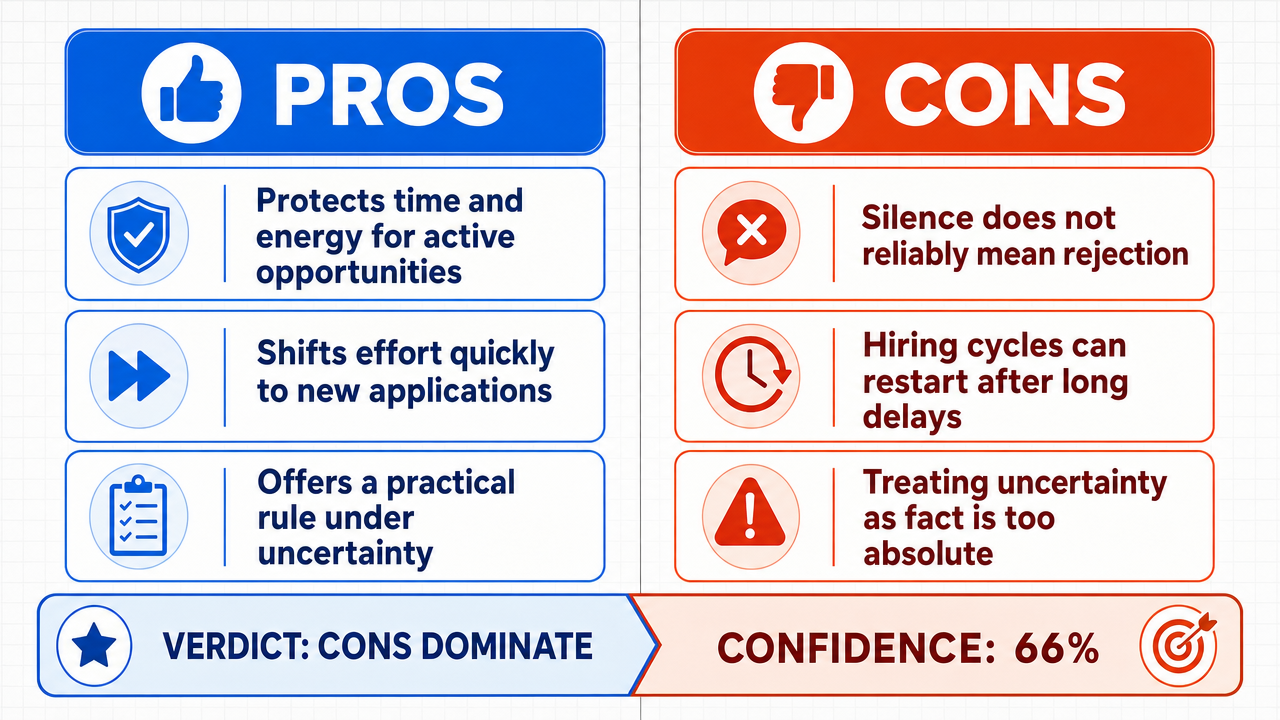
Verdict
Verdict: Mostly FALSE (66%)
This section provides a brief overview of the key arguments. It is not necessary to read the detailed report below.
✅ Key PRO arguments:
- ■Job searching is a process where energy and time are limited resources; persisting after two unsuccessful follow-ups constitutes an inefficient allocation of these resources, and the average response rate of recruiters drops sharply after an initial silence, making a second silence highly predictive of failure.
- ■Considering the position as lost allows the candidate to immediately reallocate effort toward new active applications, thereby optimizing their overall chances of re-employment.
- ■The affirmative thesis is a rational decision rule under uncertainty, not a certainty about the actual state of the recruitment; the relevant criterion is expected utility , not the ontological existence of the position.
❌ Key CONTRA arguments:
- ■The claim that silence is an implicit rejection signal relies on a misinterpretation of organizational processes: response delays often reflect operational bottlenecks (lack of decision-maker, internal reorganization , unforeseen urgencies) that suspend the process without canceling it.
- ■Prematurely concluding failure after two follow-ups excludes the candidate from decision cycles that may resume after several weeks, thus losing a real opportunity.
- ■The premise “silence = rejection” is an abusive generalization that confuses a risk management practice with a factual norm, and ignores the distinction between process closure and communication suspension .
💭 Conclusion: False: it is not better to consider a job opportunity as definitively closed after two unsuccessful follow-ups , even in the case of potential “ghosting .” The side supporting the FALSE position has successfully demonstrated that a recruiter’s silence is not systematically a rejection signal but often reflects operational bottlenecks (absence of decision-maker, internal reorganization , unforeseen urgencies) that suspend the process without canceling it. The argument that “silence = rejection” is an abusive generalization that confuses uncertainty management with factual truth, and empirical cases show that processes can resume after several weeks of silence. The rule of two follow-ups, although useful as a heuristic for time-constrained optimization, remains a risky simplification that excludes the candidate from potentially favorable decision cycles . Confidence is moderate (66%) because, although the FALSE position outweighs the structural rationality of the process, the two-follow-up rule retains practical legitimacy as a time and psychological well-being management strategy for the candidate.
🔬 Verdict: Mostly FALSE ❌ (66%)
Claim: It is better to consider a job opportunity as no longer available after two unsuccessful follow-ups following an interview, even in the case of potential "ghosting ."
Participating models: deepseek-v3.2 💬, gemma-4-26b-a4b-it 💬👁️
📊 Confrontations: 0 concluded TRUE, 1 concluded FALSE (1 confrontation, 3 models)
📊 Score per camp: TRUE=0.00, FALSE=0.66
🏅 Model score evolution:
minimax-m3 💬👁️: +7
✅ PRO arguments:
- ■Job searching is a process where energy and time are limited resources; persisting after two unsuccessful follow-ups is an inefficient allocation of these resources, and the average response rate of recruiters drops sharply after an initial silence, making a second silence highly predictive of failure. deepseek-v3.2 💬
- ■Considering the position as lost allows the candidate to immediately reallocate effort toward new active applications, thereby optimizing their overall chances of re-employment. deepseek-v3.2 💬
- ■The affirmative thesis is a rational decision rule under uncertainty, not a certainty about the actual state of the recruitment; the relevant criterion is expected utility , not the ontological existence of the position. deepseek-v3.2 💬
- ■Professional career coaching guides generally recommend abandonment after two follow-ups without response, making it a dominant uncertainty management practice. deepseek-v3.2 💬
❌ CONTRA arguments:
- ■The claim that silence is an implicit rejection signal relies on a misinterpretation of organizational processes: response delays often reflect operational bottlenecks (lack of decision-maker, internal reorganization , unforeseen urgencies) that suspend the process without canceling it. gemma-4-26b-a4b-it 💬👁️
- ■Prematurely concluding failure after two follow-ups excludes the candidate from decision cycles that may resume after several weeks, thus losing a real opportunity. gemma-4-26b-a4b-it 💬👁️
- ■The premise “silence = rejection” is an abusive generalization that confuses a risk management practice with a factual norm, and ignores the distinction between process closure and communication suspension . gemma-4-26b-a4b-it 💬👁️
- ■Recruitment processes are structurally subject to interruptions that are not rejections; a late follow-up can still receive a callback after several weeks of silence. gemma-4-26b-a4b-it 💬👁️
💭 Reasoning: False: it is not better to consider a job opportunity as definitively closed after two unsuccessful follow-ups, including in cases of potential “ghosting.” The side supporting the FALSE position has successfully demonstrated that a recruiter’s silence is not systematically a rejection signal but often reflects operational bottlenecks (lack of decision-maker, internal reorganization, unforeseen urgencies) that suspend the process without canceling it. The argument that “silence = rejection” is an abusive generalization that confuses uncertainty management with factual truth, and empirical cases show that processes can resume after several weeks of silence. The rule of two follow-ups, although useful as a heuristic for time-constrained optimization, remains a risky simplification that excludes the candidate from potentially favorable decision cycles . Confidence is moderate (66%) because, although the FALSE position outweighs the structural rationality of the process, the two-follow-up rule retains practical legitimacy as a time and psychological well-being management strategy for the candidate.
📋 FACTS PRO:
• The average response rate of recruiters after an interview drops sharply after an initial silence.
• Professional career coaching guides generally recommend abandonment after two follow-ups without response.
• Job searching involves limited resources in time and energy that must be allocated efficiently.
📋 FACTS CON:
• Recruitment processes are structurally subject to interruptions that are not refusals (absence of decision-maker, internal reorganization, unforeseen emergencies).
• Empirical cases show that recruitment processes can resume after several weeks of silence and lead to a successful follow-up.
• The response time within organizations often reflects operational bottlenecks rather than a definitive decision.
| Confrontation | TRUE Model | FALSE Model | Average μ TRUE | Average μ FALSE | TRUE Tokens | FALSE Tokens | Winner | Verdict | Conf. |
|---|---|---|---|---|---|---|---|---|---|
| #1 | deepseek-v3.2 💬 | gemma-4-26b-a4b-it 💬👁️ | 0.361 | 0.285 | 12 | 3 | TRUE | FALSE | 66% |
The following technical terms, abbreviations, and specialized concepts are used in this transcript. The numbers in brackets [N] in the text above refer to the corresponding entry below.
[1] Empirical anomaly — Observation or data that contradicts an established theory or rule, without completely invalidating it.
[2] Competitive advantage — Favorable position held by a candidate or a company relative to others, allowing them to achieve better results in a competitive context.
[3] Psychological well-being — State of mental health characterized by a sense of emotional balance and satisfaction, here invoked as a resource to protect during job searching.
[4] Closure of a process — Action of officially ending a recruitment process, as opposed to its simple temporary suspension.
[5] Coaching — Personalized professional support aimed at developing an individual's skills and performance, particularly in job search.
[6] Decision cycles — Successive phases through which a decision-making process passes within an organization, which can be suspended and then resumed.
[7] Strategic diagnosis — Analysis aimed at correctly interpreting the meaning of a signal (here, a recruiter's silence) to guide a decision.
[8] Human resources management — Organizational function that manages recruitment, training, evaluation, and development of employees.
[9] Ghosting — Practice whereby a recruiter or employer ceases all communication with a candidate without explanation or notification of rejection.
[10] Operational bottlenecks — Points of congestion in an operational process that slow down or block the flow of information and decision-making.
[11] Abusive generalization — Reasoning that applies a conclusion drawn from a limited number of cases to a broad set.
[12] Professional posture — Attitude and behavior adopted by a candidate in interactions with recruiters, which can influence the perception of their application.
[13] Recruitment process — Set of formalized steps through which an organization identifies, evaluates, and selects candidates for a position.
[14] Implicit premise — Hypothesis not explicitly stated but necessary for reasoning, often unconscious for the one who emits it.
[15] Rationality — Ability to make decisions consistent with one's goals based on logical reasoning and available information.
[16] Follow-ups — Contact efforts made by a candidate after an interview to obtain feedback on their application.
[17] Decision rule — Predefined criterion used to choose between several options based on available information, without guaranteeing certainty of the result.
[18] Internal reorganization — Structural modification of services or responsibilities within an organization, which can temporarily suspend a recruitment.
[19] Predictive signal — Observable indicator that allows anticipating a future result with some probability, here applied to a recruiter's silence.
[20] Fallacy of appeal to authority — Fallacious argument considering a statement true because it is supported by an authority, without examining the substance.
[21] Optimization strategy under uncertainty — Approach aimed at maximizing an expected outcome when available information is incomplete, by arbitrating between multiple options.
[22] Communication suspension — Temporary interruption of information exchange, without a definitive closure of the underlying process.
[23] Response rate — Proportion of people who respond to a solicitation among those contacted, here applied to recruiters after an interview.
[24] Expected utility — Weighted average value of possible outcomes of a decision, each multiplied by its probability of occurrence.
[25] Budget validation — Approval process whereby management authorizes expenses associated with a decision, including opening or confirming a position.
Face-off transcripts
- ■
Ownership & Trade Secrets. Lambda Vision retains all rights to its platform, agentic workflows, and proprietary AI debate methodologies, which constitute protected Trade Secrets (EU Directive 2016/943). Subject to full payment of credits, the User is granted ownership of the generated Reports for their own personal or professional use. Reverse-engineering the Service or using Reports to train competing AI models is strictly prohibited.
- ■
No Professional Advice. Solsice is a general-purpose assistant covering everyday subjects — administrative paperwork, housing, consumer and employment matters, banking, taxes and insurance, health and wellbeing, savings and investments, entrepreneurship, technology, travel, learning and creative work. Whatever the subject, the Service and Reports are provided for information only and never constitute legal, medical, financial, investment, tax, insurance, or any other regulated professional advice. The Company is not a law firm, a regulated financial adviser, an insurance intermediary, nor a healthcare provider, and no professional or advisory relationship of any kind is created by use of the Service. Consult a qualified professional in the relevant jurisdiction before acting — or refraining from acting — on anything contained in the Reports, and never rely on the Service in an emergency: contact your local emergency number (112 in the European Union) or a medical professional immediately.
- ■
AI-Generated Content, Sources and Viewpoints. Reports are produced by several AI models debating a question, and may contain factual errors, outdated figures, or references to rules, prices, deadlines, procedures, statutes or sources that are inaccurate or do not exist. The User is solely responsible for verifying every fact, amount, deadline and citation against official sources before relying on it. Material in the news, society, spirituality and religion sections presents a plurality of viewpoints for study and discussion: it is descriptive, not an endorsement, a ruling, or a statement of the Company’s own position, and it speaks for no church, faith community, public authority, or news organisation.
- ■
Liability & Governing Law. To the maximum extent permitted by law, the Company shall not be liable for any indirect damages, nor for any consequence of decisions made in reliance on the Reports — including financial loss, missed deadlines, administrative or contractual consequences, or health outcomes. These Terms are governed by French law. Any disputes shall be subject to the exclusive jurisdiction of the Courts of Paris, France.