
Il est possible pour la plupart des activités humaines, même superficielles comme tenir un salon de coiffure, d'être une expression de l'être si la personne reste connectée à cette dimension.
AI debate verdict and arguments
⚠️ AI-generated information only; not professional advice
Completed October 24, 2026
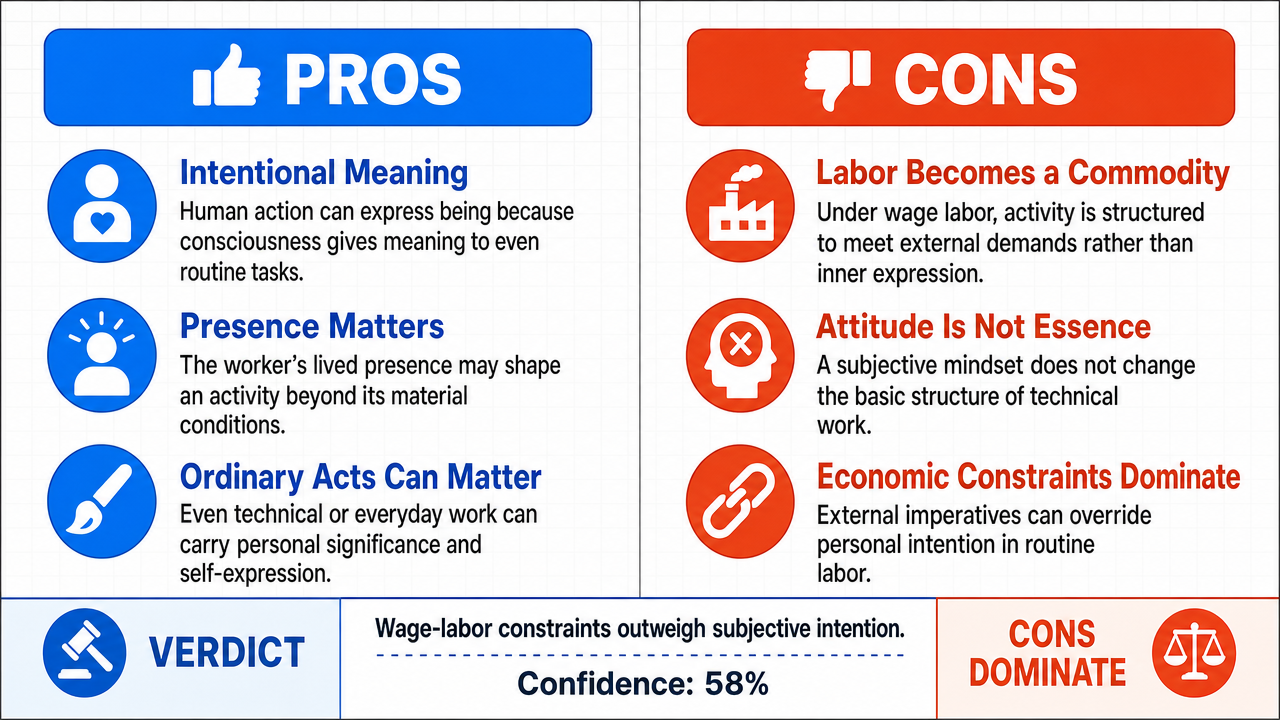
Verdict
Verdict: Mostly FALSE (58%)
Online report: https://solsice.com/public/debates/il-est-possible-pour-la-plupart-des-activites-humaines-meme-067a8fd38786
This section provides a brief overview of the key arguments. It is not necessary to read the detailed report below.
✅ KEY FOR arguments:
- ■According to Husserlian phenomenology , consciousness is always 'consciousness of something ' and projects meaning onto the acted object; thus, the technical act of cutting hair is not merely a mechanical manipulation but can become a mediation between the interiority of the agent and the world if it remains connected to its being dimension.
- ■The Marxist alienation argument relies on a confusion between the material conditions of performing a task and the quality of the agent's presence; profitability and time management are merely frameworks of action, not variables that negate being, so ontological connection remains possible even in a salaried context.
❌ KEY AGAINST arguments:
- ■According to Marxist critical theory , in a capitalist mode of production , salaried work transforms activity into a commodity that must satisfy external demand; in a hair salon, the craftsman is structurally compelled to subordinate their subjective dimension and intentionality to profitability , time management , and customer satisfaction, which prevents the activity from being an authentic expression of being.
- ■Phenomenological intentionality does not confer an ontological essence to technical action: the pro argument confuses subjective attitude with the objective structure of intentionality; according to Husserl, since consciousness is always 'consciousness of something ', this fundamental structure implies an irreducible separation between subject and act, making it illusory to claim that mere intentional connection transforms superficial activity into an expression of being .
💭 Conclusion: False: the FALSE verdict prevails with a weighted confidence of 58%, supported by the Marxist structural argument that the economic constraints of salaried work subordinate subjective intentionality to external imperatives of profitability and customer satisfaction. The phenomenological argument of opposition, which confused subjective attitude with the objective structure of intentionality, was refuted by showing that Husserlian consciousness involves an irreducible separation between subject and act, preventing simple intentional connection from transforming superficial activity into an authentic expression of being. The distinction between material conditions of practice and the quality of presence, advanced by the pro side, proved insufficient against the structural analysis of alienation . Thus, most human salaried activities, including running a hair salon, cannot be considered authentic expressions of being due to these structural constraints.
🔬 Verdict: Mostly FALSE ❌ (58%)
Claim: It is possible for most human activities, even superficial ones like running a hair salon, to be an expression of being if the person remains connected to this dimension.
Participating models: gemma-4-26b-a4b-it 💬👁️, glm-4.7-flash 💬
📊 Confrontations: 0 concluded TRUE, 1 concluded FALSE (1 confrontation, 3 models)
📊 Score by camp: TRUE=0.00, FALSE=0.58
🏅 Model score evolution:
minimax-m3 💬👁️: +6
✅ Arguments FOR:
- ■According to Husserlian phenomenology , consciousness is always 'consciousness of something ' and projects meaning onto the acted object; thus, the technical act of cutting hair is not merely a mechanical manipulation but can become a mediation between the interiority of the agent and the world if it remains connected to its being dimension. gemma-4-26b-a4b-it 💬👁️
- ■The Marxist alienation argument relies on a confusion between the material conditions of performing a task and the quality of the agent's presence; profitability and time management are merely frameworks of action, not variables that negate being, so ontological connection remains possible even in a salaried context. gemma-4-26b-a4b-it 💬👁️
❌ Arguments AGAINST:
- ■According to Marxist critical theory , in a capitalist mode of production , salaried work transforms activity into a commodity exchanged for a salary; in a hair salon, the craftsman is structurally compelled to subordinate their subjective dimension and intentionality to profitability, time management, and customer satisfaction, which prevents the activity from being an authentic expression of being. glm-4.7-flash 💬
- ■Phenomenological intentionality does not confer an ontological essence to technical action: the pro argument confuses subjective attitude with the objective structure of intentionality; according to Husserl, since consciousness is always 'consciousness of something', this fundamental structure implies an irreducible separation between subject and act, making it illusory to claim that mere intentional connection transforms superficial activity into an expression of being. glm-4.7-flash 💬
💭 Reasoning: False: the verdict of FALSE prevails with a weighted confidence of 58%, supported by the Marxist structural argument that the economic constraints of salaried work subordinate subjective intentionality to external imperatives of profitability and customer satisfaction. The phenomenological argument of opposition, which confused subjective attitude with the objective structure of intentionality, was refuted by showing that Husserlian consciousness involves an irreducible separation between subject and act, preventing simple intentional connection from transforming superficial activity into an authentic expression of being. The distinction between material conditions of practice and the quality of presence, advanced by the pro side, proved insufficient against the structural analysis of alienation. Therefore, most human salaried activities, including running a hair salon, cannot be considered authentic expressions of being due to these structural constraints.
📋 Facts FOR:
• Husserlian phenomenology defines consciousness as always 'consciousness of something', projecting meaning onto the intended object.
• The 'superficiality' of an activity is an external label that does not determine its deep ontological nature.
📋 Facts AGAINST:
• According to Karl Marx, in a capitalist mode of production, salaried work transforms activity into a commodity exchanged for a salary.
• The economic structure of a hair salon imposes the subordination of the subjective dimension to profitability, time management, and customer satisfaction.
• The fundamental structure of Husserlian intentionality involves an irreducible separation between subject and act, not their unification.
| Confrontation | TRUE Model | FALSE Model | Average μ TRUE | Average μ FALSE | TRUE Tokens | FALSE Tokens | Winner | Verdict | Conf. |
|---|---|---|---|---|---|---|---|---|---|
| #1 | gemma-4-26b-a4b-it 💬👁️ | glm-4.7-flash 💬 | 0.472 | 0.402 | 4 | 4 | TRUE | FALSE | 58% |
The following technical terms, abbreviations, and specialized concepts are used in this transcription. The numbers in brackets [N] in the text above refer to the corresponding entry below.
[1] Alienation — Central concept of Marxist critical theory referring to the process by which the worker is separated from the product of their activity, rendering it foreign to their subjectivity and ontological dimension.
[2] Subjective attitude — In phenomenology, the posture of the subject towards the intentional object, which the Opponent distinguishes from the objective structure of intentionality to show that they do not conflate.
[3] Authenticity — Existentialist concept denoting alignment between action and the individual's inner truth, as opposed to conformity to external norms.
[4] Consciousness of something — Husserl's fundamental formula stating that all consciousness is always consciousness of an object, implying an intentional relation to a content distinct from the subject.
[5] Dimension of being — Ontological dimension of the individual, their depth of existence, whose connection is presented as a condition for activity to become an expression of being.
[6] Dispossession — According to the Marxist description in the debate, separation of the worker from the product of their labor, constitutive of alienation in the capitalist mode of production.
[7] Expression of being — Manifestation of the ontological dimension of the subject through an activity, whose possibility is the central issue of the debate.
[8] Labor power — Marxist concept referring to the capacity of work sold by the employee in exchange for a salary, transformed into a commodity in the capitalist mode of production.
[9] Time management — Structural imperative to which professional activity is subordinated, presented by the Opponent as a constraint opposing the expression of being.
[10] Intentionality — Phenomenological concept referring to the property of consciousness of always being directed towards an object, through which the subject projects a meaning onto what they do.
[11] Capitalist mode of production — Economic structure analyzed by Marx in which wage labor is exchanged for a salary, transforming activity into a commodity subject to external imperatives.
[12] Mediation — Relationship through which an activity connects the subject to the world or others, rather than constituting an immediate reflection of the self according to the Opponent.
[13] Noema — Husserlian phenomenological term referring to the objective content targeted by the act of consciousness, distinct from the subject that aims at it.
[14] Ontology — Branch of philosophy studying being as being, here invoked to designate the dimension of being whose activity could be its expression.
[15] Phenomenology — Philosophical movement founded notably by Edmund Husserl, studying the structures of consciousness and intentionality; the debate refers to it, including via the cited work Ideas for a Phenomenology of Perception.
[16] Bureaucratic rationalization — Weberian concept referring to the structuring of professional activities by impersonal norms that annihilate subjective intentionality.
[17] Profitability — Economic imperative to which wage activity is subordinated, presented by the Opponent as a structural constraint preventing the expression of being.
[18] Objective structure — In phenomenology, the inherent organization of the intentional act itself, which the Opponent distinguishes from the subjective attitude to show that it imposes a subject-object separation.
[19] Critical theory — Philosophical current of Marxist inspiration analyzing social and economic structures as sources of alienation and oppression.
[20] Transcendence — Surpassing through which consciousness projects a meaning beyond the material object, invoked to support that the nature of a task depends on the consciousness animating it.
[21] Wage labor — Form of work in which labor power is exchanged for a salary, analyzed by Marx as a vector of structural alienation.
Face-off transcripts
- ■
Ownership & Trade Secrets. Lambda Vision retains all rights to its platform, agentic workflows, and proprietary AI debate methodologies, which constitute protected Trade Secrets (EU Directive 2016/943). Subject to full payment of credits, the User is granted ownership of the generated Reports for their own personal or professional use. Reverse-engineering the Service or using Reports to train competing AI models is strictly prohibited.
- ■
No Professional Advice. Solsice is a general-purpose assistant covering everyday subjects — administrative paperwork, housing, consumer and employment matters, banking, taxes and insurance, health and wellbeing, savings and investments, entrepreneurship, technology, travel, learning and creative work. Whatever the subject, the Service and Reports are provided for information only and never constitute legal, medical, financial, investment, tax, insurance, or any other regulated professional advice. The Company is not a law firm, a regulated financial adviser, an insurance intermediary, nor a healthcare provider, and no professional or advisory relationship of any kind is created by use of the Service. Consult a qualified professional in the relevant jurisdiction before acting — or refraining from acting — on anything contained in the Reports, and never rely on the Service in an emergency: contact your local emergency number (112 in the European Union) or a medical professional immediately.
- ■
AI-Generated Content, Sources and Viewpoints. Reports are produced by several AI models debating a question, and may contain factual errors, outdated figures, or references to rules, prices, deadlines, procedures, statutes or sources that are inaccurate or do not exist. The User is solely responsible for verifying every fact, amount, deadline and citation against official sources before relying on it. Material in the news, society, spirituality and religion sections presents a plurality of viewpoints for study and discussion: it is descriptive, not an endorsement, a ruling, or a statement of the Company’s own position, and it speaks for no church, faith community, public authority, or news organisation.
- ■
Liability & Governing Law. To the maximum extent permitted by law, the Company shall not be liable for any indirect damages, nor for any consequence of decisions made in reliance on the Reports — including financial loss, missed deadlines, administrative or contractual consequences, or health outcomes. These Terms are governed by French law. Any disputes shall be subject to the exclusive jurisdiction of the Courts of Paris, France.