
Il est possible de maintenir une partie de son attention dans son corps intérieur tout en interagissant avec un écran, même en tapant, pour ne pas se perdre complètement dans l'appareil.
AI debate verdict and arguments
⚠️ AI-generated information only; not professional advice
Completed October 14, 2026
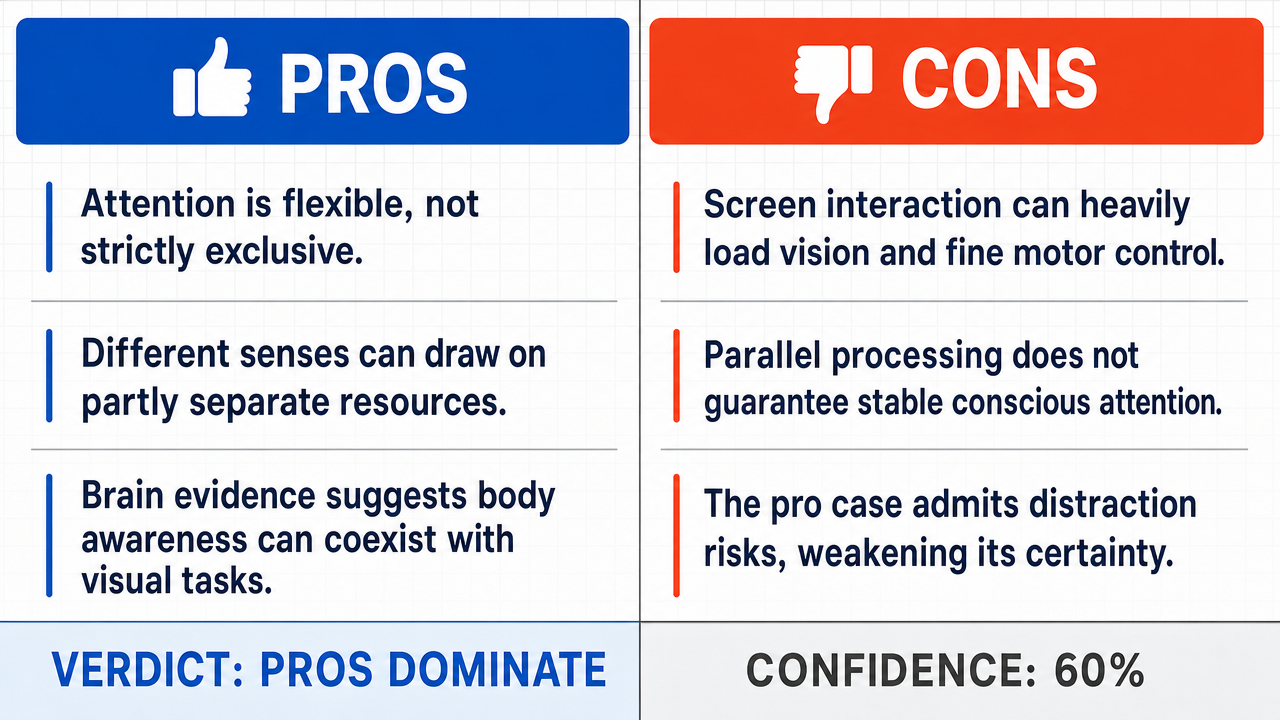
Verdict
Verdict: rather TRUE (60%)
Online report: https://solsice.com/public/debates/il-est-possible-de-maintenir-une-partie-de-son-attention-dan-e8ddd7b2eddf
This section provides a brief overview of the key arguments. It is not necessary to read the detailed report below.
✅ Key PRO arguments:
- ■Human attention is a flexible and non-exclusive system; the "spotlight attention " model has been superseded by models of multiple, shareable attentional resources , allowing for background somatic monitoring (proprioception ) while performing a focused cognitive task, a phenomenon called "interoceptive monitoring ".
- ■Wickens' multiple resource theory distinguishes separate attentional pools for visual, auditory, and somatosensory modalities, enabling functional sharing of attention between the screen and the body.
- ■A meta-analysis published in Psychological Bulletin in 2023, synthesizing 72 brain imaging studies , concludes that interoceptive processing and a visuo-motor task , such as typing, activate largely distinct networks, allowing for sharing without major interference .
❌ Key CON arguments:
- ■Interaction with a screen, especially through typing, saturates mental load through visual processing and fine motor coordination , making it impossible to consciously and functionally maintain proprioception according to cognitive load theory .
- ■There is a crucial distinction between the biological capacity for parallel processing and the cognitive capacity to maintain conscious and stable attention; residual activity in the insular cortex does not mean that part of attention is "maintained" in a functional manner.
- ■The pro argument is structurally incoherent because it simultaneously claims that attention is "flexible and non-exclusive" while acknowledging the risk of "getting completely lost in the device," two mutually exclusive propositions.
💭 Conclusion: True. The favorable verdict for the statement is based on evidence from cognitive neuroscience demonstrating that human attention operates according to a model of multiple resources rather than a strictly exclusive system. Wickens' multiple resource theory and brain imaging studies confirm that interoceptive processing and visuo-motor tasks like typing activate largely distinct neural networks, enabling functional attentional sharing. The concept of "interoceptive monitoring " supports that background somatic surveillance can coexist with a focused cognitive task on a screen. However, the moderate confidence of the judge (60%) reflects legitimate objections raised regarding cognitive load saturation during complex interactions with a screen. The counter-argument concerning the structural coherence of the proposition also warrants consideration, justifying non-absolute confidence in the verdict.
🔬 Verdict: rather TRUE ✅ (60%)
Statement: It is possible to maintain part of one's attention within one's internal body while interacting with a screen, even while typing, so as not to get completely lost in the device.
Participating models: deepseek-v3.2 💬, gemma-4-26b-a4b-it 💬👁️
📊 Confrontations: 1 concluded TRUE, 0 concluded FALSE (1 confrontation, 3 models)
📊 Score per camp: TRUE=0.60, FALSE=0.00
🏅 Model score evolution:
minimax-m3 💬👁️: +6
✅ Arguments FOR:
- ■Human attention is a flexible and non-exclusive system; the "spotlight attention " model has been surpassed by models of multiple, shareable attentional resources , allowing for background somatic monitoring (proprioception ) while performing a focused cognitive task, called "interoceptive monitoring ". deepseek-v3.2 💬
- ■Wickens' multiple resource theory distinguishes separate attentional pools for visual, auditory, and somatosensory modalities, enabling functional sharing of attention between the screen and the body. deepseek-v3.2 💬
- ■A 2023 meta-analysis , published in Psychological Bulletin and synthesizing 72 brain imaging studies , concludes that interoceptive processing and a visuo-motor task , such as typing, activate largely distinct networks, allowing for sharing without major interference . deepseek-v3.2 💬
- ■Brain imaging studies show simultaneous activation of the insular cortex (involved in interoception) and visuo-motor areas during interactions with a screen, confirming the possibility of parallel processing . deepseek-v3.2 💬
❌ Arguments AGAINST:
- ■Interaction with a screen, especially through typing, saturates mental load through visual processing and fine motor coordination , making it impossible to consciously and functionally maintain proprioception according to cognitive load theory . gemma-4-26b-a4b-it 💬👁️
- ■There is a crucial distinction between the biological capacity for parallel processing and the cognitive capacity to maintain conscious and stable attention; residual activity in the insular cortex does not mean that part of attention is "maintained" in a functional manner. gemma-4-26b-a4b-it 💬👁️
- ■The pro argument is structurally incoherent because it simultaneously claims that attention is "flexible and non-exclusive" while acknowledging the risk of "getting completely lost in the device," two mutually exclusive propositions. gemma-4-26b-a4b-it 💬👁️
💭 Reasoning: True. The favorable verdict for the statement is based on evidence from cognitive neuroscience demonstrating that human attention operates according to a model of multiple resources rather than a strictly exclusive system. Wickens' multiple resource theory and brain imaging studies confirm that interoceptive processing and visuo-motor tasks like typing activate largely distinct neural networks, enabling functional attentional sharing. The concept of "interoceptive monitoring " supports that background somatic surveillance can coexist with a focused cognitive task on a screen. However, the moderate confidence of the judge (60%) reflects legitimate objections raised regarding cognitive load saturation during complex interactions with a screen. The counter-argument concerning the structural coherence of the proposition also warrants consideration, justifying non-absolute confidence in the verdict.
📋 Facts FOR:
• The "spotlight attention" model has been superseded by models of multiple, shareable attentional resources.
• Studies published in Nature Reviews Neuroscience confirm the ability to maintain background somatic surveillance (proprioception) while performing a focused cognitive task, called "interoceptive monitoring."
• Wickens' multiple resource theory distinguishes separate attentional pools for visual, auditory, and somatosensory modalities.
• A 2023 meta-analysis in Psychological Bulletin, synthesizing 72 imaging studies, concludes that interoceptive processing and a visuo-motor task like typing engage largely distinct networks.
• Brain imaging shows simultaneous activation of the insular cortex and visuo-motor areas during interactions with a screen.
📋 FACTS AGAINST:
• The cognitive load theory demonstrates that attention is a strictly limited resource.
• During interaction with a screen, notably through typing, mental load is saturated by visual processing and fine motor coordination.
• Residual activity in the insular cortex does not guarantee a maintained functional and conscious somatic attention.
• The statement contains a structural inconsistency by postulating both the flexibility of attention and the risk of total capture by the interface.
| Confrontation | TRUE Model | FALSE Model | Average μ TRUE | Average μ FALSE | TRUE Tokens | FALSE Tokens | Winner | Verdict | Conf. |
|---|---|---|---|---|---|---|---|---|---|
| #1 | deepseek-v3.2 💬 | gemma-4-26b-a4b-it 💬👁️ | 0.497 | 0.299 | 8 | 2 | TRUE | TRUE | 60% |
The following technical terms, abbreviations, and specialized concepts are used in this transcript. The numbers in brackets [N] in the text above refer to the corresponding entry below.
[1] neural activation — Electrical and metabolic activity of populations of neurons, often measured by brain imaging (fMRI, PET) to identify regions engaged by a cognitive or sensory task.
[2] background noise — In cognitive neuroscience, refers to neuronal activity or residual unconscious processing, as opposed to explicit and intentional attentional signals.
[3] cognitive load — Amount of mental resources mobilized by a task. According to this theory, attention being limited, a high load would saturate available processing capacities (contentious point in the debate).
[4] fine motor coordination — Set of precise and controlled gestures involving small muscle units, such as typing on a keyboard or using a mouse, considered costly in attentional resources.
[5] insular cortex — Region of the cerebral cortex involved notably in bodily awareness, interoceptive processing, and perception of internal states (hunger, pain, heartbeat).
[6] prefrontal cortex — Anterior region of the frontal lobe associated with executive functions, sustained attention, planning, and cognitive control of ongoing tasks.
[7] digital mindfulness — mindfulness in digital use — Set of adapted practices of conscious attention (mindfulness) applied to screens and digital interfaces, aiming to preserve bodily presence during technological interaction.
[8] brain imaging — Techniques (fMRI, PET, EEG) that visualize brain activity to study regions engaged during cognitive or sensory tasks.
[9] attentional intentionality — Voluntary and directed nature of attention deployment, as opposed to automatic or reflexive unconscious processing.
[10] interference — In cognitive psychology, degradation of task performance when performed simultaneously with another, due to competition for shared attentional resources.
[11] somato-sensory modalities — Sensory pathways related to the body (touch, pressure, temperature, proprioception, interoception), processed by neural networks partly distinct from visual and auditory modalities.
[12] interoceptive monitoring — Conscious or semi-conscious surveillance of internal physiological signals (heartbeats, respiration, visceral sensations), associated with activity in the insular cortex.
[13] meta-analysis — Statistical method combining quantitatively the results of multiple independent studies to identify an overall trend regarding a sought effect.
[14] attentional pools — Distinct reservoirs of attentional resources, dedicated to different modalities (visual, auditory, somato-sensory), according to the multiple resource theory.
[15] proprioception — Sensitivity of the body to its own position, movements, and orientation in space, provided by muscle and joint receptors.
[16] attentional resources — Limited cognitive capacity that can be allocated to different tasks; their sharing between simultaneous tasks is subject to divergent theoretical models (single load vs multiple resources).
[17] attentional saturation — State in which available attentional resources would be fully consumed, preventing any additional conscious processing. The debate questions its established nature.
[18] spotlight attention — model of attentional spotlight — Classic model where attention functions like a "spotlight" illuminating a region of space or information. The debate indicates it has been superseded by multiple resource models.
[19] somatic monitoring — Maintenance of perception and control of internal bodily sensations during the performance of another activity.
[20] Wickens' multiple resource theory — Model proposed by Christopher Wickens suggesting that attention has separate pools according to modalities (visual, auditory, somato-sensory) and processing stages, allowing sharing without critical interference.
[21] parallel processing — The capacity of the cognitive system to process multiple streams of information simultaneously, as opposed to strictly serial processing.
[22] dual tasks — Experimental paradigm where the subject performs two tasks simultaneously (e.g., interoceptive perception and visual tapping) to evaluate interference and attentional sharing.
[23] visuo-motor — Describes the coordination between visual perception and motor action, such as typing guided by a screen.
Face-off transcripts
- ■
Ownership & Trade Secrets. Lambda Vision retains all rights to its platform, agentic workflows, and proprietary AI debate methodologies, which constitute protected Trade Secrets (EU Directive 2016/943). Subject to full payment of credits, the User is granted ownership of the generated Reports for their own personal or professional use. Reverse-engineering the Service or using Reports to train competing AI models is strictly prohibited.
- ■
No Professional Advice. Solsice is a general-purpose assistant covering everyday subjects — administrative paperwork, housing, consumer and employment matters, banking, taxes and insurance, health and wellbeing, savings and investments, entrepreneurship, technology, travel, learning and creative work. Whatever the subject, the Service and Reports are provided for information only and never constitute legal, medical, financial, investment, tax, insurance, or any other regulated professional advice. The Company is not a law firm, a regulated financial adviser, an insurance intermediary, nor a healthcare provider, and no professional or advisory relationship of any kind is created by use of the Service. Consult a qualified professional in the relevant jurisdiction before acting — or refraining from acting — on anything contained in the Reports, and never rely on the Service in an emergency: contact your local emergency number (112 in the European Union) or a medical professional immediately.
- ■
AI-Generated Content, Sources and Viewpoints. Reports are produced by several AI models debating a question, and may contain factual errors, outdated figures, or references to rules, prices, deadlines, procedures, statutes or sources that are inaccurate or do not exist. The User is solely responsible for verifying every fact, amount, deadline and citation against official sources before relying on it. Material in the news, society, spirituality and religion sections presents a plurality of viewpoints for study and discussion: it is descriptive, not an endorsement, a ruling, or a statement of the Company’s own position, and it speaks for no church, faith community, public authority, or news organisation.
- ■
Liability & Governing Law. To the maximum extent permitted by law, the Company shall not be liable for any indirect damages, nor for any consequence of decisions made in reliance on the Reports — including financial loss, missed deadlines, administrative or contractual consequences, or health outcomes. These Terms are governed by French law. Any disputes shall be subject to the exclusive jurisdiction of the Courts of Paris, France.