
Il est possible de maintenir une conscience du corps intérieur ou une sensation de présence en arrière-plan tout en étant pleinement engagé dans des interactions numériques ou sociales complexes.
AI debate verdict and arguments
⚠️ AI-generated information only; not professional advice
Completed October 30, 2026
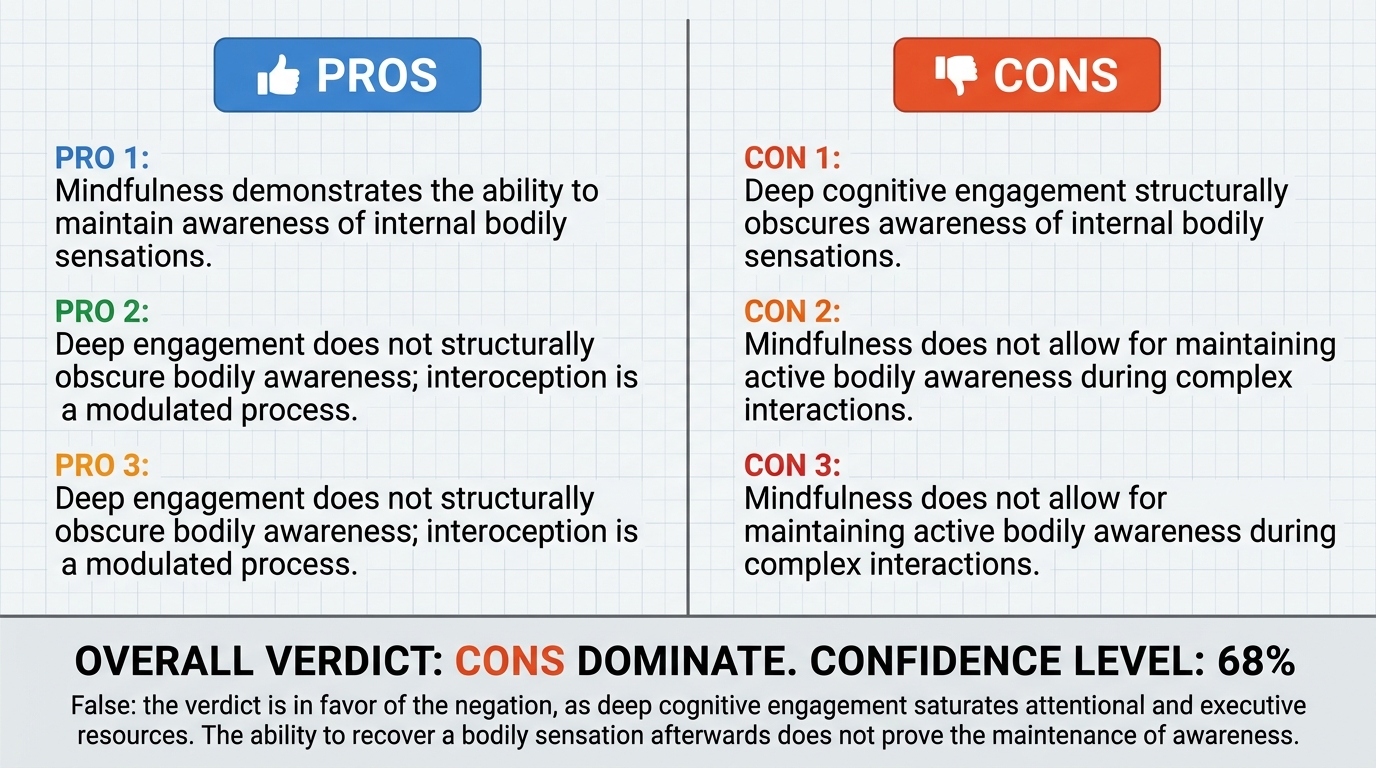
Verdict
Verdict: Mostly FALSE (68%)
Online report: https://solsice.com/public/debates/il-est-possible-de-maintenir-une-conscience-du-corps-interie-34f95197115a
This section provides a brief overview of the key arguments. It is not necessary to read the detailed report below.
✅ Key PRO arguments:
- ■Mindfulness , a recognized practice, demonstrates the ability to maintain awareness of internal bodily sensations (breathing, heartbeat) even during demanding activities. Studies show that trained individuals can direct their attention to their body while performing complex cognitive tasks, including social or digital interactions.
- ■The opposing argument states without evidence that deep engagement structurally occludes bodily awareness . However, interoception is a process modulated by attention, thresholds , and salience , not an all-or-nothing suppression : physiological signals can remain represented at low noise levels and re-emerge to the foreground.
❌ Key CONTRA arguments:
- ■Deep cognitive engagement structurally occludes awareness of internal bodily sensations . The opposing argument confuses parallel processing with the quality of phenomenal consciousness : engagement in complex digital interactions saturates attentional and executive resources, causing sensory disengagement . What is called "background consciousness" is merely automatic processing.
- ■Mindfulness practice does not allow maintaining active bodily awareness during complex interactions. The opposing claim confuses the ability to recover a sensation with maintaining consciousness during engagement. Research shows attention is a limited resource, and tasks with high cognitive load saturate executive attention networks .
💭 Conclusion: False: the verdict favors negation because deep cognitive engagement saturates attentional and executive resources. The ability to recover a bodily sensation afterward does not prove the maintenance of background consciousness during interaction. Attention studies show that social or digital tasks with high cognitive load mobilize executive networks at the expense of interoceptive monitoring . The opposing argument confuses automatic processing with subjective presence , whereas phenomenal consciousness requires resources that are not available simultaneously. Therefore, the claim that such consciousness can be maintained continuously is unsubstantiated.
🔬 Verdict: Mostly FALSE ❌ (68%)
Claim: It is possible to maintain awareness of the inner body or a sense of presence in the background while being fully engaged in complex digital or social interactions.
Participating models: deepseek-v3.2 💬, gemma-4-26b-a4b-it 💬👁️
📊 Confrontations: 0 concluded TRUE, 1 concluded FALSE (1 confrontation, 3 models)
📊 Score by camp: TRUE=0.00, FALSE=0.68
🏅 Model score evolution:
deepseek-v4-flash-0731 💬: +7
✅ PRO arguments:
- ■Mindfulness , a recognized practice, demonstrates the ability to maintain awareness of internal bodily sensations (breathing, heartbeat) even during demanding activities. Studies show that trained individuals can direct their attention to their body while performing complex cognitive tasks, including social or digital interactions. deepseek-v3.2 💬
- ■The opposing argument states without proof that deep engagement structurally occludes bodily awareness . However, interoception is a process modulated by attention, thresholds , and salience , not an all-or-nothing suppression : physiological signals can remain represented at low noise levels and re-emerge to the foreground. deepseek-v3.2 💬
❌ CONTRA arguments:
- ■Deep cognitive engagement structurally occludes awareness of internal bodily sensations. The opposing argument confuses parallel processing with the quality of phenomenal consciousness : engagement in complex digital interactions saturates attentional and executive resources, causing sensory disengagement . What is called "background consciousness" is merely automatic processing. gemma-4-26b-a4b-it 💬👁️
- ■Mindfulness practice does not allow maintaining active bodily awareness during complex interactions. The opposing claim confuses the ability to recover a sensation with maintaining consciousness during engagement. Research shows attention is a limited resource, and tasks with high cognitive load saturate executive attention networks . gemma-4-26b-a4b-it 💬👁️
💭 Reasoning: False: the verdict favors negation because deep cognitive engagement saturates attentional and executive resources. The ability to recover a sensation afterward does not prove the maintenance of background consciousness during interaction. Attention studies show that social or digital tasks with high cognitive load mobilize executive networks at the expense of interoceptive monitoring . The opposing argument confuses automatic processing with subjective presence , whereas phenomenal consciousness requires resources that are not available simultaneously. Therefore, the claim that such consciousness can be maintained continuously is unsubstantiated.
📋 Facts PRO:
• Mindfulness is a recognized practice that demonstrates the ability to maintain awareness of internal bodily sensations.
• Studies show that trained individuals can direct their attention to their body while performing complex cognitive tasks.
• Interoception is a process modulated by attention, thresholds, and salience, not an all-or-nothing suppression.
• Physiological signals can remain represented at low noise levels and re-emerge to the foreground.
📋 Facts CONTRA:
• Attention is a limited resource, and engagement in tasks with high cognitive load saturates executive attention networks.
• Engagement in complex digital interactions causes sensory disengagement.
• The brain's parallel processing does not guarantee the maintenance of consciousness in terms of subjective presence.
• The ability to recover a sensation differs from maintaining consciousness during engagement.
| Confrontation | TRUE Model | FALSE Model | Average μ TRUE | Average μ FALSE | TRUE Rolls | FALSE Rolls | Winner | Verdict | Conf. |
|---|---|---|---|---|---|---|---|---|---|
| #1 | deepseek-v3.2 💬 | gemma-4-26b-a4b-it 💬👁️ | 0.546 | 0.301 | 8 | 2 | TRUE | FALSE | 68% |
The following technical terms, abbreviations, and specialized concepts are used in this transcript. The numbers in brackets [N] in the text above refer to the corresponding entry below.
[1] arbitration — Mechanism by which the brain, according to the negative, distributes attention among competing streams instead of operating with complete simultaneity during high cognitive load interactions.
[2] executive attention — Attentional system mobilized by demanding tasks; its saturation is invoked by the negative to explain sensory disengagement during complex interactions.
[3] internal and external attention — Distinction established by neuroscience between neural networks dedicated to attention directed inward to the body and outward to the external environment.
[4] low noise — Expression describing physiological signals represented discreetly in the background and capable of returning to the foreground when attentional distribution changes.
[5] cognitive load — Quantity of attentional and executive resources required by a task; complex digital or social interactions are presented as high cognitive load.
[6] bodily awareness — Awareness of bodily sensations; its persistence in the background during digital or social engagement is the central issue of the debate.
[7] phenomenal consciousness — Quality of subjective presence, distinguished by the negative from automatic biological data processing.
[8] reflective dimension — Aspect of consciousness that allows true presence to oneself; its absence characterizes, according to the negative, automatic and unconscious processing.
[9] dual task — Concept of simultaneous processing of multiple information streams; the affirmative invokes it to support the persistence of bodily awareness, while the negative considers it misinterpreted and opposes it with arbitration functioning.
[10] sensory disengagement — Phenomenon whereby engagement in complex interactions saturates attentional and executive resources, reducing awareness of internal sensations.
[11] immersion — State of deep engagement which, according to the negative, mobilizes attention at the expense of interoceptive monitoring.
[12] interoception — Perception of internal body signals; the debate presents it as a process modulated by attention, thresholds, and salience, not as an all-or-nothing suppression.
[13] experienced meditators — Trained mindfulness practitioners; the affirmative claims they can direct their attention to their body while performing complex cognitive tasks.
[14] mindfulness — Practice of maintaining awareness of internal bodily sensations such as breathing or heartbeat; its capacity to persist during complex interactions is contested in the debate.
[15] continuous bodily presence — Uninterrupted maintenance of bodily awareness; the negative argues that controlled task alternation necessarily causes a break.
[16] subjective presence — Feeling of being present to one's own body, which the negative distinguishes from automatic and unconscious biological data processing.
[17] attentional resources — Limited attentional capacities, which engagement in high cognitive load social or digital tasks saturates.
[18] attentional distribution — Distribution of attention among different streams; a change in this distribution can bring internal signals that remained at low noise back to the foreground.
[19] neural networks — Sets of distinct neurons for internal and external attention, whose existence is confirmed by neuroscience without guaranteeing, according to the negative, the maintenance of subjective presence.
[20] salience — Prominent character of a signal; interoception is described as modulated by the salience of internal signals.
[21] internal bodily sensations — Perceptions from inside the body, such as breathing or heartbeat, whose awareness can persist during demanding activities.
[22] thresholds — Levels at which an internal signal becomes conscious; in the debate, a signal below the focus threshold is not structurally obscured but simply not focused.
[23] interoceptive monitoring — Tracking of internal body signals; the affirmative argues it can continue at low noise during external engagement.
[24] task-switching — Controlled alternation between tasks; the negative argues it necessarily involves a break in continuous bodily presence in favor of the external task.
[25] all-or-nothing — Binary mode of operation; the affirmative rejects that bodily awareness is completely suppressed by engagement in favor of modulation by attention.
[26] automatic and unconscious processing — Processing of biological data devoid of reflective dimension; the negative reduces to this what the affirmative calls background consciousness.
[27] Parallel processing of information — The brain's ability to manage multiple streams of information simultaneously, invoked by the affirmative to support the possibility of subconscious bodily awareness.
Face-off transcripts
- ■
Ownership & Trade Secrets. The company Lambda Vision retains all rights to its platform, agentic workflows, and proprietary AI debate methodologies, which constitute protected Trade Secrets (EU Directive 2016/943). Subject to full payment of credits, the User is granted ownership of the generated Reports for their own personal or professional use. Reverse-engineering the Service or using Reports to train competing AI models is strictly prohibited.
- ■
No Professional Advice. Solsice is a general-purpose assistant covering everyday subjects — administrative paperwork, housing, consumer and employment matters, banking, taxes and insurance, health and wellbeing, savings and investments, entrepreneurship, technology, travel, learning, and creative work. Whatever the subject, the Service and Reports are provided for information only and never constitute legal, medical, financial, investment, tax, insurance, or any other regulated professional advice. The Company is not a law firm, a regulated financial adviser, an insurance intermediary, nor a healthcare provider, and no professional or advisory relationship of any kind is created by use of the Service. Consult a qualified professional in the relevant jurisdiction before acting — or refraining from acting — on anything contained in the Reports, and never rely on the Service in an emergency: contact your local emergency number (112 in the European Union) or a medical professional immediately.
- ■
AI-Generated Content, Sources and Viewpoints. Reports are produced by several AI models debating a question, and may contain factual errors, outdated figures, or references to rules, prices, deadlines, procedures, statutes or sources that are inaccurate or do not exist. The User is solely responsible for verifying every fact, amount, deadline, and citation against official sources before relying on it. Material in the news, society, spirituality, and religion sections presents a plurality of viewpoints for study and discussion: it is descriptive, not an endorsement, a ruling, or a statement of the Company’s own position, and it speaks for no church, faith community, public authority, or news organization.
- ■
Liability & Governing Law. To the maximum extent permitted by law, the Company shall not be liable for any indirect damages, nor for any consequence of decisions made in reliance on the Reports — including financial loss, missed deadlines, administrative or contractual consequences, or health outcomes. These Terms are governed by French law. Any disputes shall be subject to the exclusive jurisdiction of the Courts of Paris, France.