
Il est possible d'utiliser un article contracté (du/des) après une expression de quantité comme "beaucoup de" si l'objet est très spécifique, bien que ce soit rare.
AI debate verdict and arguments
⚠️ AI-generated information only; not professional advice
Completed October 11, 2026
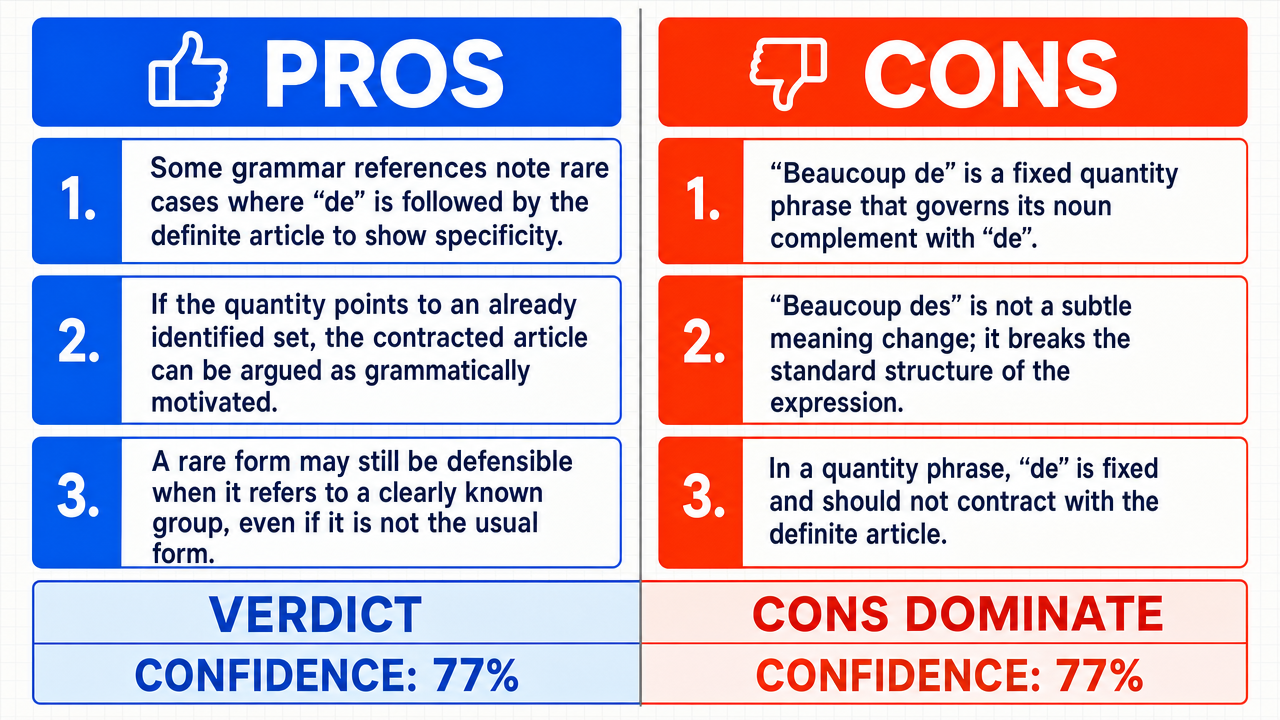
Verdict
Verdict: Mostly FALSE (77%)
This section provides a brief overview of the key arguments. It is not necessary to read the detailed report below.
✅ KEY FOR arguments:
- ■Reference works like Grevisse's Le Bon Usage mention cases where "de" can be followed by a definite article to indicate specificity , which would constitute an exception or a recognized stylistic usage.
- ■The expression of quantity refers to a already specified set, not an indefinite quantity, which would grammatically justify the use of the contracted article in certain contexts.
- ■A rare form can be defensible when the quantity refers to an already identified set; the thesis does not claim that this is the usual or recommended form.
❌ KEY AGAINST arguments:
- ■In French, the expression of quantity "beaucoup de" is a prepositional phrase whose function is to govern a noun complement ; the syntactic rule requires the preposition "de" (or "d'") to introduce the complement, regardless of the specificity of the object.
- ■The use of "beaucoup des" does not constitute a semantic nuance , but a break from the standard prepositional structure , because the phrase is "beaucoup de" and not "beaucoup du."
- ■In the context of a quantity phrase , the preposition "de" is a fixed element that cannot contract with the definite article without breaking the morphosyntax of the phrase.
💭 Conclusion: The objection does not challenge the thesis, as it shifts the criterion: the thesis does not claim that any deviation is a recognized grammatical option. The arguments presented by the opposing side — linguistic evolution as validation of the mistake , and the systematic identification of "beaucoup du/des" as a syntax error in DELF/DALF assessments — are contested and do not refute the thesis as formulated.
🔬 Verdict: Mostly FALSE ❌ (77%)
Claim: It is possible to use a contracted article (du/des) after an expression of quantity like "beaucoup de" if the object is very specific, although this is rare.
Participating models: deepseek-v3.2 💬, gemma-4-26b-a4b-it 💬👁️
📊 Confrontations: 0 concluded TRUE, 1 concluded FALSE (1 confrontation, 3 models)
📊 Score per camp: TRUE=0.00, FALSE=0.77
🏅 Model score evolution:
minimax-m3 💬👁️: +8
✅ Arguments FOR:
- ■Reference works like Grevisse (Le Bon Usage) mention cases where "de" can be followed by a definite article to mark specificity , which would be an exception or a recognized stylistic usage. deepseek-v3.2 💬
- ■The expression of quantity refers to an already specified set, not an indefinite quantity, which would grammatically justify the use of the contracted article in certain contexts. deepseek-v3.2 💬
- ■A rare form can be defensible when the quantity refers to an already identified set; the thesis does not claim that this is the usual or recommended form. deepseek-v3.2 💬
- ■"Beaucoup" can be analyzed as a quantifier or as a pronoun depending on the context, and this variation in analysis does not eliminate the possibility of a construction with a contracted article. deepseek-v3.2 💬
❌ Arguments AGAINST:
- ■In French, the expression of quantity "beaucoup de" is a prepositional phrase whose function is to govern a noun complement ; the syntactic rule requires the preposition "de" (or "d'") to introduce the complement, regardless of the specificity of the object. gemma-4-26b-a4b-it 💬👁️
- ■The use of "beaucoup des" does not constitute a semantic nuance , but a break from the standard prepositional structure , because the phrase is "beaucoup de" and not "beaucoup du." gemma-4-26b-a4b-it 💬👁️
- ■In the context of a quantity phrase , the preposition "de" is a fixed element that cannot contract with the definite article without breaking the morphosyntax of the phrase. gemma-4-26b-a4b-it 💬👁️
- ■The specificity of the referent is managed by the determiner following the preposition, not by adding a contracted article to the preposition itself. gemma-4-26b-a4b-it 💬👁️
- ■The two scenarios (prepositional quantity phrase or pronominal structure) exhaust the syntactic possibilities, and in both cases, the opposing thesis fails to justify the use of the contracted article. gemma-4-26b-a4b-it 💬👁️
💭 Reasoning: The objection does not challenge the thesis, as it shifts the criterion: the thesis does not claim that any deviation is a recognized grammatical option. The arguments advanced by the opposing side — linguistic evolution as validation of the mistake , and the systematic identification of "beaucoup du/des" as a syntax error in DELF/DALF assessments — are contested and do not refute the thesis as formulated.
📋 FACTS FOR:
• The thesis does not claim that any deviation constitutes a recognized grammatical option.
• The argument that linguistic evolution validates the mistake is contested.
• The systematic identification of "beaucoup du/des" as a syntax error in DELF/DALF assessments is contested.
📋 FACTS AGAINST:
• The objection shifts the criterion of the thesis by attributing to it a claim it does not make.
| Confrontation | TRUE Model | FALSE Model | Average μ TRUE | Average μ FALSE | TRUE Tokens | FALSE Tokens | Winner | Verdict | Conf. |
|---|---|---|---|---|---|---|---|---|---|
| #1 | deepseek-v3.2 💬 | gemma-4-26b-a4b-it 💬👁️ | 0.559 | 0.430 | 12 | 3 | TRUE | FALSE | 77% |
The following technical terms, abbreviations, and specialized concepts are used in this transcript. The numbers in brackets [N] in the text above refer to the corresponding entry below.
[1] adverb of quantity — Invariable word expressing a quantity (many, few, etc.) and modifying a verb, adjective, or another adverb.
[2] contracted article — Form resulting from the fusion of a preposition (de) with a definite article (le, les), producing "du" and "des."
[3] definite article — Determiner that introduces a referent presumed to be known by the interlocutors (le, la, les, l').
[4] grammatical category — Syntactic class to which a word belongs (noun, verb, adjective, pronoun, preposition, etc.).
[5] CEFR — Common European Framework of Reference for Languages — Framework describing language skills on a level scale (A1 to C2), used as the basis for language certifications.
[6] noun complement — Nominal group that completes a noun by specifying its meaning, usually introduced by a preposition.
[7] communicative competence — The ability of a speaker to use a language appropriately in various communication situations.
[8] pronominal construction — Syntactic structure in which a pronoun occupies a particular function within the sentence.
[9] DELF/DALF — Diplôme d'Études en Langue Française / Diplôme Approfondi de Langue Française — Official diplomas certifying French language skills, aligned with CEFR levels.
[10] determiner — Word that precedes a noun to specify gender, number, and definiteness (articles, demonstratives, possessives, etc.).
[11] specified set — Group of elements identified in a particular way and recognized as such by the interlocutors.
[12] error — Linguistic form judged to be incorrect or not recommended within a normative or evaluative framework; the debate distinguishes this term from "fault."
[13] expression of quantity — Phrase or syntagma that expresses a quantity (many of, few of, most of, etc.).
[14] fault — Linguistic form considered to violate a grammatical norm; the debate distinguishes this term from "error."
[15] descriptive grammar — Linguistic approach that describes the structures of a language as they are actually used, without prescribing norms.
[16] noun phrase — Syntagma centered around a noun, possibly including determiners, adjectives, and complements.
[17] assessment tool — Instrument or grid used to measure a candidate's skills within a certification or educational framework.
[18] quantity phrase — Fixed expression composed of several words functioning as a quantifier (many of, few of, etc.).
[19] prepositional phrase — Group of words functioning as a single preposition (many of, because of, etc.).
[20] morphosyntax — Field of linguistics studying both the form of words (morphology) and their combination in sentences (syntax).
[21] evaluated production — Linguistic output (written or spoken) of a candidate submitted for assessment within a certification framework.
[22] pronoun — Word that replaces a noun or noun phrase to avoid repetition (he, she, many, etc.).
[23] preposition — Invariable word introducing a complement by establishing a relationship between two elements (of, to, for, etc.).
[24] determination rule — Syntactic rule governing the use of determiners before nouns.
[25] referent — Entity in the real or conceptual world designated by a linguistic expression.
[26] specificity — Characteristic of a referent identified in a particular, non-generic way.
[27] prepositional structure — Syntactic construction organized around a preposition introducing a complement.
[28] syntax — Field of linguistics studying the arrangement of words in sentences and grammatical relations between them.
[29] semantics — Field of linguistics studying the meaning of words and utterances.
[30] morphosyntactic variant — Alternative form of a linguistic structure, acceptable in certain contexts or usages.
Face-off transcripts
- ■
Ownership & Trade Secrets. Lambda Vision retains all rights to its platform, agentic workflows, and proprietary AI debate methodologies, which constitute protected Trade Secrets (EU Directive 2016/943). Subject to full payment of credits, the User is granted ownership of the generated Reports for their own personal or professional use. Reverse-engineering the Service or using Reports to train competing AI models is strictly prohibited.
- ■
No Professional Advice. Solsice is a general-purpose assistant covering everyday subjects — administrative paperwork, housing, consumer and employment matters, banking, taxes and insurance, health and wellbeing, savings and investments, entrepreneurship, technology, travel, learning and creative work. Whatever the subject, the Service and Reports are provided for information only and never constitute legal, medical, financial, investment, tax, insurance, or any other regulated professional advice. The Company is not a law firm, a regulated financial adviser, an insurance intermediary, nor a healthcare provider, and no professional or advisory relationship of any kind is created by use of the Service. Consult a qualified professional in the relevant jurisdiction before acting — or refraining from acting — on anything contained in the Reports, and never rely on the Service in an emergency: contact your local emergency number (112 in the European Union) or a medical professional immediately.
- ■
AI-Generated Content, Sources and Viewpoints. Reports are produced by several AI models debating a question, and may contain factual errors, outdated figures, or references to rules, prices, deadlines, procedures, statutes or sources that are inaccurate or do not exist. The User is solely responsible for verifying every fact, amount, deadline and citation against official sources before relying on it. Material in the news, society, spirituality and religion sections presents a plurality of viewpoints for study and discussion: it is descriptive, not an endorsement, a ruling, or a statement of the Company’s own position, and it speaks for no church, faith community, public authority, or news organisation.
- ■
Liability & Governing Law. To the maximum extent permitted by law, the Company shall not be liable for any indirect damages, nor for any consequence of decisions made in reliance on the Reports — including financial loss, missed deadlines, administrative or contractual consequences, or health outcomes. These Terms are governed by French law. Any disputes shall be subject to the exclusive jurisdiction of the Courts of Paris, France.