
If a cure for cancer were discovered, it would be withheld from the public due to the immense profitability of existing treatments.
AI debate verdict and arguments
⚠️ AI-generated information only; not professional advice
Completed October 25, 2026
Verdict
Verdict: likely FALSE (77%)
Web Report: https://solsice.com/public/debates/if-a-cure-for-cancer-were-discovered-it-would-be-withheld-fr-be28a3e1ef6a
This section provides a brief overview of the key arguments. You do not need to read the full detailed report below.
✅ Key PRO arguments:
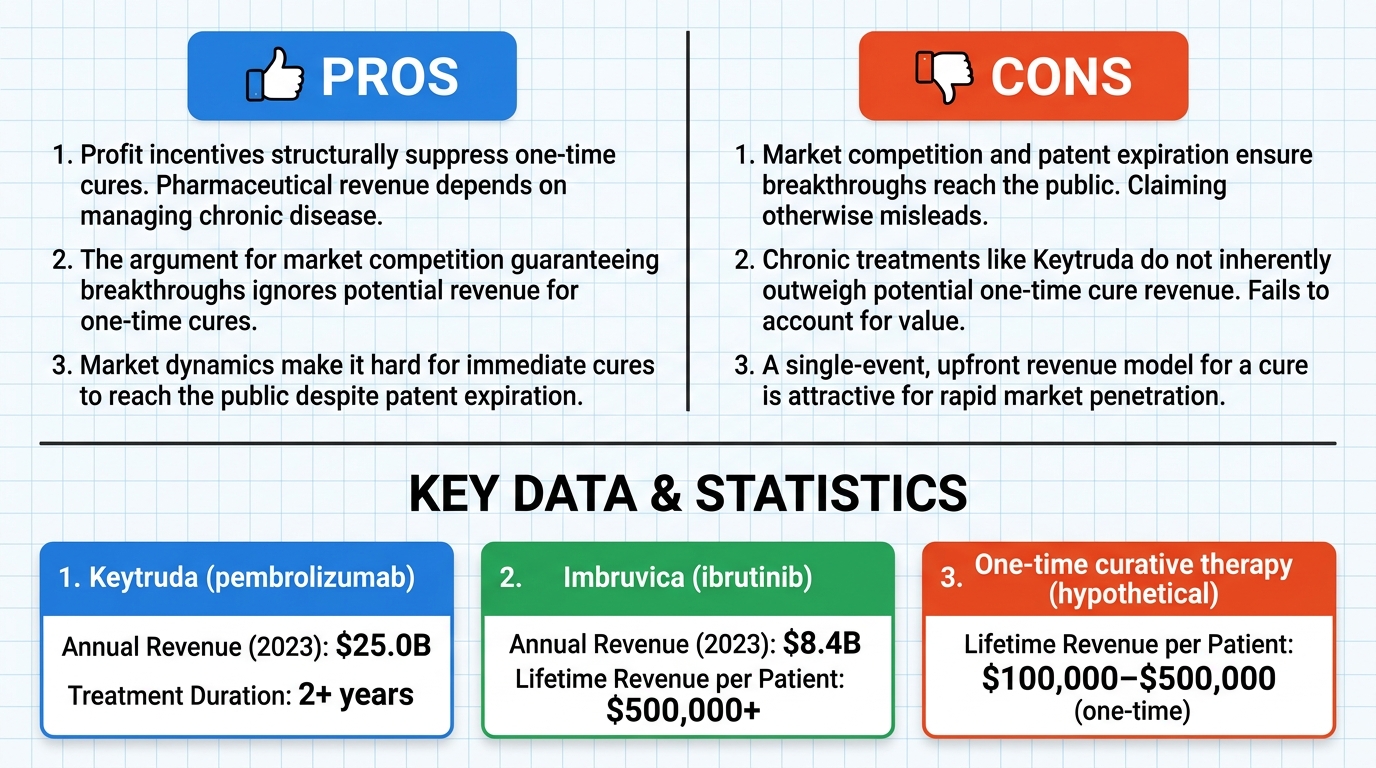
- ■Profit-driven pharmaceutical incentives structurally suppress one-time curative therapies. The architecture of pharmaceutical revenue depends on chronic disease management , not cures. A single-administration cure for cancer would terminate the treatment revenue stream for each patient, while existing chemotherapy , immunotherapy , and targeted therapy regimens generate recurring income over months or years. The global oncology drug market reached approximately $220 billion in 2023, with individual therapies like pembrolizumab (Keytruda) generating over $25 billion annually through repeated infusions priced at roughly $150,000 per patient per year. A one-time cure , even priced aggressively, cannot replicate this lifetime revenue stream.
- ■The opposing side claims that market competition and patent expiration guarantee curative breakthroughs will reach the public. This argument substitutes the abstract mechanism of competition for an actual measurement of curative therapies reaching patients, and it ignores the concrete record of suppressed or abandoned curative technologies. The claim about firm behavior is supported only by a conceptual table comparing Chronic Treatment Model and Curative Treatment Model , which measures abstract market structures, not actual firm behavior.
❌ Key ANTI arguments:
- ■Market competition and patent expiration ensure curative breakthroughs reach the public. The affirmative's argument relies on a fundamental misunderstanding of how pharmaceutical value is captured, specifically by confusing the money a company charges with the money a customer saves. They fail to provide a take-rate . The amount a company charges is determined by pricing power and competitive intensity , not by the total economic surplus created for the patient.
- ■The recurring revenue of chronic treatments like Keytruda does not inherently outweigh the potential revenue of a one-time cure . The comparison fails to account for the massive shift in pricing power and market capture that occurs when a therapy moves from management to cure. While a chronic treatment generates revenue through repeated infusions , a curative therapy allows a firm to capture the entire lifetime value of the patient in a single, high-margin transaction . The lifetime revenue of a chronic patient is not a ceiling for a company; it is a base.
💭 Conclusion: False. The negative side successfully refuted the assertion that a cancer cure would be withheld from the public due to profitability. The strongest argument was that market competition and patent expiration ensure curative breakthroughs reach the public, directly undermining the claim of systematic suppression. The negative also showed that a curative therapy can capture the entire lifetime value of a patient in a single high-margin transaction , so the recurring revenue of chronic treatments is not necessarily a superior profit model. The affirmative's case relied on comparing revenue streams without providing a take-rate or concrete evidence of shelved cures, which the judge found unpersuasive. Therefore, the verdict is FALSE with confidence reflecting the single debate's judge confidence of 77%.
🔬 DeepResearch Result: likely FALSE ❌ (77%)
Assertion: If a cure for cancer were discovered, it would be withheld from the public due to the immense profitability of existing treatments.
Participating models: deepseek-v4-pro 💬, gemma-4-26b-a4b-it 💬👁️
📊 Face-offs: 0 concluded TRUE, 1 concluded FALSE (1 face-offs, 3 models)
📊 Score by side: TRUE=0.00, FALSE=0.77
🏅 Model score changes:
deepseek-v4-flash-0731 💬: +8
✅ PRO Arguments:
- ■Profit-driven pharmaceutical incentives structurally suppress one-time curative therapies. The architecture of pharmaceutical revenue depends on chronic disease management , not cures. A single-administration cure for cancer would terminate the treatment revenue stream for each patient, while existing chemotherapy , immunotherapy , and targeted therapy regimens generate recurring income over months or years. The global oncology drug market reached approximately $220 billion in 2023, with individual therapies like pembrolizumab (Keytruda) generating over $25 billion annually through repeated infusions priced at roughly $150,000 per patient per year. A one-time cure , even priced aggressively, cannot replicate this lifetime revenue stream. deepseek-v4-pro 💬
- ■The opposing side claims that market competition and patent expiration guarantee curative breakthroughs will reach the public. This argument substitutes the abstract mechanism of competition for an actual measurement of curative therapies reaching patients, and it ignores the concrete record of suppressed or abandoned curative technologies. The claim about firm behavior is supported only by a conceptual table comparing Chronic Treatment Model and Curative Treatment Model , which measures abstract market structures, not actual firm behavior. deepseek-v4-pro 💬
❌ ANTI Arguments:
- ■Market competition and patent expiration ensure curative breakthroughs reach the public. The affirmative's argument relies on a fundamental misunderstanding of how pharmaceutical value is captured, specifically by confusing the money a company charges with the money a customer saves. They fail to provide a take-rate . The amount a company charges is determined by pricing power and competitive intensity , not by the total economic surplus created for the patient. gemma-4-26b-a4b-it 💬👁️
- ■The recurring revenue of chronic treatments like Keytruda does not inherently outweigh the potential revenue of a one-time cure. The comparison fails to account for the massive shift in pricing power and market capture that occurs when a therapy moves from management to cure. While a chronic treatment generates revenue through repeated infusions, a curative therapy allows a firm to capture the entire lifetime value of the patient in a single, high-margin transaction . The lifetime revenue of a chronic patient is not a ceiling for a company; it is a base. gemma-4-26b-a4b-it 💬👁️
💭 Reasoning: False. The negative side successfully refuted the assertion that a cancer cure would be withheld from the public due to profitability. The strongest argument was that market competition and patent expiration ensure curative breakthroughs reach the public, directly undermining the claim of systematic suppression. The negative also showed that a curative therapy can capture the entire lifetime value of a patient in a single high-margin transaction, so the recurring revenue of chronic treatments is not necessarily a superior profit model. The affirmative's case relied on comparing revenue streams without providing a take-rate or concrete evidence of shelved cures, which the judge found unpersuasive. Therefore, the verdict is FALSE with confidence reflecting the single debate's judge confidence of 77%.
📋 PRO Facts:
• The global oncology drug market reached approximately $220 billion in 2023.
• Keytruda generates over $25 billion annually through repeated infusions.
• Keytruda is priced at roughly $150,000 per patient per year.
• Existing chemotherapy, immunotherapy, and targeted therapy regimens generate recurring income over months or years.
📋 ANTI Facts:
• Market competition and patent expiration ensure curative breakthroughs reach the public.
• A curative therapy allows a firm to capture the entire lifetime value of the patient in a single, high-margin transaction.
• The amount a company charges is determined by pricing power and competitive intensity, not by the total economic surplus created for the patient.
• The lifetime revenue of a chronic patient is not a ceiling for a company; it is a base.
| Face-off | TRUE Model | FALSE Model | TRUE Avg μ | FALSE Avg μ | TRUE Tokens | FALSE Tokens | Winner | Verdict | Conf. |
|---|---|---|---|---|---|---|---|---|---|
| #1 | deepseek-v4-pro 💬 | gemma-4-26b-a4b-it 💬👁️ | 0.492 | 0.260 | 6 | 2 | TRUE | FALSE | 77% |
The following technical terms, abbreviations, and domain-specific concepts are referenced throughout this debate transcript. Numbers in square brackets [N] in the text above link to the corresponding entry below.
[1] business model — The way a company generates revenue; the affirmative argues pharmaceutical business models depend on chronic disease management.
[2] cash flow — The movement of money into and out of a business; the negative side argues a cure's revenue is realized immediately, improving cash flow.
[3] chemotherapy — A type of cancer treatment using drugs, cited as a recurring regimen.
[4] chronic disease management — The ongoing treatment and monitoring of a long-term illness, which generates recurring revenue for pharmaceutical companies.
[5] chronic treatment model — A business model based on repeated treatments over time, contrasted with a curative model in the debate.
[6] competitive intensity — The degree of rivalry among firms in a market, which the negative side argues determines pricing power and whether cures reach the public.
[7] curative treatment model — A business model based on a one-time cure, contrasted with a chronic treatment model in the debate.
[8] discounting — The financial practice of adjusting future cash flows to present value; the negative side argues a cure's immediate revenue eliminates long-term uncertainty and discounting.
[9] economic surplus — The total benefit created by a transaction, such as money saved by avoiding years of chemotherapy; the negative side argues it does not determine what a company charges.
[10] Gilead Hepatitis C case — A case referenced in the debate in which Gilead's revenue collapsed after introducing a cure for Hepatitis C, used to argue about the financial impact of curative therapies.
[11] high-margin single-event model — A revenue model based on a single high-profit transaction, which the negative side says a cure would use.
[12] high-margin transaction — A single sale with a large profit margin; the negative side argues a cure allows a firm to capture lifetime value in one such transaction.
[13] immunotherapy — A type of cancer treatment that uses the immune system, cited as a recurring regimen.
[14] infusions — The administration of a drug intravenously over time; Keytruda generates revenue through repeated infusions.
[15] lifetime value — The total value a patient generates over the entire treatment relationship; a curative therapy can capture this in a single transaction.
[16] market capture — The ability of a firm to capture the economic value of a therapy; the negative side argues a cure shifts pricing power and market capture.
[17] market competition — Rivalry among firms, which the negative side argues ensures curative breakthroughs reach the public.
[18] net present value — NPV — A financial metric used to compare the value of future cash flows; the debate disputes whether it favors chronic treatments or curative drugs.
[19] NPV — net present value — Abbreviation for net present value; a financial metric for valuing future cash flows, with the debate disputing whether it favors chronic or curative models.
[20] oncology drug market — The market for cancer drugs, cited as reaching approximately $220 billion in 2023.
[21] one-time cure — A curative therapy administered once, contrasted with chronic treatment; the debate questions whether such a cure would be withheld.
[22] patent expiration — The end of a drug patent, which the negative side argues allows competition and ensures curative breakthroughs reach the public.
[23] pembrolizumab (Keytruda) — pembrolizumab, brand name Keytruda — A cancer immunotherapy drug cited as generating over $25 billion annually through repeated infusions priced at roughly $150,000 per patient per year.
[24] pharmaceutical economics — The study of economic factors in the pharmaceutical industry, including pricing and revenue models.
[25] pricing power — The ability of a company to set prices for its products; the negative side argues it, not total economic surplus, determines revenue from a cure.
[26] recurring revenue — Revenue that repeats over time from ongoing treatments, as opposed to a one-time payment; the debate compares this to curative revenue.
[27] revenue stream — A source of income for a company; the affirmative argues chronic treatments create a recurring revenue stream that a cure would terminate.
[28] shelved cure — A curative therapy that is deliberately not developed or released; the affirmative argues such cures exist and are not rescued by competition.
[29] single-administration cure — A cure given in a single administration, which would end the recurring treatment revenue stream for each patient.
[30] take-rate — The proportion of economic surplus a company can capture in a transaction; the negative side argues the affirmative fails to provide a take-rate for a cure.
[31] targeted therapy — A type of cancer treatment that targets specific molecules, cited as a recurring regimen.
[32] transfer operator — A mathematical concept used in the debate to describe a mapping between structural categories and actual firm behavior; the affirmative argues no such operator connects market theory to documented instances.
[33] treatment cycles — Repeated periods of treatment, which generate recurring revenue in chronic models.
[34] volume-based recurring model — A revenue model based on repeated sales over time, which the negative side says a cure shifts away from.
The following financial data tables were referenced during the debate exchanges:
| Drug | Annual Revenue (2023) | Treatment Duration | Lifetime Revenue per Patient |
|---|---|---|---|
| Keytruda (pembrolizumab) | $25.0B | 2+ years | $300,000+ |
| Opdivo (nivolumab) | $9.0B | 1–2 years | $150,000–$300,000 |
| Imbruvica (ibrutinib) | $8.4B | Chronic, indefinite | $500,000+ |
| Revlimid (lenalidomide) | $9.3B | Chronic, indefinite | $400,000+ |
| One-time curative therapy (hypothetical) | N/A | Single dose | $100,000–$500,000 (one-time) |
Legend: Comparison of annual revenue for top oncology drugs (2023) versus treatment duration and estimated lifetime revenue per patient. Revenue figures in USD billions or thousands. Source: company annual reports and IQVIA market data.
| Market Driver | Chronic Treatment Model | Curative Treatment Model |
|---|---|---|
| Revenue Frequency | Recurring (Monthly/Annual) | Single-Event (Upfront) |
| Market Capture Strategy | Patient Retention/Adherence | Rapid Market Penetration |
| Competitive Pressure | Low (High Switching Costs) | High (First-to-Market Advantage) |
| Value Proposition | Management of Symptoms | Eradication of Disease |
Legend: Comparison of the structural economic drivers between chronic disease management and curative interventions.
| Revenue Metric | Chronic Model (e.g., Keytruda) | Curative Model (Hypothetical) |
|---|---|---|
| Realization Period | Multi-year (Delayed) | Immediate (Upfront) |
| Pricing Basis | Cost of ongoing administration | Total lifetime value of cure |
| NPV Sensitivity | High (Sensitive to long-term discount rates) | Low (Immediate cash flow) |
Legend: Comparison of the economic characteristics of chronic versus curative revenue models.
Face-off transcripts
- ■
Ownership & Trade Secrets. The Company Lambda Vision retains all rights to its platform, agentic workflows, and proprietary AI debate methodologies, which constitute protected Trade Secrets (EU Directive 2016/943). Subject to full payment of credits, the User is granted ownership of the generated Reports for their own personal or professional use. Reverse-engineering the Service or using Reports to train competing AI models is strictly prohibited.
- ■
No Professional Advice. Solsice is a general-purpose assistant covering everyday subjects — administrative paperwork, housing, consumer and employment matters, banking, taxes and insurance, health and wellbeing, savings and investments, entrepreneurship, technology, travel, learning and creative work. Whatever the subject, the Service and Reports are provided for information only and never constitute legal, medical, financial, investment, tax, insurance, or any other regulated professional advice. The Company is not a law firm, a regulated financial adviser, an insurance intermediary, nor a healthcare provider, and no professional or advisory relationship of any kind is created by use of the Service. Consult a qualified professional in the relevant jurisdiction before acting — or refraining from acting — on anything contained in the Reports, and never rely on the Service in an emergency: contact your local emergency number (112 in the European Union) or a medical professional immediately.
- ■
AI-Generated Content, Sources and Viewpoints. Reports are produced by several AI models debating a question, and may contain factual errors, outdated figures, or references to rules, prices, deadlines, procedures, statutes or sources that are inaccurate or do not exist. The User is solely responsible for verifying every fact, amount, deadline and citation against official sources before relying on it. Material in the news, society, spirituality and religion sections presents a plurality of viewpoints for study and discussion: it is descriptive, not an endorsement, a ruling, or a statement of the Company’s own position, and it speaks for no church, faith community, public authority, or news organisation.
- ■
Liability & Governing Law. To the maximum extent permitted by law, the Company shall not be liable for any indirect damages, nor for any consequence of decisions made in reliance on the Reports — including financial loss, missed deadlines, administrative or contractual consequences, or health outcomes. These Terms are governed by French law. Any disputes shall be subject to the exclusive jurisdiction of the Courts of Paris, France.