
Hoarding Level Three, characterized by widespread clutter, odors, and inaccessible rooms, is a 'real problem' that necessitates external professional intervention.
AI debate verdict and arguments
⚠️ AI-generated information only; not professional advice
Completed October 14, 2026
Verdict
Verdict: likely FALSE (62%)
Web Report: https://solsice.com/public/debates/hoarding-level-three-characterized-by-widespread-clutter-odo-8625f61fa5a1
This section provides a brief overview of the key arguments. You do not need to read the full detailed report below.
✅ Key PRO arguments:
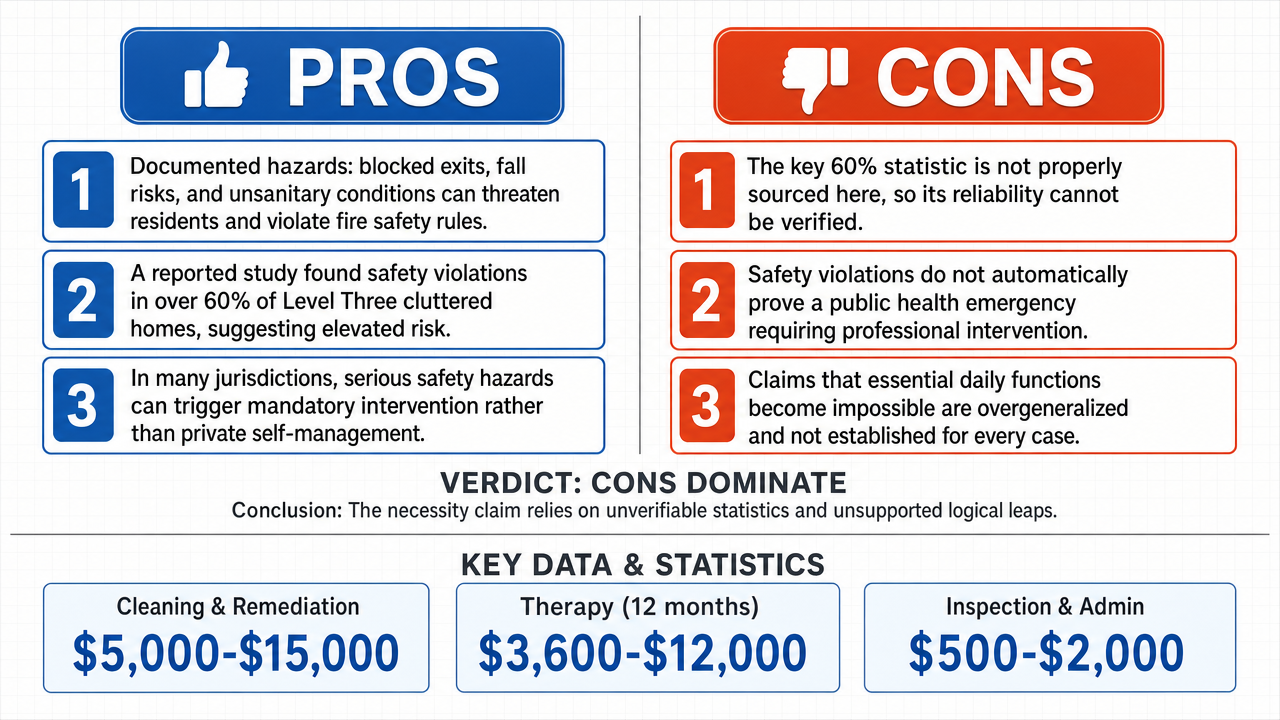
- ■Level Three hoarding creates documented health and safety hazards, including blocked egress that violates fire codes , fall risks (especially for the elderly), and biohazard conditions from rotting food, animal waste, or mold linked to respiratory illness and infection.
- ■A cited study in the American Journal of Geriatric Psychiatry reportedly found that over 60% of homes with Level Three clutter had at least one verifiable safety violation, such as blocked exits, supporting the claim of systemic risk.
- ■These hazards meet criteria for mandatory intervention in many jurisdictions, meaning Level Three hoarding is not merely a private lifestyle issue but a condition that public authorities already treat as warranting compulsory professional response.
❌ Key ANTI arguments:
- ■The affirmative's central statistic — that over 60% of Level Three homes had a verifiable safety violation — is presented without a specific title, publication date, author, or URL, so it remains an unverifiable assertion that cannot bear the weight of the necessity claim.
- ■The leap from 'safety violations exist' to 'this is a public health concern requiring professional intervention ' is conjecture about a range of possible outcomes rather than a demonstrated necessity, since violations can often be remediated through non-professional means or municipal code enforcement.
- ■The claim that Level Three clutter renders essential functions like cooking or bathing impossible is an unproven generalization; the definition specifies 'inaccessible rooms' but does not logically entail that the kitchen, bathroom, or other critical areas are necessarily non-functional for the occupant.
💭 Conclusion: False. The negative side won because it successfully exposed that the affirmative's necessity claim rested on unverifiable statistics and unsupported logical leaps. The affirmative failed to provide a citable locator for the key 60% safety-violation figure, leaving its empirical backbone unsubstantiated. More importantly, the negative drew a sharp distinction between 'professional help would be useful' and 'professional help is strictly necessitated,' showing that Level Three hoarding, while clearly harmful, does not inherently foreclose all non-professional remediation . Because the necessity component of the compound claim was the weakest link, confidence is moderated rather than maximal. Overall, the affirmative did not meet the burden of proving that external professional intervention is the only or required response to Level Three hoarding.
🔬 DeepResearch Result: likely FALSE ❌ (62%)
Assertion: Hoarding Level Three , characterized by widespread clutter, odors, and inaccessible rooms, is a 'real problem' that necessitates external professional intervention .
Participating models: deepseek-v3.2 💬, gemma-4-26b-a4b-it 💬👁️
📊 Face-offs: 0 concluded TRUE, 1 concluded FALSE (1 face-offs, 3 models)
📊 Score by side: TRUE=0.00, FALSE=0.64
🏅 Model score changes:
minimax-m3 💬👁️: +6
✅ PRO Arguments:
- ■Level Three hoarding creates documented health and safety hazards, including blocked egress that violates fire codes , fall risks (especially for the elderly), and biohazard conditions from rotting food, animal waste, or mold linked to respiratory illness and infection. deepseek-v3.2 💬
- ■A cited study in the American Journal of Geriatric Psychiatry reportedly found that over 60% of homes with Level Three clutter had at least one verifiable safety violation, such as blocked exits, supporting the claim of systemic risk. deepseek-v3.2 💬
- ■These hazards meet criteria for mandatory intervention in many jurisdictions, meaning Level Three hoarding is not merely a private lifestyle issue but a condition that public authorities already treat as warranting compulsory professional response. deepseek-v3.2 💬
- ■Level Three clutter degrades home utility to the point that basic living functions such as cooking or bathing become impossible, creating a functional disability that arguably requires trained remediation rather than self-help. deepseek-v3.2 💬
- ■Persistent odors in Level Three homes are indicators of biohazards and unsanitary conditions that extend beyond individual choice and constitute a public health concern affecting neighbors and first responders. deepseek-v3.2 💬
❌ ANTI Arguments:
- ■The affirmative's central statistic — that over 60% of Level Three homes had a verifiable safety violation — is presented without a specific title, publication date, author, or URL, so it remains an unverifiable assertion that cannot bear the weight of the necessity claim. gemma-4-26b-a4b-it 💬👁️
- ■The leap from 'safety violations exist' to 'this is a public health concern requiring professional intervention' is conjecture about a range of possible outcomes rather than a demonstrated necessity, since violations can often be remediated through non-professional means or municipal code enforcement. gemma-4-26b-a4b-it 💬👁️
- ■The claim that Level Three clutter renders essential functions like cooking or bathing impossible is an unproven generalization; the definition specifies 'inaccessible rooms' but does not logically entail that the kitchen, bathroom, or other critical areas are necessarily non-functional for the occupant. gemma-4-26b-a4b-it 💬👁️
- ■Individuals navigate cluttered environments in diverse and adaptive ways, so a universal loss-of-function claim is not supported by the clutter-level definition itself; professional help may be beneficial but is not strictly necessitated by the condition. gemma-4-26b-a4b-it 💬👁️
- ■The affirmative conflates 'professional intervention is helpful' with 'professional intervention is necessary,' and since the debate evidence does not establish that no alternative path (family support, self-directed cleanup, peer resources, municipal assistance) can address Level Three conditions, the necessity claim fails. gemma-4-26b-a4b-it 💬👁️
💭 Reasoning: False. The negative side won because it successfully exposed that the affirmative's necessity claim rested on unverifiable statistics and unsupported logical leaps. The affirmative failed to provide a citable locator for the key 60% safety-violation figure, leaving its empirical backbone unsubstantiated. More importantly, the negative drew a sharp distinction between 'professional help would be useful' and 'professional help is strictly necessitated,' showing that Level Three hoarding, while clearly harmful, does not inherently foreclose all non-professional remediation. Because the necessity component of the compound claim was the weakest link, confidence is moderated rather than maximal. Overall, the affirmative did not meet the burden of proving that external professional intervention is the only or required response to Level Three hoarding.
📋 PRO Facts:
• Level Three hoarding involves widespread clutter, odors, and inaccessible rooms.
• Clutter in Level Three homes can block egress, violating fire codes.
• Persistent odors in cluttered homes have been associated with respiratory illness and infection risks.
• The affirmative cited a statistic of over 60% of Level Three homes having at least one verifiable safety violation, attributed to the American Journal of Geriatric Psychiatry.
• Some jurisdictions treat severe hoarding conditions as warranting mandatory intervention.
📋 ANTI Facts:
• The affirmative's central 60% statistic was presented without a verifiable citation (no title, publication date, author, or URL).
• The clutter-level definition specifies 'inaccessible rooms' but does not on its face establish that all essential functional areas are unusable.
• Individuals living in cluttered environments often develop adaptive navigation strategies.
• Mandatory municipal or code-enforcement remedies exist that do not require professional intervention per se.
• No evidence in the debate demonstrated that non-professional alternatives (family, peer, self-help) categorically fail for Level Three cases.
| Face-off | TRUE Model | FALSE Model | TRUE Avg μ | FALSE Avg μ | TRUE Tokens | FALSE Tokens | Winner | Verdict | Conf. |
|---|---|---|---|---|---|---|---|---|---|
| #1 | deepseek-v3.2 💬 | gemma-4-26b-a4b-it 💬👁️ | 0.576 | 0.304 | 8 | 2 | TRUE | FALSE | 64% |
The following technical terms, abbreviations, and domain-specific concepts are referenced throughout this debate transcript. Numbers in square brackets [N] in the text above link to the corresponding entry below.
[1] American Journal of Geriatric Psychiatry — A peer-reviewed academic journal cited in the debate as the source of a statistic claiming that over 60% of homes with Level Three clutter had at least one verifiable safety violation.
[2] Biohazard — biological hazard — A substance or condition posing a threat to health from biological sources; referenced in the debate in connection with rotting food, animal waste, or mold found in Level Three hoarding environments.
[3] Code-violating hazard — A condition that contravenes established building or safety regulations, creating an objective danger. In the debate, the affirmative argues that Level Three clutter constitutes such a hazard by blocking egress paths required under the Life Safety Code.
[4] Egress — A means or route of exit from a building. The debate invokes 'maintainable egress paths' as a requirement of NFPA 101: Life Safety Code that Level Three clutter allegedly violates.
[5] Fallacy of composition — A logical fallacy in which one infers that what is true of parts of a whole must be true of the whole itself; used by the negative to criticize the affirmative's claim that inaccessible rooms render all home functions unusable.
[6] Fire codes — Regulations governing fire safety in buildings. The affirmative cites fire codes as an enforceable authority violated by blocked exits and non-functioning utilities in hoarded homes.
[7] Functional impairment — A diminished or lost ability to perform ordinary activities of daily living. The affirmative argues that Level Three hoarding produces functional impairment that degrades the utility of the home.
[8] Health codes — Regulations enacted to protect public health. The affirmative references municipal health codes alongside fire codes as relevant authority over conditions arising from hoarding.
[9] Hoarding Level Three — A specific tier within a hoarding classification scheme, defined in the debate as characterized by widespread clutter, persistent odors, and rooms rendered inaccessible.
[10] Individual autonomy — The principle that individuals have the right to make their own choices about their lives without external coercion. The negative invokes this principle against mandatory external intervention.
[11] Liability — Legal responsibility attaching to one's actions or omissions. The affirmative argues that a family member or peer cannot lawfully assume the liability involved in remediating code-violating conditions.
[12] Life Safety Code (NFPA 101) — National Fire Protection Association 101: Life Safety Code — A standard published by the National Fire Protection Association establishing minimum requirements for fire and life safety in buildings, including provisions for maintainable egress paths.
[13] Mandatory intervention — Intervention that is required rather than voluntary, often by legal authority. The affirmative contends that Level Three hoarding meets thresholds for mandatory intervention in many jurisdictions.
[14] Municipal codes — Laws and regulations enacted by local governmental authorities. The debate cites municipal fire and health codes as the public records that document the safety violations of hoarded homes.
[15] National Fire Protection Association — NFPA — The organization that develops and publishes the Life Safety Code (NFPA 101) and other fire-protection standards cited in the debate as enforceable authority.
[16] Professional intervention — Intervention provided by trained, qualified personnel rather than by laypersons, peers, or family members. The central contested question is whether Level Three hoarding inherently necessitates such intervention.
[17] Public health concern — A condition or hazard that affects the health of a population beyond the individual. The debater argues that safety violations elevate hoarding from a private matter to a public health concern warranting external action.
[18] Remediation — The act of correcting or addressing a violation, hazard, or deficiency. The affirmative argues that code violations demand 'remediation by qualified personnel' to restore compliance.
The following financial data tables were referenced during the debate exchanges:
| Category | Low Estimate | High Estimate |
|---|---|---|
| Professional Cleaning & Remediation | $5,000 | $15,000 |
| Therapeutic Intervention (12 months) | $3,600 | $12,000 |
| Municipal Inspection & Administrative Costs | $500 | $2,000 |
Legend: Estimated cost ranges for addressing a single Level Three hoarding case. Figures in USD. Source: International OCD Foundation data synthesis.
. These are costs an individual cannot typically manage alone, necessitating structured external programs.
Face-off transcripts
- ■
Ownership & Trade Secrets. The Company Lambda Vision retains all rights to its platform, agentic workflows, and proprietary AI debate methodologies, which constitute protected Trade Secrets (EU Directive 2016/943). Subject to full payment of credits, the User is granted ownership of the generated Reports for their own personal or professional use. Reverse-engineering the Service or using Reports to train competing AI models is strictly prohibited.
- ■
No Professional Advice. Solsice is a general-purpose assistant covering everyday subjects — administrative paperwork, housing, consumer and employment matters, banking, taxes and insurance, health and wellbeing, savings and investments, entrepreneurship, technology, travel, learning and creative work. Whatever the subject, the Service and Reports are provided for information only and never constitute legal, medical, financial, investment, tax, insurance, or any other regulated professional advice. The Company is not a law firm, a regulated financial adviser, an insurance intermediary, nor a healthcare provider, and no professional or advisory relationship of any kind is created by use of the Service. Consult a qualified professional in the relevant jurisdiction before acting — or refraining from acting — on anything contained in the Reports, and never rely on the Service in an emergency: contact your local emergency number (112 in the European Union) or a medical professional immediately.
- ■
AI-Generated Content, Sources and Viewpoints. Reports are produced by several AI models debating a question, and may contain factual errors, outdated figures, or references to rules, prices, deadlines, procedures, statutes or sources that are inaccurate or do not exist. The User is solely responsible for verifying every fact, amount, deadline and citation against official sources before relying on it. Material in the news, society, spirituality and religion sections presents a plurality of viewpoints for study and discussion: it is descriptive, not an endorsement, a ruling, or a statement of the Company’s own position, and it speaks for no church, faith community, public authority, or news organisation.
- ■
Liability & Governing Law. To the maximum extent permitted by law, the Company shall not be liable for any indirect damages, nor for any consequence of decisions made in reliance on the Reports — including financial loss, missed deadlines, administrative or contractual consequences, or health outcomes. These Terms are governed by French law. Any disputes shall be subject to the exclusive jurisdiction of the Courts of Paris, France.