
Historical figures like De Gaulle would have produced distinct food products, such as tarama, if they had engaged in branding similar to the Élysée Palace.
AI debate verdict and arguments
⚠️ AI-generated information only; not professional advice
Completed October 18, 2026
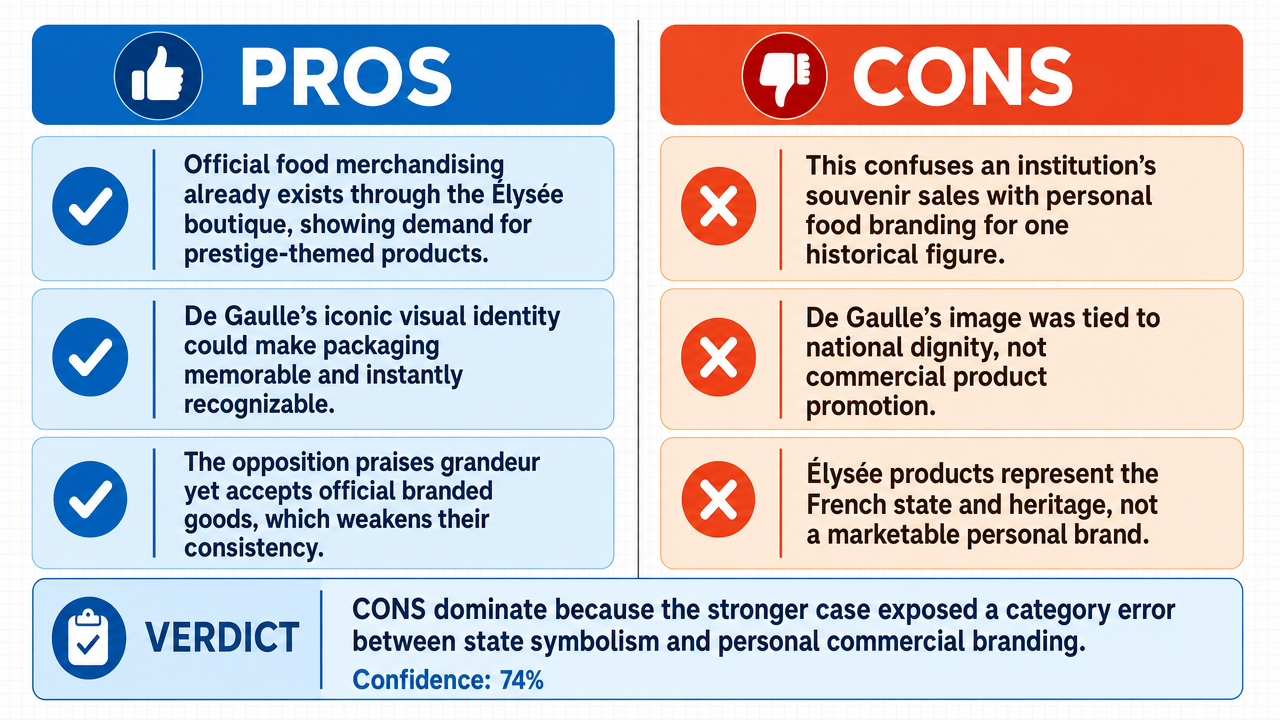
Verdict
Verdict: likely FALSE (74%)
Web Report: https://solsice.com/public/debates/historical-figures-like-de-gaulle-would-have-produced-distin-bb671faaf983
This section provides a brief overview of the key arguments. You do not need to read the full detailed report below.
✅ Key PRO arguments:
- ■The commercial viability of state-figure-branded food products is already proven by the Élysée Palace's official boutique, which successfully sells honey, chocolate, and other gourmet items under the presidential brand, and De Gaulle's even greater brand recognition would yield similar or stronger results.
- ■De Gaulle's instantly recognizable silhouette—the kepi , the Lorraine cross , the tall, austere figure—would translate powerfully onto food packaging, creating an immediate visual link to French heritage and enabling distinct branded products.
- ■The opposing side's argument contains a direct logical inconsistency: it simultaneously asserts that De Gaulle was defined by 'grandeur' and that the Élysée Palace's branding reflects 'national prestige and diplomatic soft power ,' yet claims these are fundamentally incomparable—yet grandeur and national prestige are overlapping dimensions of the same symbolic register .
❌ Key ANTI arguments:
- ■The affirmative commits a logical error of entity substitution: using the Élysée Palace's institutional boutique sales (a measurement of an institution) to conclude something about De Gaulle's personal branding potential (an individual). The Élysée is a state institution whose branding is an extension of national prestige and diplomatic soft power , managed by administrative staff to fund institutional upkeep—fundamentally different from De Gaulle's personal identity.
- ■De Gaulle was a figure defined by 'grandeur' and a refusal to subordinate the dignity of the office to commercial concerns, making him fundamentally incompatible with commercial food branding of the kind the assertion envisions.
- ■The Élysée boutique sells products as a proxy for the French State and its cultural heritage—a form of institutional souvenir-selling where the 'brand' is the Republic itself—not as personal branding, so its commercial success cannot be transferred to predict De Gaulle's hypothetical personal food products.
💭 Conclusion: False. The winning side correctly identified a fundamental category error in the affirmative's reasoning: the Élysée Palace boutique is an institutional commercial venture tied to the French Republic's soft power and administrative upkeep, not a model for personal branding by an individual historical figure. De Gaulle's political identity was defined by grandeur and a deliberate refusal to commercialize the dignity of his office, making him structurally incompatible with the kind of personal food-product branding the assertion envisions. The affirmative's attempt to bridge the institutional-to-personal gap by appealing to De Gaulle's iconic silhouette and cultural resonance does not overcome this categorical distinction between state branding and individual branding. Furthermore, the specific claim about tarama —a Greek/Mediterranean fish roe spread with no obvious connection to De Gaulle's identity or French national heritage—weakens the assertion's plausibility, as it suggests an arbitrary product choice rather than one organically tied to the figure's legacy. The compound nature of the claim (both that distinct products would emerge and that tarama specifically would be among them) means the verdict is only as strong as its weakest sub-claim, which the anti side effectively dismantled.
🔬 DeepResearch Result: likely FALSE ❌ (74%)
Assertion: Historical figures like De Gaulle would have produced distinct food products, such as tarama , if they had engaged in branding similar to the Élysée Palace.
Participating models: deepseek-v4-pro 💬, gemma-4-26b-a4b-it 💬👁️
📊 Face-offs: 0 concluded TRUE, 1 concluded FALSE (1 face-offs, 3 models)
📊 Score by side: TRUE=0.00, FALSE=0.74
🏅 Model score changes:
minimax-m3 💬👁️: +7
✅ PRO Arguments:
- ■The commercial viability of state-figure-branded food products is already proven by the Élysée Palace's official boutique, which successfully sells honey, chocolate, and other gourmet items under the presidential brand, and De Gaulle's even greater brand recognition would yield similar or stronger results. deepseek-v4-pro 💬
- ■De Gaulle's instantly recognizable silhouette—the kepi , the Lorraine cross , the tall, austere figure—would translate powerfully onto food packaging, creating an immediate visual link to French heritage and enabling distinct branded products. deepseek-v4-pro 💬
- ■The opposing side's argument contains a direct logical inconsistency: it simultaneously asserts that De Gaulle was defined by 'grandeur' and that the Élysée Palace's branding reflects 'national prestige and diplomatic soft power ,' yet claims these are fundamentally incomparable—yet grandeur and national prestige are overlapping dimensions of the same symbolic register . deepseek-v4-pro 💬
❌ ANTI Arguments:
- ■The affirmative commits a logical error of entity substitution: using the Élysée Palace's institutional boutique sales (a measurement of an institution) to conclude something about De Gaulle's personal branding potential (an individual). The Élysée is a state institution whose branding is an extension of national prestige and diplomatic soft power, managed by administrative staff to fund institutional upkeep—fundamentally different from De Gaulle's personal identity. gemma-4-26b-a4b-it 💬👁️
- ■De Gaulle was a figure defined by 'grandeur' and a refusal to subordinate the dignity of the office to commercial concerns, making him fundamentally incompatible with commercial food branding of the kind the assertion envisions. gemma-4-26b-a4b-it 💬👁️
- ■The Élysée boutique sells products as a proxy for the French State and its cultural heritage—a form of institutional souvenir-selling where the 'brand' is the Republic itself—not as personal branding, so its commercial success cannot be transferred to predict De Gaulle's hypothetical personal food products. gemma-4-26b-a4b-it 💬👁️
💭 Reasoning: False. The winning side correctly identified a fundamental category error in the affirmative's reasoning: the Élysée Palace boutique is an institutional commercial venture tied to the French Republic's soft power and administrative upkeep, not a model for personal branding by an individual historical figure. De Gaulle's political identity was defined by grandeur and a deliberate refusal to commercialize the dignity of his office, making him structurally incompatible with the kind of personal food-product branding the assertion envisions. The affirmative's attempt to bridge the institutional-to-personal gap by appealing to De Gaulle's iconic silhouette and cultural resonance does not overcome this categorical distinction between state branding and individual branding. Furthermore, the specific claim about tarama—a Greek/Mediterranean fish roe spread with no obvious connection to De Gaulle's identity or French national heritage—weakens the assertion's plausibility, as it suggests an arbitrary product choice rather than one organically tied to the figure's legacy. The compound nature of the claim (both that distinct products would emerge and that tarama specifically would be among them) means the verdict is only as strong as its weakest sub-claim, which the anti side effectively dismantled.
📋 PRO Facts:
• The Élysée Palace operates an official boutique that sells honey, chocolate, and other gourmet items under the presidential brand.
• Charles de Gaulle was the founder of the Fifth Republic and is regarded as a towering national hero in France.
• De Gaulle's silhouette—including the kepi and Lorraine cross—is instantly recognizable in French visual culture.
📋 ANTI Facts:
• The Élysée Palace is a state institution whose branding functions as an extension of national prestige and diplomatic soft power, managed by administrative staff.
• De Gaulle's political identity was defined by grandeur and a refusal to subordinate the dignity of his office to commercial concerns.
• Tarama is a Mediterranean fish roe spread with no established connection to De Gaulle's identity or French national heritage.
| Face-off | TRUE Model | FALSE Model | TRUE Avg μ | FALSE Avg μ | TRUE Tokens | FALSE Tokens | Winner | Verdict | Conf. |
|---|---|---|---|---|---|---|---|---|---|
| #1 | deepseek-v4-pro 💬 | gemma-4-26b-a4b-it 💬👁️ | 0.483 | 0.332 | 6 | 2 | TRUE | FALSE | 74% |
The following technical terms, abbreviations, and domain-specific concepts are referenced throughout this debate transcript. Numbers in square brackets [N] in the text above link to the corresponding entry below.
[1] commercial branding — The marketing practice of attaching a recognizable name, identity, or visual identity to products in order to distinguish them and build consumer recognition.
[2] commercial viability — The capacity of a product or venture to generate sufficient revenue to be financially sustainable in the marketplace.
[3] commodification — The process of converting something not previously regarded as a marketable good into a commodity that can be bought and sold; in the debate, used to describe the proposed commercialization of de Gaulle's image through food products.
[4] diplomatic soft power — A form of international influence exerted through cultural prestige, attraction, and institutional reputation rather than coercion, cited in the debate as a function of the Élysée Palace's branding.
[5] Fifth Republic — The current constitutional framework of France, established in 1958, of which Charles de Gaulle is identified in the debate as the founder.
[6] ideological construction — The formation of a political figure's identity and public meaning through specific ideological principles and values; in the debate, used to characterize de Gaulle's refusal to engage in commercial self-commodification.
[7] institutional merchandising — The sale of branded goods by state institutions or official bodies, distinguished in the debate from personal commercial branding ventures.
[8] isomorphic — Describing a structural correspondence or equivalence between two distinct categories; in the debate, used to question whether the market for state souvenirs corresponds to the market for personality-driven consumer goods.
[9] kepi — A flat-topped military cap with a stiff visor, historically associated with French military uniforms and cited in the debate as part of de Gaulle's recognizable silhouette.
[10] Lorraine cross — Croix de Lorraine — A double-barred cross symbol associated with the Lorraine region of France, cited in the debate as part of de Gaulle's visual identity.
[11] national prestige — The reputation and standing of a nation in international affairs, referenced in the debate as the symbolic basis for the Élysée Palace's branding appeal.
[12] personality-driven consumer goods — Products marketed primarily through association with a specific individual's image or identity, contrasted in the debate with state-sponsored institutional merchandise.
[13] soft power — The ability of an entity to influence others through attraction, cultural prestige, and persuasion rather than coercion or payment, referenced in the context of the Élysée Palace's branding.
[14] state souvenirs — Commemorative or branded items sold by or on behalf of a government or state institution, distinguished in the debate from personal commercial products.
[15] substitution-error — A logical fallacy in which properties, measurements, or conclusions valid for one entity are incorrectly transferred to a distinct entity; in the debate, the negative side argues the affirmative commits this error by treating the Élysée's branding as equivalent to de Gaulle's personal branding.
[16] symbolic register — A domain of meaning or signification through which cultural symbols, identities, and values operate; in the debate, used to argue that grandeur and national prestige belong to the same symbolic register.
[17] tarama — A Mediterranean food preparation, typically a spread or dip made from fish roe, olive oil, and other ingredients, cited in the debate as an example of a distinct branded food product.
[18] transfer operator — In the context of the debate, a logical or conceptual mechanism that would allow properties or conclusions valid for one entity to be applied to another; the negative side argues no such operator exists between the Élysée Palace and de Gaulle.
Face-off transcripts
- ■
Ownership & Trade Secrets. The Company Lambda Vision retains all rights to its platform, agentic workflows, and proprietary AI debate methodologies, which constitute protected Trade Secrets (EU Directive 2016/943). Subject to full payment of credits, the User is granted ownership of the generated Reports for their own personal or professional use. Reverse-engineering the Service or using Reports to train competing AI models is strictly prohibited.
- ■
No Professional Advice. Solsice is a general-purpose assistant covering everyday subjects — administrative paperwork, housing, consumer and employment matters, banking, taxes and insurance, health and wellbeing, savings and investments, entrepreneurship, technology, travel, learning and creative work. Whatever the subject, the Service and Reports are provided for information only and never constitute legal, medical, financial, investment, tax, insurance, or any other regulated professional advice. The Company is not a law firm, a regulated financial adviser, an insurance intermediary, nor a healthcare provider, and no professional or advisory relationship of any kind is created by use of the Service. Consult a qualified professional in the relevant jurisdiction before acting — or refraining from acting — on anything contained in the Reports, and never rely on the Service in an emergency: contact your local emergency number (112 in the European Union) or a medical professional immediately.
- ■
AI-Generated Content, Sources and Viewpoints. Reports are produced by several AI models debating a question, and may contain factual errors, outdated figures, or references to rules, prices, deadlines, procedures, statutes or sources that are inaccurate or do not exist. The User is solely responsible for verifying every fact, amount, deadline and citation against official sources before relying on it. Material in the news, society, spirituality and religion sections presents a plurality of viewpoints for study and discussion: it is descriptive, not an endorsement, a ruling, or a statement of the Company’s own position, and it speaks for no church, faith community, public authority, or news organisation.
- ■
Liability & Governing Law. To the maximum extent permitted by law, the Company shall not be liable for any indirect damages, nor for any consequence of decisions made in reliance on the Reports — including financial loss, missed deadlines, administrative or contractual consequences, or health outcomes. These Terms are governed by French law. Any disputes shall be subject to the exclusive jurisdiction of the Courts of Paris, France.