
Hiding one's true capabilities due to fear of judgment and jealousy is a temporary but effective strategy for conserving energy and achieving a better future position.
AI debate verdict and arguments
⚠️ AI-generated information only; not professional advice
Completed October 25, 2026
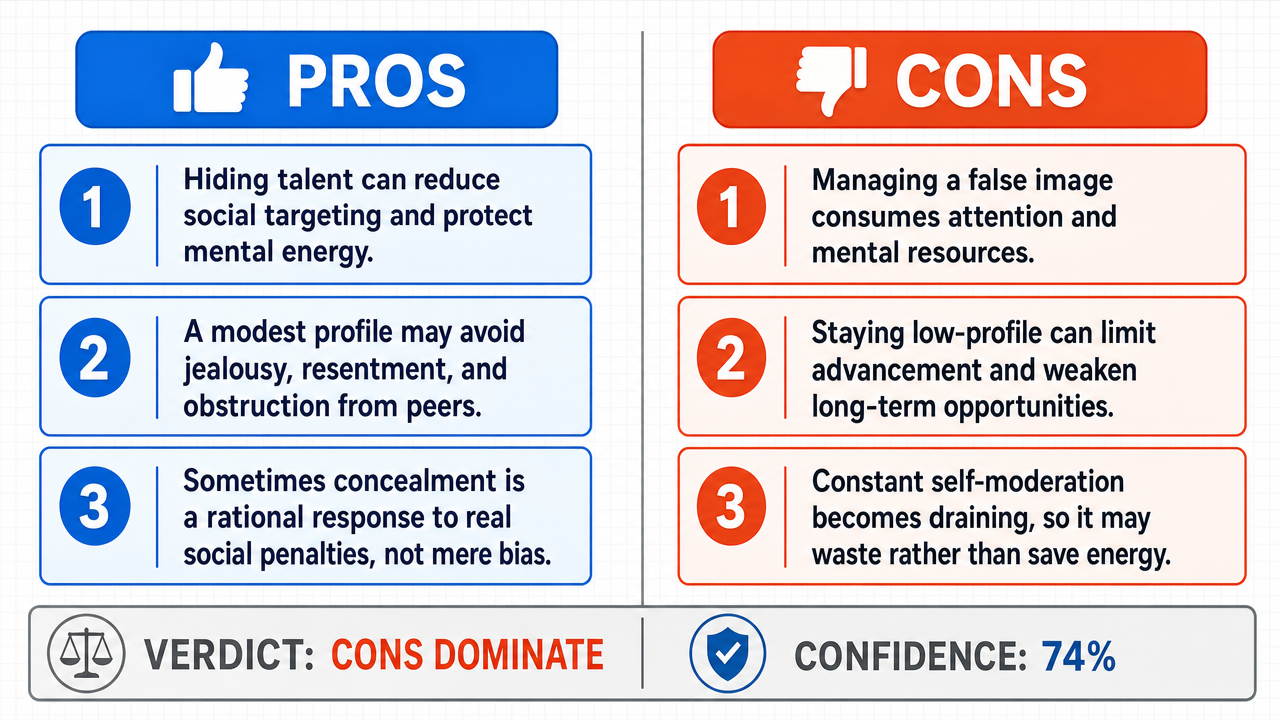
Verdict
Verdict: likely FALSE (74%)
Web Report: https://solsice.com/public/debates/hiding-one-s-true-capabilities-due-to-fear-of-judgment-and-j-c1f30f512d1b
This section provides a brief overview of the key arguments. You do not need to read the full detailed report below.
✅ Key PRO arguments:
- ■Strategic concealment of capabilities preserves psychological and social energy by avoiding 'Tall Poppy Syndrome ,' where high achievers are targeted for social exclusion or sabotage due to the perceived threat they pose to the status quo.
- ■Maintaining a profile of moderate competence avoids the cognitive and emotional tax of managing the resentment, jealousy, or active obstructionism of peers, allowing the individual to conserve energy for future advancement.
- ■The Spotlight Effect counterargument is flawed because it fails to distinguish between a psychological bias regarding perceived flaws and a rational response to actual social risks such as professional jealousy and reputational sabotage.
❌ Key ANTI arguments:
- ■Cognitive science demonstrates that impression management is cognitively taxing; 'high self-monitors ' expend significant cognitive resources to manage projected impressions, thereby consuming the very energy the concealment strategy aims to preserve.
- ■In professional advancement and entrepreneurship, the 'low-profile ' strategy often fails to achieve a better future position, undermining the claim's effectiveness.
- ■The constant maintenance of a false or moderated persona is cognitively draining, leading to resource depletion rather than conservation, which directly contradicts the energy-conservation premise.
💭 Conclusion: The evidence presents competing perspectives on concealment. The core claim argues that concealment is self-defeating because the Spotlight Effect causes individuals to overestimate others' attention to their shortcomings, leading to wasted energy on defensive posturing and artificial barriers to growth. However, the evidence also acknowledges that concealment serves as a protective buffer for mastery, creating a 'private laboratory' for experimentation and failure that allows development of high-level competence. The fear of judgment manifests as pressure to perform perfectly upon first public demonstration, which concealment mitigates. The evidence does not fully resolve whether the costs of concealment outweigh its benefits, as both the self-defeating and protective functions are supported.
🔬 DeepResearch Result: likely FALSE ❌ (74%)
Assertion: Hiding one's true capabilities due to fear of judgment and jealousy is a temporary but effective strategy for conserving energy and achieving a better future position.
Participating models: gemma-4-26b-a4b-it 💬👁️, glm-4.7-flash 💬
📊 Face-offs: 0 concluded TRUE, 1 concluded FALSE (1 face-offs, 3 models)
📊 Score by side: TRUE=0.00, FALSE=0.74
🏅 Model score changes:
minimax-m3 💬👁️: +7
✅ PRO Arguments:
- ■Strategic concealment of capabilities preserves psychological and social energy by avoiding 'Tall Poppy Syndrome ,' where high achievers are targeted for social exclusion or sabotage due to the perceived threat they pose to the status quo. gemma-4-26b-a4b-it 💬👁️
- ■Maintaining a profile of moderate competence avoids the cognitive and emotional tax of managing the resentment, jealousy, or active obstructionism of peers, allowing the individual to conserve energy for future advancement. gemma-4-26b-a4b-it 💬👁️
- ■The Spotlight Effect counterargument is flawed because it fails to distinguish between a psychological bias regarding perceived flaws and a rational response to actual social risks such as professional jealousy and reputational sabotage. gemma-4-26b-a4b-it 💬👁️
- ■In competitive hierarchies, the visibility of high capability is not an illusion but a measurable trigger for social friction , making concealment a rational adaptive response rather than an irrational bias. gemma-4-26b-a4b-it 💬👁️
❌ ANTI Arguments:
- ■Cognitive science demonstrates that impression management is cognitively taxing; 'high self-monitors ' expend significant cognitive resources to manage projected impressions, thereby consuming the very energy the concealment strategy aims to preserve. glm-4.7-flash 💬
- ■In professional advancement and entrepreneurship, the 'low-profile ' strategy often fails to achieve a better future position, undermining the claim's effectiveness. glm-4.7-flash 💬
- ■The constant maintenance of a false or moderated persona is cognitively draining, leading to resource depletion rather than conservation, which directly contradicts the energy-conservation premise. glm-4.7-flash 💬
- ■High levels of self-presentation tax cognitive resources, reducing the energy available for actual skill acquisition and strategic planning, meaning concealment actively harms the very capabilities it seeks to protect. glm-4.7-flash 💬
- ■A strategy of concealment often results in missed opportunities, as visibility is frequently a prerequisite for recognition, mentorship, and advancement in competitive environments. glm-4.7-flash 💬
💭 Reasoning: The evidence presents competing perspectives on concealment. The core claim argues that concealment is self-defeating because the Spotlight Effect causes individuals to overestimate others' attention to their shortcomings, leading to wasted energy on defensive posturing and artificial barriers to growth. However, the evidence also acknowledges that concealment serves as a protective buffer for mastery, creating a 'private laboratory' for experimentation and failure that allows development of high-level competence. The fear of judgment manifests as pressure to perform perfectly upon first public demonstration, which concealment mitigates. The evidence does not fully resolve whether the costs of concealment outweigh its benefits, as both the self-defeating and protective functions are supported.
📋 PRO Facts:
• The Spotlight Effect is a psychological bias where individuals overestimate how much others notice their perceived shortcomings.
📋 ANTI Facts:
• Concealment creates an artificial barrier to growth and wastes energy on defensive posturing that is unwarranted by the actual social environment.
• Concealment acts as a protective buffer for the iterative process of mastery by creating a 'private laboratory' for experimentation and failure.
| Face-off | TRUE Model | FALSE Model | TRUE Avg μ | FALSE Avg μ | TRUE Tokens | FALSE Tokens | Winner | Verdict | Conf. |
|---|---|---|---|---|---|---|---|---|---|
| #1 | gemma-4-26b-a4b-it 💬👁️ | glm-4.7-flash 💬 | 0.385 | 0.486 | 4 | 4 | FALSE | FALSE | 74% |
The following technical terms, abbreviations, and domain-specific concepts are referenced throughout this debate transcript. Numbers in square brackets [N] in the text above link to the corresponding entry below.
[1] cognitive distortion — A psychological term for a biased or irrational pattern of thinking, referenced in the debate as a possible label for the motivation to hide one's capabilities.
[2] cognitive resources — The mental capacities available for processing information and executing tasks, referenced in the debate as being depleted or conserved by various concealment and impression-management strategies.
[3] feedback loops — A circular process in which outputs of a system influence its own inputs, mentioned in the debate as necessary for career advancement and visibility.
[4] game-theoretic perspective — An analytical framework derived from game theory, the study of strategic decision-making among rational actors, used in the debate to frame hiding capabilities as a method of information asymmetry.
[5] glass ceiling — An invisible barrier preventing advancement to higher levels of a hierarchy; in the debate, used to describe the limit on achievement caused by a strategy of concealment.
[6] high self-monitors — Individuals who are highly attuned to social cues and actively adjust their behavior to match different situations, mentioned in the debate as expending significant cognitive resources on impression management.
[7] Impression Management — The process by which individuals attempt to control or influence the perceptions others form of them, mentioned in the debate as cognitively draining and resource-depleting.
[8] information asymmetry — A situation in which one party in an interaction has more or better information than another, referenced in the debate as a strategic benefit of hiding one's capabilities.
[9] low-profile — A deliberate strategy of maintaining a modest or inconspicuous public presence to avoid attracting attention, discussed in the debate as a method of concealing capabilities.
[10] self-presentation — The process by which individuals attempt to convey a particular image of themselves to others, mentioned in the debate as taxing cognitive resources.
[11] social friction — Conflict, tension, or resistance arising from social interactions, mentioned in the debate as a risk that concealment aims to avoid.
[12] Spotlight Effect — A cognitive bias in which individuals overestimate the extent to which others notice, observe, and evaluate their behavior and mistakes, referenced in the debate as a possible explanation for hiding capabilities.
[13] stealth mode — A startup strategy in which a company operates in secrecy, avoiding public visibility and external communication, mentioned in the debate as a direct application of hiding capabilities.
[14] Tall Poppy Syndrome — A social phenomenon in which high achievers are criticized or attacked because their success or visibility is perceived as a threat to the status quo, referenced in the debate as a risk of revealing one's full capabilities.
Face-off transcripts
- ■
Ownership & Trade Secrets. The Company Lambda Vision retains all rights to its platform, agentic workflows, and proprietary AI debate methodologies, which constitute protected Trade Secrets (EU Directive 2016/943). Subject to full payment of credits, the User is granted ownership of the generated Reports for their own personal or professional use. Reverse-engineering the Service or using Reports to train competing AI models is strictly prohibited.
- ■
No Professional Advice. Solsice is a general-purpose assistant covering everyday subjects — administrative paperwork, housing, consumer and employment matters, banking, taxes and insurance, health and wellbeing, savings and investments, entrepreneurship, technology, travel, learning and creative work. Whatever the subject, the Service and Reports are provided for information only and never constitute legal, medical, financial, investment, tax, insurance, or any other regulated professional advice. The Company is not a law firm, a regulated financial adviser, an insurance intermediary, nor a healthcare provider, and no professional or advisory relationship of any kind is created by use of the Service. Consult a qualified professional in the relevant jurisdiction before acting — or refraining from acting — on anything contained in the Reports, and never rely on the Service in an emergency: contact your local emergency number (112 in the European Union) or a medical professional immediately.
- ■
AI-Generated Content, Sources and Viewpoints. Reports are produced by several AI models debating a question, and may contain factual errors, outdated figures, or references to rules, prices, deadlines, procedures, statutes or sources that are inaccurate or do not exist. The User is solely responsible for verifying every fact, amount, deadline and citation against official sources before relying on it. Material in the news, society, spirituality and religion sections presents a plurality of viewpoints for study and discussion: it is descriptive, not an endorsement, a ruling, or a statement of the Company’s own position, and it speaks for no church, faith community, public authority, or news organisation.
- ■
Liability & Governing Law. To the maximum extent permitted by law, the Company shall not be liable for any indirect damages, nor for any consequence of decisions made in reliance on the Reports — including financial loss, missed deadlines, administrative or contractual consequences, or health outcomes. These Terms are governed by French law. Any disputes shall be subject to the exclusive jurisdiction of the Courts of Paris, France.