
Heroism is defined by an inherent willingness to answer a call to action, rather than by power.
AI debate verdict and arguments
⚠️ AI-generated information only; not professional advice
Completed October 8, 2026
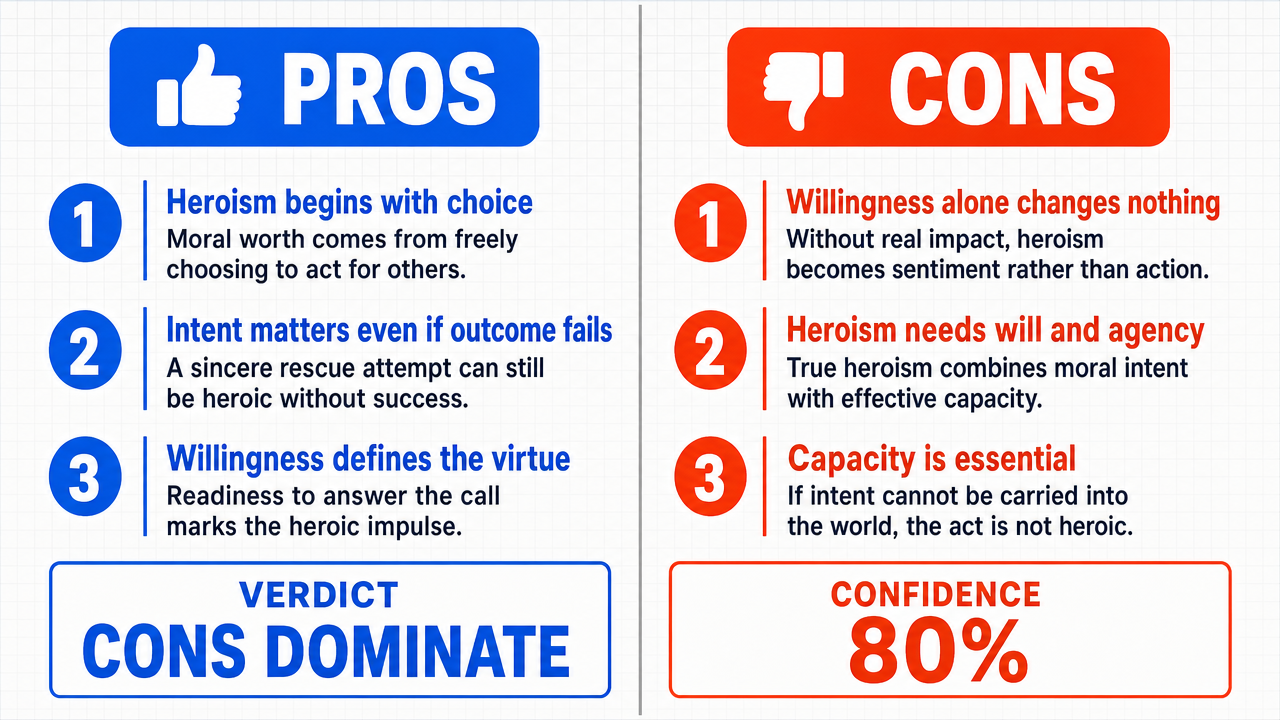
Verdict
Verdict: likely FALSE (80%)
This section provides a brief overview of the key arguments. You do not need to read the full detailed report below.
✅ Key PRO arguments:
- ■Heroism's ethical foundation lies in moral agency and the conscious choice to act for a good beyond oneself; following Kant, moral worth derives from duty performed from a good will , not from the outcomes one's natural capacities can produce, so an ordinary individual who chooses to intervene despite fear demonstrates the essence of ethical heroism.
- ■The definition of heroism must be distinguished from its successful execution: a failed rescue attempt by an untrained but willing individual is still a heroic act in its intent and initiation, and society often posthumously honors such figures precisely for their willing response, not their power.
- ■Willingness is the essential, distinguishing feature of heroism; conflating the definition of the virtue with its realization mistakes a latent heroic impulse for the absence of heroism.
❌ Key ANTI arguments:
- ■Willingness without the capacity to effect change is not heroism but merely a sentiment or desire; under consequentialist ethics, the moral value of an act is inextricably linked to its impact, so answering a call without the strength, skill, or resources to alter the outcome constitutes a failed attempt rather than a heroic deed.
- ■Heroism is a composite virtue requiring both moral volition and effective agency : power without willingness is merely an exercise of force, and willingness without power is functionally indistinguishable from passivity, so neither branch alone can define heroism.
- ■Capacity is not a secondary or optional attribute but a necessary component of the heroic act itself; without the ability to manifest one's intent in the world, the heroic quality remains a latent impulse rather than a realized virtue .
💭 Conclusion: False. The debate concluded that heroism cannot be defined by willingness alone, because a willing response without the capacity to effect change is functionally indistinguishable from passivity or mere sentiment. The winning side argued that heroism is a composite virtue requiring both moral volition and effective agency , so power and capacity are not optional attributes but necessary components of any realized heroic act. The affirmative 's attempt to decouple definition from execution was rejected as a category error that confuses latent intent with actualized virtue. While the affirmative offered compelling examples of posthumously honored figures whose willingness mattered, the judge found that such cases are best understood as heroism-in-spirit rather than the defining standard. The verdict reflects the judge's view that the consequentialist and agency-based framing of the negative side more accurately captures how heroism is recognized and valued in practice.
🔬 DeepResearch Result: likely FALSE ❌ (80%)
Assertion: Heroism is defined by an inherent willingness to answer a call to action, rather than by power.
Participating models: deepseek-v3.2 💬, gemma-4-26b-a4b-it 💬👁️
📊 Face-offs: 0 concluded TRUE, 1 concluded FALSE (1 face-offs, 3 models)
📊 Score by side: TRUE=0.00, FALSE=0.80
🏅 Model score changes:
minimax-m3 💬👁️: +8
✅ PRO Arguments:
- ■Heroism's ethical foundation lies in moral agency and the conscious choice to act for a good beyond oneself; following Kant, moral worth derives from duty performed from a good will , not from the outcomes one's natural capacities can produce, so an ordinary individual who chooses to intervene despite fear demonstrates the essence of ethical heroism. deepseek-v3.2 💬
- ■The definition of heroism must be distinguished from its successful execution: a failed rescue attempt by an untrained but willing individual is still a heroic act in its intent and initiation, and society often posthumously honors such figures precisely for their willing response, not their power. deepseek-v3.2 💬
- ■Willingness is the essential, distinguishing feature of heroism; conflating the definition of the virtue with its realization mistakes a latent heroic impulse for the absence of heroism. deepseek-v3.2 💬
❌ ANTI Arguments:
- ■Willingness without the capacity to effect change is not heroism but merely a sentiment or desire; under consequentialist ethics, the moral value of an act is inextricably linked to its impact, so answering a call without the strength, skill, or resources to alter the outcome constitutes a failed attempt rather than a heroic deed. gemma-4-26b-a4b-it 💬👁️
- ■Heroism is a composite virtue requiring both moral volition and effective agency : power without willingness is merely an exercise of force, and willingness without power is functionally indistinguishable from passivity, so neither branch alone can define heroism. gemma-4-26b-a4b-it 💬👁️
- ■Capacity is not a secondary or optional attribute but a necessary component of the heroic act itself; without the ability to manifest one's intent in the world, the heroic quality remains a latent impulse rather than a realized virtue . gemma-4-26b-a4b-it 💬👁️
💭 Reasoning: False. The debate concluded that heroism cannot be defined by willingness alone, because a willing response without the capacity to effect change is functionally indistinguishable from passivity or mere sentiment. The winning side argued that heroism is a composite virtue requiring both moral volition and effective agency, so power and capacity are not optional attributes but necessary components of any realized heroic act. The affirmative 's attempt to decouple definition from execution was rejected as a category error that confuses latent intent with actualized virtue. While the affirmative offered compelling examples of posthumously honored figures whose willingness mattered, the judge found that such cases are best understood as heroism-in-spirit rather than the defining standard. The verdict reflects the judge's view that the consequentialist and agency-based framing of the negative side more accurately captures how heroism is recognized and valued in practice.
📋 PRO Facts:
• Kantian ethics holds that moral worth derives from duty performed from a good will, independent of outcomes produced by natural capacities.
• Societies often posthumously honor individuals who attempted rescues without possessing the training or strength to succeed.
📋 ANTI Facts:
• Consequentialist ethical frameworks link the moral value of an act to its actual impact on the world rather than to intent alone.
• Social psychology distinguishes between latent impulses and realized virtues, treating the latter as requiring both volition and effective manifestation.
| Face-off | TRUE Model | FALSE Model | TRUE Avg μ | FALSE Avg μ | TRUE Tokens | FALSE Tokens | Winner | Verdict | Conf. |
|---|---|---|---|---|---|---|---|---|---|
| #1 | deepseek-v3.2 💬 | gemma-4-26b-a4b-it 💬👁️ | 0.578 | 0.382 | 12 | 3 | TRUE | FALSE | 80% |
The following technical terms, abbreviations, and domain-specific concepts are referenced throughout this debate transcript. Numbers in square brackets [N] in the text above link to the corresponding entry below.
[1] Affirmative — In debate format, the side assigned to argue in favor of the resolution.
[2] agency — The capacity to act intentionally and make free choices; in the debate, distinguished from both mere willingness and raw power as a component of heroic action.
[3] archetypal hero — The prototypical or model hero figure recurring across myths and cultural narratives, often depicted as an unlikely or humble figure who answers a call.
[4] child arguments — In the debate's hierarchical argument structure, the sub-arguments that support a root argument.
[5] Clerk — In debate format, the role responsible for reformulating or presenting the question under debate.
[6] composite virtue — A virtue composed of multiple distinct elements; in the debate, heroism is argued to be such a virtue requiring both moral volition and effective agency.
[7] consequentialism — An ethical framework in which the moral value of an act is determined by its outcomes or impact on the world.
[8] Core claim — The central argument or thesis presented by a debate side in a given round.
[9] deontology — An ethical framework focused on duties, rules, and intentions rather than the consequences of actions.
[10] duty — In Kantian ethics, the obligation to act from good will and moral principle, independent of outcomes.
[11] effective agency — The ability to translate moral intent into real-world impact or to effect change.
[12] efficacy — The capacity to produce a desired result or to alter an outcome.
[13] Facet — A category or dimension of argument within a debate round, such as 'Ethics & Values'.
[14] good will — In Kantian ethics, the intention to act from duty and moral principle, described in the debate as having 'unconditional worth' even when it 'achieves nothing'.
[15] Groundwork of the Metaphysics of Morals — Immanuel Kant's foundational ethical text, cited in the debate for the proposition that the good will has unconditional worth regardless of outcomes.
[16] heroic agency — The intentional use of capacity for a moral end, distinguished in the debate from mere power or influence.
[17] innate capacity — Inherent ability or power possessed naturally, as opposed to developed skill or acquired strength.
[18] Kantian deontology — Immanuel Kant's duty-based ethical framework, which holds that moral worth derives from the good will rather than from outcomes or natural capacities.
[19] latent impulse — An unrealized intention or tendency that has not manifested in action; in the debate, contrasted with a realized heroic virtue.
[20] latent potentiality — An unrealized capacity that has not been actualized or manifested in the world.
[21] memory tree — The hierarchical structure of arguments in the debate system, containing root arguments and their supporting child arguments.
[22] moral agency — The capacity of an individual to make conscious moral choices and to act on ethical grounds.
[23] moral choice — A decision made on ethical grounds, involving the conscious selection of a moral course of action.
[24] moral orientation — The ethical framework or direction guiding one's actions, contrasted in the debate with raw power.
[25] moral virtue — A character trait valued as ethically good, such as the courage or justice exhibited by a hero.
[26] moral volition — The act of willing or choosing on moral grounds; presented in the debate as one component of a composite heroic virtue.
[27] moral worth — The ethical value of an action or person, which in Kantian ethics is held to derive from good will rather than from outcomes.
[28] Negative — In debate format, the side assigned to argue against the resolution.
[29] realized virtue — A moral quality that has been manifested or actualized in action, contrasted in the debate with a latent impulse.
[30] root argument — The primary or top-level argument in the debate's hierarchical memory tree structure.
[31] social psychology — The academic study of how social contexts influence individual behavior, cited in the debate regarding the distinction between power and heroic agency.
[32] volition — The act of willing or making a conscious choice; in the debate, treated as a necessary component of heroic action.
Face-off transcripts
- ■
Ownership & Trade Secrets. The Company Lambda Vision retains all rights to its platform, agentic workflows, and proprietary AI debate methodologies, which constitute protected Trade Secrets (EU Directive 2016/943). Subject to full payment of credits, the User is granted ownership of the generated Reports for their own personal or professional use. Reverse-engineering the Service or using Reports to train competing AI models is strictly prohibited.
- ■
No Professional Advice. Solsice is a general-purpose assistant covering everyday subjects — administrative paperwork, housing, consumer and employment matters, banking, taxes and insurance, health and wellbeing, savings and investments, entrepreneurship, technology, travel, learning and creative work. Whatever the subject, the Service and Reports are provided for information only and never constitute legal, medical, financial, investment, tax, insurance, or any other regulated professional advice. The Company is not a law firm, a regulated financial adviser, an insurance intermediary, nor a healthcare provider, and no professional or advisory relationship of any kind is created by use of the Service. Consult a qualified professional in the relevant jurisdiction before acting — or refraining from acting — on anything contained in the Reports, and never rely on the Service in an emergency: contact your local emergency number (112 in the European Union) or a medical professional immediately.
- ■
AI-Generated Content, Sources and Viewpoints. Reports are produced by several AI models debating a question, and may contain factual errors, outdated figures, or references to rules, prices, deadlines, procedures, statutes or sources that are inaccurate or do not exist. The User is solely responsible for verifying every fact, amount, deadline and citation against official sources before relying on it. Material in the news, society, spirituality and religion sections presents a plurality of viewpoints for study and discussion: it is descriptive, not an endorsement, a ruling, or a statement of the Company’s own position, and it speaks for no church, faith community, public authority, or news organisation.
- ■
Liability & Governing Law. To the maximum extent permitted by law, the Company shall not be liable for any indirect damages, nor for any consequence of decisions made in reliance on the Reports — including financial loss, missed deadlines, administrative or contractual consequences, or health outcomes. These Terms are governed by French law. Any disputes shall be subject to the exclusive jurisdiction of the Courts of Paris, France.