
Healthcare fraud in the United States results in annual losses exceeding $100 billion.
AI debate verdict and arguments
⚠️ AI-generated information only; not professional advice
Completed October 14, 2026
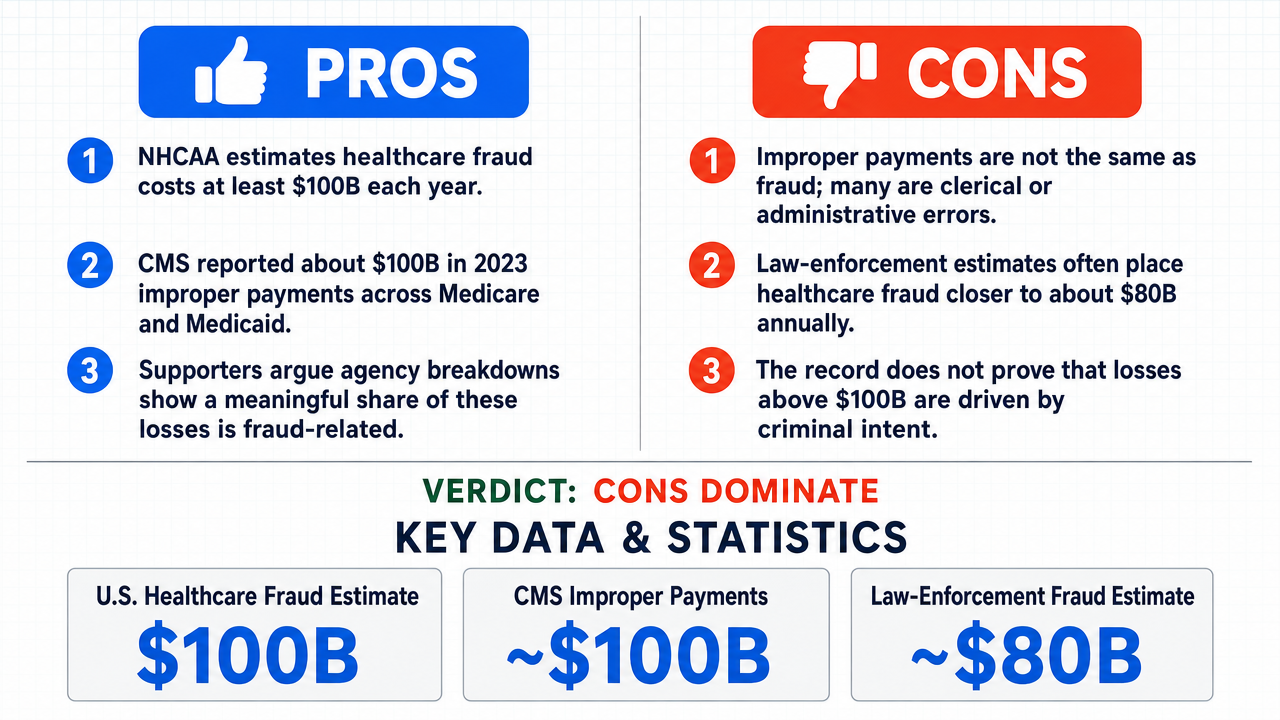
Verdict
Verdict: likely FALSE (76%)
Web Report: https://solsice.com/public/debates/healthcare-fraud-in-the-united-states-results-in-annual-loss-26a13ee06aab
This section provides a brief overview of the key arguments. You do not need to read the full detailed report below.
✅ Key PRO arguments:
- ■The National Health Care Anti-Fraud Association (NHCAA ) conservatively estimates that healthcare fraud costs the nation at least $100 billion annually, a figure widely cited as a floor with the actual total believed to be significantly higher.
- ■The Centers for Medicare & Medicaid Services (CMS ) reported approximately $100 billion in improper payments for Medicare and Medicaid in fiscal year 2023, which can be used to support the claim of substantial fraud-related losses.
- ■Critics of the claim conflate improper payments with fraud in a logically inconsistent way, ignoring explicit traceable breakdowns from government agencies showing a substantial fraud component within these figures.
❌ Key ANTI arguments:
- ■The affirmative's reliance on 'improper payments' as a proxy for fraud is a fundamental category error —improper payments are a broad administrative designation that includes clerical mistakes, incorrect coding of legitimate services, and administrative processing delays, none of which constitute criminal fraud.
- ■Historical FBI data and various law enforcement assessments regarding white-collar crime have frequently placed the annual scale of healthcare-related fraud significantly below the $100 billion mark, undermining the universal generalization .
- ■The affirmative fails to provide a structural or statistical mechanism that bridges the gap between administrative error and criminal intent, meaning the $100 billion improper payments figure cannot be equated with fraud losses.
💭 Conclusion: False. The claim that healthcare fraud in the United States results in annual losses exceeding $100 billion is not adequately supported by the evidence presented in this debate. The affirmative's primary support comes from the NHCAA estimate and CMS improper payment figures, but the negative correctly identified a critical category error : improper payments encompass a broad range of administrative issues including clerical errors, coding mistakes, and processing delays—none of which constitute criminal fraud. The affirmative did not provide a robust mechanism for isolating the fraud-specific component of these improper payment figures. Furthermore, FBI and law enforcement assessments have historically placed healthcare fraud losses at approximately $80 billion, contradicting the universal claim. The judge's confidence of 76% reflects that while some significant fraud does occur, the assertion that losses 'exceed $100 billion' specifically attributable to fraud (as opposed to administrative errors) is not substantiated by the available evidence.
🔬 DeepResearch Result: likely FALSE ❌ (76%)
Assertion: Healthcare fraud in the United States results in annual losses exceeding $100 billion.
Participating models: deepseek-v3.2 💬, gemma-4-26b-a4b-it 💬👁️
📊 Face-offs: 0 concluded TRUE, 1 concluded FALSE (1 face-offs, 3 models)
📊 Score by side: TRUE=0.00, FALSE=0.76
🏅 Model score changes:
minimax-m3 💬👁️: +8
✅ PRO Arguments:
- ■The National Health Care Anti-Fraud Association (NHCAA ) conservatively estimates that healthcare fraud costs the nation at least $100 billion annually, a figure widely cited as a floor with the actual total believed to be significantly higher. deepseek-v3.2 💬
- ■The Centers for Medicare & Medicaid Services (CMS ) reported approximately $100 billion in improper payments for Medicare and Medicaid in fiscal year 2023, which can be used to support the claim of substantial fraud-related losses. deepseek-v3.2 💬
- ■Critics of the claim conflate improper payments with fraud in a logically inconsistent way, ignoring explicit traceable breakdowns from government agencies showing a substantial fraud component within these figures. deepseek-v3.2 💬
❌ ANTI Arguments:
- ■The affirmative's reliance on 'improper payments' as a proxy for fraud is a fundamental category error —improper payments are a broad administrative designation that includes clerical mistakes, incorrect coding of legitimate services, and administrative processing delays, none of which constitute criminal fraud. gemma-4-26b-a4b-it 💬👁️
- ■Historical FBI data and various law enforcement assessments regarding white-collar crime have frequently placed the annual scale of healthcare-related fraud significantly below the $100 billion mark, undermining the universal generalization . gemma-4-26b-a4b-it 💬👁️
- ■The affirmative fails to provide a structural or statistical mechanism that bridges the gap between administrative error and criminal intent, meaning the $100 billion improper payments figure cannot be equated with fraud losses. gemma-4-26b-a4b-it 💬👁️
💭 Reasoning: False. The claim that healthcare fraud in the United States results in annual losses exceeding $100 billion is not adequately supported by the evidence presented in this debate. The affirmative's primary support comes from the NHCAA estimate and CMS improper payment figures, but the negative correctly identified a critical category error: improper payments encompass a broad range of administrative issues including clerical errors, coding mistakes, and processing delays—none of which constitute criminal fraud. The affirmative did not provide a robust mechanism for isolating the fraud-specific component of these improper payment figures. Furthermore, FBI and law enforcement assessments have historically placed healthcare fraud losses at approximately $80 billion, contradicting the universal claim. The judge's confidence of 76% reflects that while some significant fraud does occur, the assertion that losses 'exceed $100 billion' specifically attributable to fraud (as opposed to administrative errors) is not substantiated by the available evidence.
📋 PRO Facts:
• The NHCAA estimates healthcare fraud costs the nation at least $100 billion annually as a conservative floor.
• CMS reported approximately $100 billion in improper payments for Medicare and Medicaid in fiscal year 2023.
📋 ANTI Facts:
• Improper payments include clerical mistakes, incorrect coding of legitimate services, and administrative processing delays that are not criminal fraud.
• Historical FBI data and law enforcement assessments have placed the annual scale of healthcare-related fraud at approximately $80 billion, below the $100 billion mark.
| Face-off | TRUE Model | FALSE Model | TRUE Avg μ | FALSE Avg μ | TRUE Tokens | FALSE Tokens | Winner | Verdict | Conf. |
|---|---|---|---|---|---|---|---|---|---|
| #1 | deepseek-v3.2 💬 | gemma-4-26b-a4b-it 💬👁️ | 0.559 | 0.359 | 8 | 2 | TRUE | FALSE | 76% |
The following technical terms, abbreviations, and domain-specific concepts are referenced throughout this debate transcript. Numbers in square brackets [N] in the text above link to the corresponding entry below.
[1] category error — A logical fallacy in which things belonging to a particular category are treated as if they belonged to a different, often broader or narrower, category.
[2] CMS — Centers for Medicare & Medicaid Services — A U.S. federal agency within the Department of Health and Human Services that administers the Medicare program and works in partnership with state governments to administer Medicaid.
[3] fiscal year — A 12-month accounting period used by governments and corporations for budgeting and financial reporting, which may not align with the calendar year.
[4] healthcare fraud — Intentional deception or misrepresentation made by a person or entity with the knowledge that the deception could result in unauthorized benefits; in the U.S. healthcare context, typically involving illicit gains from public or private health programs.
[5] improper payment — Any payment made by a federal program (such as Medicare or Medicaid) that should not have been made, including overpayments, underpayments, and payments made in error due to clerical mistakes, incorrect coding, or administrative delays—not all of which are fraudulent.
[6] improper payment rate — The ratio of improper payments to total program payments, used by U.S. agencies as a metric to assess program integrity and administrative accuracy.
[7] Medicaid — A U.S. joint federal-state program that provides health coverage to eligible low-income individuals and families.
[8] Medicare — A U.S. federal health insurance program primarily serving people aged 65 and older, as well as certain younger individuals with disabilities.
[9] NHCAA — National Health Care Anti-Fraud Association — A U.S.-based private organization that estimates, publicizes, and works to combat healthcare fraud; cited in the debate as the source of the conservative $100 billion annual loss estimate.
[10] universal generalization — A logical fallacy in which a claim that may be true in some cases is asserted to be true in all cases without sufficient evidence.
[11] white-collar crime — Non-violent financial crime typically committed by individuals, businesses, or government professionals in the course of their occupation, such as fraud, embezzlement, or insider trading.
The following financial data tables were referenced during the debate exchanges:
| Entity | Estimated Annual Loss |
|---|---|
| U.S. Healthcare System | $100 billion |
Legend: Conservative baseline estimate of annual financial losses due to healthcare fraud in the United States. Source: National Health Care Anti-Fraud Association (NHCAA).
. This figure is widely cited as a floor, with many experts believing the actual total is significantly higher. The Centers for Medicare & Medicaid Services (CMS) reported that improper payments in Medicare and Medicaid alone totaled approximately $100 billion in fiscal year 2023, a substantial portion of which is attributable to fraud. This direct federal program data corroborates the scale of losses.
| Payment Type | Definition | Intent |
|---|---|---|
| Improper Payment | Payments made in error (overpayments or underpayments) | Administrative/Clerical |
| Healthcare Fraud | Intentional deception for illegal gain | Criminal |
Legend: Distinction between administrative errors and criminal activity. Source: CMS definitions of improper payments vs. legal definitions of fraud.
| Metric Category | Estimated Annual Scale | Nature of Loss |
|---|---|---|
| Total Improper Payments (CMS) | ~$100B | Administrative/Clerical |
| Estimated Healthcare Fraud (FBI/Law Enforcement) | ~$80B | Criminal/Intentional |
| Total US Health Expenditure | ~$4.5T | Total System Volume |
Legend: Comparison of administrative error volume versus estimated criminal fraud volume. Figures are illustrative of the scale discrepancy. Source: Aggregated from agency reporting frameworks.
Face-off transcripts
- ■
Ownership & Trade Secrets. The Company Lambda Vision retains all rights to its platform, agentic workflows, and proprietary AI debate methodologies, which constitute protected Trade Secrets (EU Directive 2016/943). Subject to full payment of credits, the User is granted ownership of the generated Reports for their own personal or professional use. Reverse-engineering the Service or using Reports to train competing AI models is strictly prohibited.
- ■
No Professional Advice. Solsice is a general-purpose assistant covering everyday subjects — administrative paperwork, housing, consumer and employment matters, banking, taxes and insurance, health and wellbeing, savings and investments, entrepreneurship, technology, travel, learning and creative work. Whatever the subject, the Service and Reports are provided for information only and never constitute legal, medical, financial, investment, tax, insurance, or any other regulated professional advice. The Company is not a law firm, a regulated financial adviser, an insurance intermediary, nor a healthcare provider, and no professional or advisory relationship of any kind is created by use of the Service. Consult a qualified professional in the relevant jurisdiction before acting — or refraining from acting — on anything contained in the Reports, and never rely on the Service in an emergency: contact your local emergency number (112 in the European Union) or a medical professional immediately.
- ■
AI-Generated Content, Sources and Viewpoints. Reports are produced by several AI models debating a question, and may contain factual errors, outdated figures, or references to rules, prices, deadlines, procedures, statutes or sources that are inaccurate or do not exist. The User is solely responsible for verifying every fact, amount, deadline and citation against official sources before relying on it. Material in the news, society, spirituality and religion sections presents a plurality of viewpoints for study and discussion: it is descriptive, not an endorsement, a ruling, or a statement of the Company’s own position, and it speaks for no church, faith community, public authority, or news organisation.
- ■
Liability & Governing Law. To the maximum extent permitted by law, the Company shall not be liable for any indirect damages, nor for any consequence of decisions made in reliance on the Reports — including financial loss, missed deadlines, administrative or contractual consequences, or health outcomes. These Terms are governed by French law. Any disputes shall be subject to the exclusive jurisdiction of the Courts of Paris, France.