
Greenland Mines (GRML) will reach commercial production at its Skaergaard and Sarfartoq projects by the end of 2029.
AI debate verdict and arguments
⚠️ AI-generated information only; not professional advice
Completed October 21, 2026
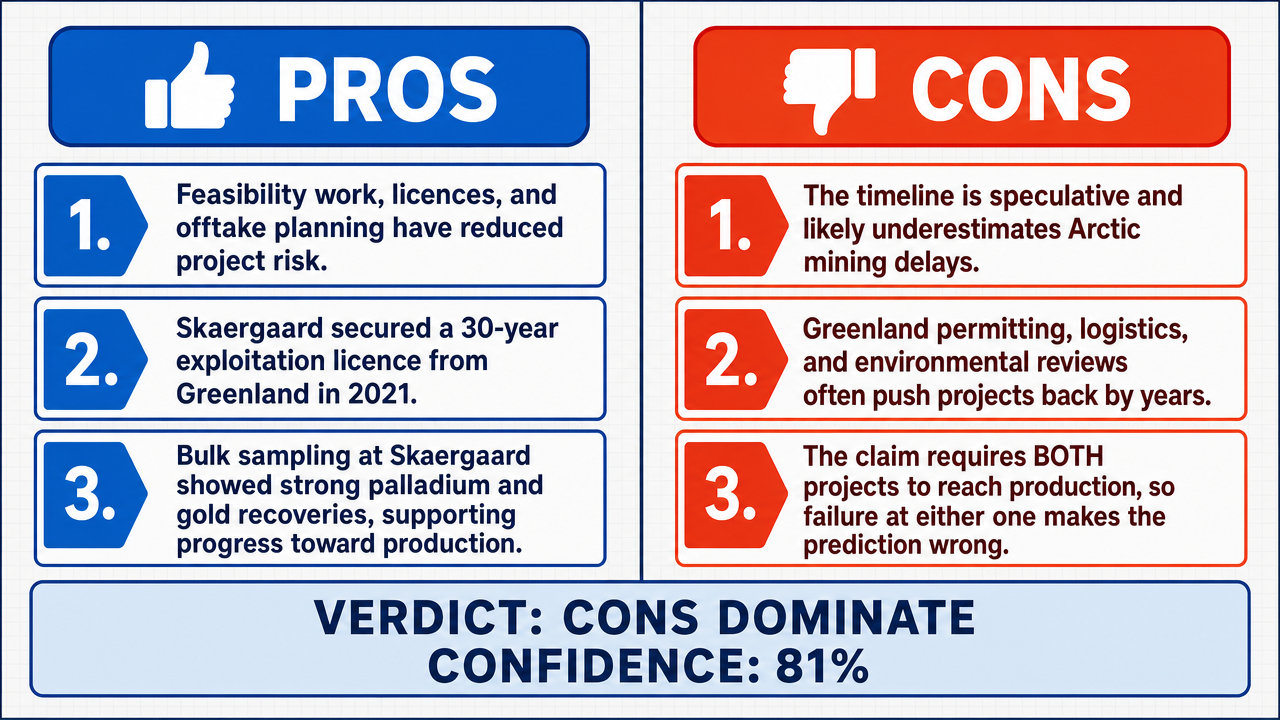
Verdict
Verdict: likely FALSE (81%)
Web Report: https://solsice.com/public/debates/greenland-mines-grml-will-reach-commercial-production-at-its-b4a867cbed84
This section provides a brief overview of the key arguments. You do not need to read the full detailed report below.
✅ Key PRO arguments:
- ■Greenland Mines has systematically de-risked both projects through completed feasibility studies, secured exploitation licences, and established offtake pathways that align with a 2029 production timeline.
- ■The Skaergaard project received its 30-year exploitation licence from the Greenland Government in December 2021, following a positive pre-feasibility study confirming economically viable grades of palladium, gold, and platinum.
- ■The 2023 bulk sampling programme at Skaergaard demonstrated recoveries exceeding 85% for palladium and gold, supporting advancement toward a mid-2028 first-concentrate production target with a buffer to 2029.
❌ Key ANTI arguments:
- ■The affirmative's timeline is speculative and ignores the systemic delays inherent in Greenlandic mining operations; the assumption that financing, permitting, and construction proceed seamlessly is uncorroborated.
- ■The Greenlandic regulatory environment and the logistical complexity of Arctic construction frequently extend timelines by years, with environmental impact assessment revisions and seasonal Arctic constraints routinely causing multi-year delays.
- ■The claim is compound, requiring BOTH Skaergaard and Sarfartoq to reach commercial production . Of the four possible outcomes (both succeed, only Skaergaard, only Sarfartoq, neither), at most one scenario supports the claim, so the probability of the joint outcome is substantially lower than for either project alone.
💭 Conclusion: False. The compound claim requires both the Skaergaard and Sarfartoq projects to independently reach commercial production by end-2029, and the negative side demonstrated that the risk of both succeeding is substantially greater than the risk for either project alone. The affirmative's reliance on completed licensing milestones and bulk sampling results was undermined by the negative's point that Arctic permitting, financing, and construction routinely cause multi-year delays in Greenlandic mining operations. The negative also highlighted that Sarfartoq's metallurgical flowsheet remains unproven at commercial scale and its offtake agreements are non-binding, making its 2028 production target a fragile foundation for a 2029 deadline. The negative's systemic risk arguments carried particular weight given the weak support for the Sarfartoq sub-claim.
🔬 DeepResearch Result: likely FALSE ❌ (81%)
Assertion: Greenland Mines (GRML ) will reach commercial production at its Skaergaard and Sarfartoq projects by the end of 2029.
Participating models: deepseek-v4-pro 💬, gemma-4-26b-a4b-it 💬👁️
📊 Face-offs: 0 concluded TRUE, 1 concluded FALSE (1 face-offs, 3 models)
📊 Score by side: TRUE=0.00, FALSE=0.81
🏅 Model score changes:
minimax-m3 💬👁️: +8
✅ PRO Arguments:
- ■Greenland Mines has systematically de-risked both projects through completed feasibility studies, secured exploitation licences, and established offtake pathways that align with a 2029 production timeline. deepseek-v4-pro 💬
- ■The Skaergaard project received its 30-year exploitation licence from the Greenland Government in December 2021, following a positive pre-feasibility study confirming economically viable grades of palladium, gold, and platinum. deepseek-v4-pro 💬
- ■The 2023 bulk sampling programme at Skaergaard demonstrated recoveries exceeding 85% for palladium and gold, supporting advancement toward a mid-2028 first-concentrate production target with a buffer to 2029. deepseek-v4-pro 💬
- ■The Sarfartoq/Kringlerne metallurgical pathway is documented in the 2023 Scoping Study filed on SEDAR , which reports that gravity separation followed by magnetic separation recovers over 80% of rare earth elements into a saleable concentrate. deepseek-v4-pro 💬
❌ ANTI Arguments:
- ■The affirmative's timeline is speculative and ignores the systemic delays inherent in Greenlandic mining operations; the assumption that financing, permitting, and construction proceed seamlessly is uncorroborated. gemma-4-26b-a4b-it 💬👁️
- ■The Greenlandic regulatory environment and the logistical complexity of Arctic construction frequently extend timelines by years, with environmental impact assessment revisions and seasonal Arctic constraints routinely causing multi-year delays. gemma-4-26b-a4b-it 💬👁️
- ■The claim is compound, requiring BOTH Skaergaard and Sarfartoq to reach commercial production. Of the four possible outcomes (both succeed, only Skaergaard, only Sarfartoq, neither), at most one scenario supports the claim, so the probability of the joint outcome is substantially lower than for either project alone. gemma-4-26b-a4b-it 💬👁️
- ■Sarfartoq's metallurgical flowsheet remains unproven at commercial scale, and its offtake arrangements are non-binding, undermining the confidence needed to assume a 2028 first-production target that feeds into the 2029 deadline. gemma-4-26b-a4b-it 💬👁️
💭 Reasoning: False. The compound claim requires both the Skaergaard and Sarfartoq projects to independently reach commercial production by end-2029, and the negative side demonstrated that the risk of both succeeding is substantially greater than the risk for either project alone. The affirmative's reliance on completed licensing milestones and bulk sampling results was undermined by the negative's point that Arctic permitting, financing, and construction routinely cause multi-year delays in Greenlandic mining operations. The negative also highlighted that Sarfartoq's metallurgical flowsheet remains unproven at commercial scale and its offtake agreements are non-binding, making its 2028 production target a fragile foundation for a 2029 deadline. The negative's systemic risk arguments carried particular weight given the weak support for the Sarfartoq sub-claim.
📋 PRO Facts:
• Skaergaard received a 30-year exploitation licence from the Greenland Government in December 2021.
• The 2023 bulk sampling programme at Skaergaard demonstrated recoveries exceeding 85% for palladium and gold.
• The 2023 Scoping Study for the Kringlerne (Sarfartoq) deposit was filed on SEDAR and reports gravity-plus-magnetic separation recovering over 80% of rare earth elements into a saleable concentrate.
📋 ANTI Facts:
• Arctic permitting, financing, and construction in Greenland have routinely caused multi-year delays in mining operations.
• Sarfartoq's offtake arrangements are described as a non-binding memorandum, not a firm commercial commitment.
• Sarfartoq's metallurgical flowsheet has not been demonstrated at commercial scale.
• The claim is compound, requiring two independent projects to meet the 2029 deadline simultaneously, which compounds execution risk.
| Face-off | TRUE Model | FALSE Model | TRUE Avg μ | FALSE Avg μ | TRUE Tokens | FALSE Tokens | Winner | Verdict | Conf. |
|---|---|---|---|---|---|---|---|---|---|
| #1 | deepseek-v4-pro 💬 | gemma-4-26b-a4b-it 💬👁️ | 0.561 | 0.254 | 6 | 2 | TRUE | FALSE | 81% |
The following technical terms, abbreviations, and domain-specific concepts are referenced throughout this debate transcript. Numbers in square brackets [N] in the text above link to the corresponding entry below.
[1] Bench-scale — An early laboratory stage of metallurgical or process testwork conducted on small samples (typically grams to kilograms) to establish proof of concept before progressing to larger-scale testing.
[2] Bulk sampling — A large-volume sampling programme taken from a mineral deposit to obtain representative material for metallurgical testing and to assess geological continuity and grade variability.
[3] Capex — Capital Expenditure — Funds a company spends to acquire, construct, or maintain physical assets such as mine infrastructure and processing facilities, distinguished from ongoing operating costs.
[4] Commercial production — The operational stage of a mine at which it is producing at a sustainable design rate and generating revenue, as distinguished from commissioning, ramp-up, or trial production.
[5] Concentrate — The upgraded mineral product produced by a beneficiation process (such as flotation or gravity separation) in which the valuable metal or mineral content has been enriched relative to the original ore.
[6] Critical minerals — Minerals and metals considered essential to a country's economy or national security and subject to supply-chain risk, the subject of dedicated funding mechanisms such as the 'European critical minerals funds' referenced in the debate.
[7] De-risked — In mining project evaluation, the state or process of having reduced technical, financial, regulatory, or market uncertainties—for example, by completing feasibility studies and securing exploitation licences.
[8] EIA — Environmental Impact Assessment — A regulatory review process that evaluates the potential environmental effects of a proposed project before approval is granted, cited in the debate as a potential source of permitting delays in Greenland.
[9] Eudialyte — A complex zirconium silicate mineral that serves as a host for rare earth elements in certain alkaline intrusions, including the Kringlerne deposit referenced in the Sarfartoq/Kringlerne flowsheet.
[10] Exploitation licence — A long-term mining permit granted by a government authority that authorises the holder to develop and extract minerals from a defined area; the Skaergaard licence discussed in the debate was a 30-year licence issued in December 2021.
[11] Feasibility study — A comprehensive technical and economic assessment of a mining project, typically more detailed than a pre-feasibility study, used to support financing and construction decisions.
[12] Flotation — A mineral processing technique in which hydrophobic target particles (such as sulphide minerals) attach to air bubbles and are separated from the rest of the ore; cited in the debate as the method used at Skaergaard to recover palladium and gold.
[13] Grades — The concentration of a target metal or mineral within an ore, typically expressed as grams per tonne or percent; 'economically viable grades' are concentrations sufficient to support profitable extraction.
[14] Gravity separation — A mineral processing technique that exploits differences in particle density to concentrate valuable minerals; described in the debate as the first stage of the Kringlerne flowsheet.
[15] GRML — Greenland Mines — Ticker symbol for Greenland Mines, the company whose Skaergaard and Sarfartoq projects are the subject of the debate.
[16] Hydrometallurgy — A branch of extractive metallurgy that uses aqueous chemical processes (leaching, solvent extraction, precipitation) to recover metals from ores or concentrates; the debate disputes whether such processing is required for Sarfartoq.
[17] Magnetic separation — A mineral processing technique that uses the magnetic properties of minerals to separate them from gangue; described in the debate as following gravity separation in the Kringlerne flowsheet.
[18] Metallurgical flowsheet — A documented sequence of physical and chemical processing steps used to recover valuable metals or minerals from ore, from crushing through to final concentrate or metal.
[19] NI 43-101 — National Instrument 43-101 — A Canadian Securities Administrators standard governing the disclosure of scientific and technical information about mineral projects by publicly listed issuers; cited in the debate as the framework for the Sarfartoq/Kringlerne Technical Report.
[20] Offtake — A forward sales arrangement between a producer and a buyer committing the buyer to purchase a defined portion of future production; the debate references both 'offtake pathways' and a 'non-binding offtake memorandum.'
[21] Pilot-scale — An intermediate stage of metallurgical or process testwork, larger than bench-scale but smaller than full production, used to validate performance on representative samples.
[22] Pre-feasibility study — An intermediate technical and economic assessment of a mining project, less detailed than a full feasibility study, used to determine whether to advance to the next stage of evaluation.
[23] Project financing — A form of debt or equity financing structured around the projected cash flows of a single project, typically used for large-scale infrastructure and resource developments; the debate argues the Skaergaard $450M project requires 'secured, binding' project financing.
[24] Recoveries — In metallurgy, the percentage of a target metal or mineral that is extracted from ore into a final product (concentrate or metal) through a given process; cited in the debate as exceeding 85% for palladium and gold at Skaergaard and over 80% for REEs at Kringlerne.
[25] REE — Rare Earth Elements — A group of seventeen chemically similar metallic elements (the fifteen lanthanides plus scandium and yttrium) that are economically important for high-technology and clean-energy applications, and the target commodity at Sarfartoq/Kringlerne.
[26] Scoping Study — An early-stage evaluation of a mining project's potential viability, less detailed than a pre-feasibility study, used to determine whether further work is warranted; the debate references a 2023 Scoping Study filed on SEDAR for Kringlerne.
[27] SEDAR — System for Electronic Document Analysis and Retrieval — The Canadian Securities Administrators' filing platform through which public companies, including mining issuers, file continuous disclosure documents such as technical reports and scoping studies cited in the debate.
The following financial data tables were referenced during the debate exchanges:
| Project | NPV (8%) | IRR | Capex | Payback |
|---|---|---|---|---|
| Skaergaard | $1.2B | 28% | $450M | 3.2 yrs |
| Sarfartoq | $890M | 34% | $320M | 2.8 yrs |
Legend: Economic metrics from the 2022 Preliminary Economic Assessment for Skaergaard and the 2023 Scoping Study for Sarfartoq. NPV in USD; Capex in USD millions. Source: Greenland Minerals Ltd. technical reports filed on SEDAR.
| Project | Claimed Capex | Required Timeline (Construction) | Target Production |
|---|---|---|---|
| Skaergaard | $450M | 24–30 Months | 2028/2029 |
| Sarfartoq | $320M | 18–22 Months | 2028 |
Legend: Estimated capital requirements and construction durations based on affirmative's technical estimates. Total required capital for both projects is $770M.
Face-off transcripts
- ■
Ownership & Trade Secrets. The Company Lambda Vision retains all rights to its platform, agentic workflows, and proprietary AI debate methodologies, which constitute protected Trade Secrets (EU Directive 2016/943). Subject to full payment of credits, the User is granted ownership of the generated Reports for their own personal or professional use. Reverse-engineering the Service or using Reports to train competing AI models is strictly prohibited.
- ■
No Professional Advice. Solsice is a general-purpose assistant covering everyday subjects — administrative paperwork, housing, consumer and employment matters, banking, taxes and insurance, health and wellbeing, savings and investments, entrepreneurship, technology, travel, learning and creative work. Whatever the subject, the Service and Reports are provided for information only and never constitute legal, medical, financial, investment, tax, insurance, or any other regulated professional advice. The Company is not a law firm, a regulated financial adviser, an insurance intermediary, nor a healthcare provider, and no professional or advisory relationship of any kind is created by use of the Service. Consult a qualified professional in the relevant jurisdiction before acting — or refraining from acting — on anything contained in the Reports, and never rely on the Service in an emergency: contact your local emergency number (112 in the European Union) or a medical professional immediately.
- ■
AI-Generated Content, Sources and Viewpoints. Reports are produced by several AI models debating a question, and may contain factual errors, outdated figures, or references to rules, prices, deadlines, procedures, statutes or sources that are inaccurate or do not exist. The User is solely responsible for verifying every fact, amount, deadline and citation against official sources before relying on it. Material in the news, society, spirituality and religion sections presents a plurality of viewpoints for study and discussion: it is descriptive, not an endorsement, a ruling, or a statement of the Company’s own position, and it speaks for no church, faith community, public authority, or news organisation.
- ■
Liability & Governing Law. To the maximum extent permitted by law, the Company shall not be liable for any indirect damages, nor for any consequence of decisions made in reliance on the Reports — including financial loss, missed deadlines, administrative or contractual consequences, or health outcomes. These Terms are governed by French law. Any disputes shall be subject to the exclusive jurisdiction of the Courts of Paris, France.