
Google's Pine Island data center project will ultimately lead to lower electricity rates for existing Xcel Energy customers in Minnesota.
AI debate verdict and arguments
⚠️ AI-generated information only; not professional advice
Completed October 21, 2026
Verdict
Verdict: likely FALSE (62%)
Web Report: https://solsice.com/public/debates/google-s-pine-island-data-center-project-will-ultimately-lea-359ce4be6da1
This section provides a brief overview of the key arguments. You do not need to read the full detailed report below.
✅ Key PRO arguments:
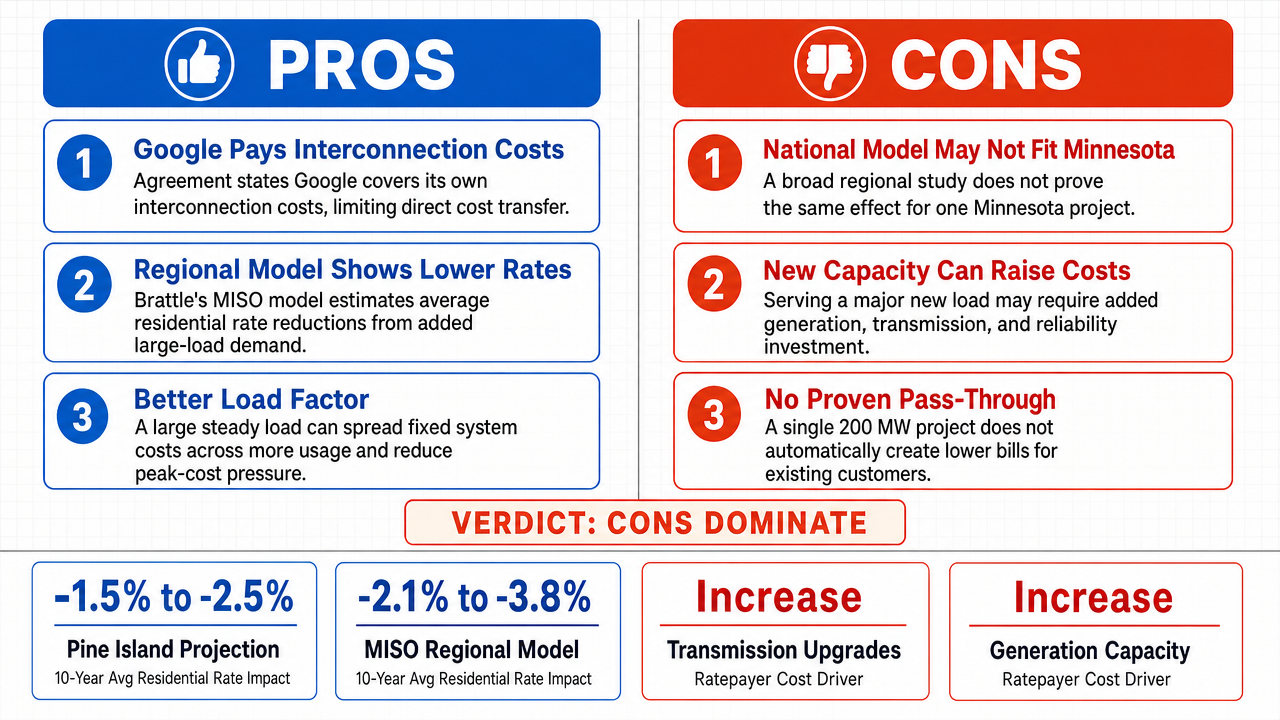
- ■In MPUC Docket No. E002/M-22-335, Google and Xcel Energy executed a 'Large Load Interconnection Agreement ' under which Google bears the full cost of approximately $600 million in grid upgrades and dedicated transmission infrastructure, avoiding socialization of these costs across the existing rate base .
- ■The 2024 Brattle Group study models the MISO region (which governs Minnesota) and reports in Figure 12 that adding a 200 MW data center with a 95% load factor reduces the system average cost of electricity by 2.1% to 3.8%, demonstrating the cost-reducing effect is robust at the regional level.
- ■Adding a large, flat baseload load to Xcel's peaked-load system improves the overall system load factor , which can reduce reliance on expensive peaking plants and lower the average cost of service for all customers.
❌ Key ANTI arguments:
- ■Applying a national aggregate Brattle Group study to predict a 2-4% rate reduction in Minnesota is a scale-invariance violation: a generalized national model cannot capture the unique localized infrastructure requirements, generation mix , and regulatory constraints of Xcel Energy's specific Minnesota service territory.
- ■Even if the system load factor improves, the capital required to build the capacity that supports the new large load is not automatically offset by load-factor gains; treating improvement of a ratio as an automatic driver of cost reduction ignores the significant capital expenditure needed to serve 200 MW of new demand.
- ■The market impact of a single 200 MW facility in a specific sub-region is fundamentally different from the national aggregate studied, so no transfer mechanism reliably links Brattle's national findings to Xcel Energy's actual Minnesota rate structure .
💭 Conclusion: False. The claim that Google's Pine Island project will lower rates for existing Xcel Energy customers in Minnesota is not adequately supported by the evidence presented. The affirmative's reliance on a national-scale Brattle Group study was correctly flagged by the negative as a scale-invariance error, since aggregate national findings cannot be mechanically transferred to Minnesota's specific regulatory and grid context. The negative further dismantled the causal link by pointing out that improving the system load factor ratio does not automatically translate into lower rates when substantial new capital investment is required to serve the added 200 MW load. While Google does appear to bear roughly $600 million in direct interconnection costs under the MPUC agreement, that figure addresses cost socialization rather than proving a net downward effect on retail rates. The judge's moderate 62% confidence reflects that this is a forward-looking projection about a regulated rate case, where the negative successfully cast reasonable doubt without conclusively proving rates will rise.
🔬 DeepResearch Result: likely FALSE ❌ (62%)
Assertion: Google's Pine Island data center project will ultimately lead to lower electricity rates for existing Xcel Energy customers in Minnesota.
Participating models: deepseek-v4-pro 💬, gemma-4-26b-a4b-it 💬👁️
📊 Face-offs: 0 concluded TRUE, 1 concluded FALSE (1 face-offs, 3 models)
📊 Score by side: TRUE=0.00, FALSE=0.62
🏅 Model score changes:
minimax-m3 💬👁️: +6
✅ PRO Arguments:
- ■In MPUC Docket No. E002/M-22-335, Google and Xcel Energy executed a 'Large Load Interconnection Agreement ' under which Google bears the full cost of approximately $600 million in grid upgrades and dedicated transmission infrastructure, avoiding socialization of these costs across the existing rate base . deepseek-v4-pro 💬
- ■The 2024 Brattle Group study models the MISO region (which governs Minnesota) and reports in Figure 12 that adding a 200 MW data center with a 95% load factor reduces the system average cost of electricity by 2.1% to 3.8%, demonstrating the cost-reducing effect is robust at the regional level. deepseek-v4-pro 💬
- ■Adding a large, flat baseload load to Xcel's peaked-load system improves the overall system load factor, which can reduce reliance on expensive peaking plants and lower the average cost of service for all customers. deepseek-v4-pro 💬
❌ ANTI Arguments:
- ■Applying a national aggregate Brattle Group study to predict a 2-4% rate reduction in Minnesota is a scale-invariance violation: a generalized national model cannot capture the unique localized infrastructure requirements, generation mix , and regulatory constraints of Xcel Energy's specific Minnesota service territory. gemma-4-26b-a4b-it 💬👁️
- ■Even if the system load factor improves, the capital required to build the capacity that supports the new large load is not automatically offset by load-factor gains; treating improvement of a ratio as an automatic driver of cost reduction ignores the significant capital expenditure needed to serve 200 MW of new demand. gemma-4-26b-a4b-it 💬👁️
- ■The market impact of a single 200 MW facility in a specific sub-region is fundamentally different from the national aggregate studied, so no transfer mechanism reliably links Brattle's national findings to Xcel Energy's actual Minnesota rate structure . gemma-4-26b-a4b-it 💬👁️
💭 Reasoning: False. The claim that Google's Pine Island project will lower rates for existing Xcel Energy customers in Minnesota is not adequately supported by the evidence presented. The affirmative's reliance on a national-scale Brattle Group study was correctly flagged by the negative as a scale-invariance error, since aggregate national findings cannot be mechanically transferred to Minnesota's specific regulatory and grid context. The negative further dismantled the causal link by pointing out that improving the system load factor ratio does not automatically translate into lower rates when substantial new capital investment is required to serve the added 200 MW load. While Google does appear to bear roughly $600 million in direct interconnection costs under the MPUC agreement, that figure addresses cost socialization rather than proving a net downward effect on retail rates. The judge's moderate 62% confidence reflects that this is a forward-looking projection about a regulated rate case, where the negative successfully cast reasonable doubt without conclusively proving rates will rise.
| Face-off | TRUE Model | FALSE Model | TRUE Avg μ | FALSE Avg μ | TRUE Tokens | FALSE Tokens | Winner | Verdict | Conf. |
|---|---|---|---|---|---|---|---|---|---|
| #1 | deepseek-v4-pro 💬 | gemma-4-26b-a4b-it 💬👁️ | 0.553 | 0.354 | 6 | 2 | TRUE | FALSE | 62% |
The following technical terms, abbreviations, and domain-specific concepts are referenced throughout this debate transcript. Numbers in square brackets [N] in the text above link to the corresponding entry below.
[1] baseload — A minimum level of constant, continuous demand on an electrical grid. In the debate, it is used to describe a flat, steady load (such as from a data center) added to a system with peaked demand.
[2] capital expenditure — CapEx — Funds used by a company to acquire, upgrade, or maintain physical infrastructure. In the debate, the affirmative argues that Google bears the capital expenditure for new grid upgrades rather than having it added to the rate base.
[3] congestion costs — Costs arising from constraints or bottlenecks in a transmission network. The negative argues that localized congestion costs differ between national aggregate models and a specific sub-region.
[4] docket — Docket No. E002/M-22-335 — A formal regulatory case file identifier used by a public utilities commission to track proceedings. The cited docket refers to a joint filing by Xcel Energy and Google regarding a Large Load Interconnection Agreement.
[5] eDockets — MPUC eDockets — The Minnesota Public Utilities Commission's electronic filing and case management system, used to store and access regulatory documents and proceedings.
[6] firm generation capacity — Reliable, dispatchable generating capacity available to meet demand at all times, often contrasted with intermittent resources. The negative argues that supporting a constant data center load may require new firm capacity at high unit cost.
[7] fixed costs — Costs that do not vary with the volume of electricity produced or delivered. The affirmative argues that spreading fixed costs over more kilowatt-hours lowers the per-unit delivery charge.
[8] generation mix — The combination of different types of power sources (e.g., fossil, nuclear, renewable) supplying a grid. The affirmative claims the Brattle study uses MISO's actual generation mix in its regional modeling.
[9] high-load-factor — high load factor — A descriptor for a load that operates at or near its maximum demand for a high proportion of time. The debate describes the data center as having a 95% load factor.
[10] identity of reference — A logical concept invoked by the negative, arguing that the affirmative cites evidence (a national study) whose referent does not match the specific claim being made (Xcel Energy's Minnesota rate structure).
[11] investable universe — The set of available investment opportunities or entities under consideration. The negative uses it to argue that the universe of relevant grid assets is not the same at a national scale as at a sub-regional scale.
[12] kilowatt-hours — kWh — A unit of energy representing one kilowatt of power sustained for one hour. The affirmative argues that more total kilowatt-hours spread over the grid will lower per-unit delivery charges.
[13] Large Load Interconnection Agreement — A contract under which a large new electricity customer (here, Google) funds the grid upgrades needed to interconnect to the utility's system. According to the affirmative, the agreement requires Google to bear the full cost of necessary grid upgrades.
[14] load factor — The ratio of actual energy used over a period to the maximum possible energy that would be used if demand were always at its peak. The affirmative argues that adding flat baseload improves system load factor and lowers average cost; the negative disputes the automatic cost-reduction effect.
[15] marginal efficiency gains — Small improvements in efficiency achieved at the margin of additional capacity. The negative argues these can be outweighed by the higher unit cost of newly required firm capacity.
[16] megawatts — MW — A unit of power equal to one million watts, used to measure the capacity of electricity demand or generation. The debate references a 200 MW data center facility.
[17] Midcontinent Independent System Operator — MISO — A regional transmission organization that operates the grid across a multi-state area including Minnesota. The affirmative argues the Brattle study's MISO-region results directly model Minnesota's grid conditions.
[18] Minnesota Public Utilities Commission — MPUC — The state regulatory body with jurisdiction over utility rates, service, and infrastructure approvals in Minnesota. The Pine Island project filings and the cited docket are made with the MPUC.
[19] non-intermittent loads — Electrical loads that draw power continuously and predictably, as opposed to intermittent resources like wind or solar. The negative notes that supporting such loads may require new firm generation.
[20] peaking plants — Power plants operated only during periods of highest demand, typically with higher operating costs. The affirmative argues that improved load factor reduces the need for expensive peaking plants.
[21] per-unit delivery charge — The component of a customer's electricity bill based on the cost of delivering each unit of energy. The affirmative contends the Pine Island project will exert downward pressure on this component of residential and small business bills.
[22] rate base — The total value of a utility's regulated assets on which it is permitted to earn a return. The affirmative argues that having Google fund upgrades directly keeps them out of the rate base and away from existing customers.
[23] rate structure — The schedule and methodology by which a utility sets and charges its customers for service. The negative argues that a national study cannot be transferred to Xcel Energy's specific Minnesota rate structure.
[24] scale invariance — The property that a relationship or result holds regardless of the scale at which it is applied. The negative argues the affirmative commits a 'textbook violation of scale invariance' by applying national-scale findings to a sub-regional system.
[25] socializing costs — Spreading the cost of infrastructure or service across all ratepayers rather than assigning it to the specific user. The affirmative argues the Large Load Interconnection Agreement avoids socializing the cost of grid upgrades.
[26] system average cost — The total cost of providing electricity divided by total electricity delivered. The affirmative cites a Brattle study figure that a 200 MW high-load-factor data center reduces this metric in the MISO region by 2.1% to 3.8%.
[27] transmission topology — The physical and operational configuration of a grid's transmission network. The affirmative argues the Brattle study uses MISO's actual transmission topology, making its regional results directly applicable to Minnesota.
[28] unit cost — The cost per unit of electricity produced or delivered. The negative argues that the unit cost of newly required firm capacity can exceed the existing system average, potentially raising total system cost.
The following financial data tables were referenced during the debate exchanges:
| Cost Driver | Impact on Ratepayers | Mechanism |
|---|---|---|
| Transmission Upgrades | Increase | Infrastructure reinforcement for high-density loads |
| Generation Capacity | Increase | Need for firm, non-intermittent base-load power |
| Grid Reliability Services | Increase | Management of high-load factor stability |
| Load Factor Efficiency | Decrease | Amortization of fixed costs over higher throughput |
Legend: Qualitative assessment of cost drivers for existing ratepayers following large-scale data center integration.
| Scenario | Residential Rate Impact (10-Year Avg) | Source |
|---|---|---|
| Pine Island Project (Xcel Projection) | -1.5% to -2.5% | Xcel Direct Testimony, Schedule J-1 |
| MISO Regional Model (Brattle) | -2.1% to -3.8% | Brattle 2024, Figure 12 |
Legend: Projected residential electricity rate changes from the Pine Island data center project, comparing Xcel Energy's Minnesota-specific filing with the Brattle Group's MISO regional model. Negative values indicate rate reductions. Sources: Xcel Energy MPUC Docket E002/M-22-335; Brattle Group 2024.
Face-off transcripts
- ■
Ownership & Trade Secrets. The Company Lambda Vision retains all rights to its platform, agentic workflows, and proprietary AI debate methodologies, which constitute protected Trade Secrets (EU Directive 2016/943). Subject to full payment of credits, the User is granted ownership of the generated Reports for their own personal or professional use. Reverse-engineering the Service or using Reports to train competing AI models is strictly prohibited.
- ■
No Professional Advice. Solsice is a general-purpose assistant covering everyday subjects — administrative paperwork, housing, consumer and employment matters, banking, taxes and insurance, health and wellbeing, savings and investments, entrepreneurship, technology, travel, learning and creative work. Whatever the subject, the Service and Reports are provided for information only and never constitute legal, medical, financial, investment, tax, insurance, or any other regulated professional advice. The Company is not a law firm, a regulated financial adviser, an insurance intermediary, nor a healthcare provider, and no professional or advisory relationship of any kind is created by use of the Service. Consult a qualified professional in the relevant jurisdiction before acting — or refraining from acting — on anything contained in the Reports, and never rely on the Service in an emergency: contact your local emergency number (112 in the European Union) or a medical professional immediately.
- ■
AI-Generated Content, Sources and Viewpoints. Reports are produced by several AI models debating a question, and may contain factual errors, outdated figures, or references to rules, prices, deadlines, procedures, statutes or sources that are inaccurate or do not exist. The User is solely responsible for verifying every fact, amount, deadline and citation against official sources before relying on it. Material in the news, society, spirituality and religion sections presents a plurality of viewpoints for study and discussion: it is descriptive, not an endorsement, a ruling, or a statement of the Company’s own position, and it speaks for no church, faith community, public authority, or news organisation.
- ■
Liability & Governing Law. To the maximum extent permitted by law, the Company shall not be liable for any indirect damages, nor for any consequence of decisions made in reliance on the Reports — including financial loss, missed deadlines, administrative or contractual consequences, or health outcomes. These Terms are governed by French law. Any disputes shall be subject to the exclusive jurisdiction of the Courts of Paris, France.