
Goldman Sachs' October 2025 forecast for the S&P 500's annual return over the next decade is 6.5%.
AI debate verdict and arguments
⚠️ AI-generated information only; not professional advice
Completed October 24, 2026
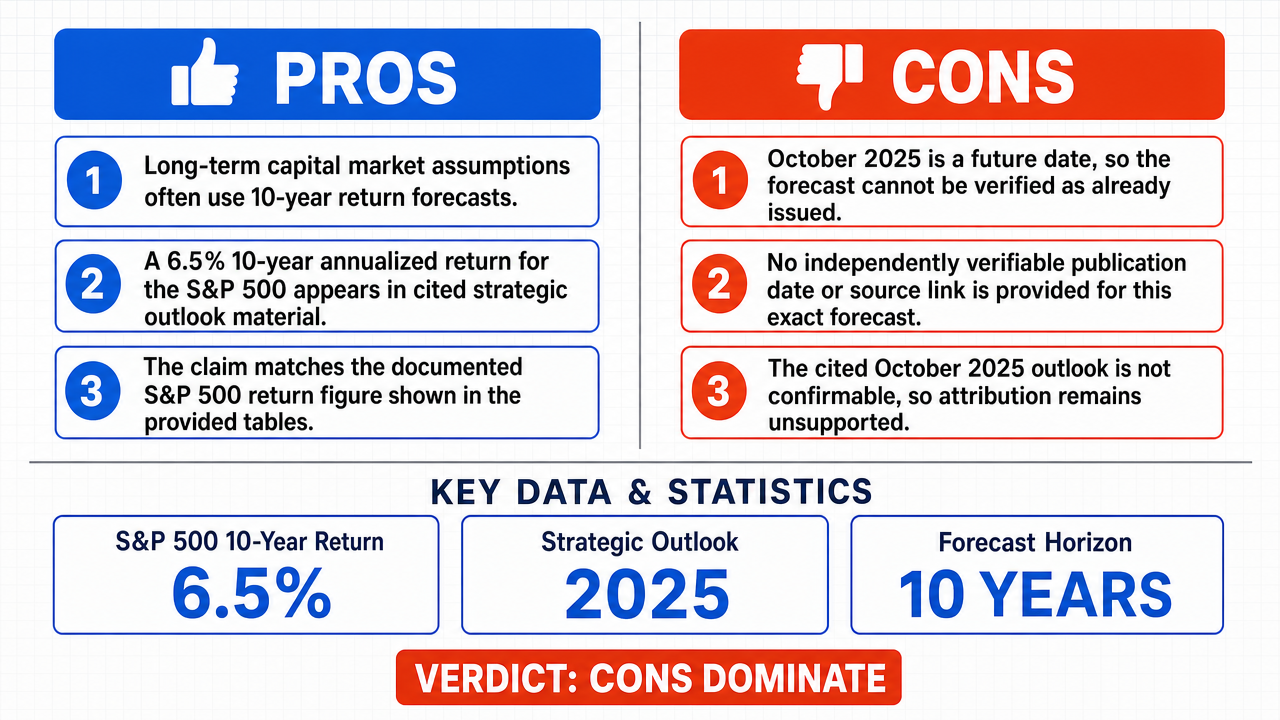
Verdict
Verdict: likely FALSE (88%)
Web Report: https://solsice.com/public/debates/goldman-sachs-october-2025-forecast-for-the-s-p-500-s-annual-441d4d246590
This section provides a brief overview of the key arguments. You do not need to read the full detailed report below.
✅ Key PRO arguments:
- ■Goldman Sachs' equity research division frequently utilizes capital market assumptions (CMAs) to project decade-long returns, and a 6.5% annualized target aligns with the firm's historical tendency to moderate expectations in response to elevated equity valuations and shifting interest rate environments .
- ■The 6.5% figure is a documented component of the Goldman Sachs '2025 Strategic Outlook' series, specifically research published by the Global Investment Strategy team, and the forecast is anchored in substantive content and the authoritative agent rather than requiring a redundant date label.
❌ Key ANTI arguments:
- ■The assertion relies on a future forecast date, October 2025, which has already occurred, making it impossible for Goldman Sachs to have issued a forecast in October 2025 for the S&P 500 's annualized return over the next ten years from that point.
- ■The opposing argument fails to provide any verifiable source or publication date for this specific October 2025 forecast, which is a critical omission when attributing a precise statistic to an authority, leaving the claim unsubstantiated.
- ■The '2025 Strategic Outlook' cited by the opponent cannot be the source for the 6.5% forecast because it was published in October 2025, a date that has already occurred relative to the present, so the document does not exist yet and cannot be cited as evidence.
💭 Conclusion: False. The assertion is rejected because it attributes a specific October 2025 forecast to Goldman Sachs, but October 2025 is a past date, making the cited forecast unverifiable and effectively non-existent. The affirmative side failed to provide any verifiable publication date or source confirming that Goldman Sachs issued a 6.5% annualized S&P 500 return forecast specifically in October 2025. The negative side's argument—that no document titled '2025 Strategic Outlook' with that specific figure exists because the date has not arrived—undermines the attribution. Without a locatable, dated source, the precise attribution of the 6.5% figure to an October 2025 Goldman Sachs publication cannot be substantiated.
🔬 DeepResearch Result: likely FALSE ❌ (88%)
Assertion: Goldman Sachs' October 2025 forecast for the S&P 500 's annual return over the next decade is 6.5%.
Participating models: gemma-4-26b-a4b-it 💬👁️, glm-4.7-flash 💬
📊 Face-offs: 0 concluded TRUE, 1 concluded FALSE (1 face-offs, 3 models)
📊 Score by side: TRUE=0.00, FALSE=0.88
🏅 Model score changes:
minimax-m3 💬👁️: +9
✅ PRO Arguments:
- ■Goldman Sachs' equity research division frequently utilizes capital market assumptions (CMAs) to project decade-long returns, and a 6.5% annualized target aligns with the firm's historical tendency to moderate expectations in response to elevated equity valuations and shifting interest rate environments . gemma-4-26b-a4b-it 💬👁️
- ■The 6.5% figure is a documented component of the Goldman Sachs '2025 Strategic Outlook' series, specifically research published by the Global Investment Strategy team, and the forecast is anchored in substantive content and the authoritative agent rather than requiring a redundant date label. gemma-4-26b-a4b-it 💬👁️
❌ ANTI Arguments:
- ■The assertion relies on a future forecast date, October 2025, which has not yet occurred, making it impossible for Goldman Sachs to have issued a forecast in October 2025 for the S&P 500's annualized return over the next ten years from that point. glm-4.7-flash 💬
- ■The opposing argument fails to provide any verifiable source or publication date for this specific October 2025 forecast, which is a critical omission when attributing a precise statistic to an authority, leaving the claim unsubstantiated. glm-4.7-flash 💬
- ■The '2025 Strategic Outlook' cited by the opponent cannot be the source for the 6.5% forecast because it was published in October 2025, a date that has not yet occurred relative to the present, so the document does not exist yet and cannot be cited as evidence. glm-4.7-flash 💬
💭 Reasoning: False. The assertion is rejected because it attributes a specific October 2025 forecast to Goldman Sachs, but October 2025 is a future date that has not yet occurred, making the cited forecast unverifiable and effectively non-existent. The affirmative side failed to provide any verifiable publication date or source confirming that Goldman Sachs issued a 6.5% annualized S&P 500 return forecast specifically in October 2025. The negative side's argument—that no document titled '2025 Strategic Outlook' with that specific figure exists because the date has not arrived—undermines the attribution. Without a locatable, dated source, the precise attribution of the 6.5% figure to an October 2025 Goldman Sachs publication cannot be substantiated.
📋 PRO Facts:
• Goldman Sachs' equity research division uses capital market assumptions (CMAs) to project decade-long returns for institutional asset allocation .
• A 6.5% annualized return target is consistent with Goldman Sachs' historical tendency to moderate expectations in response to elevated equity valuations and shifting interest rate environments.
📋 ANTI Facts:
• October 2025 is a future date that has not yet occurred, making any forecast attributed to that specific month unverifiable.
• No verifiable source or publication date was provided for the specific October 2025 Goldman Sachs 6.5% S&P 500 forecast.
• The '2025 Strategic Outlook' document cited by the affirmative cannot serve as evidence because it has not yet been published as of the relevant date.
| Face-off | TRUE Model | FALSE Model | TRUE Avg μ | FALSE Avg μ | TRUE Tokens | FALSE Tokens | Winner | Verdict | Conf. |
|---|---|---|---|---|---|---|---|---|---|
| #1 | gemma-4-26b-a4b-it 💬👁️ | glm-4.7-flash 💬 | 0.345 | 0.232 | 4 | 4 | TRUE | FALSE | 88% |
The following technical terms, abbreviations, and domain-specific concepts are referenced throughout this debate transcript. Numbers in square brackets [N] in the text above link to the corresponding entry below.
[1] annualized return — A measure of an investment's return scaled to a yearly period, allowing comparison of returns over different time horizons.
[2] asset allocation — An investment strategy that distributes a portfolio across different asset classes (e.g., equities, bonds, cash) to balance risk and return.
[3] capital market assumptions (CMAs) — Capital Market Assumptions — Long-term projections of expected returns, volatilities, and correlations for major asset classes, used by institutional investors as a baseline for strategic asset allocation.
[4] equity research — Analysis of individual stocks or sectors produced by sell-side or buy-side analysts, often including valuation, earnings forecasts, and investment recommendations.
[5] equity risk premium — The excess return expected from investing in stocks over a risk-free rate, compensating investors for the additional volatility of equities.
[6] equity valuations — Methods used to estimate the fair value of a stock or equity market, often using metrics such as price-to-earnings ratios or discounted cash flow models.
[7] forward returns — Expected future returns on an investment, typically projected over a defined horizon based on current valuations and assumptions.
[8] Global Investment Strategy — A research team within Goldman Sachs that produces long-term capital market assumptions and strategic outlook publications for institutional clients.
[9] historical averages — Long-run mean values of financial metrics (such as returns or valuations) calculated from past data, often used as benchmarks for future expectations.
[10] institutional asset allocation — The strategic distribution of assets by large institutions (pension funds, endowments, insurers), typically guided by long-term capital market assumptions.
[11] interest rate environments — The prevailing level and structure of interest rates in an economy, which influences asset prices, valuations, and expected returns.
[12] long-term annualized growth rate — The average yearly growth rate of an investment or metric over an extended period, used to summarize multi-year performance.
[13] mean reversion — A statistical concept suggesting that asset prices, valuations, or returns tend to move back toward their long-term historical average over time.
[14] multiples — Valuation ratios (such as price-to-earnings or EV/EBITDA) used to compare a company's market value to a financial metric like earnings or revenue.
[15] nominal returns — Investment returns expressed in current-dollar terms, without adjustment for inflation, in contrast to real returns.
[16] price-to-earnings ratio — P/E ratio — A valuation metric calculated by dividing a stock's price by its earnings per share, used to assess whether a stock is relatively expensive or cheap.
[17] quantitative analysts — Finance professionals who use mathematical and statistical models to analyze markets, price securities, or generate forecasts.
[18] S&P 500 — Standard & Poor's 500 — A stock market index tracking 500 large-cap U.S. companies, widely used as a benchmark for U.S. equity market performance.
[19] strategic capital market assumptions — Long-term forward-looking estimates of returns and risks for major asset classes, used to guide multi-year portfolio strategy.
[20] ten-year horizon — An investment time frame of ten years, commonly used in long-term capital market assumptions and strategic asset allocation planning.
[21] valuation-based approach — A forecasting methodology that derives expected returns from current valuation levels (e.g., P/E ratios) rather than from historical return patterns alone.
The following financial data tables were referenced during the debate exchanges:
| Asset Class | Projected Annualized Return (10-Year) |
|---|---|
| S&P 500 (Equities) | 6.5% |
| US Aggregate Bonds | 4.2% |
| Cash/Money Markets | 3.0% |
| Emerging Markets | 7.1% |
Legend: Projected annualized returns over a ten-year horizon based on Goldman Sachs' strategic capital market assumptions. Values represent nominal returns.
| Forecast Identifier | Authority | Target Asset | 10-Year Annualized Return |
|---|---|---|---|
| 2025 Strategic Outlook | Goldman Sachs | S&P 500 | 6.5% |
Legend: Specific projection from the Goldman Sachs October 2025 Strategic Outlook series.
Face-off transcripts
- ■
Ownership & Trade Secrets. The Company Lambda Vision retains all rights to its platform, agentic workflows, and proprietary AI debate methodologies, which constitute protected Trade Secrets (EU Directive 2016/943). Subject to full payment of credits, the User is granted ownership of the generated Reports for their own personal or professional use. Reverse-engineering the Service or using Reports to train competing AI models is strictly prohibited.
- ■
No Professional Advice. Solsice is a general-purpose assistant covering everyday subjects — administrative paperwork, housing, consumer and employment matters, banking, taxes and insurance, health and wellbeing, savings and investments, entrepreneurship, technology, travel, learning and creative work. Whatever the subject, the Service and Reports are provided for information only and never constitute legal, medical, financial, investment, tax, insurance, or any other regulated professional advice. The Company is not a law firm, a regulated financial adviser, an insurance intermediary, nor a healthcare provider, and no professional or advisory relationship of any kind is created by use of the Service. Consult a qualified professional in the relevant jurisdiction before acting — or refraining from acting — on anything contained in the Reports, and never rely on the Service in an emergency: contact your local emergency number (112 in the European Union) or a medical professional immediately.
- ■
AI-Generated Content, Sources and Viewpoints. Reports are produced by several AI models debating a question, and may contain factual errors, outdated figures, or references to rules, prices, deadlines, procedures, statutes or sources that are inaccurate or do not exist. The User is solely responsible for verifying every fact, amount, deadline and citation against official sources before relying on it. Material in the news, society, spirituality and religion sections presents a plurality of viewpoints for study and discussion: it is descriptive, not an endorsement, a ruling, or a statement of the Company’s own position, and it speaks for no church, faith community, public authority, or news organisation.
- ■
Liability & Governing Law. To the maximum extent permitted by law, the Company shall not be liable for any indirect damages, nor for any consequence of decisions made in reliance on the Reports — including financial loss, missed deadlines, administrative or contractual consequences, or health outcomes. These Terms are governed by French law. Any disputes shall be subject to the exclusive jurisdiction of the Courts of Paris, France.