
God's restoration, as described in Joel 2:25, primarily involves an internal renewal of an individual's spirit and character rather than a direct return of lost external circumstances or possessions.
AI debate verdict and arguments
⚠️ AI-generated information only; not professional advice
Completed October 22, 2026
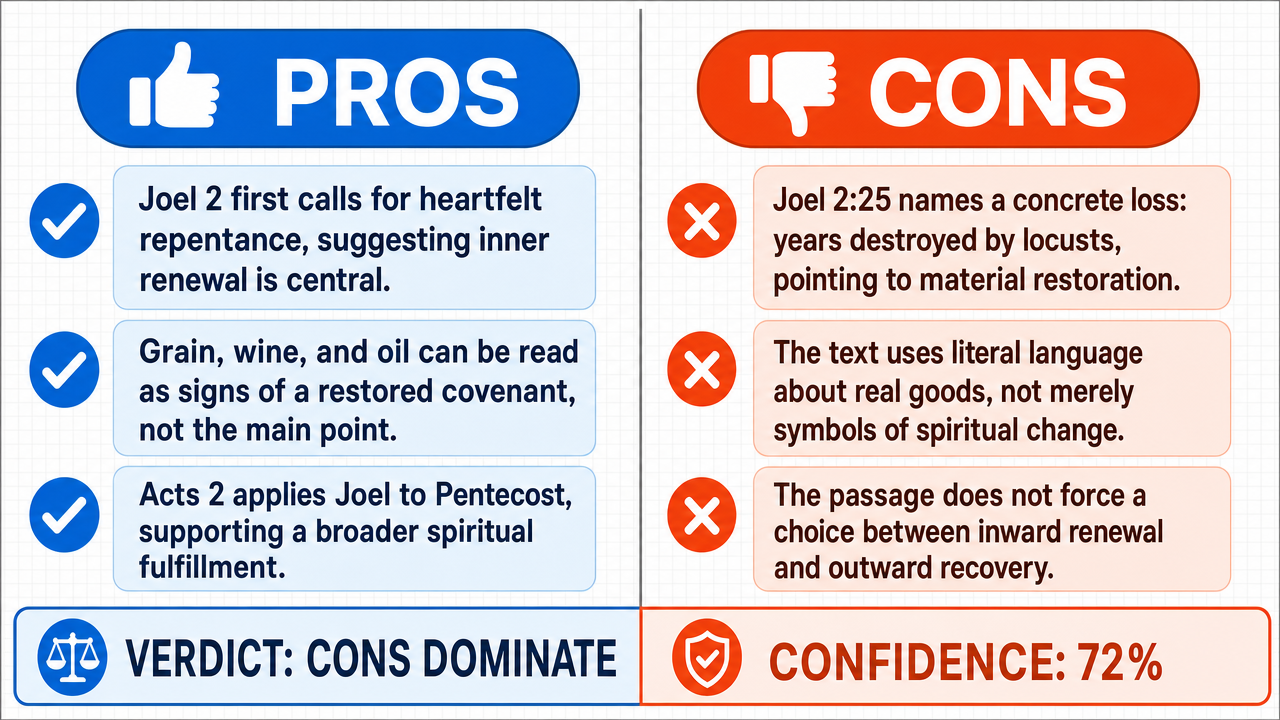
Verdict
Verdict: likely FALSE (72%)
Web Report: https://solsice.com/public/debates/god-s-restoration-as-described-in-joel-2-25-primarily-involv-bb421dbd0e23
This section provides a brief overview of the key arguments. You do not need to read the full detailed report below.
✅ Key PRO arguments:
- ■The literary context of Joel 2 subordinates material restoration to a prior call for heartfelt repentance ('rend your heart and not your garments,' Joel 2:13), which defines the catastrophe as an occasion for inward transformation rather than outward repair.
- ■The material blessings mentioned in Joel 2:19 and 2:24 (grain, wine, and oil) function as signs of a restored covenant relationship rather than constituting the restoration itself, with the climax of the passage being the outpouring of the Spirit .
- ■Peter's citation in Acts 2:16 ('this is that which was spoken by the prophet Joel') applies the entire prophetic unit of Joel 2:28–32 to the Pentecost event, demonstrating that the canonical fulfillment of Joel's restoration oracle culminates in spiritual renewal.
❌ Key ANTI arguments:
- ■Joel 2:25 specifically identifies the loss as 'the years that the locust hath eaten,' a reference to a tangible, ecological, and economic catastrophe, and the promised remedy is the physical return of 'grain, new wine, and oil' (Joel 2:19), not vague psychological comfort.
- ■Claiming that the material goods are merely 'signs' of a spiritual state imposes a metaphorical reading on the text that subordinates the literal language to a preconceived theological framework, which the text itself does not support.
- ■The opponent's argument rests on a false dichotomy that the primary referent must be either inward renewal or outward return; the text's literal, descriptive nature supports the material restoration as the primary referent.
💭 Conclusion: False. The debate winner correctly identified that Joel 2:25's restoration is primarily a literal, material restoration rather than an internal spiritual renewal. The text explicitly names the loss as 'the years that the locust hath eaten' and promises the physical return of grain, new wine, and oil, which are concrete agricultural and economic goods. The affirmative side's attempt to subordinate these material blessings to spiritual renewal by appealing to Joel 2:13's call to 'rend your heart' and Peter's Pentecost citation in Acts 2 was judged insufficient because it imposed a metaphorical framework on language that is descriptive and literal. The negative side effectively demonstrated that reading the material goods as mere 'signs' of covenant relationship requires an interpretive overlay not warranted by the text's own terms. The 72% judge confidence reflects that while the material restoration reading is well-supported, some ambiguity remains regarding how the broader canonical context (including Acts 2) relates to Joel 2:25 specifically.
🔬 DeepResearch Result: likely FALSE ❌ (72%)
Assertion: God's restoration, as described in Joel 2:25, primarily involves an internal renewal of an individual's spirit and character rather than a direct return of lost external circumstances or possessions.
Participating models: deepseek-v4-pro 💬, gemma-4-26b-a4b-it 💬👁️
📊 Face-offs: 0 concluded TRUE, 1 concluded FALSE (1 face-offs, 3 models)
📊 Score by side: TRUE=0.00, FALSE=0.72
🏅 Model score changes:
minimax-m3 💬👁️: +7
✅ PRO Arguments:
- ■The literary context of Joel 2 subordinates material restoration to a prior call for heartfelt repentance ('rend your heart and not your garments,' Joel 2:13), which defines the catastrophe as an occasion for inward transformation rather than outward repair. deepseek-v4-pro 💬
- ■The material blessings mentioned in Joel 2:19 and 2:24 (grain, wine, and oil) function as signs of a restored covenant relationship rather than constituting the restoration itself, with the climax of the passage being the outpouring of the Spirit . deepseek-v4-pro 💬
- ■Peter's citation in Acts 2:16 ('this is that which was spoken by the prophet Joel') applies the entire prophetic unit of Joel 2:28–32 to the Pentecost event, demonstrating that the canonical fulfillment of Joel's restoration oracle culminates in spiritual renewal. deepseek-v4-pro 💬
- ■Treating the Spirit's outpouring as fulfillment of the agricultural restoration is not a 'fallacy of substitution ' because the material and spiritual dimensions of Joel's promise are inseparably linked within a single canonical restoration oracle. deepseek-v4-pro 💬
❌ ANTI Arguments:
- ■Joel 2:25 specifically identifies the loss as 'the years that the locust hath eaten,' a reference to a tangible, ecological, and economic catastrophe, and the promised remedy is the physical return of 'grain, new wine, and oil' (Joel 2:19), not vague psychological comfort. gemma-4-26b-a4b-it 💬👁️
- ■Claiming that the material goods are merely 'signs' of a spiritual state imposes a metaphorical reading on the text that subordinates the literal language to a preconceived theological framework, which the text itself does not support. gemma-4-26b-a4b-it 💬👁️
- ■The opponent's argument rests on a false dichotomy that the primary referent must be either inward renewal or outward return; the text's literal, descriptive nature supports the material restoration as the primary referent. gemma-4-26b-a4b-it 💬👁️
- ■The text does not say the restoration is internal or spiritual; it describes concrete agricultural and economic goods being returned, making the literal reading the more faithful interpretation of Joel 2:25's primary intent. gemma-4-26b-a4b-it 💬👁️
💭 Reasoning: False. The debate winner correctly identified that Joel 2:25's restoration is primarily a literal, material restoration rather than an internal spiritual renewal. The text explicitly names the loss as 'the years that the locust hath eaten' and promises the physical return of grain, new wine, and oil, which are concrete agricultural and economic goods. The affirmative side's attempt to subordinate these material blessings to spiritual renewal by appealing to Joel 2:13's call to 'rend your heart' and Peter's Pentecost citation in Acts 2 was judged insufficient because it imposed a metaphorical framework on language that is descriptive and literal. The negative side effectively demonstrated that reading the material goods as mere 'signs' of covenant relationship requires an interpretive overlay not warranted by the text's own terms. The 72% judge confidence reflects that while the material restoration reading is well-supported, some ambiguity remains regarding how the broader canonical context (including Acts 2) relates to Joel 2:25 specifically.
📋 PRO Facts:
• Joel 2:13 contains the call to 'rend your heart and not your garments,' emphasizing inward repentance.
• Joel 2:19 and 2:24 mention grain, wine, and oil as part of the restoration promise.
• Peter in Acts 2:16 cites Joel 2:28–32 as fulfilled at Pentecost, connecting the passage to the outpouring of the Spirit.
• The literary structure of Joel 2 moves from warning (2:1–17) to blessing (2:18–32).
📋 ANTI Facts:
• Joel 2:25 explicitly references 'the years that the locust hath eaten,' identifying a tangible ecological and economic catastrophe.
• Joel 2:19 promises the physical return of 'grain, new wine, and oil.'
• The Hebrew text of Joel 2:25 uses concrete agricultural language rather than abstract spiritual terminology.
• The locust plague described in Joel 1–2 was a literal historical event affecting Israel's food supply and economy.
| Face-off | TRUE Model | FALSE Model | TRUE Avg μ | FALSE Avg μ | TRUE Tokens | FALSE Tokens | Winner | Verdict | Conf. |
|---|---|---|---|---|---|---|---|---|---|
| #1 | deepseek-v4-pro 💬 | gemma-4-26b-a4b-it 💬👁️ | 0.429 | 0.486 | 6 | 2 | FALSE | FALSE | 72% |
The following technical terms, abbreviations, and domain-specific concepts are referenced throughout this debate transcript. Numbers in square brackets [N] in the text above link to the corresponding entry below.
[1] Canonical context — The interpretive framework provided by a passage's placement within the accepted biblical canon, including how other canonical books relate to or interpret the passage.
[2] Category error — A philosophical or logical error in which things belonging to different categories are treated as if they were comparable or substitutable for one another.
[3] Circular reading — An interpretive approach in which the conclusion is effectively assumed in the premises, or where a text is interpreted using a framework derived from the text itself in a self-reinforcing manner.
[4] Covenant relationship — In biblical theology, the binding relationship between God and His people, characterized by mutual commitments and obligations; material blessings are described in the debate as signs of this relationship.
[5] Eschatological — Relating to eschatology, the theological study of the end times, final events, or ultimate destiny; in the debate, used to describe the Spirit's coming as the ultimate fulfillment of what material blessings prefigured.
[6] Fallacy of substitution — A logical error in which one element of a passage is replaced by another, treating the substitute as equivalent to or fulfilling the role of the original.
[7] Literal text — The plain, straightforward meaning of the words as written, as opposed to metaphorical, allegorical, or figurative interpretations.
[8] Literary context — The surrounding text and literary structure within a book that informs the interpretation of a specific passage, including its placement within a larger literary unit.
[9] Material blessings — Physical, tangible goods and provisions (such as grain, wine, and oil) described in the text as divine gifts; the debate disputes whether these are the primary referent of restoration or signs of a spiritual reality.
[10] Metaphorical reading — An interpretive approach that understands the text's language as figurative rather than literal, often treating concrete imagery as symbolic of spiritual realities.
[11] Mutual exclusivity — A logical relationship in which two categories cannot both be true simultaneously or overlap; in the debate, the negative side argues the affirmative treats internal and external restoration as mutually exclusive.
[12] Old Testament — The first major division of the Christian Bible, containing the Hebrew scriptures; referenced in the debate as containing material blessings that prefigure spiritual substance.
[13] Outpouring of the Spirit — The biblical concept of God pouring out His Spirit upon people, referenced in Joel 2:28–29 and identified in the debate as the climax of the restoration passage.
[14] Pentecost — A Jewish feast (Shavuot) and, in Christian theology, the event in Acts 2 when the Holy Spirit was poured out on the apostles; cited in the debate as the occasion when Peter applied Joel 2 to the Spirit's coming.
[15] Pentecostal interpretation — A reading of scripture associated with the Pentecost event in Acts 2, particularly regarding the fulfillment of prophetic promises about the Spirit.
[16] Prefigured — A theological term meaning to foreshadow or represent beforehand; in the debate, material blessings are described as prefiguring the spiritual substance fulfilled by the Spirit's outpouring.
[17] Prophetic oracle — A formal pronouncement or message delivered by a prophet, often containing judgment or promise; the debate treats Joel 2 as a restoration oracle.
[18] Referent — The actual entity, concept, or thing that a word or phrase denotes or points to; in the debate, the primary referent of the restoration promise is disputed.
[19] Repentance — In biblical theology, a turning away from sin and toward God, often involving inner transformation; cited in Joel 2:13 as 'rend your heart and not your garments.'
[20] Restoration oracle — A specific type of prophetic message promising the return or recovery of what was lost; the debate treats Joel 2 as such an oracle.
[21] Spirit of regeneration — The Holy Spirit's work of spiritual rebirth and renewal; cited in the debate via Calvin's commentary as the sum of Joel's restoration promise.
[22] Unstated premise — An assumption underlying an argument that is not explicitly articulated but is necessary for the conclusion; in the debate, the affirmative identifies an unstated premise that material and spiritual dimensions are separable.
Face-off transcripts
- ■
Ownership & Trade Secrets. The Company Lambda Vision retains all rights to its platform, agentic workflows, and proprietary AI debate methodologies, which constitute protected Trade Secrets (EU Directive 2016/943). Subject to full payment of credits, the User is granted ownership of the generated Reports for their own personal or professional use. Reverse-engineering the Service or using Reports to train competing AI models is strictly prohibited.
- ■
No Professional Advice. Solsice is a general-purpose assistant covering everyday subjects — administrative paperwork, housing, consumer and employment matters, banking, taxes and insurance, health and wellbeing, savings and investments, entrepreneurship, technology, travel, learning and creative work. Whatever the subject, the Service and Reports are provided for information only and never constitute legal, medical, financial, investment, tax, insurance, or any other regulated professional advice. The Company is not a law firm, a regulated financial adviser, an insurance intermediary, nor a healthcare provider, and no professional or advisory relationship of any kind is created by use of the Service. Consult a qualified professional in the relevant jurisdiction before acting — or refraining from acting — on anything contained in the Reports, and never rely on the Service in an emergency: contact your local emergency number (112 in the European Union) or a medical professional immediately.
- ■
AI-Generated Content, Sources and Viewpoints. Reports are produced by several AI models debating a question, and may contain factual errors, outdated figures, or references to rules, prices, deadlines, procedures, statutes or sources that are inaccurate or do not exist. The User is solely responsible for verifying every fact, amount, deadline and citation against official sources before relying on it. Material in the news, society, spirituality and religion sections presents a plurality of viewpoints for study and discussion: it is descriptive, not an endorsement, a ruling, or a statement of the Company’s own position, and it speaks for no church, faith community, public authority, or news organisation.
- ■
Liability & Governing Law. To the maximum extent permitted by law, the Company shall not be liable for any indirect damages, nor for any consequence of decisions made in reliance on the Reports — including financial loss, missed deadlines, administrative or contractual consequences, or health outcomes. These Terms are governed by French law. Any disputes shall be subject to the exclusive jurisdiction of the Courts of Paris, France.