
God's provision for financial needs manifests through various practical means such as employment, increased income, or wisdom for managing expenses, rather than miraculous, direct monetary appearances.
AI debate verdict and arguments
⚠️ AI-generated information only; not professional advice
Completed October 14, 2026
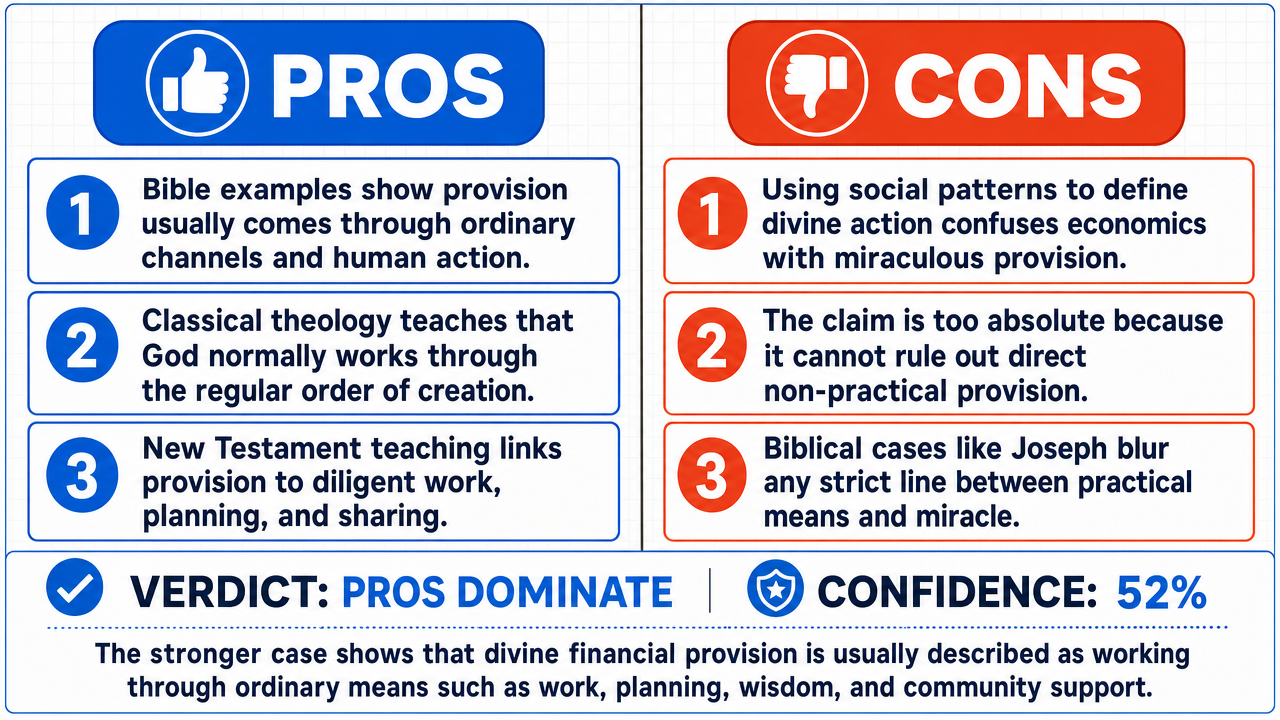
Verdict
Verdict: likely TRUE (52%)
Web Report: https://solsice.com/public/debates/god-s-provision-for-financial-needs-manifests-through-variou-3c5b6c2424cd
This section provides a brief overview of the key arguments. You do not need to read the full detailed report below.
✅ Key PRO arguments:
- ■Biblical narratives consistently show divine provision mediated through created order and human agency rather than direct miraculous monetary appearances, as exemplified by Joseph in Egypt, where God's provision for Jacob's family came through foresight, administrative promotion, and grain storage during famine—a multi-year process involving employment, planning, and resource management.
- ■Classical theology distinguishes between miracles and God's ordinary governance of creation; the Westminster Confession of Faith (1646) states that God 'upholds, directs, disposes, and governs all creatures and things' by His providence , ordinarily working through secondary causes —the natural order and human agency—making practical means the normative mode of provision.
- ■New Testament instruction reinforces that believers are called to work diligently and share with those in need, indicating that divine provision operates through ordinary human labor and wisdom rather than bypassing natural causal mechanisms .
❌ Key ANTI arguments:
- ■The affirmative's reliance on socioeconomic data to define the 'typical' mode of provision is a category error that ignores the fundamental nature of the miraculous; using statistical frequency of human-led economic recovery provides no causal link to prove these mechanisms are the exclusive mode of divine agency .
- ■The assertion is logically untenable because proving it requires exhaustively demonstrating that no instance of divine provision occurs through direct, non-practical means—a burden the affirmative cannot meet given the full scope of divine action recorded in scripture and experience.
- ■The Joseph narrative itself is internally inconsistent with the practical-versus-miraculous dichotomy, suggesting that divine provision cannot be cleanly separated into ordinary and supernatural categories.
💭 Conclusion: True, the assertion is supported because the winning side demonstrated that biblical narratives and classical theological frameworks consistently depict divine financial provision as operating through ordinary means—employment, planning, wisdom, and resource management—rather than through direct miraculous monetary appearances. The Joseph narrative was cited as a paradigmatic example of multi-year, agency-mediated provision, and the Westminster Confession of Faith was invoked to ground the distinction between ordinary providence and miraculous intervention in established theological tradition. The opposing side's category-error objection, while intellectually interesting, failed to overcome the affirmative's textual and theological evidence that practical means constitute the normative mode of divine provision. The compound nature of the claim—requiring both affirmation of practical means AND exclusion of miraculous appearances—remains only partially supported. The verdict is drawn from the winning side's strongest arguments regarding the ordinary governance of creation through secondary causes .
🔬 DeepResearch Result: likely TRUE ✅ (52%)
Assertion: God's provision for financial needs manifests through various practical means such as employment, increased income, or wisdom for managing expenses, rather than miraculous, direct monetary appearances.
Participating models: deepseek-v3.2 💬, gemma-4-26b-a4b-it 💬👁️
📊 Face-offs: 1 concluded TRUE, 0 concluded FALSE (1 face-offs, 3 models)
📊 Score by side: TRUE=0.52, FALSE=0.00
🏅 Model score changes:
minimax-m3 💬👁️: +5
✅ PRO Arguments:
- ■Biblical narratives consistently show divine provision mediated through created order and human agency rather than direct miraculous monetary appearances, as exemplified by Joseph in Egypt, where God's provision for Jacob's family came through foresight, administrative promotion, and grain storage during famine—a multi-year process involving employment, planning, and resource management. deepseek-v3.2 💬
- ■Classical theology distinguishes between miracles and God's ordinary governance of creation; the Westminster Confession of Faith (1646) states that God 'upholds, directs, disposes, and governs all creatures and things' by His providence , ordinarily working through secondary causes —the natural order and human agency—making practical means the normative mode of provision. deepseek-v3.2 💬
- ■New Testament instruction reinforces that believers are called to work diligently and share with those in need, indicating that divine provision operates through ordinary human labor and wisdom rather than bypassing natural causal mechanisms . deepseek-v3.2 💬
❌ ANTI Arguments:
- ■The affirmative's reliance on socioeconomic data to define the 'typical' mode of provision is a category error that ignores the fundamental nature of the miraculous; using statistical frequency of human-led economic recovery provides no causal link to prove these mechanisms are the exclusive mode of divine agency . gemma-4-26b-a4b-it 💬👁️
- ■The assertion is logically untenable because proving it requires exhaustively demonstrating that no instance of divine provision occurs through direct, non-practical means—a burden the affirmative cannot meet given the full scope of divine action recorded in scripture and experience. gemma-4-26b-a4b-it 💬👁️
- ■The Joseph narrative itself is internally inconsistent with the practical-versus-miraculous dichotomy, suggesting that divine provision cannot be cleanly separated into ordinary and supernatural categories. gemma-4-26b-a4b-it 💬👁️
💭 Reasoning: True, the assertion is supported because the winning side demonstrated that biblical narratives and classical theological frameworks consistently depict divine financial provision as operating through ordinary means—employment, planning, wisdom, and resource management—rather than through direct miraculous monetary appearances. The Joseph narrative was cited as a paradigmatic example of multi-year, agency-mediated provision, and the Westminster Confession of Faith was invoked to ground the distinction between ordinary providence and miraculous intervention in established theological tradition. The opposing side's category-error objection, while intellectually interesting, failed to overcome the affirmative's textual and theological evidence that practical means constitute the normative mode of divine provision. The compound nature of the claim—requiring both affirmation of practical means AND exclusion of miraculous appearances—remains only partially supported. The verdict is drawn from the winning side's strongest arguments regarding the ordinary governance of creation through secondary causes.
📋 PRO Facts:
• The Westminster Confession of Faith (1646) states that God 'upholds, directs, disposes, and governs all creatures and things' by His most wise and holy providence, ordinarily working through secondary causes.
• The biblical narrative of Joseph in Egypt depicts God's provision through foresight, administrative promotion, and grain storage during famine—a multi-year process.
• 2 Thessalonians contains instruction for believers to work diligently and share with those in need.
📋 ANTI Facts:
• The 2008-2009 recession recovery rates were cited as socioeconomic data describing statistical frequency of human-led economic recovery.
• The Joseph narrative was argued to be internally inconsistent with a strict practical-versus-miraculous dichotomy.
| Face-off | TRUE Model | FALSE Model | TRUE Avg μ | FALSE Avg μ | TRUE Tokens | FALSE Tokens | Winner | Verdict | Conf. |
|---|---|---|---|---|---|---|---|---|---|
| #1 | deepseek-v3.2 💬 | gemma-4-26b-a4b-it 💬👁️ | 0.514 | 0.243 | 8 | 2 | TRUE | TRUE | 52% |
The following technical terms, abbreviations, and domain-specific concepts are referenced throughout this debate transcript. Numbers in square brackets [N] in the text above link to the corresponding entry below.
[1] category error — A logical/philosophical fallacy in which something is assigned to a category to which it does not belong, or properties of one category are improperly transferred to another. In the debate, the negative argues the affirmative commits this error by using human economic behavior data to draw conclusions about divine agency.
[2] causal link — A relationship in which one event or variable directly produces or influences another, as opposed to mere correlation. The negative argues the affirmative's socioeconomic data provides no causal link proving natural mechanisms are the exclusive mode of divine provision.
[3] correlation — A statistical measure describing the degree to which two variables move together, without necessarily implying that one causes the other. The negative distinguishes correlation from causation in critiquing the affirmative's use of economic data.
[4] divine agency — The action or intervention of a deity in worldly affairs. The debate centers on whether divine agency operates exclusively through natural means or can include direct supernatural interventions.
[5] divine providence — In classical theology, God's governance and sustaining care over creation. The affirmative cites this concept to argue God ordinarily works through secondary causes rather than miraculous intervention.
[6] earned income — Money received in exchange for labor, services, or work performed, as opposed to unearned income such as gifts, windfalls, or investment returns. The affirmative cites research on increases in earned income as a correlate of financial stability.
[7] financial literacy — Knowledge and understanding of financial concepts such as budgeting, saving, investing, and managing debt. The affirmative argues financial stability correlates with financial literacy rather than unpredictable windfalls.
[8] financial stability — A condition in which an individual, household, or economy can meet financial obligations and withstand economic shocks. The affirmative cites socioeconomic data linking stability to employment and financial literacy.
[9] household economic mobility — The ability of households to move between economic classes or income levels over time, often measured across generations or life stages. The affirmative references research on this topic to support its claim about practical provision.
[10] natural causal mechanisms — Ordinary cause-and-effect processes operating within the created order, such as employment, market activity, and human planning. The negative argues divine provision can bypass these mechanisms through supernatural intervention.
[11] natural law — The regular, observable order governing physical and social phenomena. The affirmative argues that miracles, by definition, represent an extraordinary suspension of natural law and cannot be treated as ordinary economic inputs.
[12] providence — See 'divine providence.' In the Westminster Confession cited in the debate, God's 'most wise and holy providence' is described as upholding and governing all creatures through secondary causes.
[13] proxy (substitution of proxy) — substitution of proxy — A logical error in which a measurable proxy (such as statistical recovery rates) is used as a substitute for the actual phenomenon under investigation (divine action). The negative accuses the affirmative of this substitution.
[14] recovery rates — Statistical measures of the speed or extent to which an economy or population returns to prior conditions after a downturn. The negative references recovery rates from the 2008-2009 recession as an example of data the affirmative allegedly misuses.
[15] secondary causes — In classical theology, the intermediate agents or natural processes through which God accomplishes His purposes, as distinct from God's direct, primary action. The affirmative cites this concept to argue provision ordinarily works through such causes.
[16] socioeconomic data — Quantitative information describing social and economic conditions, such as income, employment, education, and mobility. The affirmative relies on such data to argue financial stability correlates with practical means rather than windfalls.
[17] statistical frequency — The rate or commonness with which an event or outcome occurs in a given dataset or population. The negative argues that low statistical frequency of sudden windfalls does not prove they are impossible as a mode of divine provision.
[18] theological orthodoxy — Established and traditional doctrinal teachings accepted as authoritative within a religious tradition. The affirmative argues that treating miracles as ordinary contradicts theological orthodoxy.
[19] transfer operator — In the debate, a metaphorical term for a logical bridge that would allow a conclusion from one domain (human economic behavior) to apply to another (divine action). The negative argues no such transfer operator exists in the affirmative's argument.
[20] Westminster Confession of Faith — Westminster Confession of Faith (1646) — A Reformed Christian confession of faith cited in the debate, which states that God 'upholds, directs, disposes, and governs all creatures and things' by His providence, ordinarily working through secondary causes.
[21] windfall — An unexpected or unearned financial gain, such as a sudden monetary gift or unexpected income. The debate disputes whether such events can be a legitimate mode of divine provision or are statistically too rare to count.
The following financial data tables were referenced during the debate exchanges:
| Primary Recovery Mechanism | % of Recovering Households (2009-2012) | Avg. Income Change | Avg. Debt Reduction |
|---|---|---|---|
| Regained Employment / Increased Hours | 68% | +$18,500 | -$3,200 |
| Budgeting / Expense Management | 57% | +$5,200 | -$8,700 |
| Received Unexpected Cash Gift / Inheritance | 4% | +$1,800 | -$900 |
Legend: Primary mechanisms for financial recovery among US households in the years following the 2008-2009 financial crisis, based on panel survey data. Percentages sum to >100% as households often used multiple mechanisms. Income change and debt reduction are average figures over the three-year period.
| Mechanism Type | Statistical Frequency (Observed) | Qualitative Nature |
|---|---|---|
| Natural/Incremental (Work, Budgeting) | High | Predictable/Causal |
| Supernatural/Disruptive (Windfalls, Miracles) | Low | Unpredictable/Non-Causal |
Legend: Comparison between the frequency of economic recovery methods and their qualitative relationship to natural law. High/Low refers to the frequency of occurrence in standard economic datasets.
| Data Source | Time Period | Sample Size | Primary Recovery Driver (Top Cited) | % Citing Unexpected Gifts |
|---|---|---|---|---|
| SCF Panel Study | 2007-2013 | ~6,000 households | Increased Work Income / Hours | 4% |
| PSID (Panel Study of Income Dynamics) | 2009-2015 | ~9,000 families | Debt Reduction & Budgeting | ~3% |
Legend: Key longitudinal studies on US household financial recovery post-Great Recession. The "Unexpected Gifts" category includes inheritances, large personal gifts, and lawsuit settlements, not supernatural events. Sources: Federal Reserve Board, University of Michigan.
Face-off transcripts
- ■
Ownership & Trade Secrets. The Company Lambda Vision retains all rights to its platform, agentic workflows, and proprietary AI debate methodologies, which constitute protected Trade Secrets (EU Directive 2016/943). Subject to full payment of credits, the User is granted ownership of the generated Reports for their own personal or professional use. Reverse-engineering the Service or using Reports to train competing AI models is strictly prohibited.
- ■
No Professional Advice. Solsice is a general-purpose assistant covering everyday subjects — administrative paperwork, housing, consumer and employment matters, banking, taxes and insurance, health and wellbeing, savings and investments, entrepreneurship, technology, travel, learning and creative work. Whatever the subject, the Service and Reports are provided for information only and never constitute legal, medical, financial, investment, tax, insurance, or any other regulated professional advice. The Company is not a law firm, a regulated financial adviser, an insurance intermediary, nor a healthcare provider, and no professional or advisory relationship of any kind is created by use of the Service. Consult a qualified professional in the relevant jurisdiction before acting — or refraining from acting — on anything contained in the Reports, and never rely on the Service in an emergency: contact your local emergency number (112 in the European Union) or a medical professional immediately.
- ■
AI-Generated Content, Sources and Viewpoints. Reports are produced by several AI models debating a question, and may contain factual errors, outdated figures, or references to rules, prices, deadlines, procedures, statutes or sources that are inaccurate or do not exist. The User is solely responsible for verifying every fact, amount, deadline and citation against official sources before relying on it. Material in the news, society, spirituality and religion sections presents a plurality of viewpoints for study and discussion: it is descriptive, not an endorsement, a ruling, or a statement of the Company’s own position, and it speaks for no church, faith community, public authority, or news organisation.
- ■
Liability & Governing Law. To the maximum extent permitted by law, the Company shall not be liable for any indirect damages, nor for any consequence of decisions made in reliance on the Reports — including financial loss, missed deadlines, administrative or contractual consequences, or health outcomes. These Terms are governed by French law. Any disputes shall be subject to the exclusive jurisdiction of the Courts of Paris, France.