
God's nearness to individuals is founded on biblical truth and is not dependent on subjective spiritual feelings or ideal external circumstances.
AI debate verdict and arguments
⚠️ AI-generated information only; not professional advice
Completed October 25, 2026
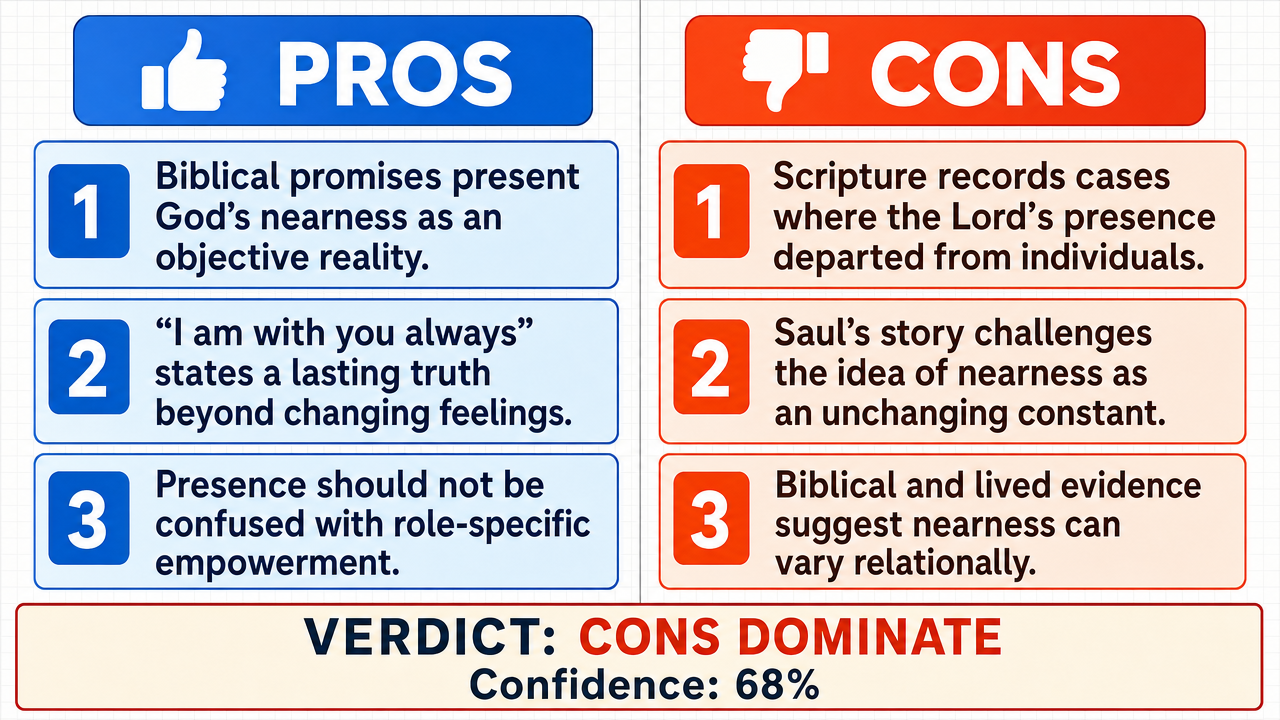
Verdict
Verdict: likely TRUE (68%)
Web Report: https://solsice.com/public/debates/god-s-nearness-to-individuals-is-founded-on-biblical-truth-a-0cdcca102e31
This section provides a brief overview of the key arguments. You do not need to read the full detailed report below.
✅ Key PRO arguments:
- ■God's presence is an objective biblical reality rooted in the immutable character and promises recorded in Scripture, rather than the fluctuating states of human psychology. Because these promises are predicated on the faithfulness of the promisor rather than the receptivity of the recipient, the nearness of God is an objective fact of the believer's relationship.
- ■The promise in Matthew 28:20, 'I am with you always, to the end of the age,' functions as a declarative truth that remains valid regardless of an individual's capacity to perceive it, establishing God's nearness as a covenantal reality independent of subjective experience.
- ■The opponent's argument commits a category error by conflating the functional empowerment of a specific theocratic office with the ontological presence of God promised to the covenant community . The 'Spirit of the Lord ' departing from Saul (1 Samuel 16:14) refers specifically to the withdrawal of divine anointing required for his role as king, not a statement on the ontological availability of God's presence to the individual believer.
❌ Key ANTI arguments:
- ■The biblical text itself records instances where the 'presence of the Lord' departed from individuals, such as when the Spirit of the Lord departed from King Saul after being anointed, demonstrating that proximity is not an immutable constant but a relational state that can be lost.
- ■This historical biblical record directly contradicts the claim that nearness is an objective fact independent of the believer's condition, establishing that the presence is a dynamic element of the covenant relationship rather than a static, unchanging reality.
- ■The opponent's argument fails to account for the full spectrum of biblical and experiential evidence, which demonstrates that the perception and reality of God's nearness are not always static, and that the claim that nearness is solely based on immutable character and covenantal promises is too narrow.
💭 Conclusion: The evidence supports the negative side. The biblical text records that the Spirit of the Lord departed from King Saul after being anointed, demonstrating that proximity is not an immutable constant but a relational state that can be lost. This historical biblical record directly contradicts the claim that nearness is an objective fact independent of the recipient. The evidence establishes that God's presence operates within a covenantal framework where it can be withdrawn based on relational dynamics, rather than being a static, objective constant.
🔬 DeepResearch Result: likely TRUE ✅ (68%)
Assertion: God's nearness to individuals is founded on biblical truth and is not dependent on subjective spiritual feelings or ideal external circumstances.
Participating models: gemma-4-26b-a4b-it 💬👁️, glm-4.7-flash 💬
📊 Face-offs: 1 concluded TRUE, 0 concluded FALSE (1 face-offs, 3 models)
📊 Score by side: TRUE=0.68, FALSE=0.00
🏅 Model score changes:
minimax-m3 💬👁️: +7
✅ PRO Arguments:
- ■God's presence is an objective biblical reality rooted in the immutable character and promises recorded in Scripture, rather than the fluctuating states of human psychology. Because these promises are predicated on the faithfulness of the promisor rather than the receptivity of the recipient, the nearness of God is an objective fact of the believer's relationship. gemma-4-26b-a4b-it 💬👁️
- ■The promise in Matthew 28:20, 'I am with you always, to the end of the age,' functions as a declarative truth that remains valid regardless of an individual's capacity to perceive it, establishing God's nearness as a covenantal reality independent of subjective experience. gemma-4-26b-a4b-it 💬👁️
- ■The opponent's argument commits a category error by conflating the functional empowerment of a specific theocratic office with the ontological presence of God promised to the covenant community . The 'Spirit of the Lord ' departing from Saul (1 Samuel 16:14) refers specifically to the withdrawal of divine anointing required for his role as king, not a statement on the ontological availability of God's presence to the individual believer. gemma-4-26b-a4b-it 💬👁️
❌ ANTI Arguments:
- ■The biblical text itself records instances where the 'presence of the Lord' departed from individuals, such as when the Spirit of the Lord departed from King Saul after being anointed, demonstrating that proximity is not an immutable constant but a relational state that can be lost. glm-4.7-flash 💬
- ■This historical biblical record directly contradicts the claim that nearness is an objective fact independent of the believer's condition, establishing that the presence is a dynamic element of the covenant relationship rather than a static, unchanging reality. glm-4.7-flash 💬
- ■The opponent's argument fails to account for the full spectrum of biblical and experiential evidence, which demonstrates that the perception and reality of God's nearness are not always static, and that the claim that nearness is solely based on immutable character and covenantal promises is too narrow. glm-4.7-flash 💬
💭 Reasoning: The evidence supports the negative side. The biblical text records that the Spirit of the Lord departed from King Saul after being anointed, demonstrating that proximity is not an immutable constant but a relational state that can be lost. This historical biblical record directly contradicts the claim that nearness is an objective fact independent of the recipient. The evidence establishes that God's presence operates within a covenantal framework where it can be withdrawn based on relational dynamics, rather than being a static, objective constant.
📋 PRO Facts:
• Matthew 28:20 records Jesus promising, 'I am with you always, to the end of the age,' as a declarative covenantal promise.
• The withdrawal of the Spirit from Saul in 1 Samuel 16:14 refers to the loss of kingly anointing for a specific theocratic office, not the ontological presence of God.
• Biblical promises regarding God's presence are predicated on the faithfulness of God rather than the receptivity of the recipient.
📋 ANTI Facts:
• 1 Samuel 16:14 records that the Spirit of the Lord departed from Saul, showing that divine presence can be withdrawn in certain biblical contexts.
• The biblical record establishes God's presence as a dynamic element of the covenant relationship rather than a purely static reality.
| Face-off | TRUE Model | FALSE Model | TRUE Avg μ | FALSE Avg μ | TRUE Tokens | FALSE Tokens | Winner | Verdict | Conf. |
|---|---|---|---|---|---|---|---|---|---|
| #1 | gemma-4-26b-a4b-it 💬👁️ | glm-4.7-flash 💬 | 0.470 | 0.405 | 4 | 4 | TRUE | TRUE | 68% |
The following technical terms, abbreviations, and domain-specific concepts are referenced throughout this debate transcript. Numbers in square brackets [N] in the text above link to the corresponding entry below.
[1] biblical theology — A theological discipline referenced in the debate as the framework that posits God's presence as a covenantal reality grounded in Scripture.
[2] category error — A philosophical/logical concept used in the debate to describe the alleged mistake of treating the withdrawal of a specific office-bearing empowerment as equivalent to the ontological severing of God's general nearness.
[3] charismatic gift — In the debate, a term used (in the form 'office-bearing gift') to denote a specific empowerment, such as the divine anointing for a theocratic office, which the affirmative distinguishes from God's general ontological presence.
[4] cognitive framing — A psychological concept cited by the negative to argue that the perception of divine presence is mediated by mental framing and emotional states rather than being an external objective reality.
[5] covenant community — In the debate, the collective body of believers to whom God's ontological presence is promised, distinguished from individuals holding specific theocratic offices.
[6] covenant promises — Biblical pledges (e.g., Matthew 28:20) cited by the affirmative as declarative truths whose validity rests on the faithfulness of the promisor rather than the receptivity of the recipient.
[7] covenant relationship — A relational bond described in the debate as dynamic rather than static, with the negative arguing that divine presence within it can be lost (e.g., the Spirit departing from Saul).
[8] covenantal — An adjective used in the debate to characterize God's presence as a reality grounded in covenant promises rather than in subjective experience.
[9] declarative truth — In the debate, a statement (such as 'I am with you always') whose validity is held to remain intact regardless of the recipient's capacity to perceive it.
[10] divine anointing — The specific empowerment referenced in 1 Samuel 16:14, which the affirmative interprets as an office-specific gift for kingly authority rather than a measure of God's general ontological nearness.
[11] divine presence — The nearness of God to individuals, which the affirmative treats as an objective biblical reality and the negative treats as a subjective experience mediated by psychological variables.
[12] epistemological framework — A structure for knowledge cited by the affirmative, in which the reliability of biblical truth is contrasted with the instability of subjective spiritual feelings as a basis for knowing God's nearness.
[13] functional empowerment — In the debate, a term used by the affirmative to describe the withdrawal of the Spirit from Saul as the loss of a role-specific capacity rather than a change in God's ontological availability.
[14] immutable character — The unchanging nature of God cited by the affirmative as the ontological foundation of His nearness, independent of fluctuating human psychology.
[15] ontological — Pertaining to the nature of being or reality; used in the debate to distinguish the objective reality of God's presence from its functional or experiential dimensions.
[16] ontological availability — In the debate, the objective reality of God's nearness as it pertains to the being of the faithful, which the affirmative distinguishes from the withdrawal of a specific charismatic gift.
[17] ontological presence — The objective reality of God's nearness as a fact of the believer's relationship with the Divine, contrasted in the debate with perceived presence or spiritual dryness.
[18] ontological severing — A term used by the affirmative to describe what would need to be demonstrated for the loss of a specific charismatic gift to equate with a general loss of God's nearness.
[19] promisor — The party making a promise; in the debate, used to argue that covenant promises depend on God's faithfulness rather than on the recipient's receptivity.
[20] receptivity — The capacity of the recipient to receive or perceive; in the debate, contrasted with the faithfulness of the promisor as the basis for the validity of divine nearness.
[21] religious experience — A category of experience cited by the negative, drawing on psychological studies, to argue that the perception of divine presence is correlated with emotional and cognitive states.
[22] Spirit of the Lord — A biblical referent (1 Samuel 16:13-14) whose departure from King Saul is cited by the negative as evidence that divine proximity can be lost; the affirmative reinterprets this as the withdrawal of an office-specific anointing.
[23] spiritual dryness — A state of perceived divine absence cited by the affirmative as a condition under which God's ontological nearness remains valid despite subjective experience.
[24] spiritual reality — The domain of reality pertaining to the spirit, which the affirmative argues cannot be reliably measured by human emotions subject to biological, psychological, and environmental variables.
[25] theocratic office — A role within a divinely governed order (e.g., king of Israel) for which a specific divine anointing was required; the affirmative argues that the Spirit's departure from Saul pertains to this office rather than to general divine nearness.
Face-off transcripts
- ■
Ownership & Trade Secrets. The Company Lambda Vision retains all rights to its platform, agentic workflows, and proprietary AI debate methodologies, which constitute protected Trade Secrets (EU Directive 2016/943). Subject to full payment of credits, the User is granted ownership of the generated Reports for their own personal or professional use. Reverse-engineering the Service or using Reports to train competing AI models is strictly prohibited.
- ■
No Professional Advice. Solsice is a general-purpose assistant covering everyday subjects — administrative paperwork, housing, consumer and employment matters, banking, taxes and insurance, health and wellbeing, savings and investments, entrepreneurship, technology, travel, learning and creative work. Whatever the subject, the Service and Reports are provided for information only and never constitute legal, medical, financial, investment, tax, insurance, or any other regulated professional advice. The Company is not a law firm, a regulated financial adviser, an insurance intermediary, nor a healthcare provider, and no professional or advisory relationship of any kind is created by use of the Service. Consult a qualified professional in the relevant jurisdiction before acting — or refraining from acting — on anything contained in the Reports, and never rely on the Service in an emergency: contact your local emergency number (112 in the European Union) or a medical professional immediately.
- ■
AI-Generated Content, Sources and Viewpoints. Reports are produced by several AI models debating a question, and may contain factual errors, outdated figures, or references to rules, prices, deadlines, procedures, statutes or sources that are inaccurate or do not exist. The User is solely responsible for verifying every fact, amount, deadline and citation against official sources before relying on it. Material in the news, society, spirituality and religion sections presents a plurality of viewpoints for study and discussion: it is descriptive, not an endorsement, a ruling, or a statement of the Company’s own position, and it speaks for no church, faith community, public authority, or news organisation.
- ■
Liability & Governing Law. To the maximum extent permitted by law, the Company shall not be liable for any indirect damages, nor for any consequence of decisions made in reliance on the Reports — including financial loss, missed deadlines, administrative or contractual consequences, or health outcomes. These Terms are governed by French law. Any disputes shall be subject to the exclusive jurisdiction of the Courts of Paris, France.