
God's authority and power are not diminished by changing human circumstances or geographical locations, and divine presence is constant and able to reach any situation.
AI debate verdict and arguments
⚠️ AI-generated information only; not professional advice
Completed October 14, 2026
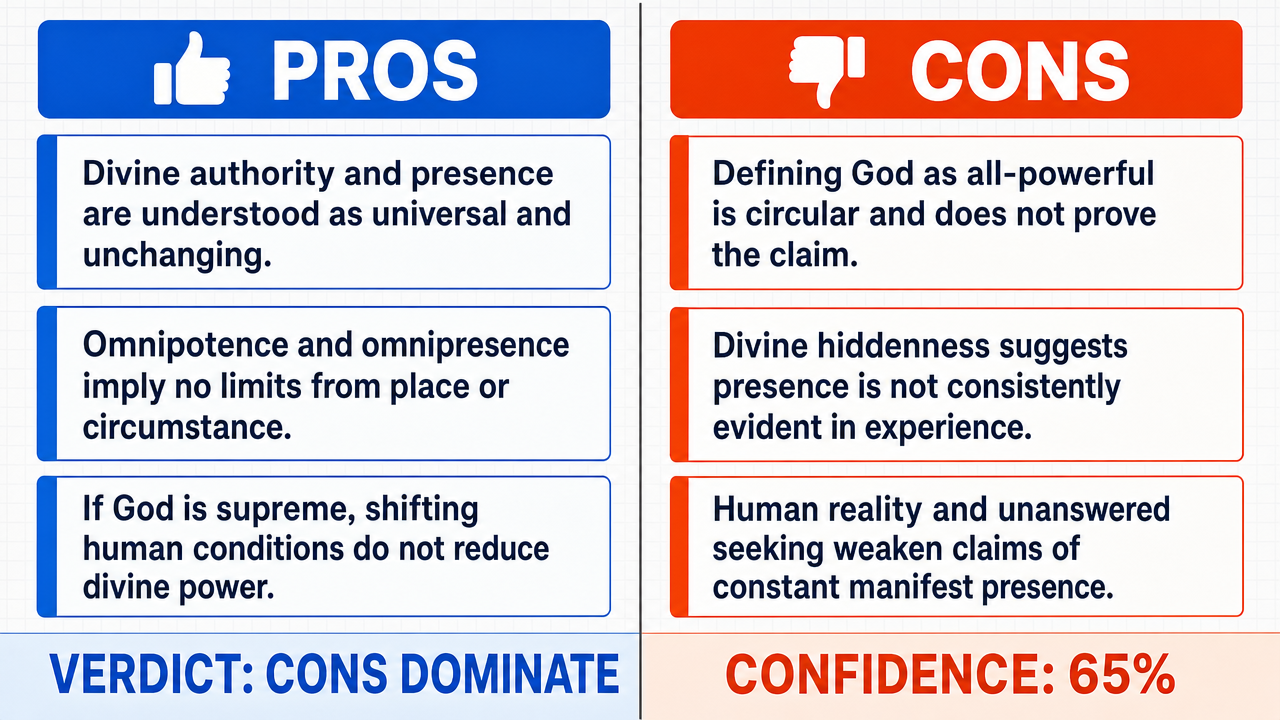
Verdict
Verdict: likely FALSE (65%)
Web Report: https://solsice.com/public/debates/god-s-authority-and-power-are-not-diminished-by-changing-hum-37f3c412b1fa
This section provides a brief overview of the key arguments. You do not need to read the full detailed report below.
✅ Key PRO arguments:
- ■Divine authority, power, and presence are universally constant and omnipresent, affirmed by the theological axiom of divine omnipotence and omnipresence foundational to major monotheistic traditions . Christian scripture (Psalm 139:7-10) explicitly states there is no place one can flee from God's Spirit, and Islamic theology (Qur'an 2:255, Ayat al-Kursi) holds that Allah's authority and knowledge encompass all things, with no circumstance hidden from Him.
- ■The opponent's position is internally self-contradictory: they assert that divine authority is constrained by empirical reality and human experience, yet simultaneously declare that human reactions to perceived divinity say nothing about the actual reach or authority of a divine entity. These two claims are mutually exclusive —if human experience constrains divine authority, then human reactions are relevant evidence; if they are irrelevant, then human experience cannot serve as a constraint.
❌ Key ANTI arguments:
- ■The affirmative's reliance on theological axioms constitutes circular reasoning. Arguing that God's power is constant because the definition of God includes omnipotence , and then using that definition to prove God's power cannot be diminished, is a textbook case of a restated assumption masquerading as evidence. Defining a being as immutable because it is defined as such provides no external verification of divine authority in changing human circumstances—it merely describes a linguistic construct .
- ■The claim of constant divine presence is fundamentally undermined by the empirical reality of 'divine hiddenness ,' a phenomenon where individuals seek divine presence through sincere, persistent effort but encounter only silence or absence. If divine presence were truly constant and able to reach any situation, the experience of profound, unmediated divine absence in moments of extreme existential crisis would be an impossibility, yet the historical and sociological record is replete with documented cases of this phenomenon.
💭 Conclusion: False. The judge ruled against the assertion with 65% confidence, finding the negative side's critique of circular reasoning more persuasive than the affirmative's theological appeals. The negative successfully demonstrated that defining God as omnipotent does not constitute external evidence of divine constancy across circumstances, exposing the affirmative's argument as a linguistic construct rather than a substantiated claim. The phenomenon of divine hiddenness further weakens the sub-claim that divine presence is constant and able to reach any situation, as documented experiences of profound divine absence contradict this promise. Because the assertion contains multiple sub-claims (authority not diminished by circumstances, authority not diminished by geography, constant presence, and reach into any situation), and the weakest sub-claim—constant presence reaching any situation—is only partially supported, the confidence reflects the judge's moderate certainty rather than full endorsement.
🔬 DeepResearch Result: likely FALSE ❌ (65%)
Assertion: God's authority and power are not diminished by changing human circumstances or geographical locations, and divine presence is constant and able to reach any situation.
Participating models: deepseek-v3.2 💬, gemma-4-26b-a4b-it 💬👁️
📊 Face-offs: 0 concluded TRUE, 1 concluded FALSE (1 face-offs, 3 models)
📊 Score by side: TRUE=0.00, FALSE=0.65
🏅 Model score changes:
minimax-m3 💬👁️: +6
✅ PRO Arguments:
- ■Divine authority, power, and presence are universally constant and omnipresent, affirmed by the theological axiom of divine omnipotence and omnipresence foundational to major monotheistic traditions . Christian scripture (Psalm 139:7-10) explicitly states there is no place one can flee from God's Spirit, and Islamic theology (Qur'an 2:255, Ayat al-Kursi) holds that Allah's authority and knowledge encompass all things, with no circumstance hidden from Him. deepseek-v3.2 💬
- ■The opponent's position is internally self-contradictory: they assert that divine authority is constrained by empirical reality and human experience, yet simultaneously declare that human reactions to perceived divinity say nothing about the actual reach or authority of a divine entity. These two claims are mutually exclusive —if human experience constrains divine authority, then human reactions are relevant evidence; if they are irrelevant, then human experience cannot serve as a constraint. deepseek-v3.2 💬
❌ ANTI Arguments:
- ■The affirmative's reliance on theological axioms constitutes circular reasoning. Arguing that God's power is constant because the definition of God includes omnipotence, and then using that definition to prove God's power cannot be diminished, is a textbook case of a restated assumption masquerading as evidence. Defining a being as immutable because it is defined as such provides no external verification of divine authority in changing human circumstances—it merely describes a linguistic construct . gemma-4-26b-a4b-it 💬👁️
- ■The claim of constant divine presence is fundamentally undermined by the empirical reality of 'divine hiddenness ,' a phenomenon where individuals seek divine presence through sincere, persistent effort but encounter only silence or absence. If divine presence were truly constant and able to reach any situation, the experience of profound, unmediated divine absence in moments of extreme existential crisis would be an impossibility, yet the historical and sociological record is replete with documented cases of this phenomenon. gemma-4-26b-a4b-it 💬👁️
💭 Reasoning: False. The judge ruled against the assertion with 65% confidence, finding the negative side's critique of circular reasoning more persuasive than the affirmative's theological appeals. The negative successfully demonstrated that defining God as omnipotent does not constitute external evidence of divine constancy across circumstances, exposing the affirmative's argument as a linguistic construct rather than a substantiated claim. The phenomenon of divine hiddenness further weakens the sub-claim that divine presence is constant and able to reach any situation, as documented experiences of profound divine absence contradict this promise. Because the assertion contains multiple sub-claims (authority not diminished by circumstances, authority not diminished by geography, constant presence, and reach into any situation), and the weakest sub-claim—constant presence reaching any situation—is only partially supported, the confidence reflects the judge's moderate certainty rather than full endorsement.
📋 PRO Facts:
• Psalm 139:7-10 states there is no place one can flee from God's Spirit, asserting divine presence encompasses heavens, depths, and the farthest sea.
• Qur'an 2:255 (Ayat al-Kursi) holds that Allah's authority and knowledge encompass all things, with no circumstance hidden from Him.
• Divine omnipotence and omnipresence are foundational axioms in major monotheistic traditions including Christianity and Islam.
📋 ANTI Facts:
• The phenomenon of 'divine hiddenness' is documented across historical and sociological records, where sincere seekers report profound, unmediated divine absence during extreme existential crises.
• Circular reasoning occurs when a conclusion is fed into the premises, as in defining God as immutable and then using that definition to prove immutability.
• Anthropological studies of religious experience show varied and inconsistent human reactions to perceived divinity across cultures and circumstances.
| Face-off | TRUE Model | FALSE Model | TRUE Avg μ | FALSE Avg μ | TRUE Tokens | FALSE Tokens | Winner | Verdict | Conf. |
|---|---|---|---|---|---|---|---|---|---|
| #1 | deepseek-v3.2 💬 | gemma-4-26b-a4b-it 💬👁️ | 0.524 | 0.309 | 8 | 2 | TRUE | FALSE | 65% |
The following technical terms, abbreviations, and domain-specific concepts are referenced throughout this debate transcript. Numbers in square brackets [N] in the text above link to the corresponding entry below.
[1] Anthropological studies — Academic research focused on human societies, cultures, and behaviors, used in the debate as a source of empirical evidence about religious experience across cultures and geographies.
[2] Causal link — A demonstrable connection in which one phenomenon directly produces or influences another; in the debate, the negative side argues the affirmative fails to provide such a link between believers' psychological states and actual divine presence.
[3] Circular demonstration — A logical fallacy in which the conclusion is assumed within the premises, so that the argument effectively restates its starting point rather than proving it; the negative side accuses the affirmative of this when defining God's power as constant and then citing that definition as evidence.
[4] Divine hiddenness — A theological and philosophical concept referring to the perceived absence or silence of a deity despite sincere seeking; cited by the negative as evidence against constant divine presence.
[5] Empirical reality — Knowledge or claims grounded in observation and experience of the physical world rather than in abstract reasoning or revelation; the negative side argues divine authority must be tested against this.
[6] Existential crisis — A moment of intense psychological or spiritual distress in which fundamental beliefs about meaning, identity, or the divine are challenged; referenced as a context in which divine absence is reportedly experienced.
[7] Immutable — Unchanging over time; in the debate, used to describe essential divine attributes that, by theological definition, cannot be altered by circumstance or location.
[8] Linguistic construct — A concept or entity that exists primarily as a product of language and definition rather than as an independently verifiable object; the negative side characterizes the affirmative's 'God' as such.
[9] Logical inconsistency — A flaw in reasoning in which a position simultaneously asserts a proposition and its negation; the affirmative argues the negative's case contains this defect.
[10] Measurable correlation — A statistically quantifiable relationship between two variables; the negative argues the affirmative has not demonstrated one between religious experience and divine presence.
[11] Monotheistic traditions — Religious systems affirming belief in a single deity; the debate cites Christian and Islamic traditions as foundational sources for claims of divine omnipotence and omnipresence.
[12] Mutually exclusive — Mutually exclusive positions — Statements or propositions that cannot both be true at the same time; the affirmative argues the negative holds two such positions regarding human experience as evidence.
[13] Omnipotence — The theological attribute of possessing unlimited or supreme power; cited as a foundational axiom supporting the claim that divine authority cannot be diminished.
[14] Omnipresence — The theological attribute of being present everywhere at all times; cited as the basis for the claim that divine presence is constant across all locations and situations.
[15] Restated assumption — A premise that is rephrased as a conclusion without independent support; the negative uses this term to describe the affirmative's argument that God's power is constant because it is defined as such.
[16] Self-contradiction — A statement or argument that contradicts itself; the affirmative contends the negative's position is internally self-contradictory and therefore proves nothing.
[17] Spiritual desertion — The experience of feeling abandoned by or cut off from the divine, particularly during moments of acute need; cited as empirical counter-evidence to claims of constant divine presence.
[18] Substitution of proxy — A reasoning error in which one observable phenomenon is offered as evidence for an unobservable one without establishing a valid connection; the negative accuses the affirmative of this when treating 'perceived divine intervention' as proof of actual divine presence.
[19] Theological axiom — A proposition in theology accepted as self-evidently true without requiring proof, such as divine omnipotence or omnipresence; the affirmative grounds its argument in such axioms.
[20] Transfer operator — A mechanism or rule that establishes how evidence about one domain (e.g., human psychology) can validly support claims about another domain (e.g., divine reality); the negative argues the affirmative has not supplied one.
Face-off transcripts
- ■
Ownership & Trade Secrets. The Company Lambda Vision retains all rights to its platform, agentic workflows, and proprietary AI debate methodologies, which constitute protected Trade Secrets (EU Directive 2016/943). Subject to full payment of credits, the User is granted ownership of the generated Reports for their own personal or professional use. Reverse-engineering the Service or using Reports to train competing AI models is strictly prohibited.
- ■
No Professional Advice. Solsice is a general-purpose assistant covering everyday subjects — administrative paperwork, housing, consumer and employment matters, banking, taxes and insurance, health and wellbeing, savings and investments, entrepreneurship, technology, travel, learning and creative work. Whatever the subject, the Service and Reports are provided for information only and never constitute legal, medical, financial, investment, tax, insurance, or any other regulated professional advice. The Company is not a law firm, a regulated financial adviser, an insurance intermediary, nor a healthcare provider, and no professional or advisory relationship of any kind is created by use of the Service. Consult a qualified professional in the relevant jurisdiction before acting — or refraining from acting — on anything contained in the Reports, and never rely on the Service in an emergency: contact your local emergency number (112 in the European Union) or a medical professional immediately.
- ■
AI-Generated Content, Sources and Viewpoints. Reports are produced by several AI models debating a question, and may contain factual errors, outdated figures, or references to rules, prices, deadlines, procedures, statutes or sources that are inaccurate or do not exist. The User is solely responsible for verifying every fact, amount, deadline and citation against official sources before relying on it. Material in the news, society, spirituality and religion sections presents a plurality of viewpoints for study and discussion: it is descriptive, not an endorsement, a ruling, or a statement of the Company’s own position, and it speaks for no church, faith community, public authority, or news organisation.
- ■
Liability & Governing Law. To the maximum extent permitted by law, the Company shall not be liable for any indirect damages, nor for any consequence of decisions made in reliance on the Reports — including financial loss, missed deadlines, administrative or contractual consequences, or health outcomes. These Terms are governed by French law. Any disputes shall be subject to the exclusive jurisdiction of the Courts of Paris, France.