
Global demand for oil, gas, and coal will peak before 2030.
AI debate verdict and arguments
⚠️ AI-generated information only; not professional advice
Completed October 11, 2026
Verdict
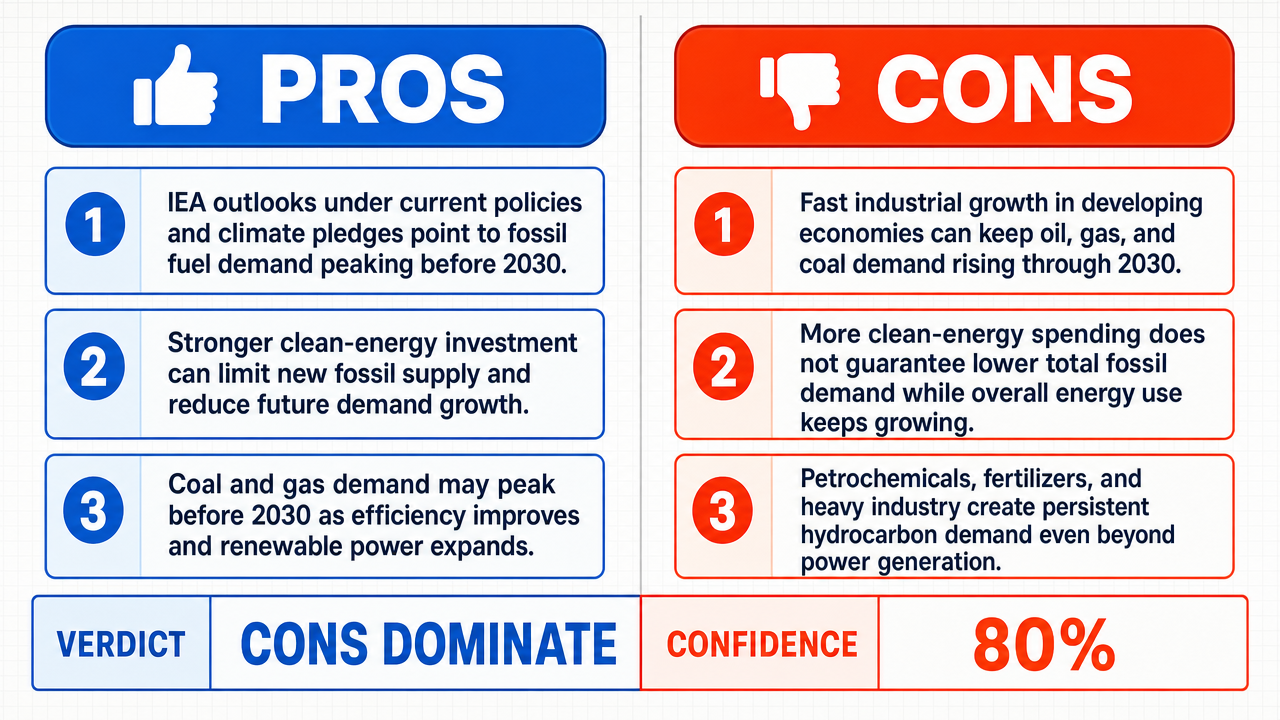
Verdict: likely FALSE (80%)
This section provides a brief overview of the key arguments. You do not need to read the full detailed report below.
✅ Key PRO arguments:
- ■Under stated national policies and announced climate pledges , the IEA 's World Energy Outlook 2024 projects that global fossil fuel demand is set to peak before 2030, with fuel-specific outlooks showing coal, natural gas, and oil each reaching their maximum before 2030.
- ■Capital allocation has shifted decisively toward clean energy, with clean-energy investment now roughly 1.8 times fossil-fuel investment , which constrains the possible paths of fossil-fuel demand to either decline, flatten, or continue growing — with the IEA projecting the first outcome.
- ■Coal demand is projected to peak before 2030 as advanced-economy use falls and Asian growth slows, natural gas demand is projected to peak before 2030 as efficiency, electrification , and renewables limit incremental growth, and oil demand is projected to plateau in the same window.
❌ Key ANTI arguments:
- ■The massive industrialization occurring in the Global South creates a structural floor for fossil fuel demand that prevents a global peak before 2030, since energy-intensive manufacturing and infrastructure in developing economies cannot be instantaneously replaced by low-carbon alternatives .
- ■The clean-to-fossil investment ratio of roughly 1.8x does not dictate the trajectory of total fossil demand because the overall energy system is expanding simultaneously; new clean capacity can be additive rather than fully substitutive, leaving room for fossil demand to continue growing.
- ■Petrochemical and heavy industry demand for non-combustion uses of hydrocarbons — such as plastics, fertilizers, and feedstocks — provides a structural demand floor that is largely insensitive to electrification and renewables, undermining the claim that all three fuels will peak before 2030.
💭 Conclusion: False. The FALSE side successfully identified a critical temporal and logical flaw in the TRUE side's argument: the affirmative relied on policy-driven projections of future demand peaks rather than evidence of present-day demand trajectories. The structural growth requirements of the Global South 's industrialization, combined with non-combustion petrochemical demand, create a floor under fossil fuel consumption that policy projections alone cannot overcome within the 2025–2030 window. The TRUE side's investment-ratio argument was undermined by the observation that clean-energy investment being 1.8 times fossil investment does not mechanically translate into fossil demand decline, since the energy system is expanding in absolute terms. Because the claim is compound (oil AND gas AND coal), the least-supported sub-claim moderates overall confidence.
🔬 DeepResearch Result: likely FALSE ❌ (80%)
Assertion: Global demand for oil, gas, and coal will peak before 2030.
Participating models: deepseek-v3.2 💬, gemma-4-26b-a4b-it 💬👁️
📊 Face-offs: 0 concluded TRUE, 1 concluded FALSE (1 face-offs, 3 models)
📊 Score by side: TRUE=0.00, FALSE=0.80
🏅 Model score changes:
minimax-m3 💬👁️: +8
✅ PRO Arguments:
- ■Under stated national policies and announced climate pledges , the IEA 's World Energy Outlook 2024 projects that global fossil fuel demand is set to peak before 2030, with fuel-specific outlooks showing coal, natural gas, and oil each reaching their maximum before 2030. deepseek-v3.2 💬
- ■Capital allocation has shifted decisively toward clean energy, with clean-energy investment now roughly 1.8 times fossil-fuel investment , which constrains the possible paths of fossil-fuel demand to either decline, flatten, or continue growing — with the IEA projecting the first outcome. deepseek-v3.2 💬
- ■Coal demand is projected to peak before 2030 as advanced-economy use falls and Asian growth slows, natural gas demand is projected to peak before 2030 as efficiency, electrification , and renewables limit incremental growth, and oil demand is projected to plateau in the same window. deepseek-v3.2 💬
❌ ANTI Arguments:
- ■The massive industrialization occurring in the Global South creates a structural floor for fossil fuel demand that prevents a global peak before 2030, since energy-intensive manufacturing and infrastructure in developing economies cannot be instantaneously replaced by low-carbon alternatives . gemma-4-26b-a4b-it 💬👁️
- ■The clean-to-fossil investment ratio of roughly 1.8x does not dictate the trajectory of total fossil demand because the overall energy system is expanding simultaneously; new clean capacity can be additive rather than fully substitutive, leaving room for fossil demand to continue growing. gemma-4-26b-a4b-it 💬👁️
- ■Petrochemical and heavy industry demand for non-combustion uses of hydrocarbons — such as plastics, fertilizers, and feedstocks — provides a structural demand floor that is largely insensitive to electrification and renewables, undermining the claim that all three fuels will peak before 2030. gemma-4-26b-a4b-it 💬👁️
💭 Reasoning: False. The FALSE side successfully identified a critical temporal and logical flaw in the TRUE side's argument: the affirmative relied on policy-driven projections of future demand peaks rather than evidence of present-day demand trajectories. The structural growth requirements of the Global South's industrialization, combined with non-combustion petrochemical demand, create a floor under fossil fuel consumption that policy projections alone cannot overcome within the 2025–2030 window. The TRUE side's investment-ratio argument was undermined by the observation that clean-energy investment being 1.8 times fossil investment does not mechanically translate into fossil demand decline, since the energy system is expanding in absolute terms. Because the claim is compound (oil AND gas AND coal), the least-supported sub-claim moderates overall confidence.
📋 PRO Facts:
• IEA World Energy Outlook 2024 projects global fossil fuel demand to peak before 2030 under current policy settings.
• Clean-energy investment is roughly 1.8 times fossil-fuel investment globally.
• IEA fuel-specific outlooks reinforce the projection of fuel-specific peaks before 2030.
📋 ANTI Facts:
• Global South industrialization is driving sustained increases in energy-intensive manufacturing demand.
• Non-combustion uses of hydrocarbons (plastics, fertilizers, feedstocks) provide a structural demand floor largely insensitive to electrification.
• The overall energy system is expanding simultaneously, meaning new clean capacity can be additive rather than fully substitutive.
| Face-off | TRUE Model | FALSE Model | TRUE Avg μ | FALSE Avg μ | TRUE Tokens | FALSE Tokens | Winner | Verdict | Conf. |
|---|---|---|---|---|---|---|---|---|---|
| #1 | deepseek-v3.2 💬 | gemma-4-26b-a4b-it 💬👁️ | 0.696 | 0.230 | 12 | 3 | TRUE | FALSE | 80% |
The following technical terms, abbreviations, and domain-specific concepts are referenced throughout this debate transcript. Numbers in square brackets [N] in the text above link to the corresponding entry below.
[1] announced climate pledges — Climate commitments announced by governments that have not yet been fully implemented as binding policy, referenced in the debate as a basis for IEA projections of fossil fuel demand peaking before 2030.
[2] capital allocation — The distribution of investment capital among different sectors or asset classes; in the debate, refers to the shift in capital toward clean energy relative to fossil fuels.
[3] clean energy investment — Capital expenditure on energy sources with lower carbon emissions, such as renewables; cited in the debate as being roughly 1.8 times fossil-fuel investment.
[4] coal phase-outs — Policies to retire or shut down coal-fired power generation, referenced as part of the policy pipeline supporting projected coal demand peaking before 2030.
[5] decarbonization — The process of reducing carbon dioxide emissions from energy and industrial systems; referenced in the debate as a constraint on fossil fuel demand growth.
[6] demand ceiling — The maximum level that demand is projected to reach; used in the debate to argue that the ceiling for fossil fuel demand is already visible in current policy pipelines.
[7] displacement mechanism — A process by which growth in one energy source reduces demand for another; the debate disputes whether clean energy investment constitutes such a mechanism for fossil fuels.
[8] electric vehicles — Vehicles powered by electric motors rather than internal combustion engines; cited as a factor expected to flatten road-fuel oil demand growth.
[9] electrification — The transition of energy end-uses from direct fossil fuel consumption to electricity; cited as limiting incremental natural gas demand growth.
[10] energy demand elasticity — The responsiveness of energy demand to changes in price or income; invoked by the negative to argue that developing-economy growth creates a structural floor for fossil demand.
[11] energy-intensive manufacturing — Industrial processes requiring large amounts of energy input; cited as a driver of fossil fuel demand in industrializing regions.
[12] fossil-fuel investment — Capital expenditure on infrastructure for extracting, processing, or using fossil fuels; compared in the debate to clean energy investment at a ratio of roughly 1:1.8.
[13] fuel economy — The efficiency with which a vehicle converts fuel into distance traveled; cited as a factor expected to flatten road-fuel oil demand growth.
[14] GDP — Gross Domestic Product — The total monetary value of goods and services produced within a country; referenced in the debate as a driver of aggregate energy demand.
[15] Global South — Developing countries, primarily in Africa, Latin America, and parts of Asia; cited as undergoing massive industrialization that creates a structural floor for fossil fuel demand.
[16] heavy industry — Industrial sectors involving large-scale production, typically energy-intensive; cited as a source of demand resistant to rapid decarbonization.
[17] hydrocarbons — Organic compounds consisting of hydrogen and carbon, including fossil fuels; referenced in the context of non-combustion uses such as plastics and fertilizers.
[18] IEA — International Energy Agency — An organization cited in the debate as the source of the World Energy Outlook 2024, Coal 2024, Natural Gas 2024, and Global Energy Review 2024 reports projecting fossil fuel demand peaks before 2030.
[19] long-term capital cycles — Extended periods over which capital investments are recouped and reinvested; cited as tying petrochemical and heavy industry demand to multi-decade infrastructure commitments.
[20] low-carbon alternatives — Energy sources or technologies that produce lower carbon emissions than fossil fuels; cited as unable to instantaneously replace fossil use in industrializing regions.
[21] marginal energy system — The incremental energy supply that meets additional demand; referenced in arguing that the investment shift toward clean energy determines the future marginal energy system.
[22] marginal fossil use — The incremental use of fossil fuels at the margin of the energy system; cited as being displaced by renewables, efficiency, and electrification.
[23] methane regulations — Rules limiting methane emissions, often from oil and gas operations; referenced (truncated as 'methane regu' in the transcript) as part of the policy pipeline supporting projected fossil fuel demand peaks.
[24] modal shifts — Changes in the mode of transportation used, such as shifts from cars to public transit or rail; cited as a factor expected to flatten road-fuel oil demand growth.
[25] non-combustion uses — Uses of fossil fuels other than burning, such as feedstocks for plastics, fertilizers, and high-heat industrial processes; cited as resistant to rapid decarbonization.
[26] Paris-aligned commitments — Policy commitments aligned with the goals of the Paris Agreement on climate change; referenced as part of the policy pipeline that could be reversed by major economies.
[27] petrochemical — Chemical products derived from petroleum or natural gas; cited as a source of fossil fuel demand tied to long-term capital cycles and essential material needs.
[28] renewable capacity — Installed power generation capacity from renewable sources such as wind and solar; cited as displacing marginal fossil fuel use.
[29] stated national policies — Government policies that have been formally adopted or enacted; referenced in the debate as the basis for IEA projections of fossil fuel demand peaking before 2030.
[30] structural floor — A minimum level of demand supported by underlying structural factors; cited as preventing a global fossil fuel demand peak before 2030 due to Global South industrialization.
[31] substitution of proxies — Replacing one indicator with another without establishing a valid relationship between them; cited in the debate as a logical flaw in using clean energy investment to imply fossil demand decline.
[32] temporal error — A logical error involving confusion of cause and effect across time; cited in the debate as the flaw of using a projection of future policy to justify a current state of demand.
[33] transfer operator — A specific mechanism that translates changes in one variable into changes in another; the debate disputes whether such an operator exists mapping GDP growth or clean investment into fossil fuel demand decline.
[34] zero-sum game — A situation in which one participant's gain is exactly balanced by another's loss; cited in the debate as a flawed framing of the relationship between clean and fossil energy investment.
The following financial data tables were referenced during the debate exchanges:
| Investment category | 2024 (USD billion) |
|---|---|
| Clean energy | 2000 |
| Fossil fuels | 1100 |
Legend: IEA World Energy Investment 2024 estimates for global energy investment in 2024; values in USD billions. Source: IEA.
| Region | Projected GDP Growth (Avg 2024-2026) | Energy Demand Growth Correlation |
|---|---|---|
| Advanced Economies | 1.5% | Low |
| Emerging Markets | 4.2% | High |
| Global Average | 3.0% | Medium |
Legend: Estimates of economic and energy demand trajectories. GDP growth represents annual percentage change; Correlation indicates the strength of the link between industrial expansion and fossil fuel consumption.
| Global energy investment | 2024 estimate (USD trillion) |
|---|---|
| Clean energy | 2.0 |
| Fossil fuels | 1.1 |
Legend: IEA World Energy Investment 2024 estimates for global energy investment in 2024; values in USD trillion. Source: IEA.
Face-off transcripts
- ■
Ownership & Trade Secrets. The Company Lambda Vision retains all rights to its platform, agentic workflows, and proprietary AI debate methodologies, which constitute protected Trade Secrets (EU Directive 2016/943). Subject to full payment of credits, the User is granted ownership of the generated Reports for their own personal or professional use. Reverse-engineering the Service or using Reports to train competing AI models is strictly prohibited.
- ■
No Professional Advice. Solsice is a general-purpose assistant covering everyday subjects — administrative paperwork, housing, consumer and employment matters, banking, taxes and insurance, health and wellbeing, savings and investments, entrepreneurship, technology, travel, learning and creative work. Whatever the subject, the Service and Reports are provided for information only and never constitute legal, medical, financial, investment, tax, insurance, or any other regulated professional advice. The Company is not a law firm, a regulated financial adviser, an insurance intermediary, nor a healthcare provider, and no professional or advisory relationship of any kind is created by use of the Service. Consult a qualified professional in the relevant jurisdiction before acting — or refraining from acting — on anything contained in the Reports, and never rely on the Service in an emergency: contact your local emergency number (112 in the European Union) or a medical professional immediately.
- ■
AI-Generated Content, Sources and Viewpoints. Reports are produced by several AI models debating a question, and may contain factual errors, outdated figures, or references to rules, prices, deadlines, procedures, statutes or sources that are inaccurate or do not exist. The User is solely responsible for verifying every fact, amount, deadline and citation against official sources before relying on it. Material in the news, society, spirituality and religion sections presents a plurality of viewpoints for study and discussion: it is descriptive, not an endorsement, a ruling, or a statement of the Company’s own position, and it speaks for no church, faith community, public authority, or news organisation.
- ■
Liability & Governing Law. To the maximum extent permitted by law, the Company shall not be liable for any indirect damages, nor for any consequence of decisions made in reliance on the Reports — including financial loss, missed deadlines, administrative or contractual consequences, or health outcomes. These Terms are governed by French law. Any disputes shall be subject to the exclusive jurisdiction of the Courts of Paris, France.