
Germany's official rejection of rubber bullets for crowd control is undermined by evidence of their secret deployment by special forces during the 2017 G20 summit in Hamburg.
AI debate verdict and arguments
⚠️ AI-generated information only; not professional advice
Completed October 8, 2026
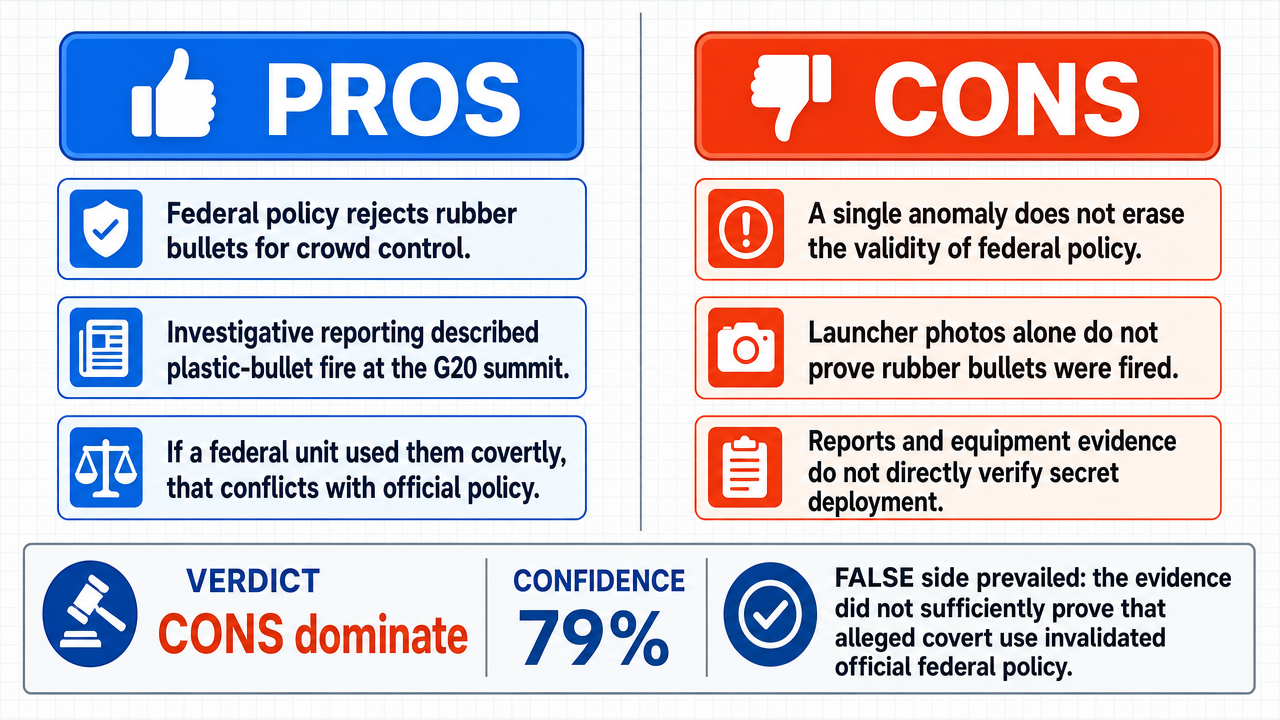
Verdict
Verdict: likely FALSE (79%)
This section provides a brief overview of the key arguments. You do not need to read the full detailed report below.
✅ Key PRO arguments:
- ■Germany's official federal policy categorically rejects rubber bullets for crowd control , making any such use by federal units a direct policy contradiction.
- ■A joint investigation by ARD and Süddeutsche Zeitung documented that GSG 9 officers fired plastic bullets at the 2017 G20 , corroborated by eyewitness accounts and photographs of 40mm launchers used exclusively for such munitions .
- ■Covert use of rubber bullets by GSG 9 —a federal special forces unit bound by the federal policy —creates a direct contradiction that undermines the official rejection.
❌ Key ANTI arguments:
- ■An isolated operational anomaly does not invalidate the structural validity of a federal policy ; the affirmative failed to provide a rival account that explains how a localized incident replaces the logic of federal doctrine .
- ■Photographic evidence of specific launchers is not a sufficient condition to confirm deployment of rubber bullets ; the existence of launchers does not necessitate their use as described, and alternative explanations exist for the observations.
- ■Journalistic reports and photographic evidence of equipment do not constitute direct, verifiable measurement of a secret deployment; observations of injuries or equipment are proxy measures subject to multiple alternative explanations and interpretive leaps.
💭 Conclusion: False: The FALSE side won this debate with strong reasoning that the affirmative failed to establish a sufficient causal link between alleged covert deployment and the invalidation of official federal policy . The winning arguments emphasized that an isolated operational incident—even if proven—does not structurally undermine a categorical federal doctrine , and that the affirmative's evidence (journalistic reports, photographs of launchers, eyewitness accounts ) consists of proxy measures subject to multiple alternative interpretations rather than direct verification. The affirmative's claim that GSG 9 's alleged use of rubber bullets 'undermines' the policy was treated as an interpretive leap rather than a demonstrated refutation. The confidence reflects the judge's 79% certainty, tempered by the fact that the underlying factual question of whether rubber bullets were actually deployed remains contested rather than definitively resolved.
🔬 DeepResearch Result: likely FALSE ❌ (79%)
Assertion: Germany's official rejection of rubber bullets for crowd control is undermined by evidence of their secret deployment by special forces during the 2017 G20 summit in Hamburg.
Participating models: deepseek-v3.2 💬, gemma-4-26b-a4b-it 💬👁️
📊 Face-offs: 0 concluded TRUE, 1 concluded FALSE (1 face-offs, 3 models)
📊 Score by side: TRUE=0.00, FALSE=0.79
🏅 Model score changes:
minimax-m3 💬👁️: +8
✅ PRO Arguments:
- ■Germany's official federal policy categorically rejects rubber bullets for crowd control, making any such use by federal units a direct policy contradiction. deepseek-v3.2 💬
- ■A joint investigation by ARD and Süddeutsche Zeitung documented that GSG 9 officers fired plastic bullets at the 2017 G20, corroborated by eyewitness accounts and photographs of 40mm launchers used exclusively for such munitions . deepseek-v3.2 💬
- ■Covert use of rubber bullets by GSG 9—a federal special forces unit bound by the federal policy—creates a direct contradiction that undermines the official rejection. deepseek-v3.2 💬
❌ ANTI Arguments:
- ■An isolated operational anomaly does not invalidate the structural validity of a federal policy; the affirmative failed to provide a rival account that explains how a localized incident replaces the logic of federal doctrine . gemma-4-26b-a4b-it 💬👁️
- ■Photographic evidence of specific launchers is not a sufficient condition to confirm deployment of rubber bullets; the existence of launchers does not necessitate their use as described, and alternative explanations exist for the observations. gemma-4-26b-a4b-it 💬👁️
- ■Journalistic reports and photographic evidence of equipment do not constitute direct, verifiable measurement of a secret deployment; observations of injuries or equipment are proxy measures subject to multiple alternative explanations and interpretive leaps. gemma-4-26b-a4b-it 💬👁️
💭 Reasoning: False: The FALSE side won this debate with strong reasoning that the affirmative failed to establish a sufficient causal link between alleged covert deployment and the invalidation of official federal policy. The winning arguments emphasized that an isolated operational incident—even if proven—does not structurally undermine a categorical federal doctrine, and that the affirmative's evidence (journalistic reports, photographs of launchers, eyewitness accounts) consists of proxy measures subject to multiple alternative interpretations rather than direct verification. The affirmative's claim that GSG 9's alleged use of rubber bullets 'undermines' the policy was treated as an interpretive leap rather than a demonstrated refutation. The confidence reflects the judge's 79% certainty, tempered by the fact that the underlying factual question of whether rubber bullets were actually deployed remains contested rather than definitively resolved.
📋 PRO Facts:
• Germany's Federal Ministry of the Interior has consistently stated that rubber bullets are not part of the standard arsenal for policing demonstrations and crowd control.
• ARD and Süddeutsche Zeitung reported that GSG 9 officers fired plastic bullets at the 2017 G20 summit in Hamburg.
• Photographs documented the presence of 40mm launchers, which are used exclusively for less-lethal munitions, at the G20 deployment.
📋 ANTI Facts:
• The presence of launchers does not constitute proof that rubber bullets were actively deployed, as the equipment could have been present without being used.
• Observations of injuries and equipment are proxy measures subject to multiple alternative explanations beyond rubber bullet deployment.
• A single operational incident by a special forces unit does not structurally invalidate a federal policy that applies to standard policing doctrine.
| Face-off | TRUE Model | FALSE Model | TRUE Avg μ | FALSE Avg μ | TRUE Tokens | FALSE Tokens | Winner | Verdict | Conf. |
|---|---|---|---|---|---|---|---|---|---|
| #1 | deepseek-v3.2 💬 | gemma-4-26b-a4b-it 💬👁️ | 0.340 | 0.227 | 12 | 3 | TRUE | FALSE | 79% |
The following technical terms, abbreviations, and domain-specific concepts are referenced throughout this debate transcript. Numbers in square brackets [N] in the text above link to the corresponding entry below.
[1] 40mm launchers — 40-millimeter launchers — Weapon systems designed to fire 40mm projectiles, referenced in the debate as equipment used exclusively for less-lethal munitions such as rubber or plastic bullets.
[2] ARD — Arbeitsgemeinschaft der öffentlich-rechtlichen Rundfunkanstalten der Bundesrepublik Deutschland — The consortium of German public broadcasters, cited in the debate as having co-published investigative journalism on the alleged use of rubber bullets at the 2017 G20 summit.
[3] covert deployment — The secret or hidden use of equipment or forces, referenced in the debate regarding the alleged unannounced use of rubber bullets by German special forces.
[4] covert violation — A secret breach of an established rule or policy, used in the debate to describe how a hidden act by policy-enforcers undermines the credibility of the policy itself.
[5] crowd control — Police or military techniques and equipment used to manage, disperse, or restrain groups of people, particularly during protests or public demonstrations.
[6] de-escalation — A strategy aimed at reducing the intensity of conflict or tension, cited in the debate as a foundational principle underlying Germany's federal policy on policing demonstrations.
[7] Der Spiegel — A major German weekly news magazine cited in the debate as having published investigative reporting on the alleged deployment of rubber bullets at the 2017 G20 summit.
[8] eyewitness accounts — Testimony from individuals who directly observed an event, referenced in the debate as corroborating evidence for the alleged use of rubber bullets at the G20 summit.
[9] federal doctrine — An officially established normative framework guiding the actions of federal entities, used in the debate to describe Germany's stated policy against rubber bullets in crowd control.
[10] Federal Ministry of the Interior — The German federal government ministry responsible for internal security and policing policy, cited in the debate as the source of Germany's official rejection of rubber bullets for crowd control.
[11] federal police — National-level police forces operating under federal authority, referenced in the debate as the entities bound by Germany's policy on crowd-control munitions.
[12] federal policy — An officially adopted position or rule at the national government level, used in the debate to describe Germany's stated rejection of rubber bullets for crowd control.
[13] G20 — Group of Twenty — An international forum of 20 major economies, referenced in the debate as the 2017 summit held in Hamburg, Germany, where the alleged covert use of rubber bullets occurred.
[14] GSG 9 — Grenzschutzgruppe 9 — An elite German federal special forces unit, cited in the debate as the unit alleged to have covertly deployed rubber bullets against protesters at the 2017 G20 summit.
[15] less-lethal ammunition — Weapons or projectiles designed to incapacitate without causing fatal injury, such as rubber or plastic bullets, referenced in the debate as the category of munitions at issue.
[16] munitions — Ammunition or projectiles designed to be fired from a weapon, referenced in the debate in the context of the specific projectiles allegedly used by GSG 9 at the G20 summit.
[17] normative framework — A system of rules or standards prescribing how entities should act, used in the debate to characterize federal policy as a guideline for standard operations rather than a guarantee of zero deviation.
[18] operational anomaly — An isolated deviation from standard practice, used in the debate to argue that a single incident does not invalidate an entire federal policy.
[19] photographic evidence — Visual documentation used as proof, cited in the debate as showing GSG 9 officers equipped with launchers for rubber or plastic bullets at the G20 summit.
[20] plastic bullets — Projectiles made of plastic or rubber materials used for crowd control, referenced in the debate as the type of munition allegedly fired by GSG 9 officers at the G20 summit.
[21] proportionality — A principle requiring that the use of force be appropriate and not excessive in relation to the threat, cited in the debate as a basis for Germany's rejection of rubber bullets.
[22] rubber bullets — Projectiles made of rubber or coated metal used as a less-lethal option for crowd control, the central subject of the debate regarding Germany's official policy and alleged covert use.
[23] special forces — Elite military or paramilitary units trained for high-risk operations, referenced in the debate in connection with GSG 9's alleged actions at the G20 summit.
[24] structural logic — The underlying reasoning or architecture of a system, used in the debate to argue that federal policy's validity rests on its normative structure rather than on the absence of any deviation.
[25] Süddeutsche Zeitung — A major German daily newspaper cited in the debate as having co-published investigative journalism on the alleged use of rubber bullets at the 2017 G20 summit.
[26] tactical environment — An operational setting involving strategic and situational considerations, referenced in the debate to argue that the presence of equipment in such a setting does not necessarily prove its use.
Face-off transcripts
- ■
Ownership & Trade Secrets. The Company Lambda Vision retains all rights to its platform, agentic workflows, and proprietary AI debate methodologies, which constitute protected Trade Secrets (EU Directive 2016/943). Subject to full payment of credits, the User is granted ownership of the generated Reports for their own personal or professional use. Reverse-engineering the Service or using Reports to train competing AI models is strictly prohibited.
- ■
No Professional Advice. Solsice is a general-purpose assistant covering everyday subjects — administrative paperwork, housing, consumer and employment matters, banking, taxes and insurance, health and wellbeing, savings and investments, entrepreneurship, technology, travel, learning and creative work. Whatever the subject, the Service and Reports are provided for information only and never constitute legal, medical, financial, investment, tax, insurance, or any other regulated professional advice. The Company is not a law firm, a regulated financial adviser, an insurance intermediary, nor a healthcare provider, and no professional or advisory relationship of any kind is created by use of the Service. Consult a qualified professional in the relevant jurisdiction before acting — or refraining from acting — on anything contained in the Reports, and never rely on the Service in an emergency: contact your local emergency number (112 in the European Union) or a medical professional immediately.
- ■
AI-Generated Content, Sources and Viewpoints. Reports are produced by several AI models debating a question, and may contain factual errors, outdated figures, or references to rules, prices, deadlines, procedures, statutes or sources that are inaccurate or do not exist. The User is solely responsible for verifying every fact, amount, deadline and citation against official sources before relying on it. Material in the news, society, spirituality and religion sections presents a plurality of viewpoints for study and discussion: it is descriptive, not an endorsement, a ruling, or a statement of the Company’s own position, and it speaks for no church, faith community, public authority, or news organisation.
- ■
Liability & Governing Law. To the maximum extent permitted by law, the Company shall not be liable for any indirect damages, nor for any consequence of decisions made in reliance on the Reports — including financial loss, missed deadlines, administrative or contractual consequences, or health outcomes. These Terms are governed by French law. Any disputes shall be subject to the exclusive jurisdiction of the Courts of Paris, France.