
Gamal Abdel Nasser's conditions for the United Arab Republic, specifically the dissolution of Syrian political parties and a highly centralized system, directly caused its failure.
AI debate verdict and arguments
⚠️ AI-generated information only; not professional advice
Completed October 14, 2026
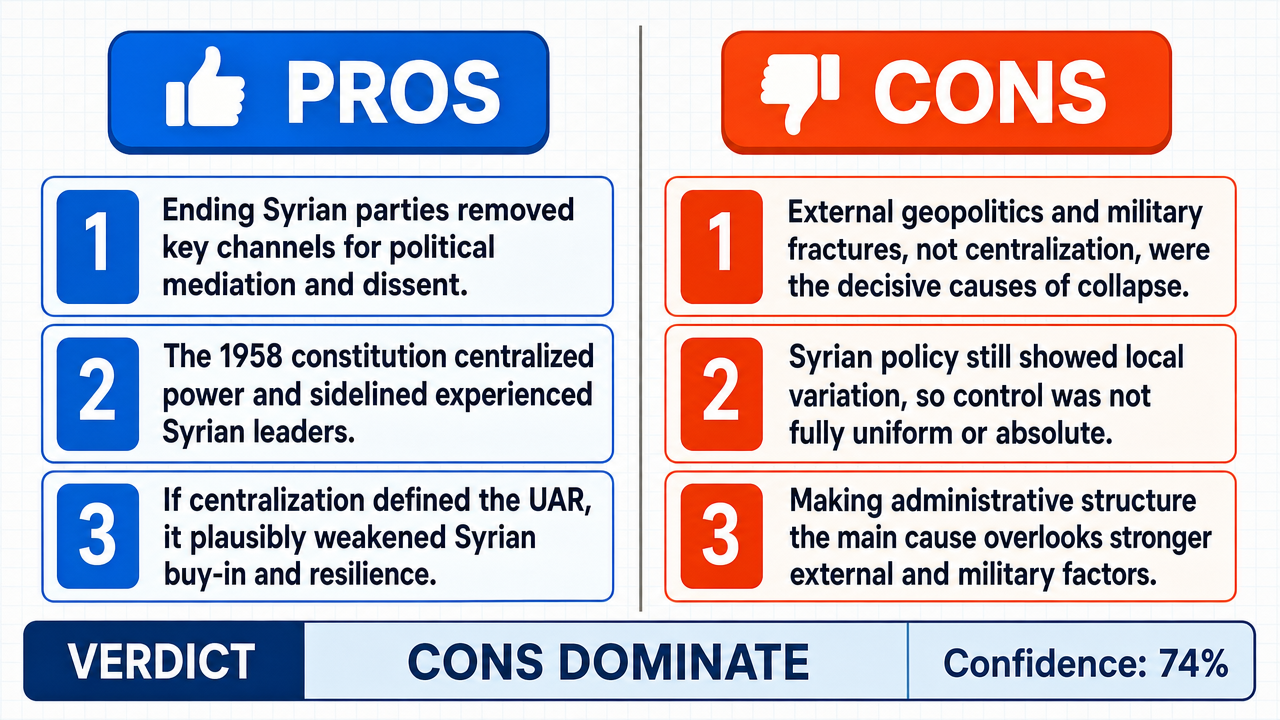
Verdict
Verdict: likely FALSE (74%)
Web Report: https://solsice.com/public/debates/gamal-abdel-nasser-s-conditions-for-the-united-arab-republic-2cc9ee64167f
This section provides a brief overview of the key arguments. You do not need to read the full detailed report below.
✅ Key PRO arguments:
- ■Nasser's dissolution of all Syrian political parties and replacement with the National Union as the sole legal organization eradicated primary channels for Syrian political expression , creating an immediate legitimacy deficit and alienating nearly every significant political group in Syria (citing Malcolm H. Kerr), which directly fueled secessionist plots.
- ■The 1958 Provisional Constitution 's hyper-centralization barred seasoned Syrian politicians from meaningful roles, transforming former leaders into disaffected opponents and stripping the union of local administrative expertise , which directly caused the UAR 's collapse.
- ■The PRO side argued that the opponent's position is internally incoherent: if administrative centralization was a dominant structural feature of the UAR , it cannot simultaneously be dismissed as non-causal in the union 's failure.
❌ Key ANTI arguments:
- ■External geopolitical pressures and internal military fractures—not administrative centralization —were the decisive drivers of the UAR 's collapse; the assertion ignores pre-existing geopolitical hostility directed at any unified Arab front.
- ■Syrian economic policy during the UAR period was characterized by significant local variation and the preservation of certain Syrian-specific legal frameworks, rather than a wholesale imposition of the Egyptian land reform and nationalization model, undermining the claim that centralized economic imposition caused economic discontent .
- ■Treating administrative structure as the primary driver of state stability is an interpretive theory that fails to account for the decisive role of external destabilization and military coups in the UAR 's dissolution.
💭 Conclusion: False. The judge ruled that Nasser's dissolution of Syrian parties and centralized governance did not directly cause the UAR 's failure, siding with the ANTI side's emphasis on external geopolitical pressures and internal military fractures as the primary causal factors. The ANTI side effectively demonstrated that Syrian economic policy retained significant local variation rather than being a wholesale Egyptian imposition, weakening the PRO side's causal narrative. The PRO side's argument that centralization was both a dominant structural feature and yet non-causal was characterized as internally incoherent, but this rhetorical point did not outweigh the substantive historical evidence marshaled by the ANTI side. The compound claim requires both sub-claims (party dissolution AND centralization) to be independently supported as direct causes, and the debate evidence only partially supports the centralization sub-claim while leaving the party dissolution sub-claim contested by alternative causal factors.
🔬 DeepResearch Result: likely FALSE ❌ (74%)
Assertion: Gamal Abdel Nasser's conditions for the United Arab Republic, specifically the dissolution of Syrian political parties and a highly centralized system, directly caused its failure.
Participating models: deepseek-v3.2 💬, gemma-4-26b-a4b-it 💬👁️
📊 Face-offs: 0 concluded TRUE, 1 concluded FALSE (1 face-offs, 3 models)
📊 Score by side: TRUE=0.00, FALSE=0.74
🏅 Model score changes:
minimax-m3 💬👁️: +7
✅ PRO Arguments:
- ■Nasser's dissolution of all Syrian political parties and replacement with the National Union as the sole legal organization eradicated primary channels for Syrian political expression , creating an immediate legitimacy deficit and alienating nearly every significant political group in Syria (citing Malcolm H. Kerr), which directly fueled secessionist plots. deepseek-v3.2 💬
- ■The 1958 Provisional Constitution 's hyper-centralization barred seasoned Syrian politicians from meaningful roles, transforming former leaders into disaffected opponents and stripping the union of local administrative expertise , which directly caused the UAR 's collapse. deepseek-v3.2 💬
- ■The PRO side argued that the opponent's position is internally incoherent: if administrative centralization was a dominant structural feature of the UAR, it cannot simultaneously be dismissed as non-causal in the union's failure. deepseek-v3.2 💬
❌ ANTI Arguments:
- ■External geopolitical pressures and internal military fractures—not administrative centralization—were the decisive drivers of the UAR's collapse; the assertion ignores pre-existing geopolitical hostility directed at any unified Arab front. gemma-4-26b-a4b-it 💬👁️
- ■Syrian economic policy during the UAR period was characterized by significant local variation and the preservation of certain Syrian-specific legal frameworks, rather than a wholesale imposition of the Egyptian land reform and nationalization model, undermining the claim that centralized economic imposition caused economic discontent . gemma-4-26b-a4b-it 💬👁️
- ■Treating administrative structure as the primary driver of state stability is an interpretive theory that fails to account for the decisive role of external destabilization and military coups in the UAR's dissolution. gemma-4-26b-a4b-it 💬👁️
💭 Reasoning: False. The judge ruled that Nasser's dissolution of Syrian parties and centralized governance did not directly cause the UAR's failure, siding with the ANTI side's emphasis on external geopolitical pressures and internal military fractures as the primary causal factors. The ANTI side effectively demonstrated that Syrian economic policy retained significant local variation rather than being a wholesale Egyptian imposition, weakening the PRO side's causal narrative. The PRO side's argument that centralization was both a dominant structural feature and yet non-causal was characterized as internally incoherent, but this rhetorical point did not outweigh the substantive historical evidence marshaled by the ANTI side. The compound claim requires both sub-claims (party dissolution AND centralization) to be independently supported as direct causes, and the debate evidence only partially supports the centralization sub-claim while leaving the party dissolution sub-claim contested by alternative causal factors.
📋 PRO Facts:
• The 1958 Provisional Constitution established the National Union as the sole legal political organization in the UAR.
• Historian Malcolm H. Kerr documented that Nasser's party dissolution alienated nearly every significant political group in Syria.
• Former Syrian political leaders were excluded from meaningful roles under the centralized UAR structure.
📋 ANTI Facts:
• Syrian economic policy during the UAR period preserved certain Syrian-specific legal frameworks rather than uniformly imposing Egyptian models.
• Pre-existing geopolitical hostility was directed at any unified Arab front, not solely at Nasser's domestic policies.
• Internal military fractures and external destabilization played decisive roles in the UAR's dissolution.
| Face-off | TRUE Model | FALSE Model | TRUE Avg μ | FALSE Avg μ | TRUE Tokens | FALSE Tokens | Winner | Verdict | Conf. |
|---|---|---|---|---|---|---|---|---|---|
| #1 | deepseek-v3.2 💬 | gemma-4-26b-a4b-it 💬👁️ | 0.417 | 0.244 | 8 | 2 | TRUE | FALSE | 74% |
The following technical terms, abbreviations, and domain-specific concepts are referenced throughout this debate transcript. Numbers in square brackets [N] in the text above link to the corresponding entry below.
[1] administrative centralization — The concentration of governmental decision-making authority in a single central authority, as opposed to devolving power to regional or local bodies.
[2] agrarian restructuring — The reorganization of agricultural land ownership and production systems, typically through state-led reform measures such as land redistribution.
[3] Arab Cold War — A term used by historians to describe the geopolitical rivalry between competing Arab states (notably Nasserist Egypt and the Hashemite monarchies) during the 1950s and 1960s.
[4] bureaucrats — Career government officials who administer policies and procedures within state administrative systems, as opposed to elected politicians.
[5] causal link — A relationship in which one event, condition, or action is held to be the cause of another, central to establishing historical causation.
[6] causality — The relationship between cause and effect; in historiography, the analytical framework used to determine which factors produced a given outcome.
[7] centralization — The consolidation of political, administrative, or economic authority within a single governing center, reducing regional or local autonomy.
[8] disaffected opponents — Former allies or political actors who have lost loyalty to a regime and actively or passively oppose it.
[9] domestic policy — Government decisions and actions concerning internal affairs, as distinct from foreign or defense policy.
[10] economic discontent — Public dissatisfaction arising from perceived negative economic conditions such as inflation, unemployment, or unequal distribution of resources.
[11] Egyptian model — The specific set of political, economic, and social policies implemented in Egypt under Nasser, including land reform and nationalization, which the debate discusses as potentially being extended to Syria.
[12] elite participation — The involvement of politically and socially influential figures in governance and decision-making processes.
[13] external agency — The capacity of actors outside a state (such as foreign governments) to influence events within that state.
[14] geopolitical hostility — Political and strategic antagonism between states driven by territorial, ideological, or power competition.
[15] Hashemite monarchies — The kingdoms of Iraq and Jordan, both ruled by branches of the Hashemite dynasty, which were rivals of Nasserist Egypt.
[16] hyper-centralization — An extreme or excessive form of centralization, in which nearly all decision-making authority is concentrated at the top of a governmental hierarchy.
[17] intelligence operations — Covert activities conducted by state agencies to gather information, influence events, or undermine rival states.
[18] land reform — State-led redistribution of agricultural land, typically from large landowners to landless peasants, often accompanied by limits on ownership.
[19] legitimacy deficit — A shortfall in the perceived right of a government to rule, often resulting from policies that alienate key political constituencies.
[20] local administrative expertise — Knowledge and skill in governance derived from familiarity with regional conditions, institutions, and populations.
[21] National Union — The sole legal political organization in the United Arab Republic under Nasser, established to replace dissolved political parties.
[22] nationalization — The transfer of private property or industries into state ownership, a policy frequently pursued by post-colonial Arab socialist regimes.
[23] operational autonomy — The degree of independence that regional or local actors retain in making and implementing decisions within their jurisdiction.
[24] political expression — The public articulation of political views, typically through parties, associations, media, or protest.
[25] political parties — Organized groups seeking to influence government policy and gain political power, often through the nomination of candidates for elected office.
[26] Provisional Constitution — Provisional Constitution of 1958 — The interim constitutional document that established the legal framework of the United Arab Republic upon its formation in 1958.
[27] regional rivalry — Competition between neighboring states for influence, resources, or ideological dominance within a geographic area.
[28] secession — The formal withdrawal of a territory or region from a political union, as occurred when Syria left the UAR in 1961.
[29] secessionist plotting — Secret planning by political actors to withdraw their region from a larger political union.
[30] state stability — The durability and continuity of a state's political institutions, territorial integrity, and governing capacity.
[31] structural feature — A defining characteristic of a political or social system that shapes how it operates and responds to events.
[32] subversion — Efforts to undermine or overthrow a government or political order through covert or illegitimate means.
[33] Syrian political class — The collective body of established politicians, party leaders, and influential elites in Syria prior to the UAR.
[34] UAR — United Arab Republic — A political union between Egypt and Syria formed in 1958 under Nasser, which dissolved in 1961 following a Syrian military coup.
[35] union — political union — A formal association of two or more political entities that share certain governing institutions while retaining distinct identities.
Face-off transcripts
- ■
Ownership & Trade Secrets. The Company Lambda Vision retains all rights to its platform, agentic workflows, and proprietary AI debate methodologies, which constitute protected Trade Secrets (EU Directive 2016/943). Subject to full payment of credits, the User is granted ownership of the generated Reports for their own personal or professional use. Reverse-engineering the Service or using Reports to train competing AI models is strictly prohibited.
- ■
No Professional Advice. Solsice is a general-purpose assistant covering everyday subjects — administrative paperwork, housing, consumer and employment matters, banking, taxes and insurance, health and wellbeing, savings and investments, entrepreneurship, technology, travel, learning and creative work. Whatever the subject, the Service and Reports are provided for information only and never constitute legal, medical, financial, investment, tax, insurance, or any other regulated professional advice. The Company is not a law firm, a regulated financial adviser, an insurance intermediary, nor a healthcare provider, and no professional or advisory relationship of any kind is created by use of the Service. Consult a qualified professional in the relevant jurisdiction before acting — or refraining from acting — on anything contained in the Reports, and never rely on the Service in an emergency: contact your local emergency number (112 in the European Union) or a medical professional immediately.
- ■
AI-Generated Content, Sources and Viewpoints. Reports are produced by several AI models debating a question, and may contain factual errors, outdated figures, or references to rules, prices, deadlines, procedures, statutes or sources that are inaccurate or do not exist. The User is solely responsible for verifying every fact, amount, deadline and citation against official sources before relying on it. Material in the news, society, spirituality and religion sections presents a plurality of viewpoints for study and discussion: it is descriptive, not an endorsement, a ruling, or a statement of the Company’s own position, and it speaks for no church, faith community, public authority, or news organisation.
- ■
Liability & Governing Law. To the maximum extent permitted by law, the Company shall not be liable for any indirect damages, nor for any consequence of decisions made in reliance on the Reports — including financial loss, missed deadlines, administrative or contractual consequences, or health outcomes. These Terms are governed by French law. Any disputes shall be subject to the exclusive jurisdiction of the Courts of Paris, France.