
Fried ravioli, or 'T-Ravs,' are a unique culinary invention exclusive to St. Louis.
AI debate verdict and arguments
⚠️ AI-generated information only; not professional advice
Completed October 11, 2026
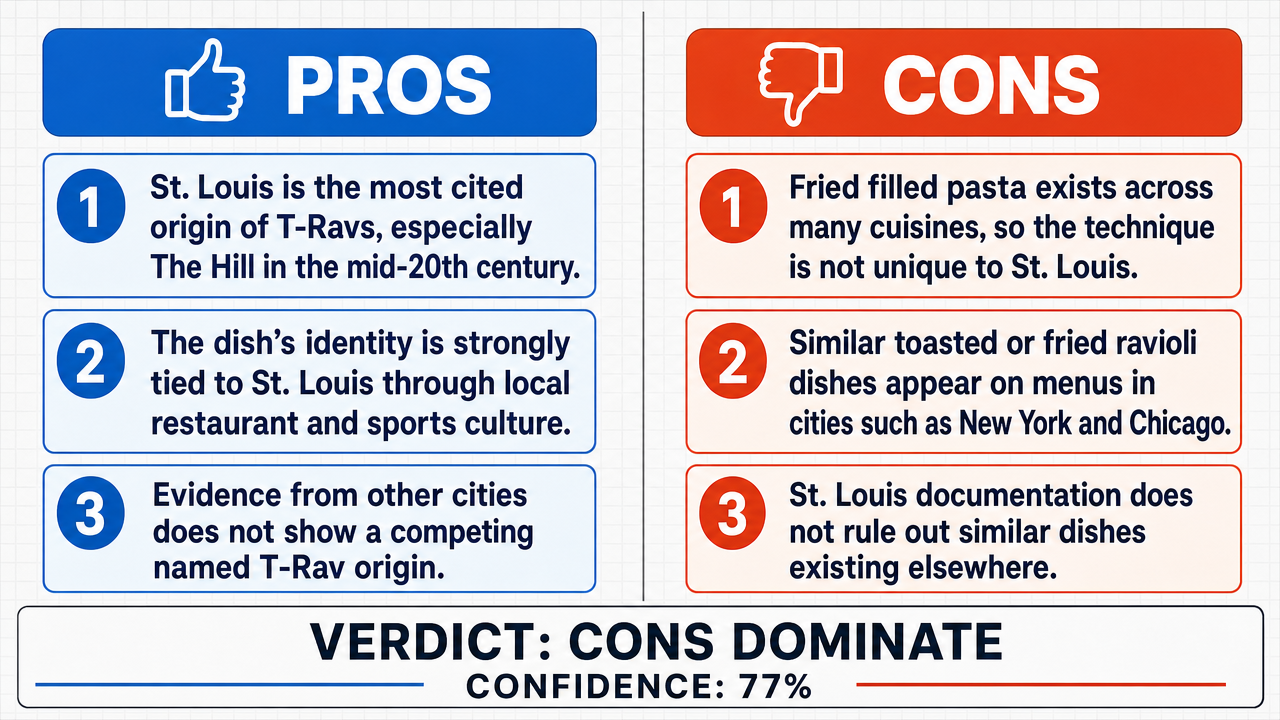
Verdict
Verdict: likely FALSE (77%)
This section provides a brief overview of the key arguments. You do not need to read the full detailed report below.
✅ Key PRO arguments:
- ■The historical record directly attributes the invention of fried ravioli to St. Louis's The Hill neighborhood in the mid-20th century, with the most cited origin story crediting either Mama Campisi's or Charlie Gitto's restaurant with its accidental creation and popularization in the 1940s or 1950s.
- ■The dish's cultural identity is inextricably linked to St. Louis, where it is carried by local restaurant history, sports culture, and the distinctive nickname T-Rav, making it more than just 'pasta fried in oil' but a local appetizer convention of breaded, deep-fried ravioli served with marinara.
- ■The negative's strongest evidence—fried or toasted ravioli existing in other food scenes—does not establish a competing named T-Rav origin elsewhere, since the culinary reference for toasted ravioli describes it as a St. Louis specialty.
❌ Key ANTI arguments:
- ■The assertion fails to account for the widespread existence of fried pasta preparations across various global cuisines; while the specific 'T-Rav' nomenclature may be concentrated in St. Louis, the fundamental culinary act of breading and deep-frying filled pasta is a common practice in many Italian-American and international contexts.
- ■Various 'toasted' or 'fried' ravioli preparations appear on menus in diverse culinary hubs, including New York and Chicago, often as seasonal or specialty items, demonstrating that the technique is not exclusive to St. Louis.
- ■Mid-20th century documentation in St. Louis's The Hill neighborhood does not preclude the existence of similar fried pasta preparations elsewhere, and the claim of exclusivity fails if the origin is a location other than St. Louis.
💭 Conclusion: False. The assertion that fried ravioli (T-Ravs ) are a unique culinary invention exclusive to St. Louis is not supported because the fundamental culinary technique of breading and deep-frying filled pasta exists across multiple global cuisines and Italian-American contexts. While St. Louis can credibly claim to have popularized the specific named dish 'T-Rav' through its The Hill neighborhood restaurants in the mid-20th century, the underlying practice of frying stuffed pasta is not unique to that city. The presence of similar fried or toasted ravioli preparations in other culinary hubs such as New York and Chicago undermines the exclusivity claim. The negative side successfully demonstrated that local branding and nomenclature do not logically establish that the broader culinary concept originated solely in St. Louis. Therefore, the assertion fails on its exclusivity component, even though St. Louis's role in popularizing the named dish is well-documented.
🔬 DeepResearch Result: likely FALSE ❌ (77%)
Assertion: Fried ravioli, or 'T-Ravs ,' are a unique culinary invention exclusive to St. Louis.
Participating models: deepseek-v3.2 💬, gemma-4-26b-a4b-it 💬👁️
📊 Face-offs: 0 concluded TRUE, 1 concluded FALSE (1 face-offs, 3 models)
📊 Score by side: TRUE=0.00, FALSE=0.77
🏅 Model score changes:
minimax-m3 💬👁️: +8
✅ PRO Arguments:
- ■The historical record directly attributes the invention of fried ravioli to St. Louis's The Hill neighborhood in the mid-20th century, with the most cited origin story crediting either Mama Campisi's or Charlie Gitto's restaurant with its accidental creation and popularization in the 1940s or 1950s. deepseek-v3.2 💬
- ■The dish's cultural identity is inextricably linked to St. Louis, where it is carried by local restaurant history, sports culture, and the distinctive nickname T-Rav, making it more than just 'pasta fried in oil' but a local appetizer convention of breaded, deep-fried ravioli served with marinara. deepseek-v3.2 💬
- ■The negative's strongest evidence—fried or toasted ravioli existing in other food scenes—does not establish a competing named T-Rav origin elsewhere, since the culinary reference for toasted ravioli describes it as a St. Louis specialty. deepseek-v3.2 💬
- ■If the dish was independently invented in St. Louis, then the opponent's argument is defeated by the documented record, as culinary histories and local archives consistently trace the dish's origin to The Hill neighborhood. deepseek-v3.2 💬
❌ ANTI Arguments:
- ■The assertion fails to account for the widespread existence of fried pasta preparations across various global cuisines; while the specific 'T-Rav' nomenclature may be concentrated in St. Louis, the fundamental culinary act of breading and deep-frying filled pasta is a common practice in many Italian-American and international contexts. gemma-4-26b-a4b-it 💬👁️
- ■Various 'toasted' or 'fried' ravioli preparations appear on menus in diverse culinary hubs, including New York and Chicago, often as seasonal or specialty items, demonstrating that the technique is not exclusive to St. Louis. gemma-4-26b-a4b-it 💬👁️
- ■Mid-20th century documentation in St. Louis's The Hill neighborhood does not preclude the existence of similar fried pasta preparations elsewhere, and the claim of exclusivity fails if the origin is a location other than St. Louis. gemma-4-26b-a4b-it 💬👁️
- ■A city can claim local branding and nomenclature for a dish (such as the term 'T-Rav') without the underlying culinary concept being unique to or originating solely in that city, since naming conventions and regional variations do not establish exclusivity of the technique itself. gemma-4-26b-a4b-it 💬👁️
💭 Reasoning: False. The assertion that fried ravioli (T-Ravs) are a unique culinary invention exclusive to St. Louis is not supported because the fundamental culinary technique of breading and deep-frying filled pasta exists across multiple global cuisines and Italian-American contexts. While St. Louis can credibly claim to have popularized the specific named dish 'T-Rav' through its The Hill neighborhood restaurants in the mid-20th century, the underlying practice of frying stuffed pasta is not unique to that city. The presence of similar fried or toasted ravioli preparations in other culinary hubs such as New York and Chicago undermines the exclusivity claim. The negative side successfully demonstrated that local branding and nomenclature do not logically establish that the broader culinary concept originated solely in St. Louis. Therefore, the assertion fails on its exclusivity component, even though St. Louis's role in popularizing the named dish is well-documented.
📋 PRO Facts:
• Fried ravioli is historically credited to St. Louis's The Hill neighborhood in the mid-20th century
• The dish is most commonly attributed to either Mama Campisi's or Charlie Gitto's restaurant in the 1940s or 1950s
• The dish carries the distinctive local nickname 'T-Rav' and is part of St. Louis sports culture
• The culinary reference for toasted ravioli describes it as a St. Louis specialty
📋 ANTI Facts:
• Fried pasta preparations exist across various global cuisines beyond St. Louis
• Various 'toasted' or 'fried' ravioli preparations appear on menus in New York and Chicago
• The fundamental culinary act of breading and deep-frying filled pasta is common in Italian-American contexts
• Local branding and nomenclature do not establish exclusivity of the underlying culinary technique
| Face-off | TRUE Model | FALSE Model | TRUE Avg μ | FALSE Avg μ | TRUE Tokens | FALSE Tokens | Winner | Verdict | Conf. |
|---|---|---|---|---|---|---|---|---|---|
| #1 | deepseek-v3.2 💬 | gemma-4-26b-a4b-it 💬👁️ | 0.278 | 0.260 | 12 | 3 | TRUE | FALSE | 77% |
The following technical terms, abbreviations, and domain-specific concepts are referenced throughout this debate transcript. Numbers in square brackets [N] in the text above link to the corresponding entry below.
[1] Core claim — The central assertion or thesis presented in a debate round, serving as the foundation for the arguments that follow.
[2] Culinary evolution — The historical development and transformation of cuisine over time, often shaped by immigration, cultural exchange, and regional adaptation.
[3] Culinary genesis — The documented origin or point of creation of a specific dish or culinary preparation.
[4] Culinary histories — Written or archival accounts that document the development, origins, and cultural context of dishes and food traditions.
[5] Culinary hub — A city or region recognized for its prominent food scene and concentration of notable dining establishments.
[6] Culinary invention — The creation of a new dish or preparation. In this debate, the affirmative argues T-Ravs are a unique culinary invention exclusive to St. Louis, while the negative disputes this, characterizing fried ravioli as a common variation of a widespread technique.
[7] Exhaustive scenarios — A logical reasoning approach that considers all possible cases or branches of an argument to test the validity of a claim.
[8] Facet — A specific dimension or aspect of an argument addressed within a debate round, such as historical evidence or cultural context.
[9] Italian-American cuisine — A culinary tradition developed by Italian immigrants in the United States, characterized by regional adaptations of traditional Italian dishes.
[10] Italian-American enclaves — Neighborhoods with concentrated Italian-American populations, such as St. Louis's The Hill, that serve as centers for the preservation and evolution of Italian-American food traditions.
[11] Local branding — The association of a product, dish, or cultural item with a specific geographic location through naming, marketing, or regional identity.
[12] Nomenclature — A system of names or terms used within a particular field or region, such as the local nickname 'T-Rav' for toasted ravioli in St. Louis.
[13] Stuffed pasta — Pasta varieties filled with ingredients such as cheese, meat, or vegetables, including ravioli, which can be prepared through various cooking methods including frying.
[14] T-Ravs — A local St. Louis nickname for toasted ravioli, used as a distinctive marker of the dish's regional heritage and adopted by local professional sports teams.
[15] The Hill — A historic Italian-American neighborhood in St. Louis, Missouri, credited in the debate as the point of origin for fried ravioli in the mid-20th century.
[16] Toasted ravioli — A St. Louis-style preparation of ravioli that is breaded, deep-fried, and typically served with marinara sauce, distinguished from generic fried pasta by its specific formulation and local identity.
Face-off transcripts
- ■
Ownership & Trade Secrets. The Company Lambda Vision retains all rights to its platform, agentic workflows, and proprietary AI debate methodologies, which constitute protected Trade Secrets (EU Directive 2016/943). Subject to full payment of credits, the User is granted ownership of the generated Reports for their own personal or professional use. Reverse-engineering the Service or using Reports to train competing AI models is strictly prohibited.
- ■
No Professional Advice. Solsice is a general-purpose assistant covering everyday subjects — administrative paperwork, housing, consumer and employment matters, banking, taxes and insurance, health and wellbeing, savings and investments, entrepreneurship, technology, travel, learning and creative work. Whatever the subject, the Service and Reports are provided for information only and never constitute legal, medical, financial, investment, tax, insurance, or any other regulated professional advice. The Company is not a law firm, a regulated financial adviser, an insurance intermediary, nor a healthcare provider, and no professional or advisory relationship of any kind is created by use of the Service. Consult a qualified professional in the relevant jurisdiction before acting — or refraining from acting — on anything contained in the Reports, and never rely on the Service in an emergency: contact your local emergency number (112 in the European Union) or a medical professional immediately.
- ■
AI-Generated Content, Sources and Viewpoints. Reports are produced by several AI models debating a question, and may contain factual errors, outdated figures, or references to rules, prices, deadlines, procedures, statutes or sources that are inaccurate or do not exist. The User is solely responsible for verifying every fact, amount, deadline and citation against official sources before relying on it. Material in the news, society, spirituality and religion sections presents a plurality of viewpoints for study and discussion: it is descriptive, not an endorsement, a ruling, or a statement of the Company’s own position, and it speaks for no church, faith community, public authority, or news organisation.
- ■
Liability & Governing Law. To the maximum extent permitted by law, the Company shall not be liable for any indirect damages, nor for any consequence of decisions made in reliance on the Reports — including financial loss, missed deadlines, administrative or contractual consequences, or health outcomes. These Terms are governed by French law. Any disputes shall be subject to the exclusive jurisdiction of the Courts of Paris, France.