
France has undergone a profound transformation since October 2006, evolving into an entrepreneurial nation that has departed from its historical identity as a vertical, dirigiste, and statist country.
AI debate verdict and arguments
⚠️ AI-generated information only; not professional advice
Completed October 11, 2026
Verdict
Verdict: likely FALSE (86%)
This section provides a brief overview of the key arguments. You do not need to read the full detailed report below.
✅ Key PRO arguments:
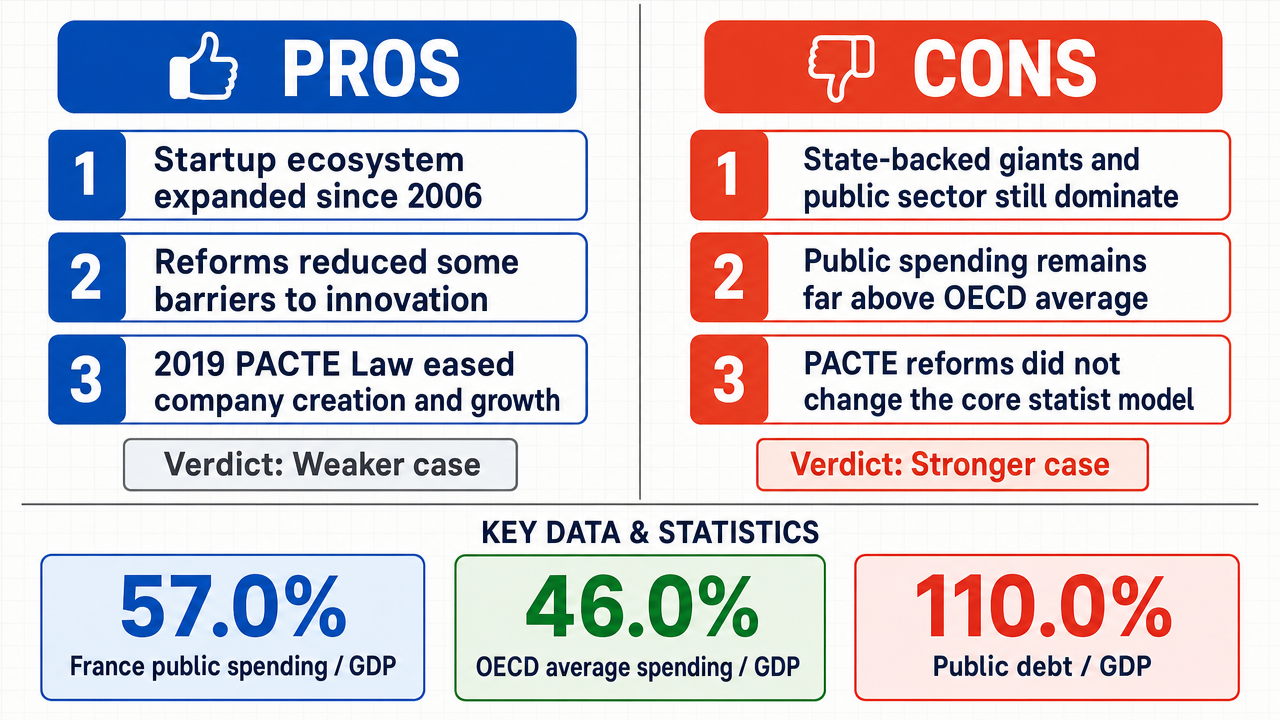
- ■France has significantly fostered an entrepreneurial ecosystem since 2006, with substantial growth in startup creation and venture capital investment, supported by government initiatives like the 'French Tech ' program launched in 2013, which provides funding, mentorship, and a supportive network for tech companies.
- ■The French government has actively implemented policies to reduce bureaucratic hurdles and shift the nature of state intervention toward fostering innovation and private enterprise rather than solely directing industrial strategy .
- ■The 2019 Pacte Law simplified company creation, facilitated business growth, and improved employee participation , signaling a meaningful departure from France's statist identity.
❌ Key ANTI arguments:
- ■France's economy remains dominated by massive, state-backed champions and a massive public sector ; while niche tech ecosystems have expanded, they have not replaced the fundamental dirigiste architecture.
- ■France consistently maintains one of the highest public spending -to-GDP ratios in the OECD , a clear indicator of a statist model rather than an entrepreneurial one, with the state remaining the primary architect of industrial strategy .
- ■The 2019 Pacte Law 's stated objectives—simplifying company creation, facilitating business growth, and improving employee participation —fail to fundamentally alter the nation's dirigiste and vertical economic structure, as the underlying regulatory environment remains one of the most complex in Europe.
💭 Conclusion: False. France has not undergone a profound transformation into an entrepreneurial nation, as its core economic and political structures remain deeply statist . While specific sectors like 'French Tech ' have seen notable growth, this represents a niche development rather than a systemic shift away from dirigisme. France continues to maintain one of the highest public spending -to-GDP ratios in the OECD , with the state remaining dominant through state-backed champions and high state-owned enterprise influence. The 2019 Pacte Law , while streamlining some administrative procedures , did not fundamentally alter the regulatory environment , which remains among the most complex in Europe. The affirmative side's reliance on startup ecosystem growth fails to account for the persistent dominance of state-backed champions and the dirigiste , vertical economic structure that continues to define France's economic identity.
🔬 DeepResearch Result: likely FALSE ❌ (86%)
Assertion: France has undergone a profound transformation since October 2006, evolving into an entrepreneurial nation that has departed from its historical identity as a vertical , dirigiste , and statist country.
Participating models: deepseek-v3.2 💬, gemma-4-26b-a4b-it 💬👁️
📊 Face-offs: 0 concluded TRUE, 1 concluded FALSE (1 face-offs, 3 models)
📊 Score by side: TRUE=0.00, FALSE=0.86
🏅 Model score changes:
minimax-m3 💬👁️: +9
✅ PRO Arguments:
- ■France has significantly fostered an entrepreneurial ecosystem since 2006, with substantial growth in startup creation and venture capital investment, supported by government initiatives like the 'French Tech ' program launched in 2013, which provides funding, mentorship, and a supportive network for tech companies. deepseek-v3.2 💬
- ■The French government has actively implemented policies to reduce bureaucratic hurdles and shift the nature of state intervention toward fostering innovation and private enterprise rather than solely directing industrial strategy . deepseek-v3.2 💬
- ■The 2019 Pacte Law simplified company creation, facilitated business growth, and improved employee participation , signaling a meaningful departure from France's statist identity. deepseek-v3.2 💬
- ■Startup growth in France represents more than a mere 'niche' and constitutes a qualitative change in the economic structure, not just a quantitative expansion of a small sector. deepseek-v3.2 💬
❌ ANTI Arguments:
- ■France's economy remains dominated by massive, state-backed champions and a massive public sector ; while niche tech ecosystems have expanded, they have not replaced the fundamental dirigiste architecture. gemma-4-26b-a4b-it 💬👁️
- ■France consistently maintains one of the highest public spending -to-GDP ratios in the OECD , a clear indicator of a statist model rather than an entrepreneurial one, with the state remaining the primary architect of industrial strategy. gemma-4-26b-a4b-it 💬👁️
- ■The 2019 Pacte Law's stated objectives—simplifying company creation, facilitating business growth, and improving employee participation—fail to fundamentally alter the nation's dirigiste and vertical economic structure, as the underlying regulatory environment remains one of the most complex in Europe. gemma-4-26b-a4b-it 💬👁️
- ■France's fundamental economic and political structures remain deeply statist, characterized by high public spending, significant state influence over strategic industries, and a highly centralized , top-down political architecture that recent reforms have not dismantled. gemma-4-26b-a4b-it 💬👁️
💭 Reasoning: False. France has not undergone a profound transformation into an entrepreneurial nation, as its core economic and political structures remain deeply statist. While specific sectors like 'French Tech' have seen notable growth, this represents a niche development rather than a systemic shift away from dirigisme. France continues to maintain one of the highest public spending-to-GDP ratios in the OECD, with the state remaining dominant through state-backed champions and high state-owned enterprise influence. The 2019 Pacte Law, while streamlining some administrative procedures , did not fundamentally alter the regulatory environment, which remains among the most complex in Europe. The affirmative side's reliance on startup ecosystem growth fails to account for the persistent dominance of state-backed champions and the dirigiste, vertical economic structure that continues to define France's economic identity.
📋 PRO Facts:
• The 'French Tech' program has provided crucial support to tech companies, fostering a dynamic environment for innovation.
• The 2019 Pacte Law aimed to simplify company creation, facilitate business growth, and improve employee participation.
📋 ANTI Facts:
• France consistently maintains one of the highest public spending-to-GDP ratios in the OECD.
• France's regulatory environment remains one of the most complex in Europe despite the 2019 Pacte Law.
• The French economy remains dominated by massive, state-backed champions and a large public sector.
| Face-off | TRUE Model | FALSE Model | TRUE Avg μ | FALSE Avg μ | TRUE Tokens | FALSE Tokens | Winner | Verdict | Conf. |
|---|---|---|---|---|---|---|---|---|---|
| #1 | deepseek-v3.2 💬 | gemma-4-26b-a4b-it 💬👁️ | 0.469 | 0.336 | 12 | 3 | TRUE | FALSE | 86% |
The following technical terms, abbreviations, and domain-specific concepts are referenced throughout this debate transcript. Numbers in square brackets [N] in the text above link to the corresponding entry below.
[1] administrative procedures — Official processes required by government agencies for business operations and compliance, referenced in the debate as targets of streamlining efforts.
[2] Bpifrance — The French public investment bank, described in the debate as actively supporting startups and SMEs and acting as a catalyst for private investment.
[3] bureaucratic hurdles — Administrative obstacles and regulatory complexities that impede business activities, cited as a barrier the French government has sought to reduce.
[4] centralized — A political or administrative structure where authority and decision-making are concentrated at the top levels of government, used to describe France's traditional political architecture.
[5] compliance frameworks — Legal and regulatory structures that businesses must adhere to in their operations, referenced as part of France's complex regulatory environment.
[6] dirigiste — A French economic term describing a state-directed economic model where the government plays a central role in directing industrial and economic activity.
[7] employee participation — A business concept involving employee involvement in company profits and decision-making, cited as an objective of the Pacte Law.
[8] entrepreneurial ecosystem — A network of resources, including funding, mentorship, and support systems, that fosters the creation and growth of new businesses.
[9] French Tech — A government program launched in 2013 that provides funding, mentorship, and a supportive network for tech companies in France.
[10] GDP — Gross Domestic Product — A measure of the total economic output of a country, used in the debate as a denominator for comparing public spending and debt levels.
[11] industrial strategy — Government planning and policies aimed at directing the development of key industries and economic sectors, cited as a hallmark of the dirigiste model.
[12] labor market rigidities — Inflexibilities in employment regulations and practices that can affect hiring, firing, and workforce management, cited as a persistent feature of the French economy.
[13] legal and compliance frameworks — The system of laws and regulations governing business operations, described in the debate as among the most complex in Europe.
[14] OECD — Organisation for Economic Co-operation and Development — An international organization whose economic indicators are used for cross-country comparisons, referenced for benchmarking France's public spending.
[15] Pacte Law — Plan d'Action pour la Croissance et la Transformation des Entreprises — French legislation from 2019 aimed at simplifying company creation, facilitating business growth, and improving employee participation in company profits.
[16] public debt — The total amount of government borrowing, expressed in the debate as a percentage of GDP for cross-country comparison.
[17] public investment — Government spending on assets and initiatives intended to support economic development, cited as a tool for fostering innovation.
[18] public sector — The portion of the economy controlled and operated by the government, cited as remaining massive in France.
[19] public spending — Government expenditure on public services and programs, measured in the debate as a percentage of GDP.
[20] public spending-to-GDP ratio — A fiscal metric comparing government expenditure to the country's total economic output, used to assess the size of the state's economic role.
[21] regulatory environment — The overall system of laws, rules, and administrative practices that govern business operations, described as highly complex in France.
[22] SME — Small and Medium Enterprises — Businesses below a certain size threshold, referenced in the context of Bpifrance's support activities.
[23] startup — A newly established business venture, typically in the technology sector, focused on innovation and rapid growth.
[24] state-backed champions — Large corporations supported by the state, often through subsidies or other forms of assistance, that dominate strategic sectors of the economy.
[25] state-directed credit — Lending and financial resources allocated according to government direction rather than purely market mechanisms.
[26] state-owned enterprise — A business entity owned and controlled by the government, cited as exerting high influence in the French economy.
[27] statist — A political-economic system characterized by extensive state involvement and dominance in economic affairs.
[28] strategic sectors — Key industries considered vital to national interests, such as energy and transport, often subject to state control or influence.
[29] subsidies — Direct financial support provided by the government to businesses or industries, cited as a tool of state industrial strategy.
[30] top-down — A hierarchical approach to management or governance where decisions are made at higher levels and implemented downward.
[31] venture capital — Private equity financing provided to startups and early-stage companies with high growth potential, cited as having grown substantially in France.
[32] vertical — A hierarchical organizational structure where authority flows from top to bottom, used in the debate to describe France's traditional economic governance.
The following financial data tables were referenced during the debate exchanges:
| Indicator | France (Approx. Value) | OECD Average (Approx. Value) |
|---|---|---|
| Public Spending as % of GDP | 57.0% | 46.0% |
| Public Debt as % of GDP | 110.0% | 110.0% |
| State-Owned Enterprise Influence | High | Moderate |
Legend: Comparison of French public spending and debt levels against OECD averages. Data represents recent historical trends.
Face-off transcripts
- ■
Ownership & Trade Secrets. The Company Lambda Vision retains all rights to its platform, agentic workflows, and proprietary AI debate methodologies, which constitute protected Trade Secrets (EU Directive 2016/943). Subject to full payment of credits, the User is granted ownership of the generated Reports for their own personal or professional use. Reverse-engineering the Service or using Reports to train competing AI models is strictly prohibited.
- ■
No Professional Advice. Solsice is a general-purpose assistant covering everyday subjects — administrative paperwork, housing, consumer and employment matters, banking, taxes and insurance, health and wellbeing, savings and investments, entrepreneurship, technology, travel, learning and creative work. Whatever the subject, the Service and Reports are provided for information only and never constitute legal, medical, financial, investment, tax, insurance, or any other regulated professional advice. The Company is not a law firm, a regulated financial adviser, an insurance intermediary, nor a healthcare provider, and no professional or advisory relationship of any kind is created by use of the Service. Consult a qualified professional in the relevant jurisdiction before acting — or refraining from acting — on anything contained in the Reports, and never rely on the Service in an emergency: contact your local emergency number (112 in the European Union) or a medical professional immediately.
- ■
AI-Generated Content, Sources and Viewpoints. Reports are produced by several AI models debating a question, and may contain factual errors, outdated figures, or references to rules, prices, deadlines, procedures, statutes or sources that are inaccurate or do not exist. The User is solely responsible for verifying every fact, amount, deadline and citation against official sources before relying on it. Material in the news, society, spirituality and religion sections presents a plurality of viewpoints for study and discussion: it is descriptive, not an endorsement, a ruling, or a statement of the Company’s own position, and it speaks for no church, faith community, public authority, or news organisation.
- ■
Liability & Governing Law. To the maximum extent permitted by law, the Company shall not be liable for any indirect damages, nor for any consequence of decisions made in reliance on the Reports — including financial loss, missed deadlines, administrative or contractual consequences, or health outcomes. These Terms are governed by French law. Any disputes shall be subject to the exclusive jurisdiction of the Courts of Paris, France.