
For real estate investors, the most significant delays in rental property turnovers, both expected and unexpected, typically occur during the 'last 5%' of the project.
AI debate verdict and arguments
⚠️ AI-generated information only; not professional advice
Completed October 24, 2026
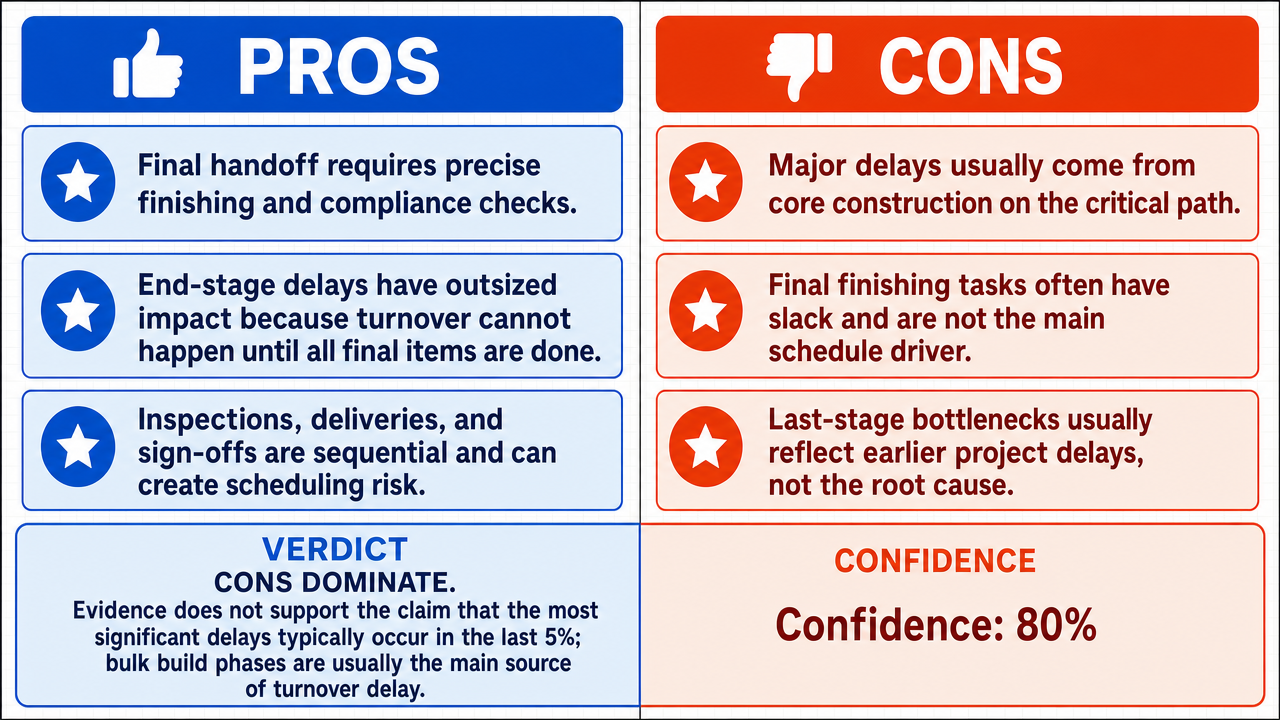
Verdict
Verdict: likely FALSE (80%)
Web Report: https://solsice.com/public/debates/for-real-estate-investors-the-most-significant-delays-in-ren-6491720ccbbf
This section provides a brief overview of the key arguments. You do not need to read the full detailed report below.
✅ Key PRO arguments:
- ■The 'last 5%' phenomenon is driven by the transition from structural work to high-precision finishing and compliance, where specialized trades and meticulous inspections create a 'dependency bottleneck ' that disproportionately delays project completion.
- ■Delays in the final phase are significant not by total duration but by critical impact on the project's terminal state, since the entire project's completion hinges on a single highly scheduled event such as a final municipal inspection or specialized electrical sign-off .
- ■The final stage involves sequential and non-negotiable tasks (inspections, fixture arrivals, specialized sign-offs) that create disproportionate scheduling risk compared to the parallelizable bulk work earlier in the project.
❌ Key ANTI arguments:
- ■The Critical Path Method (CPM ) shows that bulk build activities—foundation, structural framing , and MEP rough-ins —form the critical path and constitute 60–80% of the total project duration, meaning structural delays in this phase extend the entire project.
- ■The 'last 5%' (finishing) consists of activities with 'float' (slack) scheduled to occur only after the critical path is nearly complete, so a delay in the final 5% is rarely the cause of a late completion; rather, a delay in the first 95% is the cause.
- ■Dependency bottlenecks observed in the final 5% are symptoms of earlier bulk build delays, not primary causes—when a delay occurs in the final 5%, it is almost invariably because the bulk build finished late, creating a bottleneck where none existed during construction.
💭 Conclusion: The assertion that the most significant delays in rental property turnovers typically occur during the 'last 5%' is not supported by the evidence. The Critical Path Method demonstrates that bulk build activities—foundation, structural framing , and MEP rough-ins —constitute 60–80% of the total project duration and form the critical path, meaning delays in this phase extend the entire project. The final 5% consists of finishing activities that are scheduled only after the critical path is nearly complete, so delays there are rarely the primary cause of late completion. Dependency bottlenecks observed in the final 5% are symptoms of earlier bulk build delays rather than independent causes.
🔬 DeepResearch Result: likely FALSE ❌ (80%)
Assertion: For real estate investors, the most significant delays in rental property turnovers , both expected and unexpected, typically occur during the 'last 5%' of the project.
Participating models: gemma-4-26b-a4b-it 💬👁️, glm-4.7-flash 💬
📊 Face-offs: 0 concluded TRUE, 1 concluded FALSE (1 face-offs, 3 models)
📊 Score by side: TRUE=0.00, FALSE=0.80
🏅 Model score changes:
minimax-m3 💬👁️: +8
✅ PRO Arguments:
- ■The 'last 5%' phenomenon is driven by the transition from structural work to high-precision finishing and compliance, where specialized trades and meticulous inspections create a 'dependency bottleneck ' that disproportionately delays project completion. gemma-4-26b-a4b-it 💬👁️
- ■Delays in the final phase are significant not by total duration but by critical impact on the project's terminal state, since the entire project's completion hinges on a single highly scheduled event such as a final municipal inspection or specialized electrical sign-off . gemma-4-26b-a4b-it 💬👁️
- ■The final stage involves sequential and non-negotiable tasks (inspections, fixture arrivals, specialized sign-offs) that create disproportionate scheduling risk compared to the parallelizable bulk work earlier in the project. gemma-4-26b-a4b-it 💬👁️
❌ ANTI Arguments:
- ■The Critical Path Method (CPM ) shows that bulk build activities—foundation, structural framing , and MEP rough-ins —form the critical path and constitute 60–80% of the total project duration, meaning structural delays in this phase extend the entire project. glm-4.7-flash 💬
- ■The 'last 5%' (finishing) consists of activities with 'float' (slack) scheduled to occur only after the critical path is nearly complete, so a delay in the final 5% is rarely the cause of a late completion; rather, a delay in the first 95% is the cause. glm-4.7-flash 💬
- ■Dependency bottlenecks observed in the final 5% are symptoms of earlier bulk build delays, not primary causes—when a delay occurs in the final 5%, it is almost invariably because the bulk build finished late, creating a bottleneck where none existed during construction. glm-4.7-flash 💬
- ■The duration and probability of delays are overwhelmingly concentrated in the bulk build phase, not the finishing phase, because the bulk build involves more tasks, more trades, and longer exposure to scheduling and supply-chain risk. glm-4.7-flash 💬
💭 Reasoning: The assertion that the most significant delays in rental property turnovers typically occur during the 'last 5%' is not supported by the evidence. The Critical Path Method demonstrates that bulk build activities—foundation, structural framing, and MEP rough-ins—constitute 60–80% of the total project duration and form the critical path, meaning delays in this phase extend the entire project. The final 5% consists of finishing activities that are scheduled only after the critical path is nearly complete, so delays there are rarely the primary cause of late completion. Dependency bottlenecks observed in the final 5% are symptoms of earlier bulk build delays rather than independent causes.
📋 PRO Facts:
• The final stage of a turnover involves specialized trades and meticulous inspections that are sequential and non-negotiable.
• A single highly scheduled event (e.g., a final inspection, specialized trade sign-off, or specific fixture delivery) can gate the entire project's completion.
• Delays can be 'significant' to an investor either by total duration or by critical impact on the project's terminal state.
📋 ANTI Facts:
• Bulk build activities (foundation, structural framing, MEP rough-ins) form the critical path and constitute 60–80% of the total project duration.
• Finishing activities in the 'last 5%' typically have float (slack) and are scheduled after the critical path is nearly complete.
• When a delay occurs in the final 5%, it is almost invariably because the bulk build finished late, making the final-phase bottleneck a symptom rather than a primary cause.
| Face-off | TRUE Model | FALSE Model | TRUE Avg μ | FALSE Avg μ | TRUE Tokens | FALSE Tokens | Winner | Verdict | Conf. |
|---|---|---|---|---|---|---|---|---|---|
| #1 | gemma-4-26b-a4b-it 💬👁️ | glm-4.7-flash 💬 | 0.288 | 0.459 | 4 | 4 | FALSE | FALSE | 80% |
The following technical terms, abbreviations, and domain-specific concepts are referenced throughout this debate transcript. Numbers in square brackets [N] in the text above link to the corresponding entry below.
[1] AACE International — Association for the Advancement of Cost Engineering International — A professional association cited in the debate as the source of project management standards that categorize schedule overruns by phase.
[2] bulk build — In the debate, refers to the major construction activities (foundation, structural framing, MEP rough-ins) that constitute the majority of a turnover's timeline, contrasted with the final finishing phase.
[3] commissioning — A project phase referenced in the debate as distinct from the 'construction' phase, involving final verification and handover activities.
[4] CPM — Critical Path Method — A project management technique that identifies the sequence of dependent tasks determining the minimum project duration.
[5] critical path — The longest sequence of dependent tasks in a project schedule; delays on this path directly extend the overall project duration.
[6] dependency bottleneck — A point in a project where completion hinges on a single scheduled event, such that a minor setback can halt the entire timeline.
[7] Design Changes — Cited in the debate as one of the leading statistical causes of construction project slippage.
[8] electrical sign-off — A specialized inspection approval cited as an example of a sequential, non-negotiable event in the final phase of a turnover.
[9] float (slack) — The amount of time a task can be delayed without affecting the project completion date; finishing activities are described as having float scheduled after the critical path.
[10] gatekeeper — Used metaphorically in the debate to describe the final 5% phase, which only opens if the bulk build (critical path) is clear.
[11] habitable rental unit — A dwelling that meets the standards required for legal occupancy, marking the transition from construction site to rental use.
[12] inspection and compliance hurdle — A concept in the debate describing the regulatory and inspection requirements that must be cleared as a property nears the end of its turnover.
[13] last 5% — The final portion of a rental property turnover, characterized in the debate as involving finishing work, inspections, and compliance steps. The affirmative argues this phase contains disproportionate delays; the negative disputes this.
[14] man-hours — A unit of labor input measuring the total hours worked by personnel; cited in the debate as a measure of where project effort is concentrated.
[15] MEP rough-ins — Mechanical, Electrical, and Plumbing rough-ins — The initial installation of mechanical, electrical, and plumbing systems before walls are closed up, cited as part of the bulk build critical path.
[16] municipal inspection — A government-conducted inspection cited as an example of a sequential, non-negotiable event that can halt the final phase of a turnover.
[17] Permitting and Approvals — Cited in the debate as one of the leading statistical causes of construction project slippage.
[18] project slippage — The condition in which a project falls behind its planned schedule; the debate cites statistical analyses identifying its leading causes.
[19] rental property turnovers — The process of preparing a rental property between tenants, involving renovation, inspection, and compliance activities.
[20] rigid sequentiality — A state in which tasks must be performed in strict sequence with no parallel work possible, described in the debate as characteristic of the final 5%.
[21] schedule overruns — Instances where a project exceeds its planned timeline; AACE International standards are cited in the debate as categorizing these by phase.
[22] structural framing — The construction of a building's load-bearing skeleton, cited as part of the bulk build critical path.
[23] terminal phase volatility — A concept introduced in the debate describing unpredictable delays that occur in the final phase of a project, where the project's success is validated.
The following financial data tables were referenced during the debate exchanges:
| Phase of Turnover | Primary Activity Type | Delay Sensitivity | Impact on Occupancy |
|---|---|---|---|
| Initial 95% | Structural/Bulk | Moderate | Low |
| Final 5% | Finishing/Compliance | Extreme | Critical |
Legend: Comparison of turnover phases. Sensitivity and Impact are qualitative assessments of how much a delay affects the final move-in date.
| Phase of Project | Approx. Duration % | Primary Delay Risks | % of Total Delay Hours |
|---|---|---|---|
| Planning & Permitting | 5% | Zoning, Environmental, Design | 15% |
| Construction (Bulk) | 75% | Labor, Weather, Material | 65% |
| Finishing & Turnover | 20% | Coordination, Sign-offs | 15% |
Legend: Duration and delay impact based on general construction management industry benchmarks (e.g., Dodge Data & Analytics). Duration is the standard time allocation; Delay Hours represents the estimated percentage of total project delay hours attributed to that phase.
Face-off transcripts
- ■
Ownership & Trade Secrets. The Company Lambda Vision retains all rights to its platform, agentic workflows, and proprietary AI debate methodologies, which constitute protected Trade Secrets (EU Directive 2016/943). Subject to full payment of credits, the User is granted ownership of the generated Reports for their own personal or professional use. Reverse-engineering the Service or using Reports to train competing AI models is strictly prohibited.
- ■
No Professional Advice. Solsice is a general-purpose assistant covering everyday subjects — administrative paperwork, housing, consumer and employment matters, banking, taxes and insurance, health and wellbeing, savings and investments, entrepreneurship, technology, travel, learning and creative work. Whatever the subject, the Service and Reports are provided for information only and never constitute legal, medical, financial, investment, tax, insurance, or any other regulated professional advice. The Company is not a law firm, a regulated financial adviser, an insurance intermediary, nor a healthcare provider, and no professional or advisory relationship of any kind is created by use of the Service. Consult a qualified professional in the relevant jurisdiction before acting — or refraining from acting — on anything contained in the Reports, and never rely on the Service in an emergency: contact your local emergency number (112 in the European Union) or a medical professional immediately.
- ■
AI-Generated Content, Sources and Viewpoints. Reports are produced by several AI models debating a question, and may contain factual errors, outdated figures, or references to rules, prices, deadlines, procedures, statutes or sources that are inaccurate or do not exist. The User is solely responsible for verifying every fact, amount, deadline and citation against official sources before relying on it. Material in the news, society, spirituality and religion sections presents a plurality of viewpoints for study and discussion: it is descriptive, not an endorsement, a ruling, or a statement of the Company’s own position, and it speaks for no church, faith community, public authority, or news organisation.
- ■
Liability & Governing Law. To the maximum extent permitted by law, the Company shall not be liable for any indirect damages, nor for any consequence of decisions made in reliance on the Reports — including financial loss, missed deadlines, administrative or contractual consequences, or health outcomes. These Terms are governed by French law. Any disputes shall be subject to the exclusive jurisdiction of the Courts of Paris, France.