
For men, independently connecting with their 'feminine side' is crucial to avoid codependent relationships and access emotional experiences without relying on a partner.
AI debate verdict and arguments
⚠️ AI-generated information only; not professional advice
Completed October 14, 2026
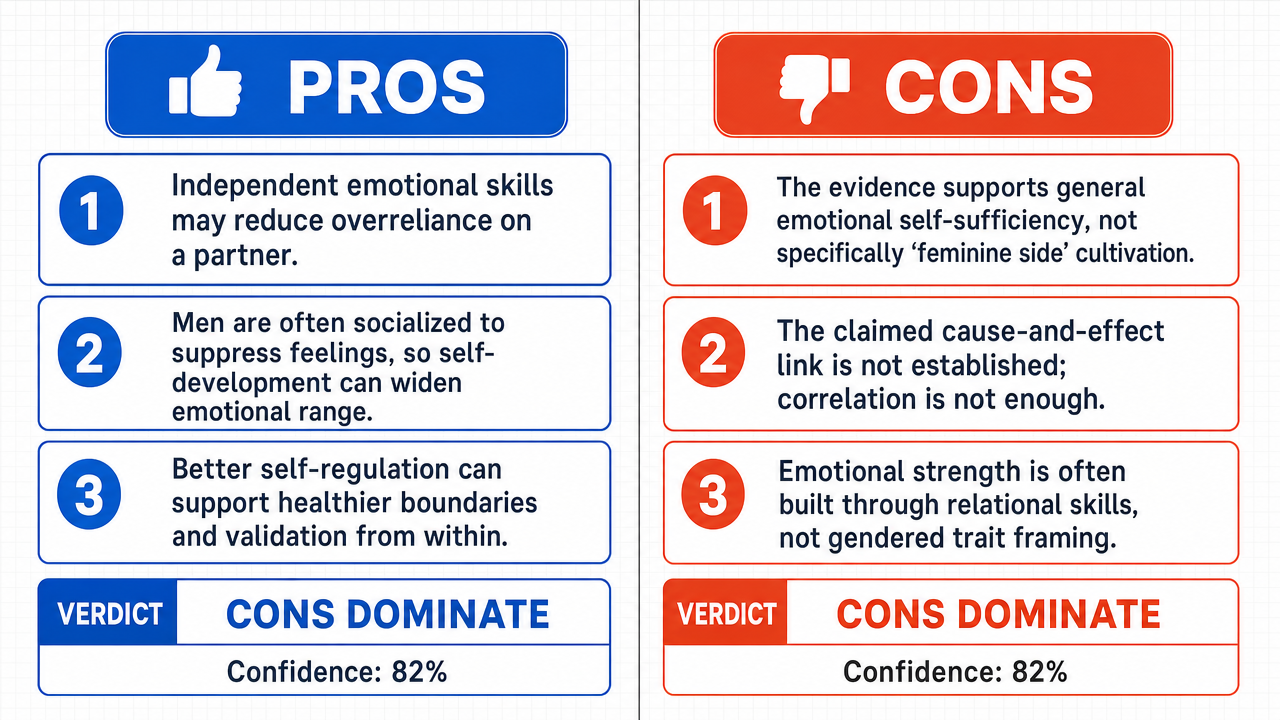
Verdict
Verdict: likely FALSE (82%)
Web Report: https://solsice.com/public/debates/for-men-independently-connecting-with-their-feminine-side-is-9214325d6ac5
This section provides a brief overview of the key arguments. You do not need to read the full detailed report below.
✅ Key PRO arguments:
- ■Emotional self-sufficiency is a protective factor against codependency , as a meta-analysis of attachment and dependency studies found that individuals with higher self-reported emotional self-sufficiency scores exhibited significantly lower codependency traits.
- ■Male gender socialization discourages emotional expressiveness and encourages outsourcing emotional labor to female partners, creating a structural barrier that independent cultivation of a fuller emotional repertoire directly addresses.
- ■Codependency is characterized by an excessive reliance on a partner for emotional regulation and validation, so developing independent emotional processing capacity is necessary to break this pattern.
❌ Key ANTI arguments:
- ■The affirmative commits a fundamental substitution of entities: it presents evidence on the general psychological construct of 'emotional self-sufficiency ' but concludes about the specific gendered performance of 'feminine traits' without establishing any transfer operator or causal link between the two.
- ■The argument is logically inconsistent because it asserts a causal, protective relationship (self-sufficiency protects against codependency ) while providing only evidence of negative correlation (higher scores associated with lower codependency traits), which is insufficient to support the causal claim.
- ■Emotional self-sufficiency is better achieved through relational competence rather than independent gendered trait cultivation, undermining the claim that connecting with a 'feminine side' is the necessary mechanism.
💭 Conclusion: False. The FALSE side won because the affirmative failed to establish the critical causal link between cultivating 'feminine' traits specifically and achieving emotional self-sufficiency , instead substituting evidence about a general psychological construct for a claim about a specific gendered performance. The affirmative's reliance on correlational data to support a causal protective relationship was identified as a logical inconsistency that undermined the compound claim. Both sub-claims—that connecting with a feminine side avoids codependency and enables independent emotional access—were weakened by this missing causal bridge. The confidence is set at 82% reflecting the judge's assessment, though the compound nature of the claim and the absence of direct evidence linking feminine trait cultivation to the asserted outcomes prevents higher certainty.
🔬 DeepResearch Result: likely FALSE ❌ (82%)
Assertion: For men, independently connecting with their 'feminine side' is crucial to avoid codependent relationships and access emotional experiences without relying on a partner.
Participating models: deepseek-v3.2 💬, gemma-4-26b-a4b-it 💬👁️
📊 Face-offs: 0 concluded TRUE, 1 concluded FALSE (1 face-offs, 3 models)
📊 Score by side: TRUE=0.00, FALSE=0.82
🏅 Model score changes:
minimax-m3 💬👁️: +8
✅ PRO Arguments:
- ■Emotional self-sufficiency is a protective factor against codependency , as a meta-analysis of attachment and dependency studies found that individuals with higher self-reported emotional self-sufficiency scores exhibited significantly lower codependency traits. deepseek-v3.2 💬
- ■Male gender socialization discourages emotional expressiveness and encourages outsourcing emotional labor to female partners, creating a structural barrier that independent cultivation of a fuller emotional repertoire directly addresses. deepseek-v3.2 💬
- ■Codependency is characterized by an excessive reliance on a partner for emotional regulation and validation, so developing independent emotional processing capacity is necessary to break this pattern. deepseek-v3.2 💬
❌ ANTI Arguments:
- ■The affirmative commits a fundamental substitution of entities: it presents evidence on the general psychological construct of 'emotional self-sufficiency' but concludes about the specific gendered performance of 'feminine traits' without establishing any transfer operator or causal link between the two. gemma-4-26b-a4b-it 💬👁️
- ■The argument is logically inconsistent because it asserts a causal, protective relationship (self-sufficiency protects against codependency) while providing only evidence of negative correlation (higher scores associated with lower codependency traits), which is insufficient to support the causal claim. gemma-4-26b-a4b-it 💬👁️
- ■Emotional self-sufficiency is better achieved through relational competence rather than independent gendered trait cultivation, undermining the claim that connecting with a 'feminine side' is the necessary mechanism. gemma-4-26b-a4b-it 💬👁️
💭 Reasoning: False. The FALSE side won because the affirmative failed to establish the critical causal link between cultivating 'feminine' traits specifically and achieving emotional self-sufficiency, instead substituting evidence about a general psychological construct for a claim about a specific gendered performance. The affirmative's reliance on correlational data to support a causal protective relationship was identified as a logical inconsistency that undermined the compound claim. Both sub-claims—that connecting with a feminine side avoids codependency and enables independent emotional access—were weakened by this missing causal bridge. The confidence is set at 82% reflecting the judge's assessment, though the compound nature of the claim and the absence of direct evidence linking feminine trait cultivation to the asserted outcomes prevents higher certainty.
📋 PRO Facts:
• A meta-analysis of attachment and dependency studies found that individuals with higher self-reported emotional self-sufficiency scores exhibited significantly lower codependency traits.
• Codependency is characterized by an excessive reliance on a partner for emotional regulation and validation.
📋 ANTI Facts:
• The affirmative provided evidence of negative correlation between self-sufficiency and codependency, not a causal protective relationship.
• No direct causal link was established between 'feminine' trait cultivation and emotional self-sufficiency outcomes.
| Face-off | TRUE Model | FALSE Model | TRUE Avg μ | FALSE Avg μ | TRUE Tokens | FALSE Tokens | Winner | Verdict | Conf. |
|---|---|---|---|---|---|---|---|---|---|
| #1 | deepseek-v3.2 💬 | gemma-4-26b-a4b-it 💬👁️ | 0.440 | 0.384 | 8 | 2 | TRUE | FALSE | 82% |
The following technical terms, abbreviations, and domain-specific concepts are referenced throughout this debate transcript. Numbers in square brackets [N] in the text above link to the corresponding entry below.
[1] attachment style — A concept from attachment theory describing characteristic patterns of relating to others in close relationships (e.g., secure attachment), referenced as a possible third variable influencing both codependency and self-sufficiency.
[2] causal mechanism — A description of the process by which one variable produces an effect on another; the debate notes that the affirmative's evidence shows correlation only, which does not license claims about a causal protective mechanism.
[3] codependency — Excessive reliance on a partner for emotional regulation and validation, characterized by behaviors such as enmeshment and loss of self.
[4] codependent dynamics — Patterns of compulsive external emotional seeking between partners, contrasted in the debate with self-sufficient emotional processing.
[5] cognitive regulation — A means of emotional self-sufficiency through thought-based control of affect, cited by the negative as an alternative to gendered trait cultivation.
[6] correlation — A statistical relationship between two variables; the debate distinguishes a negative correlation between self-sufficiency and codependency from a causal protective relationship.
[7] emotional expressiveness — The capacity to outwardly display and communicate one's emotions, described in the debate as a traditionally feminine quality.
[8] emotional processing — Identifying, expressing, and managing a full range of emotions, which the debate describes as correlating negatively with codependent behaviors when performed independently.
[9] emotional regulation — The process of managing and modulating one's emotional states, mentioned as something partners become excessively relied upon for in codependent dynamics.
[10] emotional repertoire — The range of emotional capacities a person can access; the affirmative argues independent cultivation expands this repertoire to overcome socialization-based deficits.
[11] emotional self-sufficiency — A psychological construct referring to the capacity for independent emotional processing, presented in the debate as a protective factor against codependency.
[12] empathy — The capacity to recognize and share the emotional states of others, listed among the traditionally feminine qualities the affirmative urges men to cultivate.
[13] enmeshment — A relational pattern in which boundaries between individuals become blurred, cited as one of the codependent behaviors that self-sufficiency counteracts.
[14] gender socialization — The process by which individuals learn gender norms; the affirmative argues male gender socialization discourages emotional expressiveness and encourages outsourcing emotional labor to partners.
[15] interdependence — Mutual reliance between partners; the negative's position is framed in terms of secure attachment requiring interdependence rather than isolation.
[16] loss of self — Erosion of one's independent identity or boundaries within a relationship, listed as a codependent behavior alongside enmeshment.
[17] meta-analysis — A research method that statistically aggregates results from multiple studies; cited by the affirmative as the basis for the self-sufficiency/codependency finding.
[18] neuroticism — A personality trait characterized by emotional instability, mentioned as a possible third variable that could explain the observed correlation between self-sufficiency and low codependency.
[19] outsourcing emotional labor — Delegating one's emotional processing and expression to a partner rather than performing it internally, characterized in the debate as a product of male socialization.
[20] resilience — The capacity to recover from emotional difficulty, offered by the negative as a non-gendered route to emotional self-sufficiency.
[21] reverse causality — The possibility that the direction of causation runs opposite to the one asserted; raised by the negative to argue low codependency could enable self-sufficiency rather than vice versa.
[22] secure attachment — An attachment style marked by comfort with both closeness and autonomy, cited as a potential confounding variable in the self-sufficiency/codependency relationship.
[23] socialization — The process by which individuals internalize norms and behaviors of their culture or group; the debate treats socialization patterns as the structural barrier to self-sufficient emotional access.
[24] stoicism — A philosophical and psychological orientation emphasizing emotional restraint and endurance, cited as one non-gendered path to emotional self-sufficiency.
[25] transfer operator — A term used by the negative to denote the missing causal link or correlation between a general construct (self-sufficiency) and a specific gendered performance (feminine traits).
Face-off transcripts
- ■
Ownership & Trade Secrets. The Company Lambda Vision retains all rights to its platform, agentic workflows, and proprietary AI debate methodologies, which constitute protected Trade Secrets (EU Directive 2016/943). Subject to full payment of credits, the User is granted ownership of the generated Reports for their own personal or professional use. Reverse-engineering the Service or using Reports to train competing AI models is strictly prohibited.
- ■
No Professional Advice. Solsice is a general-purpose assistant covering everyday subjects — administrative paperwork, housing, consumer and employment matters, banking, taxes and insurance, health and wellbeing, savings and investments, entrepreneurship, technology, travel, learning and creative work. Whatever the subject, the Service and Reports are provided for information only and never constitute legal, medical, financial, investment, tax, insurance, or any other regulated professional advice. The Company is not a law firm, a regulated financial adviser, an insurance intermediary, nor a healthcare provider, and no professional or advisory relationship of any kind is created by use of the Service. Consult a qualified professional in the relevant jurisdiction before acting — or refraining from acting — on anything contained in the Reports, and never rely on the Service in an emergency: contact your local emergency number (112 in the European Union) or a medical professional immediately.
- ■
AI-Generated Content, Sources and Viewpoints. Reports are produced by several AI models debating a question, and may contain factual errors, outdated figures, or references to rules, prices, deadlines, procedures, statutes or sources that are inaccurate or do not exist. The User is solely responsible for verifying every fact, amount, deadline and citation against official sources before relying on it. Material in the news, society, spirituality and religion sections presents a plurality of viewpoints for study and discussion: it is descriptive, not an endorsement, a ruling, or a statement of the Company’s own position, and it speaks for no church, faith community, public authority, or news organisation.
- ■
Liability & Governing Law. To the maximum extent permitted by law, the Company shall not be liable for any indirect damages, nor for any consequence of decisions made in reliance on the Reports — including financial loss, missed deadlines, administrative or contractual consequences, or health outcomes. These Terms are governed by French law. Any disputes shall be subject to the exclusive jurisdiction of the Courts of Paris, France.