
For a hydraulic services company, making climate adaptation part of every tender is a competitive advantage rather than a net cost.
AI debate verdict and arguments
⚠️ AI-generated information only; not professional advice
Completed October 29, 2026
Verdict
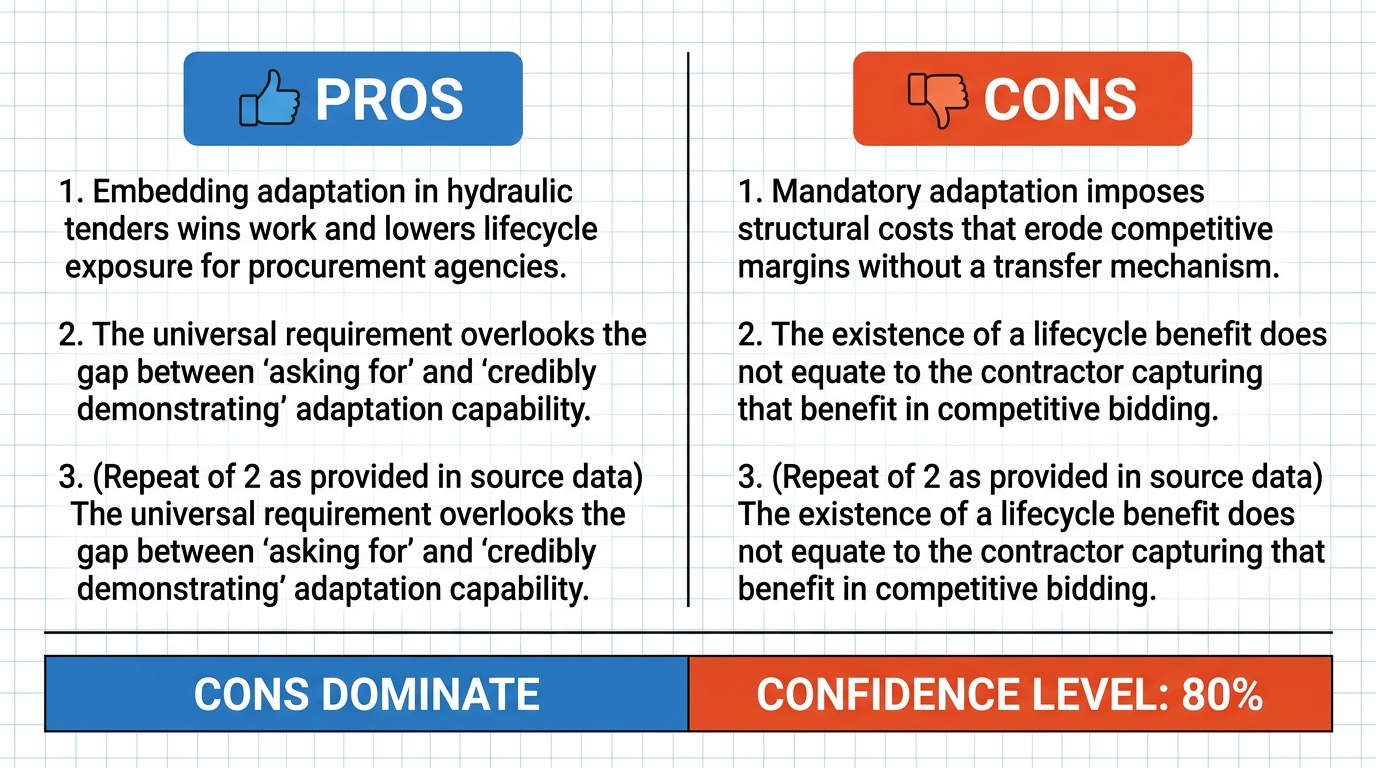
Verdict: likely FALSE (80%)
Web Report: https://solsice.com/public/debates/for-a-hydraulic-services-company-making-climate-adaptation-p-b00f36b4f43d
This section provides a brief overview of the key arguments. You do not need to read the full detailed report below.
✅ Key PRO arguments:
- ■Embedding climate adaptation in hydraulic tenders generally wins work and lowers lifecycle exposure ; agencies procuring flood control, drainage, pumping and water-security works increasingly require bidders to show designs can cope with changed rainfall, sea level, drought and flood regimes, making adaptation credentials a way to satisfy evaluators and reduce bid non-compliance risk .
- ■The opponent treats a universal requirement as producing a universal capability; the gap between 'adaptation is asked for' and 'adaptation is credibly demonstrated' is where competitive advantage resides, because not all bidders can credibly demonstrate adaptation.
❌ Key ANTI arguments:
- ■Mandatory climate adaptation in every tender imposes structural costs that erode competitive margins; the affirmative fails to provide a transfer operator between the buyer's saved capital and the seller's captured revenue.
- ■The argument conflates the existence of a lifecycle benefit with the capture of that benefit by the contractor; in a competitive bidding environment, the 'avoided cost' is a value proposition for the buyer, not a revenue stream for the seller, so the upfront expense remains an immediate net cost to the hydraulic services company.
💭 Conclusion: False: the winning side demonstrated that making climate adaptation part of every tender is a net cost to a hydraulic services company, not a competitive advantage. The core flaw in the affirmative case is the missing transfer operator : lifecycle savings from resilience accrue to the buyer, while the contractor bears the upfront tender and construction costs. In a competitive bidding environment, mandatory adaptation requirements become baseline compliance costs that raise prices and erode margins without differentiating the bidder. The affirmative's claim that a universal requirement creates a universal capability was rebutted by the negative's point that the gap between requirement and credible demonstration does not guarantee revenue capture. Therefore the verdict is FALSE, with confidence reflecting the single judge's 80% confidence in the negative side.
🔬 DeepResearch Result: likely FALSE ❌ (80%)
Assertion: For a hydraulic services company, making climate adaptation part of every tender is a competitive advantage rather than a net cost.
Participating models: deepseek-v3.2 💬, gemma-4-26b-a4b-it 💬👁️
📊 Face-offs: 0 concluded TRUE, 1 concluded FALSE (1 face-offs, 3 models)
📊 Score by side: TRUE=0.00, FALSE=0.80
🏅 Model score changes:
deepseek-v4-flash-0731 💬: +8
✅ PRO Arguments:
- ■Embedding climate adaptation in hydraulic tenders generally wins work and lowers lifecycle exposure ; agencies procuring flood control, drainage, pumping and water-security works increasingly require bidders to show designs can cope with changed rainfall, sea level, drought and flood regimes, making adaptation credentials a way to satisfy evaluators and reduce bid non-compliance risk . deepseek-v3.2 💬
- ■The opponent treats a universal requirement as producing a universal capability; the gap between 'adaptation is asked for' and 'adaptation is credibly demonstrated' is where competitive advantage resides, because not all bidders can credibly demonstrate adaptation. deepseek-v3.2 💬
❌ ANTI Arguments:
- ■Mandatory climate adaptation in every tender imposes structural costs that erode competitive margins; the affirmative fails to provide a transfer operator between the buyer's saved capital and the seller's captured revenue. gemma-4-26b-a4b-it 💬👁️
- ■The argument conflates the existence of a lifecycle benefit with the capture of that benefit by the contractor; in a competitive bidding environment, the 'avoided cost' is a value proposition for the buyer, not a revenue stream for the seller, so the upfront expense remains an immediate net cost to the hydraulic services company. gemma-4-26b-a4b-it 💬👁️
💭 Reasoning: False: the winning side demonstrated that making climate adaptation part of every tender is a net cost to a hydraulic services company, not a competitive advantage. The core flaw in the affirmative case is the missing transfer operator: lifecycle savings from resilience accrue to the buyer, while the contractor bears the upfront tender and construction costs. In a competitive bidding environment, mandatory adaptation requirements become baseline compliance costs that raise prices and erode margins without differentiating the bidder. The affirmative's claim that a universal requirement creates a universal capability was rebutted by the negative's point that the gap between requirement and credible demonstration does not guarantee revenue capture. Therefore the verdict is FALSE, with confidence reflecting the single judge's 80% confidence in the negative side.
📋 PRO Facts:
• USACE states that climate change affects civil works and that resilience must be considered in planning, design and operations.
• Public, utility, donor-funded and regulated hydraulic services tenders increasingly include adaptation as a responsiveness and scoring factor .
• Adaptation credentials can satisfy evaluators and reduce bid non-compliance risk.
📋 ANTI Facts:
• Mandatory climate adaptation in every tender imposes structural costs that erode competitive margins.
• Avoided lifecycle cost is a value proposition for the buyer, not a revenue stream for the seller.
• In competitive bidding, the upfront expense of resilient hydraulic infrastructure is an immediate net cost during the tender phase.
| Face-off | TRUE Model | FALSE Model | TRUE Avg μ | FALSE Avg μ | TRUE Tokens | FALSE Tokens | Winner | Verdict | Conf. |
|---|---|---|---|---|---|---|---|---|---|
| #1 | deepseek-v3.2 💬 | gemma-4-26b-a4b-it 💬👁️ | 0.565 | 0.311 | 8 | 2 | TRUE | FALSE | 80% |
The following technical terms, abbreviations, and domain-specific concepts are referenced throughout this debate transcript. Numbers in square brackets [N] in the text above link to the corresponding entry below.
[1] avoided lifecycle cost — The reduction in future damages, downtime, and repair costs over an asset's life, used as a value proposition for the buyer.
[2] baseline compliance cost — The minimum cost a bidder must incur to meet standard procurement requirements, which does not differentiate bidders.
[3] bid non-compliance risk — The risk that a proposal fails to meet procurement requirements and is disqualified.
[4] CAPEX — capital expenditure — Upfront capital spending on resilient, more expensive components.
[5] climate adaptation — Adjusting designs and operations to cope with changed rainfall, sea level, drought, and flood regimes.
[6] climate-resilient assets — Infrastructure designed to withstand climate impacts and reduce long-term operational costs.
[7] COGS — cost of goods sold — The direct costs of producing the components or services sold, which increase with adaptive components.
[8] commodity-driven market — A market where products are largely undifferentiated and competition is based mainly on price.
[9] drought-compatible backflow design — A design feature ensuring backflow prevention works under drought conditions.
[10] environmental and social risk management — Procurement requirements that proposals address environmental and social risks in infrastructure projects.
[11] flood-rated pump curves — Pump performance curves specified for flood conditions, used to demonstrate adaptation capability.
[12] hydraulic services — Services related to water flow, flood control, drainage, pumping, and water-security infrastructure.
[13] lifecycle cost — Total cost of owning and operating an asset over its lifetime, including maintenance and repairs.
[14] lifecycle exposure — The potential costs and risks an asset faces over its lifetime due to climate and other factors.
[15] lowest-bidder environments — Procurement settings where contracts are awarded to the lowest price bidder.
[16] OPEX — operational expenditure — Recurring costs of operating and maintaining assets, which resilience may reduce for the owner.
[17] pricing power — A contractor's ability to charge prices above cost without losing customers, limited in commodity markets.
[18] procurement regulations — Rules governing infrastructure procurement that require bidders to address climate and environmental risks.
[19] resilience — The ability of infrastructure to withstand and recover from climate-related shocks.
[20] responsiveness — How well a bid meets the stated requirements and scoring factors in a tender.
[21] scoring factor — A criterion used by evaluators to score and compare proposals.
[22] tender — A formal offer to undertake work at a stated price, submitted in response to a procurement request.
[23] total cost of ownership — The complete cost of owning an asset, including acquisition, operation, and maintenance.
[24] transfer operator — A mechanism that would convert a buyer's saved costs into a contractor's captured revenue; the debate argues none is provided.
[25] water-security works — Infrastructure projects aimed at ensuring reliable water supply and protection from water-related risks.
[26] win rates — The percentage of tenders a company successfully wins.
The following financial data tables were referenced during the debate exchanges:
| Cost Driver | Standard Tender | Adaptation-Integrated Tender | Δ Cost Impact |
|---|---|---|---|
| Material/Equipment CAPEX | 1.0x | 1.25x | +25.0% |
| Engineering/Design Hours | 1.0x | 1.40x | +40.0% |
| Professional Indemnity Premium | 1.0x | 1.15x | +15.0% |
| Bid Preparation Overhead | 1.0x | 1.30x | +30.0% |
| Total Estimated Bid Cost | 1.0x | 1.28x | +28.0% |
Legend: Comparative cost scaling for hydraulic service tenders. Base unit (1.0x) represents standard non-adaptation tenders. Δ Cost Impact represents the percentage increase in specific cost categories.
Face-off transcripts
- ■
Ownership & Trade Secrets. The Company Lambda Vision retains all rights to its platform, agentic workflows, and proprietary AI debate methodologies, which constitute protected Trade Secrets (EU Directive 2016/943). Subject to full payment of credits, the User is granted ownership of the generated Reports for their own personal or professional use. Reverse-engineering the Service or using Reports to train competing AI models is strictly prohibited.
- ■
No Professional Advice. Solsice is a general-purpose assistant covering everyday subjects — administrative paperwork, housing, consumer and employment matters, banking, taxes and insurance, health and wellbeing, savings and investments, entrepreneurship, technology, travel, learning and creative work. Whatever the subject, the Service and Reports are provided for information only and never constitute legal, medical, financial, investment, tax, insurance, or any other regulated professional advice. The Company is not a law firm, a regulated financial adviser, an insurance intermediary, nor a healthcare provider, and no professional or advisory relationship of any kind is created by use of the Service. Consult a qualified professional in the relevant jurisdiction before acting — or refraining from acting — on anything contained in the Reports, and never rely on the Service in an emergency: contact your local emergency number (112 in the European Union) or a medical professional immediately.
- ■
AI-Generated Content, Sources and Viewpoints. Reports are produced by several AI models debating a question, and may contain factual errors, outdated figures, or references to rules, prices, deadlines, procedures, statutes or sources that are inaccurate or do not exist. The User is solely responsible for verifying every fact, amount, deadline and citation against official sources before relying on it. Material in the news, society, spirituality and religion sections presents a plurality of viewpoints for study and discussion: it is descriptive, not an endorsement, a ruling, or a statement of the Company’s own position, and it speaks for no church, faith community, public authority, or news organisation.
- ■
Liability & Governing Law. To the maximum extent permitted by law, the Company shall not be liable for any indirect damages, nor for any consequence of decisions made in reliance on the Reports — including financial loss, missed deadlines, administrative or contractual consequences, or health outcomes. These Terms are governed by French law. Any disputes shall be subject to the exclusive jurisdiction of the Courts of Paris, France.