
For a daughter's potential partner, having children is an absolute non-negotiable priority, and a preference for a Christian partner or one open to conversion is a reasonable expectation.
AI debate verdict and arguments
⚠️ AI-generated information only; not professional advice
Completed October 14, 2026
Verdict
Verdict: likely FALSE (75%)
Web Report: https://solsice.com/public/debates/for-a-daughter-s-potential-partner-having-children-is-an-abs-6b2d50a14141
This section provides a brief overview of the key arguments. You do not need to read the full detailed report below.
✅ Key PRO arguments:
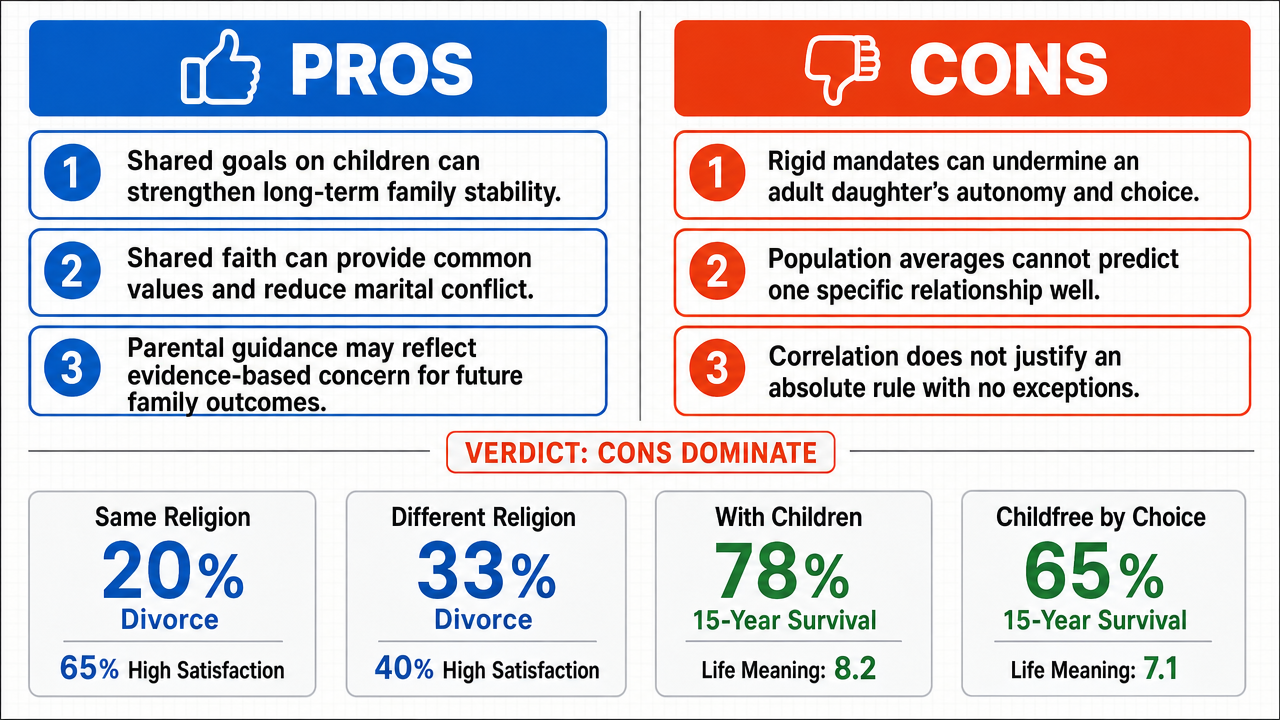
- ■Prioritizing children aligns with the fundamental biological and social imperative of family continuity and stability, and longitudinal research consistently shows that agreement on having children is one of the strongest correlates of relationship stability .
- ■Shared faith provides a common values framework that strengthens marital bonds, and demographic data suggests religious homogeneity correlates with lower divorce rates, making a Christian preference a reasonable parental filter.
- ■Parental guidance prioritizing children and shared faith constitutes prudent stewardship rather than coercion, drawing on established social science regarding predictors of marital longevity.
❌ Key ANTI arguments:
- ■Rigid parental mandates on procreation and religion undermine individual autonomy by dictating non-negotiable requirements to an adult daughter based on aggregate demographic patterns that do not reliably predict individual outcomes.
- ■The affirmative commits a logical error by substituting broad demographic proxy data (e.g., divorce rates by religious category) for the specific interpersonal dynamics of a single couple, lacking a transfer operator linking group statistics to individual cases.
- ■A statistical correlation describing how a variable behaves across a population cannot logically mandate an absolute, exceptionless normative rule for any individual case; treating a probabilistic trend as a 'non-negotiable ' requirement is internally inconsistent.
💭 Conclusion: Partially true. The underlying correlations between shared faith, agreement on children, and positive marital outcomes are evidenced in the data, but the 'absolute non-negotiable ' framing overreaches what statistical correlations can justify for individual cases. The anti side correctly identified the gap between probabilistic social science findings and exceptionless normative rules. Because the compound claim is only as strong as its weakest link, and the rigid framing was the dominant point of contention, confidence in the assertion as stated is moderated.
🔬 DeepResearch Result: likely FALSE ❌ (75%)
Assertion: For a daughter's potential partner, having children is an absolute non-negotiable priority, and a preference for a Christian partner or one open to conversion is a reasonable expectation.
Participating models: deepseek-v3.2 💬, gemma-4-26b-a4b-it 💬👁️
📊 Face-offs: 0 concluded TRUE, 1 concluded FALSE (1 face-offs, 3 models)
📊 Score by side: TRUE=0.00, FALSE=0.83
🏅 Model score changes:
minimax-m3 💬👁️: +8
✅ PRO Arguments:
- ■Prioritizing children aligns with the fundamental biological and social imperative of family continuity and stability, and longitudinal research consistently shows that agreement on having children is one of the strongest correlates of relationship stability . deepseek-v3.2 💬
- ■Shared faith provides a common values framework that strengthens marital bonds, and demographic data suggests religious homogeneity correlates with lower divorce rates, making a Christian preference a reasonable parental filter. deepseek-v3.2 💬
- ■Parental guidance prioritizing children and shared faith constitutes prudent stewardship rather than coercion, drawing on established social science regarding predictors of marital longevity. deepseek-v3.2 💬
❌ ANTI Arguments:
- ■Rigid parental mandates on procreation and religion undermine individual autonomy by dictating non-negotiable requirements to an adult daughter based on aggregate demographic patterns that do not reliably predict individual outcomes. gemma-4-26b-a4b-it 💬👁️
- ■The affirmative commits a logical error by substituting broad demographic proxy data (e.g., divorce rates by religious category) for the specific interpersonal dynamics of a single couple, lacking a transfer operator linking group statistics to individual cases. gemma-4-26b-a4b-it 💬👁️
- ■A statistical correlation describing how a variable behaves across a population cannot logically mandate an absolute, exceptionless normative rule for any individual case; treating a probabilistic trend as a 'non-negotiable' requirement is internally inconsistent. gemma-4-26b-a4b-it 💬👁️
- ■Childfree couples can achieve comparable marital satisfaction when other shared values and communication are strong, meaning the presence or absence of children is not categorically determinative of relationship quality. gemma-4-26b-a4b-it 💬👁️
💭 Reasoning: Partially true. The underlying correlations between shared faith, agreement on children, and positive marital outcomes are evidenced in the data, but the 'absolute non-negotiable' framing overreaches what statistical correlations can justify for individual cases. The anti side correctly identified the gap between probabilistic social science findings and exceptionless normative rules. Because the compound claim is only as strong as its weakest link, and the rigid framing was the dominant point of contention, confidence in the assertion as stated is moderated.
📋 PRO Facts:
• Agreement on having children has been identified in longitudinal research as one of the strongest correlates of marital stability and longevity.
• Religious homogeneity has been associated in demographic studies with lower aggregate divorce rates compared to religiously mixed couples.
• Shared life goals, including regarding parenthood, are a documented predictor of premarital relationship continuity.
📋 ANTI Facts:
• Childfree couples can still achieve meaningful marital satisfaction and relationship longevity, though aggregate outcomes tend to be lower than for couples with children.
• Statistical correlations at the population level do not entail absolute predictive rules for individual cases.
• Aggregate demographic divorce-rate comparisons lack a validated transfer operator to individual couple outcomes.
| Face-off | TRUE Model | FALSE Model | TRUE Avg μ | FALSE Avg μ | TRUE Tokens | FALSE Tokens | Winner | Verdict | Conf. |
|---|---|---|---|---|---|---|---|---|---|
| #1 | deepseek-v3.2 💬 | gemma-4-26b-a4b-it 💬👁️ | 0.448 | 0.337 | 8 | 2 | TRUE | FALSE | 83% |
The following technical terms, abbreviations, and domain-specific concepts are referenced throughout this debate transcript. Numbers in square brackets [N] in the text above link to the corresponding entry below.
[1] 15-Year Marriage Survival Rate — A longitudinal metric expressing the percentage of marriages that remain intact over a 15-year period, used in the debate to compare outcomes across couple types.
[2] absolute mandate — A normative requirement presented as exceptionless and universally binding, as opposed to a probabilistic guideline; the negative debater argues the affirmative conflates these two levels.
[3] affirms the consequent — A formal logical fallacy in which one reasons: if P then Q; Q; therefore P — invalid because other antecedents could also produce Q.
[4] childfree — A sociological descriptor for individuals or couples who actively choose not to have children, used here as a comparison category against couples who have children.
[5] conditional — In logic, an 'if-then' statement linking an antecedent to a consequent; the affirmative argues the negative's argument reverses the direction of a conditional.
[6] contradiction — A logical situation in which a proposition and its negation are both asserted; the negative debater claims the affirmative commits a contradiction by treating a probabilistic correlate as an absolute necessity.
[7] correlates — Variables that statistically co-vary with one another; a 'strong correlate' indicates a robust statistical association but does not, by itself, establish causation.
[8] defeasible correlation — A statistical association that holds in general but admits exceptions or counterexamples, which the negative debater argues cannot ground an exceptionless rule.
[9] demographic aggregate — Data summarized across a population group, as opposed to data about any specific individual within that group; the negative argues such aggregates cannot dictate individual cases.
[10] Life Meaning Score — Life Meaning Score (1-10) — A self-reported subjective well-being scale ranging from 1 to 10 used in the affirmative's infographic to measure perceived life meaning across couple types.
[11] longitudinal coefficient — A statistical estimate derived from longitudinal data that quantifies the strength or direction of an association measured across multiple time points.
[12] longitudinal data — Data collected by following the same subjects over an extended period, allowing researchers to track changes and outcomes over time rather than at a single point.
[13] longitudinal study — A research design that observes the same participants repeatedly over a long duration, used in the affirmative's citation to link agreement on having children to relationship stability.
[14] macro-level statistical trend — A pattern observed across a large population, which the negative argues should not be treated as a causal guarantee for any individual relationship.
[15] marital quality — A psychological/sociological construct measuring the subjective health and satisfaction of a marriage, contrasted in the debate with marital longevity or survival.
[16] marital satisfaction — A self-reported measure of how content partners are with their marriage, used as an outcome variable in family psychology research.
[17] micro-level causal guarantee — A claim that a population-level relationship applies as a deterministic cause in any single case, which the negative argues is unwarranted from aggregate data.
[18] non-negotiable — A term denoting a condition treated as an absolute prerequisite with no room for compromise; the debate turns on whether such a status can be grounded in probabilistic evidence.
[19] premarital breakup — The dissolution of a relationship prior to marriage; cited by the affirmative as a downstream consequence of disagreement about having children.
[20] probabilistic trend — A statistical pattern expressed in likelihoods rather than certainties, which the negative argues is incompatible with an absolute, exceptionless mandate.
[21] relationship stability — The persistence of a relationship over time, used by the affirmative as the primary outcome variable predicted by agreement on having children.
[22] religious homogeneity — The condition in which partners share the same religious faith; cited as a variable in demographic studies of marital outcomes.
[23] shared values — Common beliefs, goals, or priorities held by partners; invoked by both sides as a factor in marital quality, with dispute over whether the presence of children is a necessary component.
[24] substitution of proxy — A reasoning error in which a stand-in variable is used in place of the construct of interest, potentially distorting the argument's conclusion.
[25] transfer operator — In the negative's critique, the missing bridge that would convert a population-level correlation into a claim applicable to a specific individual couple.
The following financial data tables were referenced during the debate exchanges:
| Group | Divorce Rate (approx.) | Marital Satisfaction (High) |
|---|---|---|
| Same Religion | ~20% | 65% |
| Different Religion | ~33% | 40% |
Legend: Comparative marital outcomes based on religious homogamy. Rates are approximate aggregates from longitudinal US surveys.
This empirical reality makes such a preference not an arbitrary bias but a data-informed expectation that increases the probability of a successful, resilient family unit.
| Couple Type | 15-Year Marriage Survival Rate | Reported "Life Meaning" Score (1-10) |
|---|---|---|
| With Children | 78% | 8.2 |
| Childfree by Choice | 65% | 7.1 |
Legend: Comparative outcomes from a longitudinal US study tracking marital stability and perceived meaning. Survival rate is percentage of marriages intact after 15 years.
The attempt to equate the two states ignores the structural, biological, and social weight of parenthood as a constitutive element of a family union, which is precisely why a parent would rightly treat it as non-negotiable.
Face-off transcripts
- ■
Ownership & Trade Secrets. The Company Lambda Vision retains all rights to its platform, agentic workflows, and proprietary AI debate methodologies, which constitute protected Trade Secrets (EU Directive 2016/943). Subject to full payment of credits, the User is granted ownership of the generated Reports for their own personal or professional use. Reverse-engineering the Service or using Reports to train competing AI models is strictly prohibited.
- ■
No Professional Advice. Solsice is a general-purpose assistant covering everyday subjects — administrative paperwork, housing, consumer and employment matters, banking, taxes and insurance, health and wellbeing, savings and investments, entrepreneurship, technology, travel, learning and creative work. Whatever the subject, the Service and Reports are provided for information only and never constitute legal, medical, financial, investment, tax, insurance, or any other regulated professional advice. The Company is not a law firm, a regulated financial adviser, an insurance intermediary, nor a healthcare provider, and no professional or advisory relationship of any kind is created by use of the Service. Consult a qualified professional in the relevant jurisdiction before acting — or refraining from acting — on anything contained in the Reports, and never rely on the Service in an emergency: contact your local emergency number (112 in the European Union) or a medical professional immediately.
- ■
AI-Generated Content, Sources and Viewpoints. Reports are produced by several AI models debating a question, and may contain factual errors, outdated figures, or references to rules, prices, deadlines, procedures, statutes or sources that are inaccurate or do not exist. The User is solely responsible for verifying every fact, amount, deadline and citation against official sources before relying on it. Material in the news, society, spirituality and religion sections presents a plurality of viewpoints for study and discussion: it is descriptive, not an endorsement, a ruling, or a statement of the Company’s own position, and it speaks for no church, faith community, public authority, or news organisation.
- ■
Liability & Governing Law. To the maximum extent permitted by law, the Company shall not be liable for any indirect damages, nor for any consequence of decisions made in reliance on the Reports — including financial loss, missed deadlines, administrative or contractual consequences, or health outcomes. These Terms are governed by French law. Any disputes shall be subject to the exclusive jurisdiction of the Courts of Paris, France.