
Food aid, such as EBT, should be exclusively reserved for individuals and households who demonstrate genuine financial need.
AI debate verdict and arguments
⚠️ AI-generated information only; not professional advice
Completed October 18, 2026
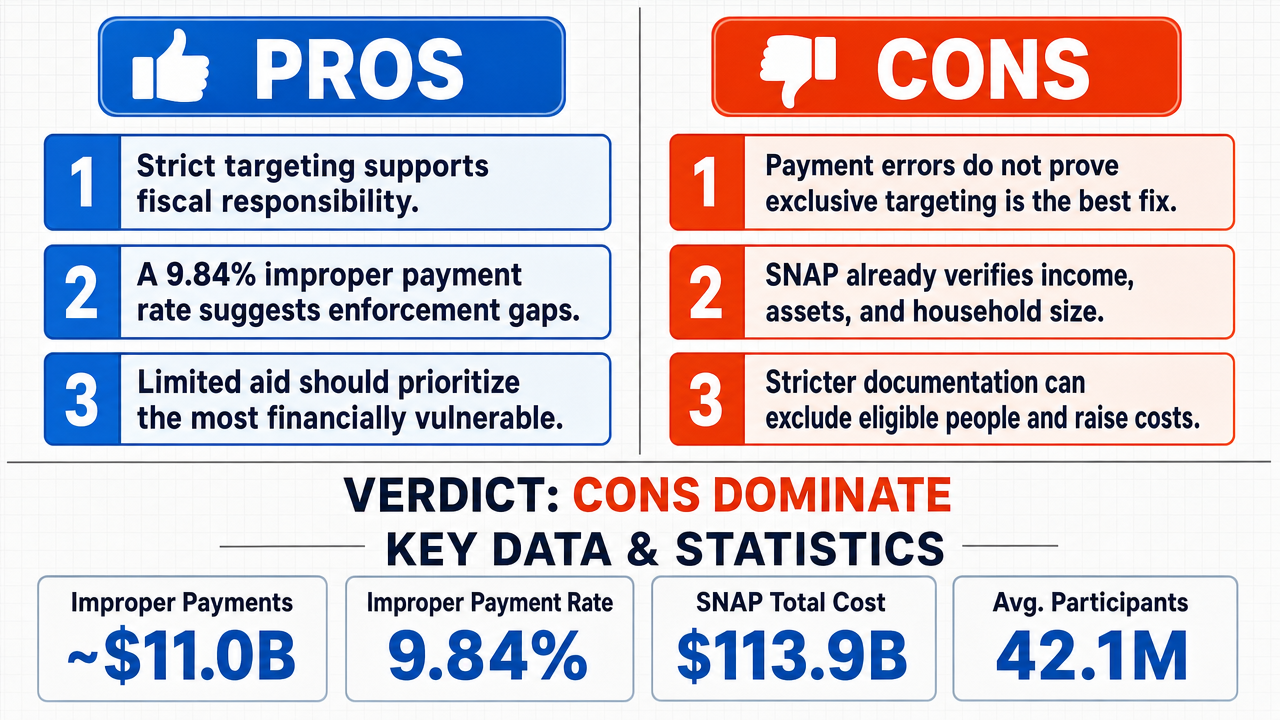
Verdict
Verdict: likely FALSE (63%)
Web Report: https://solsice.com/public/debates/food-aid-such-as-ebt-should-be-exclusively-reserved-for-indi-d5f787a0abea
This section provides a brief overview of the key arguments. You do not need to read the full detailed report below.
✅ Key PRO arguments:
- ■Targeting food aid strictly to households with proven financial need is essential for fiscal responsibility , because even a modest misallocation rate in a program as large as SNAP multiplies into billions of dollars of improper payments .
- ■SNAP 's 9.84% improper payment rate demonstrates that current eligibility enforcement is insufficient and that exclusive, need-based targeting is necessary to prevent leakage of public funds.
- ■Without strict need-based criteria, scarce nutrition resources risk being diverted away from the truly vulnerable, undermining the program's core mission.
❌ Key ANTI arguments:
- ■The affirmative's reliance on improper payment rates to justify exclusive targeting commits a logical fallacy of substitution , because the administrative cost of implementing rigorous, need-exclusive verification would likely exceed the cost of the leakage it aims to eliminate.
- ■SNAP is already a need-based program that requires extensive verification of income, assets, and household composition , so the existence of a 9.84% error rate does not prove that 'exclusive' targeting is the solution; rather, it shows the current need-based framework is already in place.
- ■Broad eligibility preserves administrative efficiency and social stability, and overly stringent documentation requirements would structurally exclude the most vulnerable populations who lack the capacity to navigate complex verification processes.
💭 Conclusion: False. The winning side convincingly demonstrated that the affirmative's central premise—that exclusive, need-based targeting is necessary to prevent improper payments —is logically flawed because SNAP already operates as a need-based program with extensive income, asset, and household verification . The 9.84% improper payment rate cited by the affirmative does not establish that 'exclusive' targeting would reduce leakage , since that rate already arises within an existing need-verified framework. The negative further argued that the administrative cost of imposing even more rigorous, exclusive verification would likely exceed the cost of the leakage itself, a point the affirmative failed to rebut. Taken together, these arguments support the verdict that food aid should not be exclusively reserved for those demonstrating genuine financial need.
🔬 DeepResearch Result: likely FALSE ❌ (63%)
Assertion: Food aid, such as EBT , should be exclusively reserved for individuals and households who demonstrate genuine financial need.
Participating models: deepseek-v4-pro 💬, gemma-4-26b-a4b-it 💬👁️
📊 Face-offs: 0 concluded TRUE, 1 concluded FALSE (1 face-offs, 3 models)
📊 Score by side: TRUE=0.00, FALSE=0.63
🏅 Model score changes:
minimax-m3 💬👁️: +6
✅ PRO Arguments:
- ■Targeting food aid strictly to households with proven financial need is essential for fiscal responsibility , because even a modest misallocation rate in a program as large as SNAP multiplies into billions of dollars of improper payments . deepseek-v4-pro 💬
- ■SNAP's 9.84% improper payment rate demonstrates that current eligibility enforcement is insufficient and that exclusive, need-based targeting is necessary to prevent leakage of public funds. deepseek-v4-pro 💬
- ■Without strict need-based criteria, scarce nutrition resources risk being diverted away from the truly vulnerable, undermining the program's core mission. deepseek-v4-pro 💬
❌ ANTI Arguments:
- ■The affirmative's reliance on improper payment rates to justify exclusive targeting commits a logical fallacy of substitution , because the administrative cost of implementing rigorous, need-exclusive verification would likely exceed the cost of the leakage it aims to eliminate. gemma-4-26b-a4b-it 💬👁️
- ■SNAP is already a need-based program that requires extensive verification of income, assets, and household composition , so the existence of a 9.84% error rate does not prove that 'exclusive' targeting is the solution; rather, it shows the current need-based framework is already in place. gemma-4-26b-a4b-it 💬👁️
- ■Broad eligibility preserves administrative efficiency and social stability, and overly stringent documentation requirements would structurally exclude the most vulnerable populations who lack the capacity to navigate complex verification processes. gemma-4-26b-a4b-it 💬👁️
- ■The affirmative's position is internally inconsistent: it cites a 9.84% improper payment rate as evidence that targeting must be tightened, yet that rate already occurs within a program that mandates proof of financial need, undermining the claim that exclusivity would resolve the issue. gemma-4-26b-a4b-it 💬👁️
💭 Reasoning: False. The winning side convincingly demonstrated that the affirmative's central premise—that exclusive, need-based targeting is necessary to prevent improper payments—is logically flawed because SNAP already operates as a need-based program with extensive income, asset, and household verification. The 9.84% improper payment rate cited by the affirmative does not establish that 'exclusive' targeting would reduce leakage, since that rate already arises within an existing need-verified framework. The negative further argued that the administrative cost of imposing even more rigorous, exclusive verification would likely exceed the cost of the leakage itself, a point the affirmative failed to rebut. Taken together, these arguments support the verdict that food aid should not be exclusively reserved for those demonstrating genuine financial need.
📋 PRO Facts:
• SNAP served an average of 42.1 million people per month in fiscal year 2023.
• SNAP total cost was $113.9 billion in fiscal year 2023 (USDA Food and Nutrition Service, SNAP Data Tables, updated June 7, 2024).
• SNAP had a 9.84% improper payment rate in FY2022 as cited in the debate.
• The Government Accountability Office has reported on SNAP improper payments.
📋 ANTI Facts:
• SNAP already requires extensive verification of income, assets, and household composition as a condition of eligibility.
• The 9.84% improper payment rate occurred within a program that already mandates proof of financial need.
• Administrative costs of rigorous, need-exclusive verification can exceed the cost of the leakage such verification aims to eliminate in large-scale social programs .
| Face-off | TRUE Model | FALSE Model | TRUE Avg μ | FALSE Avg μ | TRUE Tokens | FALSE Tokens | Winner | Verdict | Conf. |
|---|---|---|---|---|---|---|---|---|---|
| #1 | deepseek-v4-pro 💬 | gemma-4-26b-a4b-it 💬👁️ | 0.612 | 0.373 | 6 | 2 | TRUE | FALSE | 63% |
The following technical terms, abbreviations, and domain-specific concepts are referenced throughout this debate transcript. Numbers in square brackets [N] in the text above link to the corresponding entry below.
[1] administrative burden — The costs and procedural requirements imposed on applicants or administrators when accessing or running a program, such as documentation and verification demands.
[2] administrative cost — The expenses associated with running a program (e.g., processing applications, verifying eligibility) as distinct from the program's direct benefit payments.
[3] barrier to entry — In this context, any requirement (such as exhaustive documentation) that prevents eligible individuals from accessing a program or benefit.
[4] cost to collect — The administrative expense of identifying, verifying, and collecting from (or screening) recipients, often weighed against the value of funds recovered or errors prevented.
[5] EBT — Electronic Benefit Transfer — An electronic system that allows recipients of government food and cash benefits to access funds via a payment card, used to administer programs such as SNAP.
[6] eligibility — The set of criteria (such as income, assets, or household composition) that an individual or household must meet to qualify for a benefit program.
[7] fiscal responsibility — A policy principle emphasizing prudent management of public funds, including minimizing waste, fraud, improper payments, and unnecessary expenditure.
[8] FNS — Food and Nutrition Service — The federal agency within the USDA that administers domestic food assistance programs, including SNAP.
[9] FY — Fiscal Year — A 12-month accounting period used by governments and organizations for budgeting purposes; in U.S. federal usage it runs October 1 through September 30.
[10] GAO — Government Accountability Office — The U.S. congressional watchdog agency that audits federal programs and reports on issues such as improper payments.
[11] household composition — The makeup of a household by size, age, and relationships of members, used as a factor in determining benefit eligibility.
[12] improper payment rate — The percentage of program payments made incorrectly (overpayments, underpayments, or payments to ineligible recipients), used as a measure of program integrity.
[13] improper payments — Payments made by a federal program in incorrect amounts, to ineligible recipients, or without sufficient documentation; the term encompasses both overpayments and underpayments.
[14] leakage — In fiscal/program terms, the portion of program funds that flows to recipients or uses outside the program's intended target population.
[15] logical contradiction — A statement or set of statements in which two asserted claims cannot both be true at the same time.
[16] logical fallacy of substitution — A reasoning error in which one concept or metric is silently swapped for another, treating them as equivalent when they are not.
[17] need-based program — A benefit program whose eligibility is conditioned on demonstrating financial need, typically through income and asset tests.
[18] overpayments — Payments made to recipients in excess of the amount to which they were entitled under program rules.
[19] program error — A mistake in the administration of a program (such as incorrect eligibility determinations or payment calculations) that contributes to improper payments.
[20] SNAP — Supplemental Nutrition Assistance Program — The largest U.S. federal food assistance program, administered by the USDA's Food and Nutrition Service, providing monthly benefits to eligible low-income households.
[21] social programs — Government programs designed to provide benefits, services, or income support to individuals or households, often means-tested.
[22] structural exclusion — The systematic denial of access to a program or benefit caused by the program's own design or requirements, rather than by the applicant's circumstances.
[23] taxpayer funds — Government revenue collected from taxes and used to finance public expenditures, including benefit programs.
[24] underpayments — Payments made to recipients in an amount less than what they were entitled to receive under program rules.
[25] USDA — United States Department of Agriculture — The U.S. federal executive department responsible for agricultural policy, food safety, nutrition assistance, and related programs.
[26] verification — The process of confirming an applicant's eligibility information (such as income, assets, or household composition) through documentation or other evidence.
The following financial data tables were referenced during the debate exchanges:
| Program | Total Cost (FY2023) | Participants (millions) | Improper Payment Rate (FY2022) |
|---|---|---|---|
| SNAP | $113.9B | 42.1 | 9.84% |
Legend: SNAP participation and cost data for fiscal year 2023; improper payment rate for fiscal year 2022. Source: USDA Food and Nutrition Service and GAO-23-105454.
| Metric | Value |
|---|---|
| SNAP Improper Payment Rate (FY2022) | 9.84% |
| SNAP Total Cost (FY2023) | $113.9B |
| SNAP Monthly Participants (Avg FY2023) | 42.1M |
Legend: Summary of SNAP fiscal data as cited by the opponent.
| Category | Amount (FY2023) |
|---|---|
| Total SNAP Spending | $113.9B |
| SNAP Administrative Costs | $6.4B |
| Overpayments (approx.) | $11.0B |
Legend: SNAP spending, administrative costs, and estimated overpayments for fiscal year 2023. Administrative cost data from USDA SNAP State Activity Report; overpayments derived from GAO's 9.84% improper payment rate applied to total spending.
| SNAP Metric | Value |
|---|---|
| Improper Payment Rate (FY2022) | 9.84% |
| Estimated Improper Payments | ~$11.0B |
Legend: SNAP error rate and estimated dollar value of improper payments as reported by the GAO.
Face-off transcripts
- ■
Ownership & Trade Secrets. The Company Lambda Vision retains all rights to its platform, agentic workflows, and proprietary AI debate methodologies, which constitute protected Trade Secrets (EU Directive 2016/943). Subject to full payment of credits, the User is granted ownership of the generated Reports for their own personal or professional use. Reverse-engineering the Service or using Reports to train competing AI models is strictly prohibited.
- ■
No Professional Advice. Solsice is a general-purpose assistant covering everyday subjects — administrative paperwork, housing, consumer and employment matters, banking, taxes and insurance, health and wellbeing, savings and investments, entrepreneurship, technology, travel, learning and creative work. Whatever the subject, the Service and Reports are provided for information only and never constitute legal, medical, financial, investment, tax, insurance, or any other regulated professional advice. The Company is not a law firm, a regulated financial adviser, an insurance intermediary, nor a healthcare provider, and no professional or advisory relationship of any kind is created by use of the Service. Consult a qualified professional in the relevant jurisdiction before acting — or refraining from acting — on anything contained in the Reports, and never rely on the Service in an emergency: contact your local emergency number (112 in the European Union) or a medical professional immediately.
- ■
AI-Generated Content, Sources and Viewpoints. Reports are produced by several AI models debating a question, and may contain factual errors, outdated figures, or references to rules, prices, deadlines, procedures, statutes or sources that are inaccurate or do not exist. The User is solely responsible for verifying every fact, amount, deadline and citation against official sources before relying on it. Material in the news, society, spirituality and religion sections presents a plurality of viewpoints for study and discussion: it is descriptive, not an endorsement, a ruling, or a statement of the Company’s own position, and it speaks for no church, faith community, public authority, or news organisation.
- ■
Liability & Governing Law. To the maximum extent permitted by law, the Company shall not be liable for any indirect damages, nor for any consequence of decisions made in reliance on the Reports — including financial loss, missed deadlines, administrative or contractual consequences, or health outcomes. These Terms are governed by French law. Any disputes shall be subject to the exclusive jurisdiction of the Courts of Paris, France.