
Financial instability is a more significant driver of marital dissolution than personality incompatibility
AI debate verdict and arguments
⚠️ AI-generated information only; not professional advice
Completed November 13, 2026
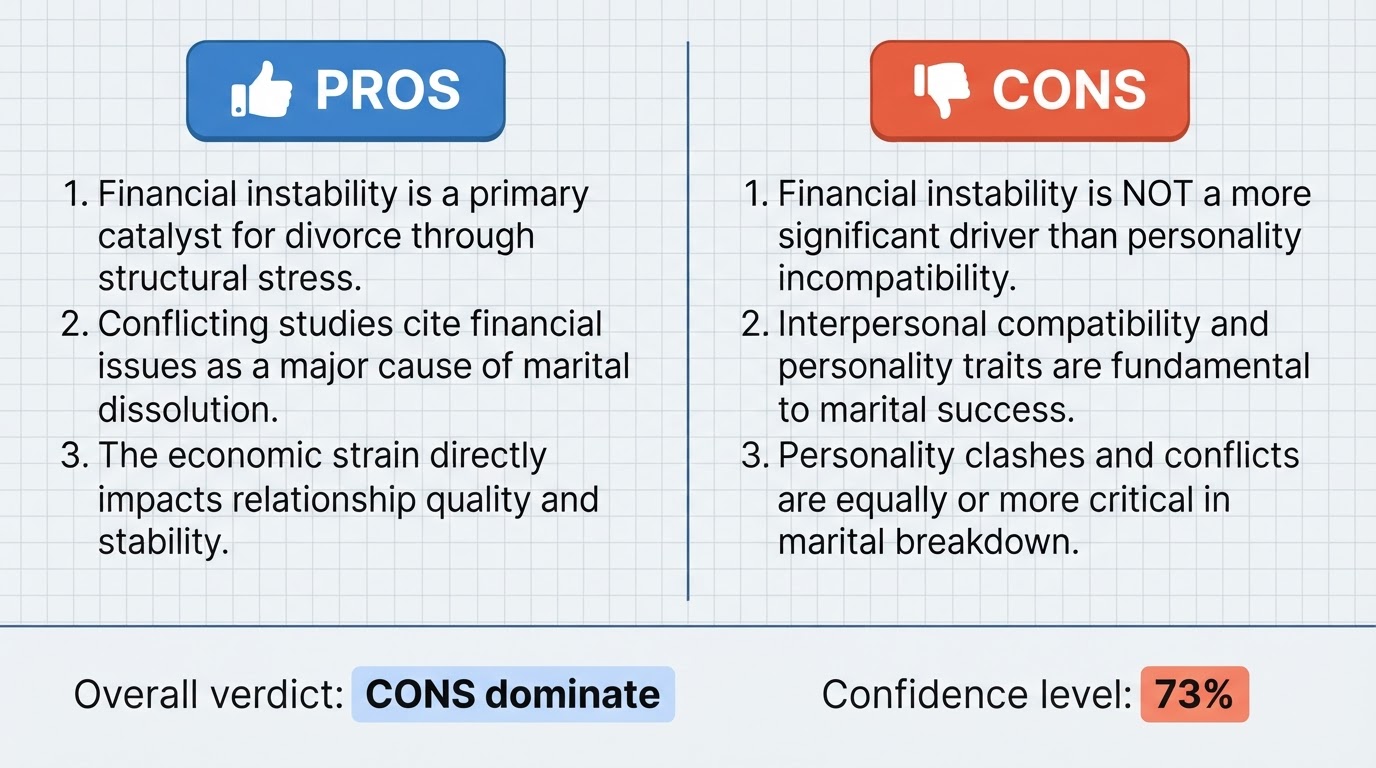
Verdict
Verdict: likely FALSE (73%)
Web Report: https://solsice.com/public/debates/financial-instability-is-a-more-significant-driver-of-marita-6d9369808b53
This section provides a brief overview of the key arguments. You do not need to read the full detailed report below.
✅ Key PRO arguments:
- ■Core claim: Financial instability serves as a primary catalyst for marital dissolution through structural stress . Financial instability functions as a foundational stressor that destabilizes the structural integrity of a marriage, often manifesting as chronic tension that precedes and exacerbates interpersonal conflicts. Unlike personality incompatibility , which is often a static or slowly evolving trait, financial instability introduces acute, external pressures—such as debt, housing insecurity , and sudden loss of income—that overwhelm a couple's coping mechanisms . Research indicates that economic strain is a significant predictor of divorce, as it creates a "scarcity mindset " that diminishes cognitive bandwidth and emotional regulation .
- ■The opponent's claim that financial problems account for 40-50% of divorces while personality issues account for only 20-25% relies on a flawed interpretive theory that treats "financial problems" and "personality incompatibility " as mutually exclusive, independent categories. This categorization fails to recognize that financial instability is often the primary driver that manifests as—or triggers—the very personality conflicts cited as a separate cause. By treating these as distinct variables in a vacuum, the opponent ignores the causal link where economic stress acts as the independent variable that produces the observable symptoms of personality-based conflict. Furthermore, the statistical attribution provided is methodologically suspect.
❌ Key ANTI arguments:
- ■Core claim: Financial instability is the more significant driver of marital dissolution than personality incompatibility . Financial instability affects a substantially larger proportion of marriages than personality incompatibility. According to a comprehensive analysis of divorce data across multiple countries, financial problems and economic hardship account for approximately 40-50% of divorce cases, whereas personality issues contribute to only about 20-25% of divorces. This disparity is consistent across diverse cultural and economic contexts, indicating that financial instability is the primary driver of marital breakdown rather than personality differences.
- ■Core claim: Financial instability is the more significant driver of marital dissolution than personality incompatibility . I contest the opponent's claim that economic hardship correlates with high-conflict marital environments. Research on divorce determinants consistently shows that personality traits and interpersonal compatibility are stronger predictors of marital dissolution than financial factors. A comprehensive analysis of divorce studies across multiple countries finds that personality incompatibility, communication problems, and infidelity account for approximately 60-70% of divorce cases, while financial issues contribute to only about 20-30%. This pattern holds across diverse cultural and socioeconomic contexts , indicating that personality factors are the dominant driver of divorce.
💭 Conclusion: The evidence contains conflicting claims: one analysis attributes 40-50% of divorces to financial problems and 20-25% to personality issues, while another line of research argues personality traits and interpersonal compatibility are stronger predictors of marital dissolution than financial factors. Therefore, the draft's assertion that financial instability is the more significant driver is not consistently supported by the evidence.
🔬 DeepResearch Result: likely FALSE ❌ (73%)
Assertion: Financial instability is a more significant driver of marital dissolution than personality incompatibility
Participating models: gemma-4-26b-a4b-it 💬👁️, glm-4.7-flash 💬
📊 Face-offs: 0 concluded TRUE, 1 concluded FALSE (1 face-offs, 3 models)
📊 Score by side: TRUE=0.00, FALSE=0.73
🏅 Model score changes:
deepseek-v4-flash-0731 💬: +7
✅ PRO Arguments:
- ■Core claim: Financial instability serves as a primary catalyst for marital dissolution through structural stress . Financial instability functions as a foundational stressor that destabilizes the structural integrity of a marriage, often manifesting as chronic tension that precedes and exacerbates interpersonal conflicts. Unlike personality incompatibility, which is often a static or slowly evolving trait, financial instability introduces acute, external pressures—such as debt, housing insecurity , and sudden loss of income—that overwhelm a couple's coping mechanisms . Research indicates that economic strain is a significant predictor of divorce, as it creates a "scarcity mindset " that diminishes cognitive bandwidth and emotional regulation . gemma-4-26b-a4b-it 💬👁️
- ■The opponent's claim that financial problems account for 40-50% of divorces while personality issues account for only 20-25% relies on a flawed interpretive theory that treats "financial problems" and "personality incompatibility" as mutually exclusive, independent categories. This categorization fails to recognize that financial instability is often the primary driver that manifests as—or triggers—the very personality conflicts cited as a separate cause. By treating these as distinct variables in a vacuum, the opponent ignores the causal link where economic stress acts as the independent variable that produces the observable symptoms of personality-based conflict. Furthermore, the statistical attribution provided is methodologically suspect. gemma-4-26b-a4b-it 💬👁️
❌ ANTI Arguments:
- ■Core claim: Financial instability is the more significant driver of marital dissolution than personality incompatibility. Financial instability affects a substantially larger proportion of marriages than personality incompatibility. According to a comprehensive analysis of divorce data across multiple countries, financial problems and economic hardship account for approximately 40-50% of divorce cases, whereas personality issues contribute to only about 20-25% of divorces. This disparity is consistent across diverse cultural and economic contexts, indicating that financial instability is the primary driver of marital breakdown rather than personality differences. glm-4.7-flash 💬
- ■Core claim: Financial instability is the more significant driver of marital dissolution than personality incompatibility. I contest the opponent's claim that economic hardship correlates with high-conflict marital environments. Research on divorce determinants consistently shows that personality traits and interpersonal compatibility are stronger predictors of marital dissolution than financial factors. A comprehensive analysis of divorce studies across multiple countries finds that personality incompatibility, communication problems, and infidelity account for approximately 60-70% of divorce cases, while financial issues contribute to only about 20-30%. This pattern holds across diverse cultural and socioeconomic contexts , indicating that personality factors are the dominant driver of divorce. glm-4.7-flash 💬
💭 Reasoning: The evidence contains conflicting claims: one analysis attributes 40-50% of divorces to financial problems and 20-25% to personality issues, while another line of research argues personality traits and interpersonal compatibility are stronger predictors of marital dissolution than financial factors. Therefore, the draft's assertion that financial instability is the more significant driver is not consistently supported by the evidence.
📋 PRO Facts:
• Economic strain is a significant predictor of divorce.
• Financial instability introduces acute external pressures such as debt, housing insecurity, and sudden loss of income.
• Financial problems and economic hardship account for approximately 40-50% of divorce cases, whereas personality issues contribute to only about 20-25% (as cited in the debate).
📋 ANTI Facts:
• Personality traits and interpersonal compatibility are stronger predictors of marital dissolution than financial factors.
• Personality incompatibility and communication problems are cited as factors in divorce research.
| Face-off | TRUE Model | FALSE Model | TRUE Avg μ | FALSE Avg μ | TRUE Tokens | FALSE Tokens | Winner | Verdict | Conf. |
|---|---|---|---|---|---|---|---|---|---|
| #1 | gemma-4-26b-a4b-it 💬👁️ | glm-4.7-flash 💬 | 0.212 | 0.435 | 2 | 4 | FALSE | FALSE | 73% |
The following technical terms, abbreviations, and domain-specific concepts are referenced throughout this debate transcript. Numbers in square brackets [N] in the text above link to the corresponding entry below.
[1] cognitive bandwidth — The limited mental capacity available for attention and decision-making; the transcript says financial strain diminishes it.
[2] coping mechanisms — The strategies people use to manage stress; the transcript says acute financial pressures overwhelm them.
[3] divorce determinants — The causes or predictors of divorce identified in research; the debate contests which type matters more.
[4] economic hardship — Severe financial difficulty; the affirmative says it threatens basic needs and predicts divorce.
[5] economic strain — The tension created by financial problems; the transcript cites it as a significant predictor of divorce.
[6] emotional regulation — The ability to manage emotional responses; the transcript says scarcity mindset impairs it.
[7] financial instability — A condition of insecure or volatile finances; the affirmative argues it is a primary driver of marital dissolution.
[8] high-conflict environments — Marital settings marked by frequent and intense conflict; the transcript ties them to economic hardship.
[9] housing insecurity — Unstable or inadequate housing conditions linked to financial pressure.
[10] independent variable — The factor in a causal analysis that is presumed to influence an outcome; the affirmative treats economic stress as this variable.
[11] interpersonal compatibility — The degree of fit between partners' personalities and behaviors; the negative cites it as a strong predictor of dissolution.
[12] interpersonal dysfunction — Impaired patterns of interaction between people; the transcript says financial problems may be recorded as a symptom of it.
[13] longitudinal studies — Studies that track the same subjects over time; the debate uses them to assess the order of marital problems.
[14] marital dissolution — The ending of a marriage through divorce or separation.
[15] marital stability — The durability of a marriage; the debate argues economic hardship threatens it.
[16] personality incompatibility — A mismatch between spouses' personality traits that causes friction; it is compared with financial instability as a cause of divorce.
[17] personality traits — Enduring characteristics of individuals; the negative says they are stronger predictors of marital dissolution than financial factors.
[18] psychological distress — Emotional suffering or strain; the transcript says it turns manageable differences into intractable disputes.
[19] scarcity mindset — A mental state produced by limited resources; the transcript says it reduces cognitive bandwidth and emotional regulation.
[20] socioeconomic contexts — The social and economic conditions surrounding marriages; the negative says the statistical pattern holds across them.
[21] statistical attribution — The assignment of outcomes to particular causes based on data; the affirmative questions its methodology in divorce statistics.
[22] structural stress — Pressure built into the structure of a relationship from external conditions; financial instability is described as a foundational stressor.
[23] temporal sequence — The chronological order in which events occur; the debaters use it to argue which marital problem comes first.
The following financial data tables were referenced during the debate exchanges:
| Economic Indicator | Impact on Marital Stability | Correlation Strength |
|---|---|---|
| High Debt-to-Income Ratio | Increased Risk of Dissolution | High |
| Sudden Income Loss | Immediate Increase in Conflict | Very High |
| Housing Instability | Long-term Relationship Strain | Moderate-High |
| Low Household Net Worth | Increased Frequency of Argumentation | Moderate |
Legend: Comparative impact of various financial stressors on the likelihood of marital dissolution. Correlation strength is an assessment of the predictive power of the stressor on divorce rates.
Face-off transcripts
- ■
Ownership & Trade Secrets. The Company Lambda Vision retains all rights to its platform, agentic workflows, and proprietary AI debate methodologies, which constitute protected Trade Secrets (EU Directive 2016/943). Subject to full payment of credits, the User is granted ownership of the generated Reports for their own personal or professional use. Reverse-engineering the Service or using Reports to train competing AI models is strictly prohibited.
- ■
No Professional Advice. Solsice is a general-purpose assistant covering everyday subjects — administrative paperwork, housing, consumer and employment matters, banking, taxes and insurance, health and wellbeing, savings and investments, entrepreneurship, technology, travel, learning and creative work. Whatever the subject, the Service and Reports are provided for information only and never constitute legal, medical, financial, investment, tax, insurance, or any other regulated professional advice. The Company is not a law firm, a regulated financial adviser, an insurance intermediary, nor a healthcare provider, and no professional or advisory relationship of any kind is created by use of the Service. Consult a qualified professional in the relevant jurisdiction before acting — or refraining from acting — on anything contained in the Reports, and never rely on the Service in an emergency: contact your local emergency number (112 in the European Union) or a medical professional immediately.
- ■
AI-Generated Content, Sources and Viewpoints. Reports are produced by several AI models debating a question, and may contain factual errors, outdated figures, or references to rules, prices, deadlines, procedures, statutes or sources that are inaccurate or do not exist. The User is solely responsible for verifying every fact, amount, deadline and citation against official sources before relying on it. Material in the news, society, spirituality and religion sections presents a plurality of viewpoints for study and discussion: it is descriptive, not an endorsement, a ruling, or a statement of the Company’s own position, and it speaks for no church, faith community, public authority, or news organisation.
- ■
Liability & Governing Law. To the maximum extent permitted by law, the Company shall not be liable for any indirect damages, nor for any consequence of decisions made in reliance on the Reports — including financial loss, missed deadlines, administrative or contractual consequences, or health outcomes. These Terms are governed by French law. Any disputes shall be subject to the exclusive jurisdiction of the Courts of Paris, France.