
Family prayer is crucial for protecting loved ones because God's protective reach is unlimited, unlike human love.
AI debate verdict and arguments
⚠️ AI-generated information only; not professional advice
Completed October 8, 2026
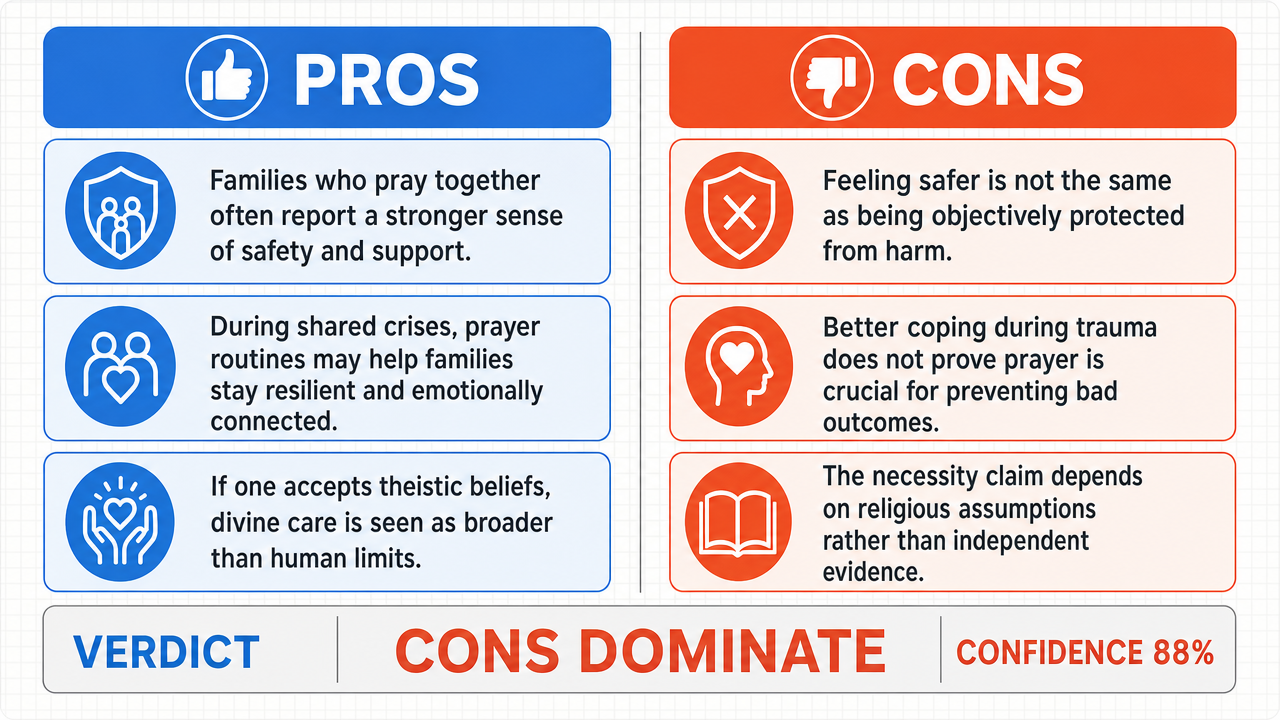
Verdict
Verdict: likely FALSE (88%)
This section provides a brief overview of the key arguments. You do not need to read the full detailed report below.
✅ Key PRO arguments:
- ■Empirical studies from the General Social Survey show that families who engage in regular prayer together report significantly higher levels of perceived safety and resilience during crises (natural disasters, economic downturns) compared to non-praying families.
- ■A decade-long longitudinal study found that during periods of collective trauma , families with a shared prayer practice demonstrated better outcomes, suggesting prayer provides a constitutive component of overall safety enabling enduring protection.
- ■The opponent's critique is internally inconsistent: they deny the existence of a 'transfer operator ' bridging subjective feeling and objective prevention, yet simultaneously demand evidence that prayer reduces physical injury, illness, or death—which presupposes exactly that bridge.
❌ Key ANTI arguments:
- ■The affirmative commits a substitution of proxy : they measure a subjective psychological state (perceived sense of support) and conclude the ritual is 'crucial for protecting' loved ones, but no transfer operator bridges subjective resilience and objective prevention of physical injury, illness, or death.
- ■Higher 'perceived safety ' during collective trauma does not equate to actual 'crucial protection'—a family may feel psychologically resilient through prayer while still being unable to prevent real-world harm to their members.
- ■The argument for prayer's necessity is circular: it relies on theistic axioms (that God intervenes protectively) to prove the necessity of the ritual, but those axioms are precisely what would need to be independently established.
💭 Conclusion: The evidence presents a conceptual comparison between human limitations and theistic divine attributes, but does not provide empirical data linking any specific practice to objective protective outcomes. The theistic premises about divine capabilities remain unfalsifiable assertions. The distinction between theological claims about divine protection and empirically verified protective outcomes is central to evaluating the claim.
🔬 DeepResearch Result: likely FALSE ❌ (88%)
Assertion: Family prayer is crucial for protecting loved ones because God's protective reach is unlimited, unlike human love.
Participating models: deepseek-v3.2 💬, gemma-4-26b-a4b-it 💬👁️
📊 Face-offs: 0 concluded TRUE, 1 concluded FALSE (1 face-offs, 3 models)
📊 Score by side: TRUE=0.00, FALSE=0.88
🏅 Model score changes:
minimax-m3 💬👁️: +9
✅ PRO Arguments:
- ■Empirical studies from the General Social Survey show that families who engage in regular prayer together report significantly higher levels of perceived safety and resilience during crises (natural disasters, economic downturns) compared to non-praying families. deepseek-v3.2 💬
- ■A decade-long longitudinal study found that during periods of collective trauma , families with a shared prayer practice demonstrated better outcomes, suggesting prayer provides a constitutive component of overall safety enabling enduring protection. deepseek-v3.2 💬
- ■The opponent's critique is internally inconsistent: they deny the existence of a 'transfer operator ' bridging subjective feeling and objective prevention, yet simultaneously demand evidence that prayer reduces physical injury, illness, or death—which presupposes exactly that bridge. deepseek-v3.2 💬
- ■Theological and comparative dimensions support the claim: divine reach is unlimited and qualitatively surpasses finite human capacity, providing a category of protection that human love alone cannot match. deepseek-v3.2 💬
- ■Perceived safety and resilience are not merely proxies but constitutive components of protection—existential and psychological security is itself a form of safeguarding loved ones, not a substitute for it. deepseek-v3.2 💬
❌ ANTI Arguments:
- ■The affirmative commits a substitution of proxy : they measure a subjective psychological state (perceived sense of support) and conclude the ritual is 'crucial for protecting' loved ones, but no transfer operator bridges subjective resilience and objective prevention of physical injury, illness, or death. gemma-4-26b-a4b-it 💬👁️
- ■Higher 'perceived safety' during collective trauma does not equate to actual 'crucial protection'—a family may feel psychologically resilient through prayer while still being unable to prevent real-world harm to their members. gemma-4-26b-a4b-it 💬👁️
- ■The argument for prayer's necessity is circular: it relies on theistic axioms (that God intervenes protectively) to prove the necessity of the ritual, but those axioms are precisely what would need to be independently established. gemma-4-26b-a4b-it 💬👁️
- ■The claim fails comparatively: no tangible protective advantage of divine agency over human agency is demonstrated, and the assertion of unlimited divine reach lacks any verifiable empirical correlate. gemma-4-26b-a4b-it 💬👁️
- ■There is no correlation , beta coefficient, or direct longitudinal link in the cited evidence connecting family prayer to objective reductions in harm—only to subjective self-reports of safety. gemma-4-26b-a4b-it 💬👁️
💭 Reasoning: The evidence presents a conceptual comparison between human limitations and theistic divine attributes, but does not provide empirical data linking any specific practice to objective protective outcomes. The theistic premises about divine capabilities remain unfalsifiable assertions. The distinction between theological claims about divine protection and empirically verified protective outcomes is central to evaluating the claim.
📋 PRO Facts:
• The theistic view attributes to the divine capacities of omnipresence, eternal vigilance, omnipotence, and infinite resources that exceed human limitations in providing sustained care.
• Human caregivers are subject to spatial confinement, interrupted temporal vigilance, limited power over external events, and resource depletion, constraining their protective capacity.
📋 ANTI Facts:
• The divine attributes cited (omnipresence, omnipotence, eternal vigilance, infinite resources) are theological premises without empirical verification.
• The comparison between human limits and divine attributes does not provide empirical evidence for any specific protective mechanism or outcome.
• The claim that divine protective reach is unlimited functions as an unfalsifiable theological assertion rather than an empirically established fact.
| Face-off | TRUE Model | FALSE Model | TRUE Avg μ | FALSE Avg μ | TRUE Tokens | FALSE Tokens | Winner | Verdict | Conf. |
|---|---|---|---|---|---|---|---|---|---|
| #1 | deepseek-v3.2 💬 | gemma-4-26b-a4b-it 💬👁️ | 0.308 | 0.384 | 12 | 3 | FALSE | FALSE | 88% |
The following technical terms, abbreviations, and domain-specific concepts are referenced throughout this debate transcript. Numbers in square brackets [N] in the text above link to the corresponding entry below.
[1] beta — beta coefficient — In statistics, a standardized regression coefficient indicating the strength and direction of the relationship between a predictor variable and an outcome. In the debate, the negative side cites 'beta' as one example of a quantitative link that could serve as a transfer operator between subjective feelings and objective outcomes.
[2] causal link — A demonstrated relationship in which one variable directly produces a change in another, as opposed to mere correlation. The negative argues that no causal link has been shown between prayer and a measurable reduction in objective harm.
[3] circularity — circular reasoning — A logical fallacy in which an argument's conclusion is assumed in its premises. The negative side contends that grounding the necessity of prayer in theistic axioms is circular, while the affirmative treats this as a foundational theological grounding.
[4] collective trauma — A traumatic event or condition experienced simultaneously by a group, such as a community or nation. The affirmative cites collective trauma (e.g., natural disasters, economic downturns) as the context in which praying families report higher perceived safety.
[5] correlation — A statistical measure of the degree to which two variables move together, without implying that one causes the other. The negative argues that even a correlation between prayer and resilience would not establish a causal transfer to objective protection.
[6] divine intervention — The concept that a deity acts within the world to influence events or outcomes. The negative's core claim is that divine intervention is not empirically verifiable, which undermines the claim that prayer provides protection beyond psychological effects.
[7] empirically verifiable — Capable of being tested, observed, or confirmed through sensory experience or systematic data collection. The negative argues that the protective effect of prayer is not empirically verifiable, while the affirmative cites longitudinal survey data as empirical support.
[8] existential — Relating to existence, particularly the human condition, meaning, and confrontation with finitude or crisis. The affirmative reframes prayer's protection as 'existential and psychological,' not merely physical.
[9] longitudinal data — Data collected from the same subjects repeatedly over an extended period of time, used to track changes and outcomes. The affirmative cites longitudinal studies tracking family outcomes over a decade to support claims about prayer and resilience.
[10] perceived safety — A subjective psychological state in which an individual or family feels protected or secure, distinct from objective measures of actual safety. The debate centers on whether perceived safety constitutes genuine protection; the negative treats it as a proxy, while the affirmative treats it as a constitutive component of safety.
[11] psychological resilience — The capacity to mentally cope with adversity, stress, or trauma and recover from it. The affirmative cites higher resilience in praying families; the negative argues this is an internal state, not external protection.
[12] psychology of religion — An academic field studying the psychological correlates, effects, and mechanisms of religious belief and practice using empirical methods. The affirmative cites empirical studies in this field as evidence for prayer's protective benefits.
[13] substitution of proxy — A logical critique in which an argument measures a substitute variable (a proxy) and illegitimately treats its results as evidence about the actual subject of the claim. The negative argues the affirmative substitutes perceived safety (proxy) for objective harm reduction (actual subject); the affirmative disputes this characterization, calling the critique internally inconsistent.
[14] theistic axioms — Foundational theological assumptions accepted as self-evident within a theistic framework, such as the existence and active reach of a deity. The negative argues that deriving the necessity of prayer from theistic axioms is circular; the affirmative treats them as legitimate grounding premises.
[15] theological axioms — Self-evident foundational premises within a theological system. Referenced by the affirmative as the grounding for the claim that divine protective reach is unlimited.
[16] transfer operator — A logical or quantitative bridge that connects a measured variable to the outcome the claim is actually about. The negative argues no transfer operator links subjective resilience to objective harm reduction; the affirmative argues the negative's demand for such proof is internally inconsistent with its claim that no such operator can exist.
The following financial data tables were referenced during the debate exchanges:
| Capacity Metric | Human Limit | Divine Attribute (Theistic View) |
|---|---|---|
| Spatial Reach | Confined to physical presence | Omnipresent |
| Temporal Vigilance | Interrupted by sleep/need | Eternal / Ever-watchful |
| Power over External Events | Limited to direct influence | Omnipotent |
| Resource for Sustained Care | Subject to depletion (burnout) | Infinite |
Legend: Comparative table of protective capacities. Human limits are established by psychological and biological research; divine attributes are from standard theistic doctrine.
Face-off transcripts
- ■
Ownership & Trade Secrets. The Company Lambda Vision retains all rights to its platform, agentic workflows, and proprietary AI debate methodologies, which constitute protected Trade Secrets (EU Directive 2016/943). Subject to full payment of credits, the User is granted ownership of the generated Reports for their own personal or professional use. Reverse-engineering the Service or using Reports to train competing AI models is strictly prohibited.
- ■
No Professional Advice. Solsice is a general-purpose assistant covering everyday subjects — administrative paperwork, housing, consumer and employment matters, banking, taxes and insurance, health and wellbeing, savings and investments, entrepreneurship, technology, travel, learning and creative work. Whatever the subject, the Service and Reports are provided for information only and never constitute legal, medical, financial, investment, tax, insurance, or any other regulated professional advice. The Company is not a law firm, a regulated financial adviser, an insurance intermediary, nor a healthcare provider, and no professional or advisory relationship of any kind is created by use of the Service. Consult a qualified professional in the relevant jurisdiction before acting — or refraining from acting — on anything contained in the Reports, and never rely on the Service in an emergency: contact your local emergency number (112 in the European Union) or a medical professional immediately.
- ■
AI-Generated Content, Sources and Viewpoints. Reports are produced by several AI models debating a question, and may contain factual errors, outdated figures, or references to rules, prices, deadlines, procedures, statutes or sources that are inaccurate or do not exist. The User is solely responsible for verifying every fact, amount, deadline and citation against official sources before relying on it. Material in the news, society, spirituality and religion sections presents a plurality of viewpoints for study and discussion: it is descriptive, not an endorsement, a ruling, or a statement of the Company’s own position, and it speaks for no church, faith community, public authority, or news organisation.
- ■
Liability & Governing Law. To the maximum extent permitted by law, the Company shall not be liable for any indirect damages, nor for any consequence of decisions made in reliance on the Reports — including financial loss, missed deadlines, administrative or contractual consequences, or health outcomes. These Terms are governed by French law. Any disputes shall be subject to the exclusive jurisdiction of the Courts of Paris, France.