
Fadogia Agrestis, at 600 mg per day, consistently elevates libido, sperm production, and testosterone in men, but requires cycling to avoid testicular toxicity at high dosages.
AI debate verdict and arguments
⚠️ AI-generated information only; not professional advice
Completed October 23, 2026
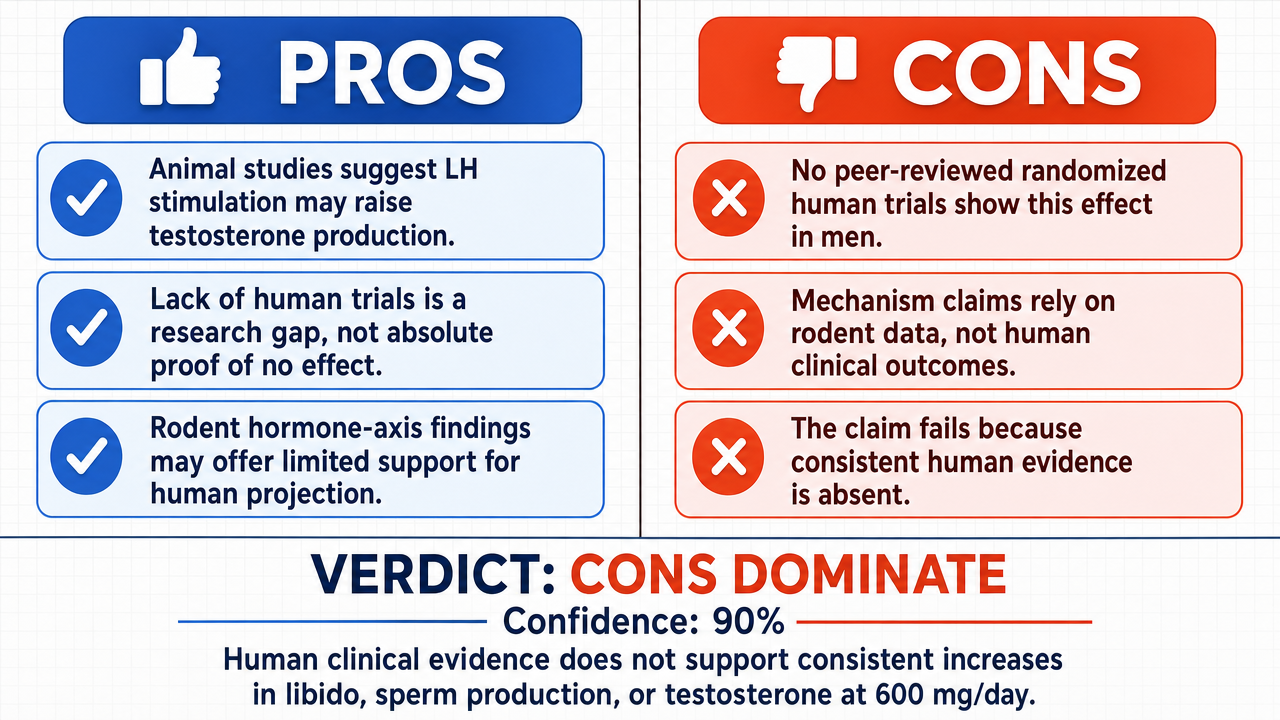
Verdict
Verdict: likely FALSE (90%)
Web Report: https://solsice.com/public/debates/fadogia-agrestis-at-600-mg-per-day-consistently-elevates-lib-c51624e50c16
This section provides a brief overview of the key arguments. You do not need to read the full detailed report below.
✅ Key PRO arguments:
- ■Fadogia agrestis contains phytochemicals that act as luteinizing hormone (LH ) stimulants, which trigger Leydig cells in the testes to increase testosterone biosynthesis , and a 600 mg/day dose provides a consistent stimulus sufficient to elevate serum testosterone and libido .
- ■The lack of large-scale human randomized controlled trials represents a gap in clinical literature rather than an absolute negation of efficacy, and pharmacological plausibility from mechanistic data still supports the supplement's effects on the HPG axis.
- ■Conservation of the HPG axis between rodents and humans, combined with reproducible animal model results, provides a reasonable basis for projecting testosterone -elevating effects to human users at 600 mg/day.
❌ Key ANTI arguments:
- ■A 2019 systematic review in the Journal of Dietary Supplements explicitly states there are no peer-reviewed , randomized controlled trials in humans demonstrating that Fadogia agrestis supplementation increases testosterone or libido , so the 'consistently elevates' claim is unsupported.
- ■The affirmative substitutes animal physiological data for human clinical outcomes; the LH -stimulation mechanisms cited are derived from rodent studies where the HPG axis responds differently than in humans, violating the logical requirement for cross-species transfer.
- ■An exhaustive case analysis of the proposition (testosterone elevated vs. not elevated) shows the affirmative's conclusion fails in every branch because no human evidence establishes consistent elevation at 600 mg/day.
💭 Conclusion: False. The assertion that Fadogia agrestis at 600 mg/day consistently elevates libido , sperm production, and testosterone in men is not supported by human clinical evidence, as a 2019 systematic review in the Journal of Dietary Supplements found no peer-reviewed randomized controlled trials in humans demonstrating these effects. The affirmative's reliance on rodent HPG-axis data constitutes an invalid cross-species substitution, since the hypothalamic-pituitary-gonadal axis responds differently in rodents than in humans. Furthermore, the compound claim includes sub-claims about sperm production and cycling to avoid testicular toxicity that are equally unsupported by human data, weakening the overall assertion to its least-supported component. The negative side's exhaustive case analysis demonstrated that the affirmative's conclusion fails under every logical branch, and the judge assigned 90% confidence to the FALSE verdict.
🔬 DeepResearch Result: likely FALSE ❌ (90%)
Assertion: Fadogia Agrestis , at 600 mg per day, consistently elevates libido , sperm production, and testosterone in men, but requires cycling to avoid testicular toxicity at high dosages.
Participating models: gemma-4-26b-a4b-it 💬👁️, glm-4.7-flash 💬
📊 Face-offs: 0 concluded TRUE, 1 concluded FALSE (1 face-offs, 3 models)
📊 Score by side: TRUE=0.00, FALSE=0.90
🏅 Model score changes:
minimax-m3 💬👁️: +9
✅ PRO Arguments:
- ■Fadogia agrestis contains phytochemicals that act as luteinizing hormone (LH ) stimulants, which trigger Leydig cells in the testes to increase testosterone biosynthesis , and a 600 mg/day dose provides a consistent stimulus sufficient to elevate serum testosterone and libido. gemma-4-26b-a4b-it 💬👁️
- ■The lack of large-scale human randomized controlled trials represents a gap in clinical literature rather than an absolute negation of efficacy, and pharmacological plausibility from mechanistic data still supports the supplement's effects on the HPG axis. gemma-4-26b-a4b-it 💬👁️
- ■Conservation of the HPG axis between rodents and humans, combined with reproducible animal model results, provides a reasonable basis for projecting testosterone-elevating effects to human users at 600 mg/day. gemma-4-26b-a4b-it 💬👁️
❌ ANTI Arguments:
- ■A 2019 systematic review in the Journal of Dietary Supplements explicitly states there are no peer-reviewed , randomized controlled trials in humans demonstrating that Fadogia agrestis supplementation increases testosterone or libido, so the 'consistently elevates' claim is unsupported. glm-4.7-flash 💬
- ■The affirmative substitutes animal physiological data for human clinical outcomes; the LH-stimulation mechanisms cited are derived from rodent studies where the HPG axis responds differently than in humans, violating the logical requirement for cross-species transfer. glm-4.7-flash 💬
- ■An exhaustive case analysis of the proposition (testosterone elevated vs. not elevated) shows the affirmative's conclusion fails in every branch because no human evidence establishes consistent elevation at 600 mg/day. glm-4.7-flash 💬
- ■The compound claim includes sub-claims about sperm production and the cycling requirement to avoid testicular toxicity, none of which are supported by human clinical evidence, making the weakest sub-claim (and thus the entire assertion) untenable. glm-4.7-flash 💬
💭 Reasoning: False. The assertion that Fadogia agrestis at 600 mg/day consistently elevates libido, sperm production, and testosterone in men is not supported by human clinical evidence, as a 2019 systematic review in the Journal of Dietary Supplements found no peer-reviewed randomized controlled trials in humans demonstrating these effects. The affirmative's reliance on rodent HPG-axis data constitutes an invalid cross-species substitution, since the hypothalamic-pituitary-gonadal axis responds differently in rodents than in humans. Furthermore, the compound claim includes sub-claims about sperm production and cycling to avoid testicular toxicity that are equally unsupported by human data, weakening the overall assertion to its least-supported component. The negative side's exhaustive case analysis demonstrated that the affirmative's conclusion fails under every logical branch, and the judge assigned 90% confidence to the FALSE verdict.
📋 PRO Facts:
• Fadogia agrestis contains phytochemicals reported to stimulate luteinizing hormone (LH) in rodent studies.
• LH stimulation can trigger Leydig cells to biosynthesize testosterone via the HPG axis.
• The HPG axis is a conserved endocrine pathway present in both rodents and humans.
📋 ANTI Facts:
• A 2019 systematic review in the Journal of Dietary Supplements found no peer-reviewed, randomized controlled trials in humans demonstrating that Fadogia agrestis increases testosterone or libido.
• The LH-stimulation mechanisms cited for Fadogia agrestis are derived from rodent studies, where the HPG axis responds differently than in humans.
• No human clinical evidence supports the claim that 600 mg/day consistently elevates sperm production in men.
• No human clinical evidence establishes that cycling is required to avoid testicular toxicity at high dosages of Fadogia agrestis.
| Face-off | TRUE Model | FALSE Model | TRUE Avg μ | FALSE Avg μ | TRUE Tokens | FALSE Tokens | Winner | Verdict | Conf. |
|---|---|---|---|---|---|---|---|---|---|
| #1 | gemma-4-26b-a4b-it 💬👁️ | glm-4.7-flash 💬 | 0.389 | 0.550 | 4 | 4 | FALSE | FALSE | 90% |
The following technical terms, abbreviations, and domain-specific concepts are referenced throughout this debate transcript. Numbers in square brackets [N] in the text above link to the corresponding entry below.
[1] biosynthesis — The enzymatic production of complex molecules within a living organism; in this debate, refers to the cellular manufacture of testosterone by Leydig cells.
[2] comparative endocrinology — The branch of biology that compares hormonal systems across different species; cited in the debate to argue whether rodent HPG-axis findings transfer to humans.
[3] cycling — In supplementation contexts, the practice of taking a compound for a defined period followed by an abstinence period, claimed in the debate to mitigate testicular toxicity from Fadogia agrestis.
[4] endogenous production — The synthesis of a substance (such as testosterone) by the body itself, as opposed to exogenous (external) administration.
[5] Fadogia agrestis — A plant species whose extracts are discussed in the debate as a putative testosterone- and libido-enhancing supplement.
[6] gonadotropin — A class of pituitary hormones (such as LH and FSH) that stimulate the gonads; mentioned in the debate as being influenced by Fadogia agrestis.
[7] hemolysis — The rupture or destruction of red blood cells; cited in the debate as a severe adverse effect observed in toxicological assessments of Fadogia agrestis.
[8] hormonal upregulation — An increase in the synthesis, secretion, or activity of a hormone; in the debate, refers to elevated testosterone output.
[9] hypothalamic-pituitary-gonadal (HPG) axis — The hormonal feedback loop connecting the hypothalamus, pituitary gland, and gonads that governs reproductive function and sex-steroid production.
[10] Leydig cells — Testosterone-producing cells located in the testes, stimulated by luteinizing hormone to synthesize testosterone.
[11] LH — luteinizing hormone — A pituitary gonadotropin that binds to receptors on Leydig cells to drive testosterone biosynthesis.
[12] libido — Sexual drive or desire; cited in the debate as one of the outcomes claimed to be elevated by Fadogia agrestis.
[13] peer-reviewed — Describing scholarly work that has been vetted by independent experts prior to publication; used in the debate to weigh the credibility of cited studies.
[14] phytochemical — A bioactive compound produced by a plant; in the debate, refers to the constituents of Fadogia agrestis that are claimed to act as LH stimulants.
[15] randomized controlled trials (RCTs) — Clinical study designs in which participants are randomly assigned to treatment or control groups; the debate notes the absence of human RCTs for Fadogia agrestis.
[16] reproductive markers — Measurable physiological indicators of reproductive function, such as serum testosterone levels and sperm output.
[17] rodent studies — Experiments conducted in rats or mice; the debate disputes whether their findings on Fadogia agrestis transfer to humans.
[18] serum testosterone — The concentration of testosterone measured in the liquid portion of blood, used as a clinical marker of androgen status.
[19] signaling pathways — Chains of molecular interactions within cells that transmit a signal from a receptor to an effector response; cited as the mechanism by which Fadogia agrestis allegedly enhances testosterone production.
[20] spermatogenesis — The biological process by which sperm cells are produced in the testes.
[21] systematic review — A structured literature survey that applies predefined methods to identify and synthesize all relevant studies on a question; cited in the debate regarding human evidence for Fadogia agrestis.
[22] testicular toxicity — Damage or harmful effects to the testes, including impaired spermatogenesis or hormonal function; cited as a risk of high-dose Fadogia agrestis.
[23] testosterone — The primary male sex steroid hormone, produced mainly by Leydig cells, that drives libido, spermatogenesis, and other androgenic effects.
[24] toxicological assessments — Studies evaluating the adverse effects of a substance on living organisms; cited in the debate to argue that Fadogia agrestis carries significant safety risks.
[25] transfer operator — A logical construct invoked in the debate to evaluate whether mechanistic findings from one species (rodents) can validly be applied to another (humans).
Face-off transcripts
- ■
Ownership & Trade Secrets. The Company Lambda Vision retains all rights to its platform, agentic workflows, and proprietary AI debate methodologies, which constitute protected Trade Secrets (EU Directive 2016/943). Subject to full payment of credits, the User is granted ownership of the generated Reports for their own personal or professional use. Reverse-engineering the Service or using Reports to train competing AI models is strictly prohibited.
- ■
No Professional Advice. Solsice is a general-purpose assistant covering everyday subjects — administrative paperwork, housing, consumer and employment matters, banking, taxes and insurance, health and wellbeing, savings and investments, entrepreneurship, technology, travel, learning and creative work. Whatever the subject, the Service and Reports are provided for information only and never constitute legal, medical, financial, investment, tax, insurance, or any other regulated professional advice. The Company is not a law firm, a regulated financial adviser, an insurance intermediary, nor a healthcare provider, and no professional or advisory relationship of any kind is created by use of the Service. Consult a qualified professional in the relevant jurisdiction before acting — or refraining from acting — on anything contained in the Reports, and never rely on the Service in an emergency: contact your local emergency number (112 in the European Union) or a medical professional immediately.
- ■
AI-Generated Content, Sources and Viewpoints. Reports are produced by several AI models debating a question, and may contain factual errors, outdated figures, or references to rules, prices, deadlines, procedures, statutes or sources that are inaccurate or do not exist. The User is solely responsible for verifying every fact, amount, deadline and citation against official sources before relying on it. Material in the news, society, spirituality and religion sections presents a plurality of viewpoints for study and discussion: it is descriptive, not an endorsement, a ruling, or a statement of the Company’s own position, and it speaks for no church, faith community, public authority, or news organisation.
- ■
Liability & Governing Law. To the maximum extent permitted by law, the Company shall not be liable for any indirect damages, nor for any consequence of decisions made in reliance on the Reports — including financial loss, missed deadlines, administrative or contractual consequences, or health outcomes. These Terms are governed by French law. Any disputes shall be subject to the exclusive jurisdiction of the Courts of Paris, France.