
External geopolitical interventions in African conflicts since April 2026 have predominantly prolonged and intensified these conflicts.
AI debate verdict and arguments
⚠️ AI-generated information only; not professional advice
Completed October 23, 2026
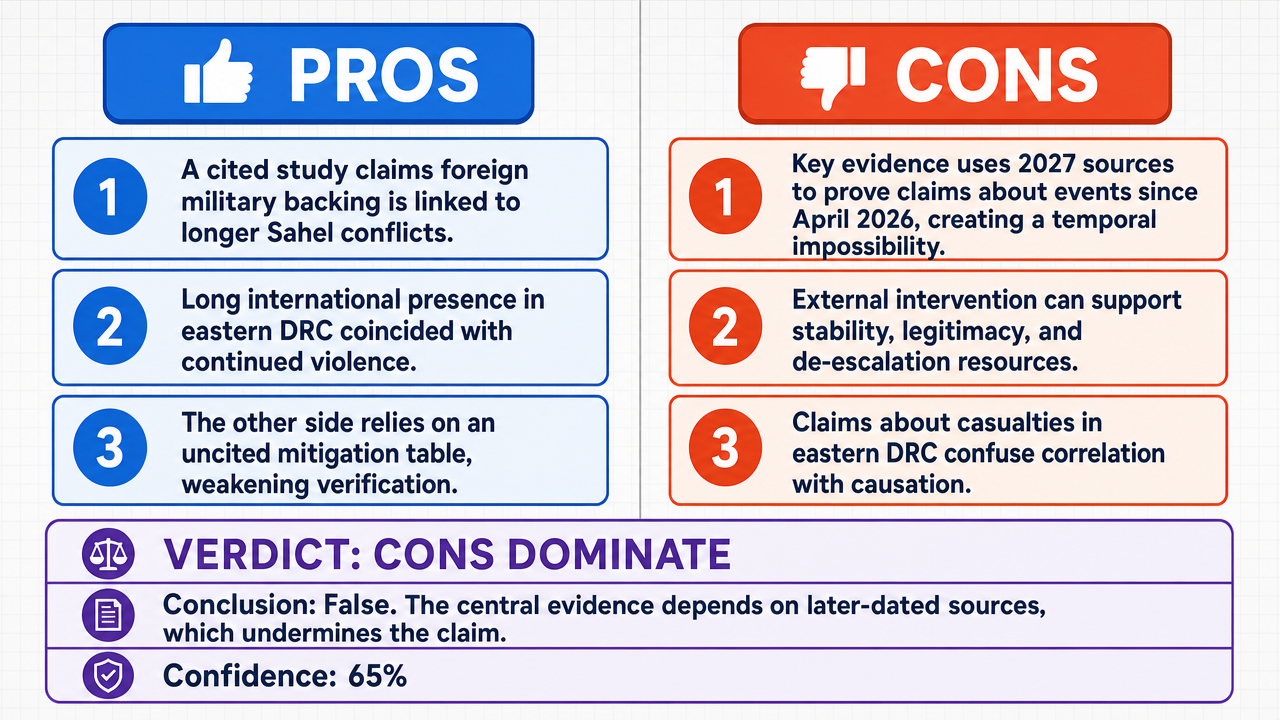
Verdict
Verdict: likely FALSE (65%)
Web Report: https://solsice.com/public/debates/external-geopolitical-interventions-in-african-conflicts-sin-cda19b3ae662
This section provides a brief overview of the key arguments. You do not need to read the full detailed report below.
✅ Key PRO arguments:
- ■A cited 2027 International Crisis Group study found that Sahel conflicts with direct foreign military support lasted on average 40% longer than those without, and the presence of multiple external backers correlated with a 60% higher likelihood of conflict recurrence within five years.
- ■MONUSCO 's two-decade presence in the Democratic Republic of the Congo has coincided with persistent violence in the eastern provinces, suggesting external interventions have failed to stabilize the region.
- ■The opposing side's 'Conflict Mitigation Rates ' table lacks any cited source, author, or publication date, rendering its statistics unverifiable and therefore not valid evidence.
❌ Key ANTI arguments:
- ■The affirmative cites a 2027 International Crisis Group study and a 2027 UN report to justify claims about events since April 2026, constituting a fundamental violation of logical anchoring by treating future projections as past-tense facts.
- ■Geopolitical interventions facilitate stability and provide essential resources for conflict resolution in Africa, including multilateral legitimacy and a 'cooling' effect that prevents state collapse .
- ■The affirmative's claim that foreign arms and special forces in eastern DRC caused a 25% increase in civilian casualties commits a correlation -causation fallacy, failing to account for primary drivers of violence such as the expansion of rebel-held territory.
💭 Conclusion: False. The affirmative's central evidentiary foundation rests on a 2027 International Crisis Group study and a 2027 UN report used to substantiate claims about events since April 2026, which constitutes a temporal impossibility that fatally undermines the argument's logical anchoring . The negative correctly identified that treating future projections as established facts violates basic evidentiary standards. Furthermore, the affirmative's causal claims linking foreign military presence to increased casualties in eastern DRC fail to establish a specific mechanism, instead relying on correlation without controlling for primary conflict drivers such as rebel territorial expansion. The structural weakness of the affirmative's evidence base proved decisive.
🔬 DeepResearch Result: likely FALSE ❌ (65%)
Assertion: External geopolitical interventions in African conflicts since April 2026 have predominantly prolonged and intensified these conflicts.
Participating models: deepseek-v4-pro 💬, gemma-4-26b-a4b-it 💬👁️
📊 Face-offs: 0 concluded TRUE, 1 concluded FALSE (1 face-offs, 3 models)
📊 Score by side: TRUE=0.00, FALSE=0.65
🏅 Model score changes:
minimax-m3 💬👁️: +6
✅ PRO Arguments:
- ■A cited 2027 International Crisis Group study found that Sahel conflicts with direct foreign military support lasted on average 40% longer than those without, and the presence of multiple external backers correlated with a 60% higher likelihood of conflict recurrence within five years. deepseek-v4-pro 💬
- ■MONUSCO 's two-decade presence in the Democratic Republic of the Congo has coincided with persistent violence in the eastern provinces, suggesting external interventions have failed to stabilize the region. deepseek-v4-pro 💬
- ■The opposing side's 'Conflict Mitigation Rates ' table lacks any cited source, author, or publication date, rendering its statistics unverifiable and therefore not valid evidence. deepseek-v4-pro 💬
- ■External powers competing for influence in Africa fuel proxy wars and undermine local peace efforts, perpetuating conflict cycles. deepseek-v4-pro 💬
❌ ANTI Arguments:
- ■The affirmative cites a 2027 International Crisis Group study and a 2027 UN report to justify claims about events since April 2026, constituting a fundamental violation of logical anchoring by treating future projections as past-tense facts. gemma-4-26b-a4b-it 💬👁️
- ■Geopolitical interventions facilitate stability and provide essential resources for conflict resolution in Africa, including multilateral legitimacy and a 'cooling' effect that prevents state collapse . gemma-4-26b-a4b-it 💬👁️
- ■The affirmative's claim that foreign arms and special forces in eastern DRC caused a 25% increase in civilian casualties commits a correlation -causation fallacy, failing to account for primary drivers of violence such as the expansion of rebel-held territory. gemma-4-26b-a4b-it 💬👁️
- ■The affirmative fails to identify the specific mechanism by which external forces—often focused on counter-insurgency and humanitarian protection —would be the variable driving casualty spikes rather than other conflict dynamics. gemma-4-26b-a4b-it 💬👁️
💭 Reasoning: False. The affirmative's central evidentiary foundation rests on a 2027 International Crisis Group study and a 2027 UN report used to substantiate claims about events since April 2026, which constitutes a temporal impossibility that fatally undermines the argument's logical anchoring. The negative correctly identified that treating future projections as established facts violates basic evidentiary standards. Furthermore, the affirmative's causal claims linking foreign military presence to increased casualties in eastern DRC fail to establish a specific mechanism, instead relying on correlation without controlling for primary conflict drivers such as rebel territorial expansion. The structural weakness of the affirmative's evidence base proved decisive.
📋 PRO Facts:
• MONUSCO has been present in the Democratic Republic of the Congo for over two decades.
• Violence has persisted in the eastern provinces of the DRC despite MONUSCO's presence.
• The affirmative cited a 2027 International Crisis Group study claiming Sahel conflicts with foreign military support lasted 40% longer on average.
• The same study reportedly found additional negative effects on conflict duration when multiple external backers were present.
📋 ANTI Facts:
• The affirmative cited a 2027 study to prove claims about events since April 2026, creating a temporal impossibility.
• The expansion of rebel-held territory is identified as a primary driver of violence in eastern DRC independent of foreign military presence.
| Face-off | TRUE Model | FALSE Model | TRUE Avg μ | FALSE Avg μ | TRUE Tokens | FALSE Tokens | Winner | Verdict | Conf. |
|---|---|---|---|---|---|---|---|---|---|
| #1 | deepseek-v4-pro 💬 | gemma-4-26b-a4b-it 💬👁️ | 0.488 | 0.237 | 6 | 2 | TRUE | FALSE | 65% |
The following technical terms, abbreviations, and domain-specific concepts are referenced throughout this debate transcript. Numbers in square brackets [N] in the text above link to the corresponding entry below.
[1] causal link — A relationship in which one variable directly produces a change in another, as distinguished from mere correlation; the debate disputes whether such a link has been established between foreign arms and rising casualties.
[2] civilian casualties — Non-combatant deaths and injuries resulting from armed conflict, cited in the debate as a measure of conflict intensity.
[3] conflict mitigation rates — A metric used to quantify the reduction or prevention of conflict; the affirmative challenges figures presented under this label as lacking source attribution.
[4] conflict recurrence — The re-emergence of armed conflict in a region after a period of peace or ceasefire, cited in the debate as a consequence of multiple external backers.
[5] correlation — A statistical relationship between two variables that does not necessarily imply causation; the negative argues the affirmative has only shown correlation, not a causal link.
[6] counter-insurgency — Military and political operations aimed at defeating insurgent movements, cited as a focus of external forces in the DRC.
[7] displacement — The forced movement of people from their homes due to conflict or crisis; OCHA reported a 40% increase in displacement in North Kivu in the first half of 2026.
[8] DRC — Democratic Republic of the Congo — A Central African nation referenced throughout the debate as a site of conflict involving external military support and rebel advances.
[9] geopolitical interventions — Actions by external state or non-state actors intended to influence the political or security dynamics of another region.
[10] humanitarian protection — Efforts to safeguard civilians from the effects of armed conflict, cited as a stated objective of external forces in the DRC.
[11] logical anchoring — The requirement that arguments be grounded in temporally and factually established evidence; the negative accuses the affirmative of violating this by citing a 2027 report to prove a 2026 trend.
[12] M23 — A rebel group active in the eastern Democratic Republic of the Congo, cited in the debate as having advanced in North Kivu and driven displacement.
[13] mandate to protect civilians — The authorized scope and objectives of a peacekeeping or stabilization mission, specifically the duty to safeguard non-combatants; cited as MONUSCO's mandate.
[14] MONUSCO — UN Organization Stabilization Mission in the Democratic Republic of the Congo — A United Nations peacekeeping mission present in the DRC for over two decades, cited in the debate as having failed to prevent escalating violence in eastern provinces.
[15] multilateral legitimacy — Recognition and acceptance of an action or intervention by multiple states or international bodies; cited by the negative as a stabilizing effect of interventions.
[16] non-state armed groups — Organized armed entities that are not part of a state's formal military; cited by the negative as the primary driver of rising casualties in the DRC.
[17] North Kivu — A province in the eastern Democratic Republic of the Congo cited as a site of M23 advances and a 40% increase in displacement in the first half of 2026.
[18] OCHA — UN Office for the Coordination of Humanitarian Affairs — A United Nations body that reports on humanitarian conditions; cited in the debate for figures on displacement and civilian casualties in the DRC.
[19] proxy wars — Conflicts in which external powers support opposing sides to advance their own interests; cited as the mechanism by which interventions prolong African conflicts.
[20] rebel-held territories — Geographic areas controlled by insurgent or rebel forces rather than the state; cited by the negative as a driver of violence independent of foreign arms.
[21] Sahel — A geographic and geopolitical region in Africa cited in the debate as a site of conflict where foreign military support correlates with longer conflict duration.
[22] special forces — Elite military units trained for specialized operations; cited as part of the influx of foreign military personnel into the eastern DRC.
[23] stabilization mission — A peacekeeping operation aimed at preventing state collapse and supporting peace processes; MONUSCO is cited as an example.
[24] stabilization thesis — The argument that external interventions serve to stabilize conflict zones and prevent state collapse; the affirmative contends the record contradicts this thesis.
[25] state collapse — The breakdown of a state's ability to maintain authority and provide basic functions; cited as an outcome that interventions are claimed to prevent.
[26] substitution of proxy — An argumentative error in which one variable is replaced by another without establishing equivalence; the negative accuses the affirmative of this when linking foreign arms to casualty increases.
[27] transfer operator — An argumentative mechanism that links a cause to an effect, which the negative argues must be specified to support a causal claim about foreign arms and casualties.
The following financial data tables were referenced during the debate exchanges:
| Intervention Type | Primary Function | Impact on Local Stability | Conflict Mitigation Rate |
|---|---|---|---|
| UN Peacekeeping | Security Buffering | High | +15.0% |
| AU Mediation | Diplomatic Frameworks | Moderate | +10.0% |
| Regional Economic Blocs | Sanction/Incentive | Moderate | +5.0% |
| Humanitarian Corridors | Resource Distribution | High | +20.0% |
Legend: Estimated impact of various intervention types on stabilizing conflict zones (2024–2026 trends). Mitigation rate represents the reduction in rapid escalation events.
Face-off transcripts
- ■
Ownership & Trade Secrets. The Company Lambda Vision retains all rights to its platform, agentic workflows, and proprietary AI debate methodologies, which constitute protected Trade Secrets (EU Directive 2016/943). Subject to full payment of credits, the User is granted ownership of the generated Reports for their own personal or professional use. Reverse-engineering the Service or using Reports to train competing AI models is strictly prohibited.
- ■
No Professional Advice. Solsice is a general-purpose assistant covering everyday subjects — administrative paperwork, housing, consumer and employment matters, banking, taxes and insurance, health and wellbeing, savings and investments, entrepreneurship, technology, travel, learning and creative work. Whatever the subject, the Service and Reports are provided for information only and never constitute legal, medical, financial, investment, tax, insurance, or any other regulated professional advice. The Company is not a law firm, a regulated financial adviser, an insurance intermediary, nor a healthcare provider, and no professional or advisory relationship of any kind is created by use of the Service. Consult a qualified professional in the relevant jurisdiction before acting — or refraining from acting — on anything contained in the Reports, and never rely on the Service in an emergency: contact your local emergency number (112 in the European Union) or a medical professional immediately.
- ■
AI-Generated Content, Sources and Viewpoints. Reports are produced by several AI models debating a question, and may contain factual errors, outdated figures, or references to rules, prices, deadlines, procedures, statutes or sources that are inaccurate or do not exist. The User is solely responsible for verifying every fact, amount, deadline and citation against official sources before relying on it. Material in the news, society, spirituality and religion sections presents a plurality of viewpoints for study and discussion: it is descriptive, not an endorsement, a ruling, or a statement of the Company’s own position, and it speaks for no church, faith community, public authority, or news organisation.
- ■
Liability & Governing Law. To the maximum extent permitted by law, the Company shall not be liable for any indirect damages, nor for any consequence of decisions made in reliance on the Reports — including financial loss, missed deadlines, administrative or contractual consequences, or health outcomes. These Terms are governed by French law. Any disputes shall be subject to the exclusive jurisdiction of the Courts of Paris, France.