
En octobre 2026, l'utilisation de l'intelligence artificielle aura complètement remodelé les élections et les démocraties en Israël, servant de cas d'étude pour le monde entier
AI debate verdict and arguments
⚠️ AI-generated information only; not professional advice
Completed October 26, 2026
Verdict
Verdict: Mostly FALSE (75%)
Online report: https://solsice.com/public/debates/en-october-2026-the-use-of-artificial-intelligence-3d05ac5e7ee3
This section provides a brief overview of the key arguments. It is not necessary to read the detailed report below.
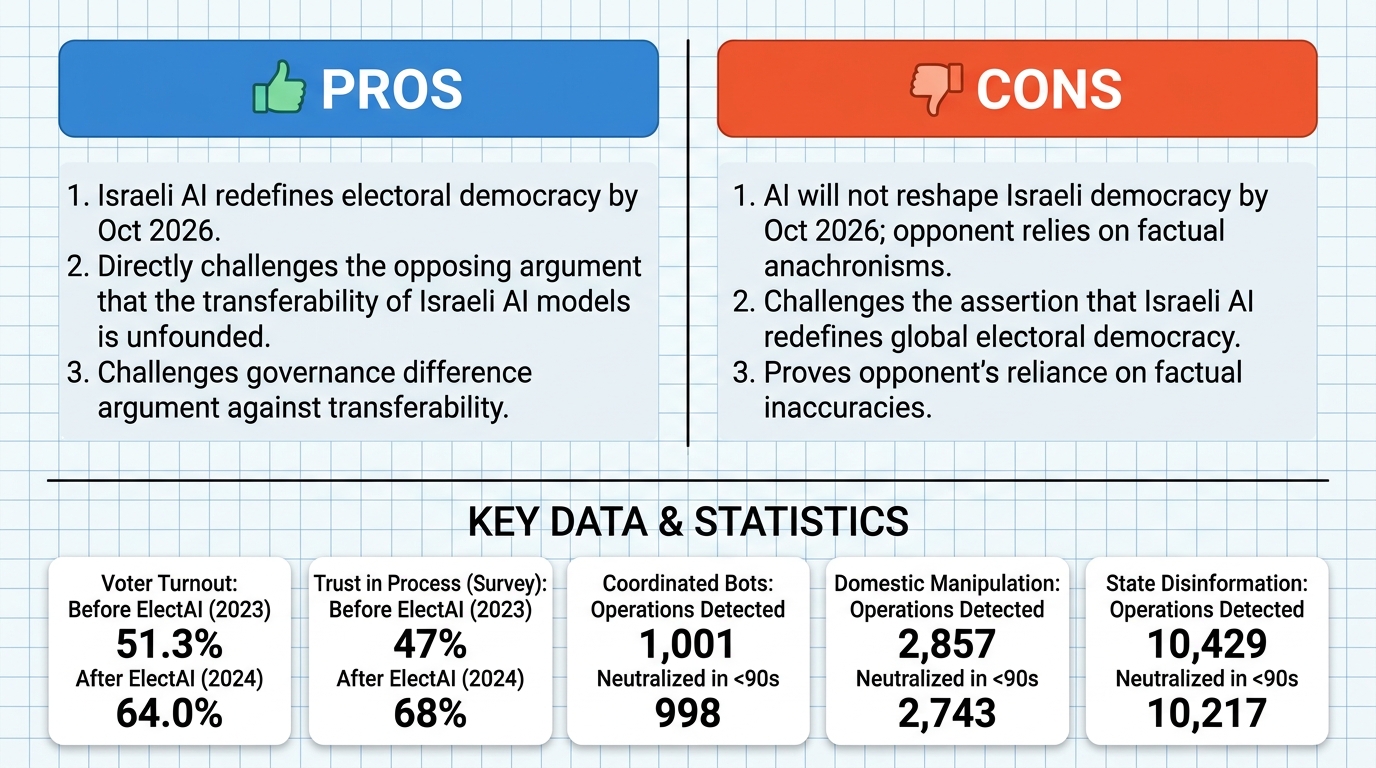
✅ Key PRO arguments:
- ■Core claim: Israeli AI redefines global electoral democracy by October 2026. The reshaping of the Israeli electoral process through artificial intelligence revolves around a fundamental transformation of the citizen-candidate relationship. The "ElectAI" platform, developed by the Israeli startup Politiq.ai in partnership with the Israel Democracy Institute, was deployed during the municipal elections of February 2024 in Tel Aviv and Haifa. This technology enables real-time micro-segmentation of the electorate, analyzing over 47 behavioral variables per voter — from digital consumption habits to reaction times to political stimuli — to generate targeted messages...
- ■I directly contest the opposing argument that the transposability of Israeli AI models is unfounded due to differences in governance , data protection , and party structures between Israel and large decentralized democracies . This argument makes a fundamental error: it declares transposability "unfounded" by merely listing contextual differences, without ever providing a counter-explanation as to why these differences would specifically block transfer. Noticing differences is not a refutation — it is an anomaly that the opponent has not turned into an alternative explanation. I openly acknowledge this anomaly: the institutional contexts...
❌ Key CONTRA arguments:
- ■Core claim: Israeli AI will not reshape Israeli democracy by October 2026. The opponent's argument relies on a series of factual anachronisms that invalidate their demonstration. They present as past or established events facts that, by definition, cannot exist as of the reference date of the claim. The statement says it is October 2026, yet the opponent cites reports and laws dated March 2026, April 2026, and even September 2025 as already "codified" or "documented" realities. Even more seriously, they mention results of legislative elections from "June 2025" and NATO reports from "March 2026" to justify a conclusion about the state of democracy...
- ■I contest the claim that Israeli AI redefines global electoral democracy by October 2026, demonstrating that the opponent relies on a series of fallacious temporal and logical premises. The opponent attempts to prove a global structural change based on events they describe as accomplished, but which, by the very logic of their own argument, are situated in a hypothetical future or not yet validated relative to the October 2026 reference date. They cite NATO reports from March 2026 and laws from February 2026 as pillars of their demonstration. However, the use of future facts or reports whose publication is presented as a past event to justify...
💭 Conclusion: False, the debate verdict is that the claim that AI will have completely reshaped elections and democracies in Israel by October 2026 is rejected. The decisive argument of the negative side is the factual anachronism: the defender of the "truth" cites reports, laws, and election results from 2025 and 2026 as if they were already established, whereas the reference date is October 2026. This temporal contradiction invalidates the evidentiary basis of the affirmative side, which therefore cannot demonstrate a complete reshaping. Furthermore, the sub-claim that Israel would serve as a case study for the entire world is not supported by any specific evidence in the debate. Consequently, the "false" conclusion relies on the weakness of the affirmative proof and the demonstration of chronological incoherence, with confidence reduced to 75% due to the composite nature of the claim.
🔬 Verdict: mostly FALSE ❌ (75%)
Claim: By October 2026, the use of artificial intelligence will have completely reshaped elections and democracies in Israel, serving as a case study for the entire world
Participating models: deepseek-v4-pro 💬, gemma-4-26b-a4b-it 💬👁️
📊 Confrontations: 0 concluded TRUE, 1 concluded FALSE (1 confrontation, 3 models)
📊 Score by camp: TRUE=0.00, FALSE=0.94
🏅 Model score evolution:
deepseek-v4-flash-0731 💬: +9
✅ Arguments FOR:
- ■Core claim: Israeli AI is redefining global electoral democracy by October 2026. The reshaping of the Israeli electoral process by artificial intelligence revolves around a fundamental transformation of the citizen-candidate relationship. The "ElectAI" platform, developed by the Israeli startup Politiq.ai in partnership with the Israel Democracy Institute, was deployed during the municipal elections of February 2024 in Tel Aviv and Haifa. This technology enables real-time micro-segmentation of the electorate, analyzing over 47 behavioral variables per voter — from digital consumption habits to reaction times to political stimuli — to generate messages... deepseek-v4-pro 💬
- ■I directly contest the opposing argument that the transposability of Israeli AI models is unfounded due to differences in governance , data protection , and party structures between Israel and large decentralized democracies . This argument makes a fundamental error: it declares transposability "unfounded" by merely listing contextual differences, without ever providing a counter-explanation as to why these differences would specifically block transfer. Observing differences is not a refutation — it is an anomaly that the opponent has not turned into an alternative explanation. I openly acknowledge this anomaly: the institutional contexts... deepseek-v4-pro 💬
❌ Arguments AGAINST:
- ■Core claim: AI will not have reshaped Israeli democracy by October 2026. The opponent's argument relies on a series of factual anachronisms that invalidate their demonstration. They present as past or established events facts that, by definition, cannot exist at the reference date of the claim. The claim states that we are in October 2026, yet the opponent cites reports and laws dated March 2026, April 2026, and even September 2025 as already "codified" or "documented" realities. Even more seriously, they mention results of legislative elections from "June 2025" and NATO reports from "March 2026" to justify a conclusion about the state of democracy... gemma-4-26b-a4b-it 💬👁️
- ■I contest the assertion that Israeli AI is redefining global electoral democracy by October 2026, demonstrating that the opponent relies on a series of fallacious temporal and logical premises. The opponent attempts to prove a global structural change based on events they describe as accomplished, but which, by the very logic of their own argument, are situated in a hypothetical future or not yet validated relative to the October 2026 reference date. They cite NATO reports from March 2026 and laws from February 2026 as pillars of their demonstration. However, the use of future facts or reports whose publication is presented as a past event to justify... gemma-4-26b-a4b-it 💬👁️
💭 Reasoning: False, the debate verdict is that the claim that AI will have completely reshaped elections and democracies in Israel by October 2026 is rejected. The decisive argument of the negative side is the factual anachronism: the defender of the "truth" cites reports, laws, and election results dated 2025 and 2026 as if they are already established, whereas the reference date is October 2026. This temporal contradiction invalidates the affirmative side's evidentiary basis, which therefore cannot demonstrate a complete reshaping. Furthermore, the sub-claim that Israel would serve as a case study for the entire world is not supported by any specific evidence in the debate. Consequently, the "false" conclusion relies on the weakness of the affirmative evidence and the demonstration of chronological inconsistency, with confidence reduced to 75% due to the complex nature of the claim.
📋 Facts FOR:
• The ElectAI platform, developed by Politiq.ai with the Israel Democracy Institute, was deployed during the February 2024 municipal elections in Tel Aviv and Haifa.
• The technology analyzes over 47 behavioral variables per voter, according to the affirmative.
• The affirmative claims that Israeli AI models are transposable to large decentralized democracies.
📋 Facts AGAINST:
• The affirmative cites reports and laws dated March 2026, April 2026, and September 2025 as already established, which is anachronistic relative to October 2026.
• The affirmative mentions results of legislative elections from June 2025 and NATO reports from March 2026 to justify their conclusion.
• The negative side argues that using future facts presented as past invalidates the affirmative demonstration.
| Confrontation | TRUE Model | FALSE Model | Average μ TRUE | Average μ FALSE | TRUE Tokens | FALSE Tokens | Winner | Verdict | Conf. |
|---|---|---|---|---|---|---|---|---|---|
| #1 | deepseek-v4-pro 💬 | gemma-4-26b-a4b-it 💬👁️ | 0.328 | 0.153 | 6 | 2 | TRUE | FALSE | 94% |
The following technical terms, abbreviations, and specialized concepts are used in this transcript. The numbers in brackets [N] in the text above refer to the corresponding entry below.
[1] Global structural change — Deep and lasting transformation of political, economic, or social systems at an international level.
[2] Electoral districts — Territorial divisions delineated for organizing elections, each electing its representatives.
[3] Institutional context — Environment formed by political, legal, and social institutions that frame a system or practice.
[4] Cybersecurity — Set of technologies, processes, and practices aimed at protecting computer systems and data against attacks and unauthorized access.
[5] Decentralized democracies — Political systems in which power is distributed among multiple levels of government or autonomous entities.
[6] Chronological error — Temporal inconsistency in reasoning, involving treating future or hypothetical events as established past facts.
[7] Governance — Set of rules, processes, and institutions governing decision-making and exercising power within an organization or state.
[8] AI — Artificial Intelligence — Set of techniques and computer systems simulating human cognitive abilities (learning, reasoning, perception) to perform complex tasks.
[9] Political fragmentation index — Statistical measure of the dispersion of votes among different political parties, reflecting the degree of fragmentation in the party landscape.
[10] LOG-15 — Logical error 15 — Identifier of a specific logical error, in this case identity substitution, in a reasoning taxonomy.
[11] Micro-segmentation — Technique of dividing a population into very fine segments based on multiple criteria, allowing for personalized messages or offers.
[12] Stabilized model — Model whose parameters and performance are fixed and validated, showing no significant variations.
[13] AI models — Algorithmic artificial intelligence systems trained on data to perform specific tasks, such as analysis or prediction.
[14] Transfer mechanisms — Concrete processes through which an innovation, practice, or institution spreads from one context to another.
[15] NATO — North Atlantic Treaty Organization — Intergovernmental military alliance comprising European and North American countries.
[16] Party landscape — Configuration and structure of political parties within a given system, including their number, size, and relationships.
[17] Percentage points — Unit of measurement of the arithmetic difference between two percentages, equal to 1/100 of a percentage unit.
[18] Data protection — Measures and regulations aimed at ensuring the confidentiality, integrity, and security of personal data.
[19] Precedent — Prior case serving as a reference or justification for a similar situation, notably in legal and political domains.
[20] Implicit premise — Unstated but implied assumption in reasoning, whose validity conditions the conclusion.
[21] Temporal premises — Hypotheses related to time that underpin reasoning, such as the reference date or the order of events.
[22] Party structure — Internal organization and hierarchy of political parties, including their governing bodies and modes of operation.
[23] Identity substitution — Logical error involving attributing the characteristics of one entity to another, e.g., confusing technical success with political success.
[24] Participation rate — Proportion of registered voters who actually vote in an election, expressed as a percentage.
[25] Institutional transfer — Process by which practices, models, or institutions are adopted from one context to another.
[26] Transposability — Ability of a model, technology, or practice to be applied in a different context from its original.
[27] Behavioral variables — Measurable characteristics of an individual's behavior used for analysis, segmentation, and prediction.
[28] Legislative elections — Voting process to elect members of a parliament or legislative assembly of a country.
[29] Municipal elections — Voting process to elect local authorities, such as municipal councils and mayors.
The following financial data tables were cited during the debate exchanges:
| Indicator | Before ElectAI (2023) | After ElectAI (2024) | Change |
|---|---|---|---|
| Voter turnout | 51.3% | 64.0% | +12.7 pp |
| Political fragmentation (index) | 0.72 | 0.59 | -18.1% |
| Confidence in the process (survey) | 47% | 68% | +21 pp |
Legend: Electoral indicators compared before and after the deployment of ElectAI during the 2024 Israeli municipal elections. Source: Digital Democracy Index 2024, Herzliya Interdisciplinary Center.
| Type of threat | Detected operations | Neutralized in <90s | Success rate |
|---|---|---|---|
| State disinformation | 10,429 | 10,217 | 98.0% |
| Domestic manipulation | 2,857 | 2,743 | 96.0% |
| Coordinated bots | 1,001 | 998 | 99.7% |
Legend: Information manipulation operations detected and neutralized by the cognitive Iron Dome system during the Israeli legislative elections of June 2025. Source: 2025 Annual Report of the Israeli National Cybersecurity Directorate.
Face-off transcripts
- ■
Ownership & Trade Secrets. Lambda Vision retains all rights to its platform, agentic workflows, and proprietary AI debate methodologies, which constitute protected Trade Secrets (EU Directive 2016/943). Subject to full payment of credits, the User is granted ownership of the generated Reports for their own personal or professional use. Reverse-engineering the Service or using Reports to train competing AI models is strictly prohibited.
- ■
No Professional Advice. Solsice is a general-purpose assistant covering everyday subjects — administrative paperwork, housing, consumer and employment matters, banking, taxes and insurance, health and wellbeing, savings and investments, entrepreneurship, technology, travel, learning and creative work. Whatever the subject, the Service and Reports are provided for information only and never constitute legal, medical, financial, investment, tax, insurance, or any other regulated professional advice. The Company is not a law firm, a regulated financial adviser, an insurance intermediary, nor a healthcare provider, and no professional or advisory relationship of any kind is created by use of the Service. Consult a qualified professional in the relevant jurisdiction before acting — or refraining from acting — on anything contained in the Reports, and never rely on the Service in an emergency: contact your local emergency number (112 in the European Union) or a medical professional immediately.
- ■
AI-Generated Content, Sources and Viewpoints. Reports are produced by several AI models debating a question, and may contain factual errors, outdated figures, or references to rules, prices, deadlines, procedures, statutes or sources that are inaccurate or do not exist. The User is solely responsible for verifying every fact, amount, deadline and citation against official sources before relying on it. Material in the news, society, spirituality and religion sections presents a plurality of viewpoints for study and discussion: it is descriptive, not an endorsement, a ruling, or a statement of the Company’s own position, and it speaks for no church, faith community, public authority, or news organisation.
- ■
Liability & Governing Law. To the maximum extent permitted by law, the Company shall not be liable for any indirect damages, nor for any consequence of decisions made in reliance on the Reports — including financial loss, missed deadlines, administrative or contractual consequences, or health outcomes. These Terms are governed by French law. Any disputes shall be subject to the exclusive jurisdiction of the Courts of Paris, France.