
En France, la crise politique de 2026 est une crise de confiance entre le peuple et ses représentants, et non une crise de la Cinquième République.
AI debate verdict and arguments
⚠️ AI-generated information only; not professional advice
Completed October 27, 2026
Verdict
Verdict: Mostly FALSE (64%)
Online report: https://solsice.com/public/debates/en-france-la-crise-politique-de-2026-est-une-crise-de-confia-4150e1667c93
This section provides a brief overview of the key arguments. It is not necessary to read the detailed report below.
✅ Key PRO arguments:
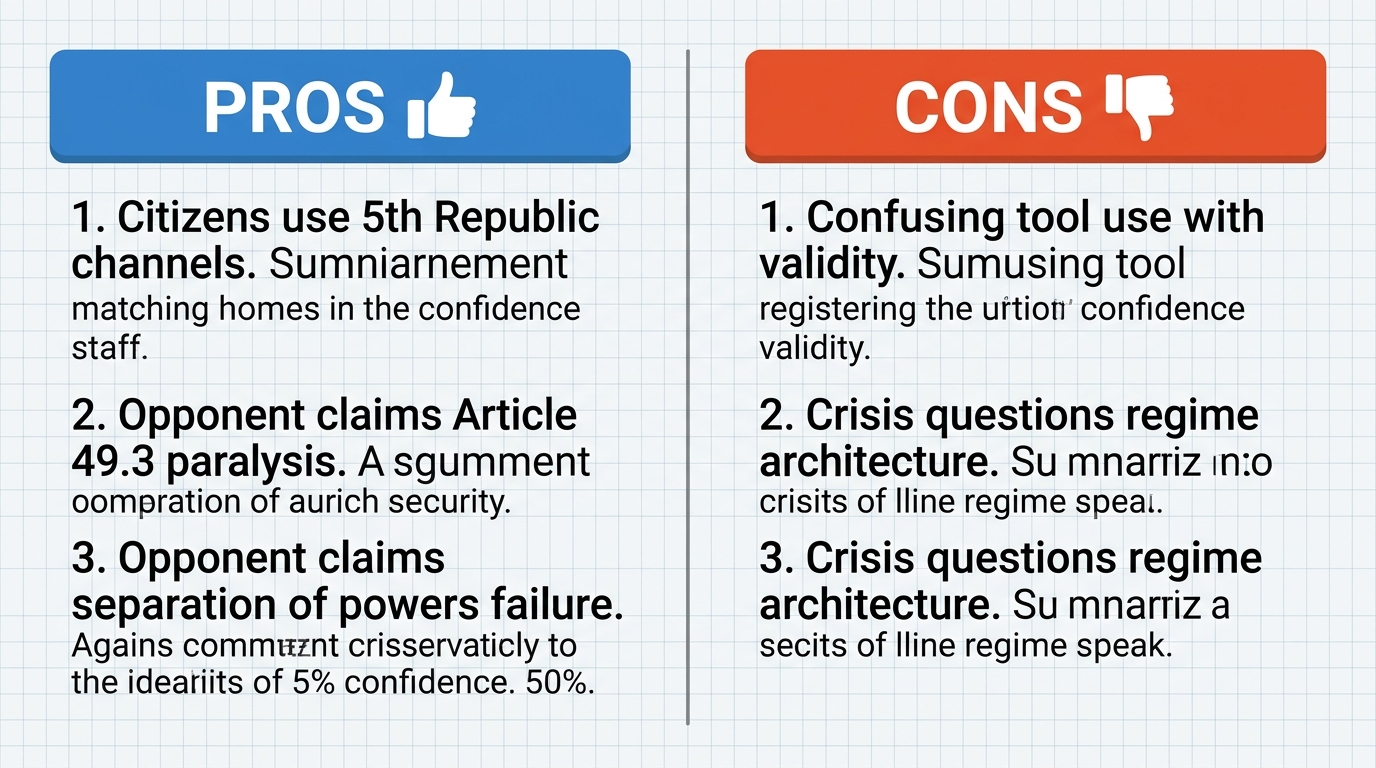
- ■The persistence of significant voter turnout demonstrates that citizens continue to utilize the channels of the Fifth Republic to express their discontent, rather than rejecting them outright. During the early legislative elections of June-July 2024, turnout reached 66.7% in the second round, a level unprecedented since 1997, according to data published by the Ministry of the Interior. This civic rebound, far from indicating disaffection with the institutional framework, reveals a strong desire to sanction or support representatives through mechanisms provided by the 1958 Constitution.
- ■The opponent claims that the use of Article 49.3 reveals a paralysis of the representative function and a structural failure of the separation of powers characteristic of the Fifth Republic. This conclusion relies on an implicit auxiliary hypothesis that has never been named or justified: that resorting to 49.3 is solely a symptom of a French constitutional flaw, rather than a common practice among parliamentary democracies facing fragmented majorities. In fact, this hypothesis is contradicted by facts. The mechanism of Article 49.3 has a direct functional equivalent in the UK Parliament Act of 1911, which allows the House of Commons to bypass the Lords' blockage after u
❌ Key CONTRARY arguments:
- ■The opposing argument relies on a fundamental confusion between the use of a tool and the validity of the tool itself. Claiming that the crisis is purely relational because citizens use constitutional mechanisms is a fallacy of begging the question. The use of Article 49.3 to bypass parliamentary votes, although provided for by the Constitution, reveals a paralysis of the representative function. When the very architecture of the regime allows governing by decree or emergency procedures in the absence of a majority, it is no longer a matter of "political personnel," but a failure of the separation
- ■I contest the assertion that the 2026 crisis is merely a distrust of representatives, without questioning the regime's architecture. The opponent attempts to import a concept of "institutional stability" based on electoral participation data, but makes a significant error by not projecting these figures onto the regime's governance capacity. The opponent's argument rests on the idea that if citizens vote, they validate the framework. However, this analysis ignores the very nature of the crisis: an institution that can no longer produce a stable majority and which d
💭 Conclusion: The opposing argument, which relies on electoral participation, makes a significant error by conflating the use of constitutional mechanisms with their validity. A turnout rate of 66.7% does not measure trust in the Fifth Republic, but the intensity of mobilization against the status quo.
🔬 Verdict: Mostly FALSE ❌ (64%)
Claim: In France, the 2026 political crisis is a crisis of trust between the people and their representatives, not a crisis of the Fifth Republic.
Participating models: deepseek-v4-pro 💬, gemma-4-26b-a4b-it 💬👁️
📊 Confrontations: 0 concluded TRUE, 1 concluded FALSE (1 confrontation, 3 models)
📊 Score by camp: TRUE=0.00, FALSE=0.64
🏅 Model score evolution:
deepseek-v4-flash-0731 💬: +6
✅ PRO arguments:
- ■The persistence of significant voter turnout demonstrates that citizens continue to utilize the channels of the Fifth Republic to express their discontent, rather than rejecting them outright. During the early legislative elections of June-July 2024, turnout reached 66.7% in the second round, a level unprecedented since 1997, according to data published by the Ministry of the Interior. This civic rebound, far from indicating disaffection with the institutional framework, reveals a strong desire to sanction or support representatives through mechanisms provided by the 1958 Constitution.
- ■The opponent claims that the use of Article 49.3 reveals a paralysis of the representative function and a structural failure of the separation of powers characteristic of the Fifth Republic. This conclusion relies on an implicit auxiliary hypothesis that has never been named or justified: that resorting to 49.3 is solely a symptom of a French constitutional flaw, rather than a common practice among parliamentary democracies facing fragmented majorities. In fact, this hypothesis is contradicted by facts. The mechanism of Article 49.3 has a direct functional equivalent in the UK Parliament Act of 1911, which allows the House of Commons to bypass the Lords' blockage after u deepseek-v4-pro 💬
❌ CONTRARY arguments:
- ■The opposing argument relies on a fundamental confusion between the use of a tool and the validity of the tool itself. Claiming that the crisis is purely relational because citizens use constitutional mechanisms is a fallacy of begging the question. The use of Article 49.3 to bypass parliamentary votes, although provided for by the Constitution, reveals a paralysis of the representative function. When the very architecture of the regime allows governing by decree or emergency procedures in the absence of a majority, it is no longer a matter of "political personnel," but a failure of the separation gemma-4-26b-a4b-it 💬👁️
- ■I contest the assertion that the 2026 crisis is merely a distrust of representatives, without questioning the regime's architecture. The opponent attempts to import a concept of "institutional stability" based on electoral participation data, but makes a significant error by not projecting these figures onto the regime's governance capacity. The opponent's argument rests on the idea that if citizens vote, they validate the framework. However, this analysis ignores the very nature of the crisis: an institution that can no longer produce a stable majority and which d gemma-4-26b-a4b-it 💬👁️
💭 Reasoning: The opposing argument, which relies on electoral participation, makes a significant error by conflating the use of constitutional mechanisms with their validity. A turnout rate of 66.7% does not measure trust in the Fifth Republic, but the intensity of mobilization against the status quo.
📋 Facts PRO:
• 66.7% voter turnout in the second round of the early legislative elections of June-July 2024, an unprecedented level since 1997 (Ministry of the Interior).
📋 Facts CON:
• Article 49.3 has been used to bypass parliamentary votes.
• The regime's architecture allows governing by decree or emergency procedures in the absence of a majority.
• The institution can no longer produce a stable majority.
| Confrontation | TRUE Model | FALSE Model | Average μ TRUE | Average μ FALSE | TRUE Tokens | FALSE Tokens | Winner | Verdict | Confidence |
|---|---|---|---|---|---|---|---|---|---|
| #1 | deepseek-v4-pro 💬 | gemma-4-26b-a4b-it 💬👁️ | 0.445 | 0.294 | 6 | 2 | TRUE | FALSE | 64% |
The following financial data tables were cited during the debate exchanges:
| Election | First Round Participation | Second Round Participation | Source |
|---|---|---|---|
| Legislative Elections 2022 | 47.5% | 46.2% | Ministry of the Interior |
| Legislative Elections 2024 | 66.7% | 66.7% | Ministry of the Interior |
Legend: Voter turnout rates for the French legislative elections of 2022 and 2024. Source: official data from the Ministry of the Interior.
Face-off transcripts
- ■
Ownership & Trade Secrets. Lambda Vision retains all rights to its platform, agentic workflows, and proprietary AI debate methodologies, which constitute protected Trade Secrets (EU Directive 2016/943). Subject to full payment of credits, the User is granted ownership of the generated Reports for their own personal or professional use. Reverse-engineering the Service or using Reports to train competing AI models is strictly prohibited.
- ■
No Professional Advice. Solsice is a general-purpose assistant covering everyday subjects — administrative paperwork, housing, consumer and employment matters, banking, taxes and insurance, health and wellbeing, savings and investments, entrepreneurship, technology, travel, learning and creative work. Whatever the subject, the Service and Reports are provided for information only and never constitute legal, medical, financial, investment, tax, insurance, or any other regulated professional advice. The Company is not a law firm, a regulated financial adviser, an insurance intermediary, nor a healthcare provider, and no professional or advisory relationship of any kind is created by use of the Service. Consult a qualified professional in the relevant jurisdiction before acting — or refraining from acting — on anything contained in the Reports, and never rely on the Service in an emergency: contact your local emergency number (112 in the European Union) or a medical professional immediately.
- ■
AI-Generated Content, Sources and Viewpoints. Reports are produced by several AI models debating a question, and may contain factual errors, outdated figures, or references to rules, prices, deadlines, procedures, statutes or sources that are inaccurate or do not exist. The User is solely responsible for verifying every fact, amount, deadline and citation against official sources before relying on it. Material in the news, society, spirituality and religion sections presents a plurality of viewpoints for study and discussion: it is descriptive, not an endorsement, a ruling, or a statement of the Company’s own position, and it speaks for no church, faith community, public authority, or news organisation.
- ■
Liability & Governing Law. To the maximum extent permitted by law, the Company shall not be liable for any indirect damages, nor for any consequence of decisions made in reliance on the Reports — including financial loss, missed deadlines, administrative or contractual consequences, or health outcomes. These Terms are governed by French law. Any disputes shall be subject to the exclusive jurisdiction of the Courts of Paris, France.