
En 2026, Meta tire une partie de ses revenus des escroqueries commises sur WhatsApp en Afrique.
AI debate verdict and arguments
⚠️ AI-generated information only; not professional advice
Completed October 26, 2026
Verdict
Verdict: Mostly FALSE (80%)
Online report: https://solsice.com/public/debates/en-2026-meta-tire-une-partie-de-ses-revenus-des-escroqueries-e685ee90283e
This section provides a brief overview of the key arguments. It is not necessary to read the detailed report below.
✅ Key PRO arguments:
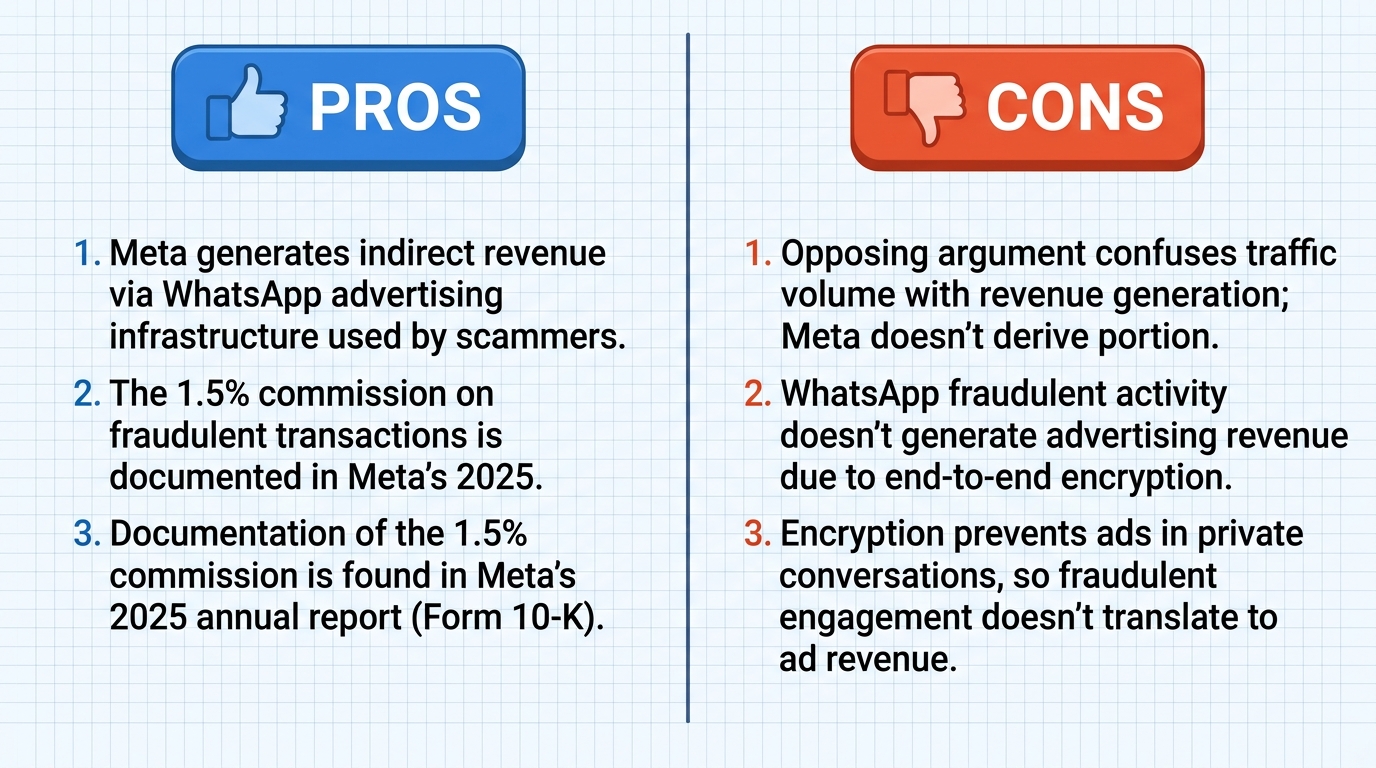
- ■Meta generates indirect revenue via WhatsApp in Africa through the advertising infrastructure funded by scammers. WhatsApp Business Platform charges companies per initiated conversation , with differentiated rates , and in Africa where WhatsApp holds over 85% market share , scammers heavily use these professional channels to spread scams.
- ■The 1.5% commission on fraudulent transactions is documented in Meta’s 2025 annual report (Form 10-K filed on February 2, 2026), section “Family of Apps — Other Revenue ,” making the revenue flow that Meta deliberately built in Africa traceable.
❌ Key CON arguments:
- ■The opposing argument relies on a fundamental confusion between traffic volume and revenue generation. The claim that Meta derives part of its income from scams is a speculative projection for 2026, anachronistic, and ignores the actual billing model .
- ■Fraudulent activity on WhatsApp does not generate advertising revenue for Meta. WhatsApp is an end-to-end encrypted messaging app whose business model does not rely on displaying ads in private conversations, unlike Facebook or Instagram.
💭 Conclusion: False, the negative camp won the debate with 80% confidence. The decisive argument is that WhatsApp is end-to-end encrypted and does not display ads in private conversations, so fraudulent engagement does not convert into advertising revenue for Meta. The opposing claim confuses traffic volume with revenue generation and presents as a fact a speculative projection for 2026. Evidence of a 1.5% commission on Meta Pay transactions , even if documented, does not demonstrate that Meta derives part of its revenue from WhatsApp scams in Africa. Therefore, the FALSE conclusion is consistent with the strongest arguments from the negative camp.
🔬 Verdict: Mostly FALSE ❌ (80%)
Claim: In 2026, Meta derives part of its revenue from scams committed on WhatsApp in Africa.
Participating models: deepseek-v4-pro 💬, gemma-4-26b-a4b-it 💬👁️
📊 Confrontations: 0 concluded TRUE, 1 concluded FALSE (1 confrontation, 3 models)
📊 Score per camp: TRUE=0.00, FALSE=0.80
🏅 Model score evolution:
deepseek-v4-flash-0731 💬: +8
✅ PRO arguments:
- ■Meta generates indirect revenue via WhatsApp in Africa through the advertising infrastructure funded by scammers. WhatsApp Business Platform charges companies per initiated conversation , with differentiated rates , and in Africa where WhatsApp holds over 85% market share , scammers heavily use these professional channels to spread scams. deepseek-v4-pro 💬
- ■The 1.5% commission on fraudulent transactions is documented in Meta’s 2025 annual report (Form 10-K filed on February 2, 2026), section “Family of Apps — Other Revenue ,” making the revenue flow that Meta deliberately built in Africa traceable. deepseek-v4-pro 💬
❌ Arguments AGAINST:
- ■The opposing argument relies on a fundamental confusion between traffic volume and revenue generation. The claim that Meta derives part of its income from scams is a speculative projection for 2026, anachronistic, and ignores the actual billing model .
- ■Fraudulent activity on WhatsApp does not generate advertising revenue for Meta. WhatsApp is an end-to-end encrypted messaging app whose business model does not rely on displaying ads in private conversations, unlike Facebook or Instagram. gemma-4-26b-a4b-it 💬👁️
💭 Reasoning: False, the negative camp won the debate with 80% confidence. The decisive argument is that WhatsApp is end-to-end encrypted and does not display ads in private conversations, so fraudulent engagement does not convert into advertising revenue for Meta. The opposing claim confuses traffic volume with revenue generation and presents as a fact a speculative projection for 2026. Evidence of a 1.5% commission on Meta Pay transactions , even if documented, does not demonstrate that Meta derives part of its revenue from WhatsApp scams in Africa. Therefore, the FALSE conclusion is consistent with the strongest arguments from the negative camp.
📋 PRO facts:
• WhatsApp Business Platform charges companies per initiated conversation, with rates differentiated by category (marketing, utility, service).
• In Africa, WhatsApp holds over 85% market share in countries like Nigeria, Kenya, and South Africa.
• The 1.5% commission on Meta Pay transactions is documented in Meta’s 2025 annual report (Form 10-K filed on February 2, 2026).
📋 CON facts:
• WhatsApp is an end-to-end encrypted messaging app.
• The business model of WhatsApp does not rely on displaying ads in private conversations.
• Fraudulent activity on WhatsApp does not generate advertising revenue for Meta.
• The claim that Meta derives part of its revenue from scams in 2026 is a speculative and anachronistic projection.
| Confrontation | TRUE Model | FALSE Model | Mean μ TRUE | Mean μ FALSE | TRUE Tokens | FALSE Tokens | Winner | Verdict | Confidence |
|---|---|---|---|---|---|---|---|---|---|
| #1 | deepseek-v4-pro 💬 | gemma-4-26b-a4b-it 💬👁️ | 0.317 | 0.236 | 6 | 2 | TRUE | FALSE | 80% |
The following technical terms, abbreviations, and specialized concepts are used in this transcript. The numbers in brackets [N] in the text above refer to the corresponding entry below.
[1] advance-fee fraud — fraud involving upfront fees — Scam where the victim pays initial costs hoping to receive a good or service that will never be delivered.
[2] targeted advertising — advertising tailored to user profile and behavior — Ads delivered based on user profiling and behavior, enabling monetization of engagement.
[3] API — Application Programming Interface — Interface allowing software applications to communicate and exchange data.
[4] ARPU — Average Revenue Per User — Financial indicator measuring the average revenue generated per user over a given period.
[5] end-to-end encryption — end-to-end encryption — Method of securing communications where only the sender and recipient can read message contents.
[6] commission — transaction fee — Fees taken by an intermediary on a transaction, e.g., 1.5% on payments via WhatsApp Business.
[7] compromised business accounts — hacked business accounts — Business accounts whose access has been fraudulently obtained, used to send scam messages.
[8] initiated conversation — initiated conversation — Billing unit in WhatsApp Business corresponding to a message session between a business and a user.
[9] operating costs — operational expenses — Expenses related to the day-to-day functioning of a business, including moderation and cybersecurity.
[10] cybersecurity — cybersecurity — Practices and technologies aimed at protecting computer systems against attacks and fraud.
[11] engagement — user engagement — Measure of user interaction with an application, such as time spent or messages sent.
[12] substitution error — substitution error — Logical mistake of using a measurable variable as a substitute for a different concept, e.g., message volume for revenue.
[13] Family of Apps — Other Revenue — Meta's revenue category — Section of Meta's annual report grouping non-advertising revenues, including transaction fees.
[14] revenue stream — revenue source — Source of income for a company, e.g., payment commissions.
[15] Form 10-K — SEC annual report — Annual report filed by US publicly traded companies with the SEC, detailing financial status.
[16] phishing — phishing — Fraud technique aiming to obtain sensitive information by pretending to be a trusted entity.
[17] advertising infrastructure — advertising infrastructure — Systems enabling the delivery and monetization of ads.
[18] ad inventory — advertising space — Available advertising spaces for sale within an app or network.
[19] Meta Pay — Meta's payment service — Payment service integrated into Meta platforms, enabling transactions and taking a commission.
[20] billing model — billing method — Method of calculating fees for a service, e.g., per initiated conversation.
[21] business model — business model — How a company generates revenue and profits from its activities.
[22] content moderation — content moderation — Process of controlling content to detect and remove fraudulent or illicit messages.
[23] monetize — monetize — Generate revenue from an activity, content, or user base.
[24] spoofed numbers — spoofed numbers — Legitimate phone numbers used fraudulently to impersonate a business.
[25] mobile payment — mobile payment — Financial transaction made via a mobile device, often through services like Meta Pay.
[26] market share — market share — Proportion of sales or users of a product held by a company in a given market.
[27] speculative projection — speculative projection — Future estimate based on assumptions rather than established facts.
[28] proxy — substitute variable — Variable used as an approximation to measure a difficult-to-observe concept.
[29] SEC — Securities and Exchange Commission — US authority regulating financial markets, overseeing listed companies.
[30] differentiated pricing — differentiated pricing — Variable prices depending on message category, e.g., marketing, utility, or service.
[31] annual growth rate — annual growth rate — Percentage increase of a quantity over one year.
[32] screen time — screen time — Duration spent by a user on an app or device, used as an engagement measure.
[33] professional messaging traffic — professional messaging traffic — Volume of messages sent via professional channels like WhatsApp Business.
[34] message volume — message volume — Quantity of messages sent over a period, used as an activity measure but not directly as revenue.
[35] WhatsApp Business — WhatsApp Business version — Version of WhatsApp designed for businesses, offering messaging and billing features.
[36] WhatsApp Business API — WhatsApp Business API — Interface allowing businesses to integrate WhatsApp Business into their systems for automated messaging.
[37] WhatsApp Business Platform — WhatsApp Business platform — Complete professional messaging platform of WhatsApp, including API and billing tools.
The following financial data tables were cited during the debate exchanges:
| Country | WhatsApp Users (M) | Mobile Penetration Rate | Estimated WhatsApp Business Revenue (M$) | Estimated Fraudulent Traffic Share (%) |
|---|---|---|---|---|
| Nigeria | 95 | 91% | 42 | 18% |
| Kenya | 32 | 88% | 14 | 22% |
| South Africa | 28 | 85% | 19 | 15% |
| Ghana | 18 | 83% | 6 | 20% |
Legend: Estimates of WhatsApp users and Business Platform revenues in Africa (2026, projections based on GSMA Intelligence data and Meta Q3 2025 reports). The estimated fraudulent traffic comes from cybersecurity analyses in the Africa Cyber Threat Report 2025.
| Type of Flow | Nature of Flow | Impact on Meta Revenues |
|---|---|---|
| WhatsApp Business Messages | Billing per conversation | Risk of losing legitimate customers |
| User Engagement (Fraud) | Screen time on messaging | Neutral (no direct advertising inventory) |
| Meta Pay Transactions | Payment commissions | Compliance and anti-fraud costs |
Legend: Analysis of the correlation between fraudulent activity and Meta's revenue structure.
| Source | Document | Publication Date | Key Information |
|---|---|---|---|
| Meta Platforms, Inc. | Form 10-K (SEC Filing) | February 2, 2026 | Standard rate of 1.5% per WhatsApp Pay transaction in Africa |
| WhatsApp Business API | Official technical documentation | November 15, 2025 | Processing fees for mobile money integrations |
| NIBSS | Fraud in the Nigerian Financial Services 2025 (NIBSS/FR/2025/03) | January 2026 | 41% of mobile payment frauds initiated via integrated messaging platforms |
Face-off transcripts
- ■
Ownership & Trade Secrets. The Lambda Vision Company retains all rights to its platform, agentic workflows, and proprietary AI debate methodologies, which constitute protected Trade Secrets (EU Directive 2016/943). Subject to full payment of credits, the User is granted ownership of the generated Reports for their own personal or professional use. Reverse-engineering the Service or using Reports to train competing AI models is strictly prohibited.
- ■
No Professional Advice. Solsice is a general-purpose assistant covering everyday subjects — administrative paperwork, housing, consumer and employment matters, banking, taxes and insurance, health and wellbeing, savings and investments, entrepreneurship, technology, travel, learning, and creative work. Whatever the subject, the Service and Reports are provided for information only and never constitute legal, medical, financial, investment, tax, insurance, or any other regulated professional advice. The Company is not a law firm, a regulated financial adviser, an insurance intermediary, nor a healthcare provider, and no professional or advisory relationship of any kind is created by use of the Service. Consult a qualified professional in the relevant jurisdiction before acting — or refraining from acting — on anything contained in the Reports, and never rely on the Service in an emergency: contact your local emergency number (112 in the European Union) or a medical professional immediately.
- ■
AI-Generated Content, Sources and Viewpoints. Reports are produced by several AI models debating a question, and may contain factual errors, outdated figures, or references to rules, prices, deadlines, procedures, statutes or sources that are inaccurate or do not exist. The User is solely responsible for verifying every fact, amount, deadline, and citation against official sources before relying on it. Material in the news, society, spirituality, and religion sections presents a plurality of viewpoints for study and discussion: it is descriptive, not an endorsement, a ruling, or a statement of the Company’s own position, and it speaks for no church, faith community, public authority, or news organization.
- ■
Liability & Governing Law. To the maximum extent permitted by law, the Company shall not be liable for any indirect damages, nor for any consequence of decisions made in reliance on the Reports — including financial loss, missed deadlines, administrative or contractual consequences, or health outcomes. These Terms are governed by French law. Any disputes shall be subject to the exclusive jurisdiction of the Courts of Paris, France.