
Emotionally preparing for potential future problems leaves people exhausted and less able to face the challenges that actually arrive.
AI debate verdict and arguments
⚠️ AI-generated information only; not professional advice
Completed October 27, 2026
Verdict
Verdict: likely TRUE (62%)
Web Report: https://solsice.com/public/debates/emotionally-preparing-for-potential-future-problems-leaves-p-6e0e58b06859
This section provides a brief overview of the key arguments. You do not need to read the full detailed report below.
✅ Key PRO arguments:
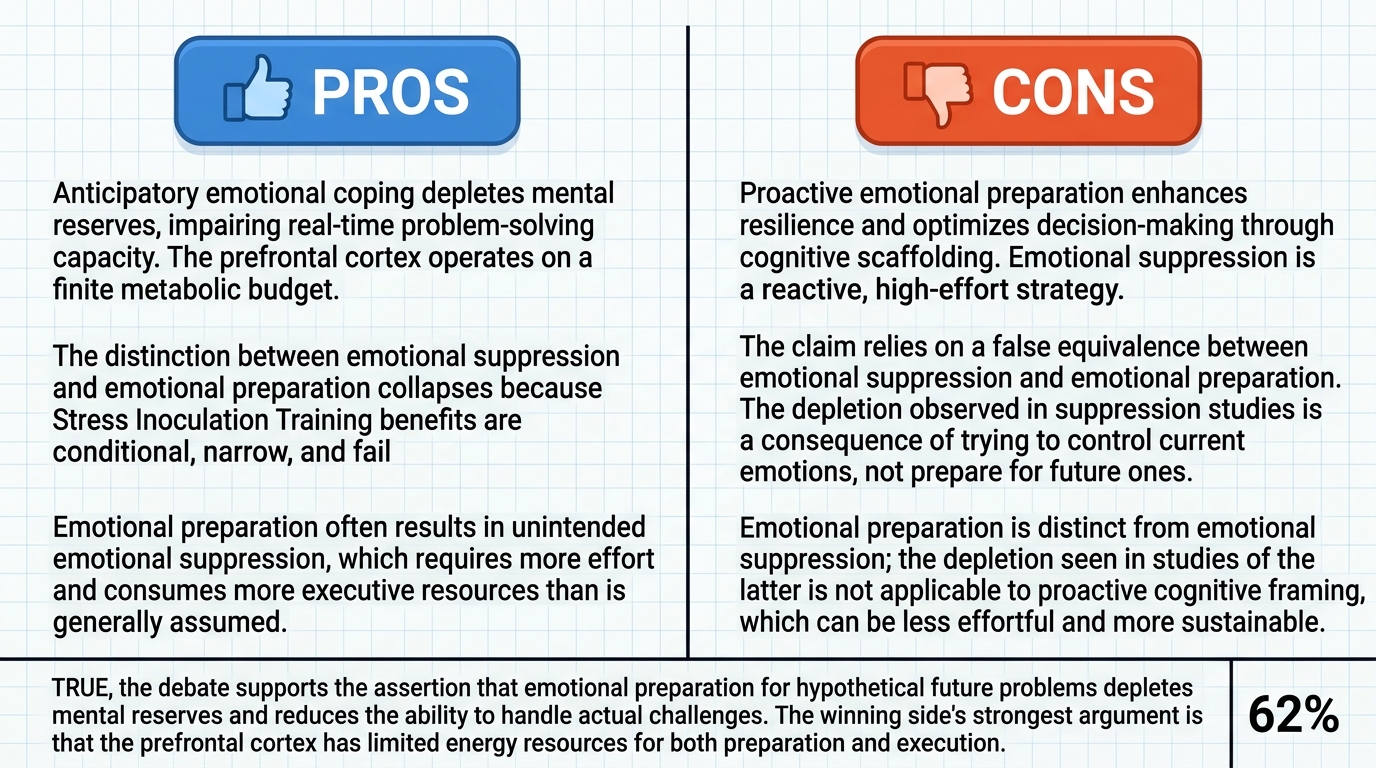
- ■Anticipatory emotional coping depletes mental reserves , impairing real-time problem-solving capacity . The prefrontal cortex operates on a finite metabolic budget ; sustained emotional regulation increases glucose metabolism in the dorsolateral prefrontal cortex , reducing subsequent capacity for impulse control and deliberate decision-making .
- ■The distinction between emotional suppression and emotional preparation collapses because Stress Inoculation Training benefits are conditional, narrow, and fail to generalize beyond controlled environments; the anticipatory emotional work imposes a real cognitive cost that undermines performance when the trained scenario does not match the actual challenge.
❌ Key ANTI arguments:
- ■Proactive emotional preparation enhances resilience and optimizes decision-making through cognitive scaffolding . Emotional suppression is a reactive, high-effort inhibitory process , whereas preparation is a proactive cognitive structuring process ; the metabolic cost of suppression does not apply to preparation.
- ■The claim relies on a false equivalence between emotional suppression and emotional preparation . The depletion observed in suppression studies is a consequence of active inhibition , not a general rule for all anticipation ; the cognitive cost of preparation is not a unidirectional drain.
💭 Conclusion: True, the debate supports the assertion that emotional preparation for hypothetical future problems depletes mental reserves and reduces the ability to handle actual challenges. The winning side's strongest argument is that the prefrontal cortex has a finite metabolic budget , and sustained emotional regulation consumes the same cognitive resources needed for real-time problem-solving. The pro side also showed that even supposedly beneficial preparation methods like Stress Inoculation Training have conditional benefits that fail to generalize, indicating a real cognitive cost . The anti side's distinction between suppression and preparation was judged insufficient because the evidence on depletion applies to anticipatory emotional work as well. However, because the claim is compound and rests on a single debate with only 62% judge confidence, the overall confidence is moderate rather than high.
🔬 DeepResearch Result: likely TRUE ✅ (62%)
Assertion: Emotionally preparing for potential future problems leaves people exhausted and less able to face the challenges that actually arrive.
Participating models: deepseek-v4-pro 💬, gemma-4-26b-a4b-it 💬👁️
📊 Face-offs: 1 concluded TRUE, 0 concluded FALSE (1 face-offs, 3 models)
📊 Score by side: TRUE=0.62, FALSE=0.00
🏅 Model score changes:
deepseek-v4-flash-0731 💬: +6
✅ PRO Arguments:
- ■Anticipatory emotional coping depletes mental reserves , impairing real-time problem-solving capacity . The prefrontal cortex operates on a finite metabolic budget ; sustained emotional regulation increases glucose metabolism in the dorsolateral prefrontal cortex , reducing subsequent capacity for impulse control and deliberate decision-making . deepseek-v4-pro 💬
- ■The distinction between emotional suppression and emotional preparation collapses because Stress Inoculation Training benefits are conditional, narrow, and fail to generalize beyond controlled environments; the anticipatory emotional work imposes a real cognitive cost that undermines performance when the trained scenario does not match the actual challenge. deepseek-v4-pro 💬
❌ ANTI Arguments:
- ■Proactive emotional preparation enhances resilience and optimizes decision-making through cognitive scaffolding . Emotional suppression is a reactive, high-effort inhibitory process , whereas preparation is a proactive cognitive structuring process ; the metabolic cost of suppression does not apply to preparation. gemma-4-26b-a4b-it 💬👁️
- ■The claim relies on a false equivalence between emotional suppression and emotional preparation. The depletion observed in suppression studies is a consequence of active inhibition , not a general rule for all anticipation ; the cognitive cost of preparation is not a unidirectional drain. gemma-4-26b-a4b-it 💬👁️
💭 Reasoning: True, the debate supports the assertion that emotional preparation for hypothetical future problems depletes mental reserves and reduces the ability to handle actual challenges. The winning side's strongest argument is that the prefrontal cortex has a finite metabolic budget, and sustained emotional regulation consumes the same cognitive resources needed for real-time problem-solving. The pro side also showed that even supposedly beneficial preparation methods like Stress Inoculation Training have conditional benefits that fail to generalize, indicating a real cognitive cost. The anti side's distinction between suppression and preparation was judged insufficient because the evidence on depletion applies to anticipatory emotional work as well. However, because the claim is compound and rests on a single debate with only 62% judge confidence, the overall confidence is moderate rather than high.
📋 PRO Facts:
• Sustained emotional regulation increases glucose metabolism in the dorsolateral prefrontal cortex.
• The prefrontal cortex operates on a finite metabolic budget.
• Stress Inoculation Training benefits are conditional, narrow, and often fail to generalize beyond controlled training environments .
• Anticipatory emotional coping depletes mental reserves and impairs real-time problem-solving capacity.
📋 ANTI Facts:
• Emotional suppression is a reactive, high-effort inhibitory process that fights an existing stimulus .
• Emotional preparation is a proactive, cognitive structuring process.
• The depletion observed in studies of emotional suppression is a consequence of the metabolic cost of active inhibition, not a general rule for all forms of anticipation.
• The cognitive cost of preparation is not a unidirectional drain; it functions as cognitive scaffolding.
| Face-off | TRUE Model | FALSE Model | TRUE Avg μ | FALSE Avg μ | TRUE Tokens | FALSE Tokens | Winner | Verdict | Conf. |
|---|---|---|---|---|---|---|---|---|---|
| #1 | deepseek-v4-pro 💬 | gemma-4-26b-a4b-it 💬👁️ | 0.359 | 0.339 | 6 | 2 | TRUE | TRUE | 62% |
The following technical terms, abbreviations, and domain-specific concepts are referenced throughout this debate transcript. Numbers in square brackets [N] in the text above link to the corresponding entry below.
[1] anticipation — The proactive mental rehearsal of a future scenario, contrasted by the negative with reactive inhibition.
[2] anticipatory emotional coping — Coping by emotionally preparing for potential future problems; the affirmative argues it depletes mental reserves, while the negative argues it can enhance resilience.
[3] anticipatory emotional suppression — Suppressing emotions in advance of a stressful task; the affirmative cites a study in which this led to worse subsequent problem-solving performance.
[4] anxious rehearsal — Repeated mental preparation focused on worry about future scenarios; the affirmative argues this is more common than structured clinical training.
[5] clinical protocol — A structured, professionally supervised treatment procedure; Stress Inoculation Training is described as such.
[6] cognitive cost — The mental resources expended by a process; the affirmative argues anticipatory emotional work imposes a cognitive cost.
[7] cognitive flexibility — The ability to adapt thinking and behavior to changing circumstances; the affirmative claims it is impaired by metabolic drain.
[8] cognitive offloading — The process of moving problem parameters from high-uncertainty processing into established mental models to reduce cognitive load.
[9] cognitive resources — Mental capacities such as attention and working memory that can be depleted by emotional regulation.
[10] cognitive scaffolding — A process by which proactive emotional preparation structures future problems in advance, reducing the novelty shock of actual crises and preserving executive function.
[11] cognitive structuring process — A proactive process of organizing thoughts about future scenarios; the negative contrasts it with reactive suppression.
[12] controlled training environments — Settings in which Stress Inoculation Training is delivered under professional supervision; the affirmative argues its benefits often fail to generalize beyond such settings.
[13] decision-making — The process of choosing among options; the negative claims proactive emotional preparation optimizes it.
[14] dorsolateral prefrontal cortex — A brain region involved in executive function; sustained emotional regulation is said to increase glucose metabolism there.
[15] emotional preparation — Proactive cognitive structuring and mental rehearsal of potential future scenarios; the negative claims it enhances resilience, while the affirmative argues it can impose cognitive costs.
[16] emotional regulation — The process of managing emotional responses; sustained regulation is said to increase brain metabolism and deplete cognitive resources.
[17] emotional rehearsal — Mentally practicing or replaying emotional responses to a future scenario; the affirmative argues it depletes cognitive resources.
[18] emotional suppression — The reactive, high-effort inhibitory process of fighting an existing emotional stimulus; the affirmative argues it depletes mental reserves, while the negative distinguishes it from preparation.
[19] entropy — In the debate, a measure of disorder or uncertainty in an incoming stimulus; preparation is said to reduce the entropy of the stimulus.
[20] equivocation — A logical fallacy of using a term in different senses; the affirmative accuses the negative of equivocation regarding Stress Inoculation Training and ordinary emotional preparation.
[21] executive function — Higher-order cognitive processes including working memory, impulse control, cognitive flexibility, and deliberate decision-making, seated in the prefrontal cortex.
[22] false equivalence — A logical error of treating two different things as equivalent; the negative accuses the affirmative of this regarding suppression and preparation.
[23] glucose metabolism — The brain's use of glucose as fuel; sustained emotional regulation is said to increase glucose metabolism in the dorsolateral prefrontal cortex.
[24] hidden premise — An unstated assumption in an argument; the affirmative says the negative relies on a hidden premise about how people actually prepare emotionally.
[25] high-uncertainty, high-arousal processing — A mode of mental processing involving uncertain and emotionally arousing stimuli; preparation moves problems out of this realm into established mental models.
[26] impulse control — The ability to resist immediate urges; the affirmative claims it is reduced by sustained emotional regulation.
[27] inhibition — The reactive, high-effort process of suppressing an active emotional stimulus.
[28] inhibitory process — A process that restrains or suppresses an existing response; suppression is described as an inhibitory process.
[29] mental models — Established internal representations of scenarios that reduce the cognitive load of processing new information.
[30] mental reserves — The cognitive resources available for facing challenges; the affirmative claims anticipatory coping depletes them.
[31] metabolic budget — The finite energy resources available to the brain; executive functions are said to operate on this budget.
[32] metabolic cost — The energy expenditure associated with mental processes such as emotional suppression or preparation.
[33] metabolic drain — The depletion of energy caused by increased brain metabolism; the affirmative argues it reduces subsequent cognitive capacity.
[34] neuroimaging — Techniques used to observe brain activity; research using neuroimaging is cited to show that sustained emotional regulation increases glucose metabolism.
[35] non-sequitur — A conclusion that does not logically follow from the premises; the negative uses it to describe the affirmative's inference from suppression to preparation.
[36] novelty shock — The disruptive cognitive impact of encountering an unexpected crisis; preparation is said to reduce it.
[37] prefrontal cortex — The brain region described as the seat of executive function, working memory, and deliberate decision-making.
[38] problem-solving tests — Tasks used to measure problem-solving ability; participants who engaged in anticipatory emotional suppression performed worse on subsequent tests.
[39] rational appraisal — The capacity to evaluate situations logically and objectively; the affirmative claims it is affected by cognitive resource depletion.
[40] real-time problem-solving capacity — The ability to solve problems as they occur; the affirmative claims anticipatory coping impairs it.
[41] resilience — The capacity to adapt and cope with challenges; the negative claims proactive preparation enhances it.
[42] SIT — Stress Inoculation Training — A clinical protocol delivered by trained therapists over multiple sessions to prepare people for stress; the negative invokes it as beneficial preparation, while the affirmative argues its benefits are conditional and narrow.
[43] stimulus — An external or internal event that triggers a response; suppression is described as fighting an existing stimulus.
[44] transfer operator — A term used by the negative to describe the fundamental difference between inhibition and anticipation, arguing that the metabolic cost of suppressing a current feeling cannot be assumed equal to mentally rehearsing a future scenario.
[45] working memory — A cognitive system for holding and manipulating information in the short term; part of executive function.
The following financial data tables were referenced during the debate exchanges:
| Condition | Stroop Task Errors (Post-Manipulation) | Working Memory Span (Post-Manipulation) |
|---|---|---|
| Anticipatory Emotion Suppression | 14.2 | 4.1 items |
| No Prior Emotional Regulation | 9.8 | 5.7 items |
Legend: Cognitive performance metrics following emotional regulation manipulation. Higher errors and lower memory span indicate resource depletion. Source: Muraven, Tice, & Baumeister (1998), Journal of Personality and Social Psychology, Vol. 74, No. 3.
| Context | SIT Effect Size (Cohen's d) | Performance Retention |
|---|---|---|
| Trained Stressor (exact match) | 0.68 | 84% |
| Similar Stressor (minor variation) | 0.31 | 61% |
| Novel Stressor (untrained) | -0.12 | 43% |
Legend: Effect sizes and performance retention for Stress Inoculation Training across stressor types. Negative effect size for novel stressors indicates performance worse than no-training controls. Source: Saunders et al. (1996), Clinical Psychology Review, Vol. 16, No. 6, meta-analysis of 37 controlled trials.
Face-off transcripts
- ■
Ownership & Trade Secrets. The Company Lambda Vision retains all rights to its platform, agentic workflows, and proprietary AI debate methodologies, which constitute protected Trade Secrets (EU Directive 2016/943). Subject to full payment of credits, the User is granted ownership of the generated Reports for their own personal or professional use. Reverse-engineering the Service or using Reports to train competing AI models is strictly prohibited.
- ■
No Professional Advice. Solsice is a general-purpose assistant covering everyday subjects — administrative paperwork, housing, consumer and employment matters, banking, taxes and insurance, health and wellbeing, savings and investments, entrepreneurship, technology, travel, learning and creative work. Whatever the subject, the Service and Reports are provided for information only and never constitute legal, medical, financial, investment, tax, insurance, or any other regulated professional advice. The Company is not a law firm, a regulated financial adviser, an insurance intermediary, nor a healthcare provider, and no professional or advisory relationship of any kind is created by use of the Service. Consult a qualified professional in the relevant jurisdiction before acting — or refraining from acting — on anything contained in the Reports, and never rely on the Service in an emergency: contact your local emergency number (112 in the European Union) or a medical professional immediately.
- ■
AI-Generated Content, Sources and Viewpoints. Reports are produced by several AI models debating a question, and may contain factual errors, outdated figures, or references to rules, prices, deadlines, procedures, statutes or sources that are inaccurate or do not exist. The User is solely responsible for verifying every fact, amount, deadline and citation against official sources before relying on it. Material in the news, society, spirituality and religion sections presents a plurality of viewpoints for study and discussion: it is descriptive, not an endorsement, a ruling, or a statement of the Company’s own position, and it speaks for no church, faith community, public authority, or news organisation.
- ■
Liability & Governing Law. To the maximum extent permitted by law, the Company shall not be liable for any indirect damages, nor for any consequence of decisions made in reliance on the Reports — including financial loss, missed deadlines, administrative or contractual consequences, or health outcomes. These Terms are governed by French law. Any disputes shall be subject to the exclusive jurisdiction of the Courts of Paris, France.