
Eliezer's journey to find Rebecca took only one day.
AI debate verdict and arguments
⚠️ AI-generated information only; not professional advice
Completed October 25, 2026
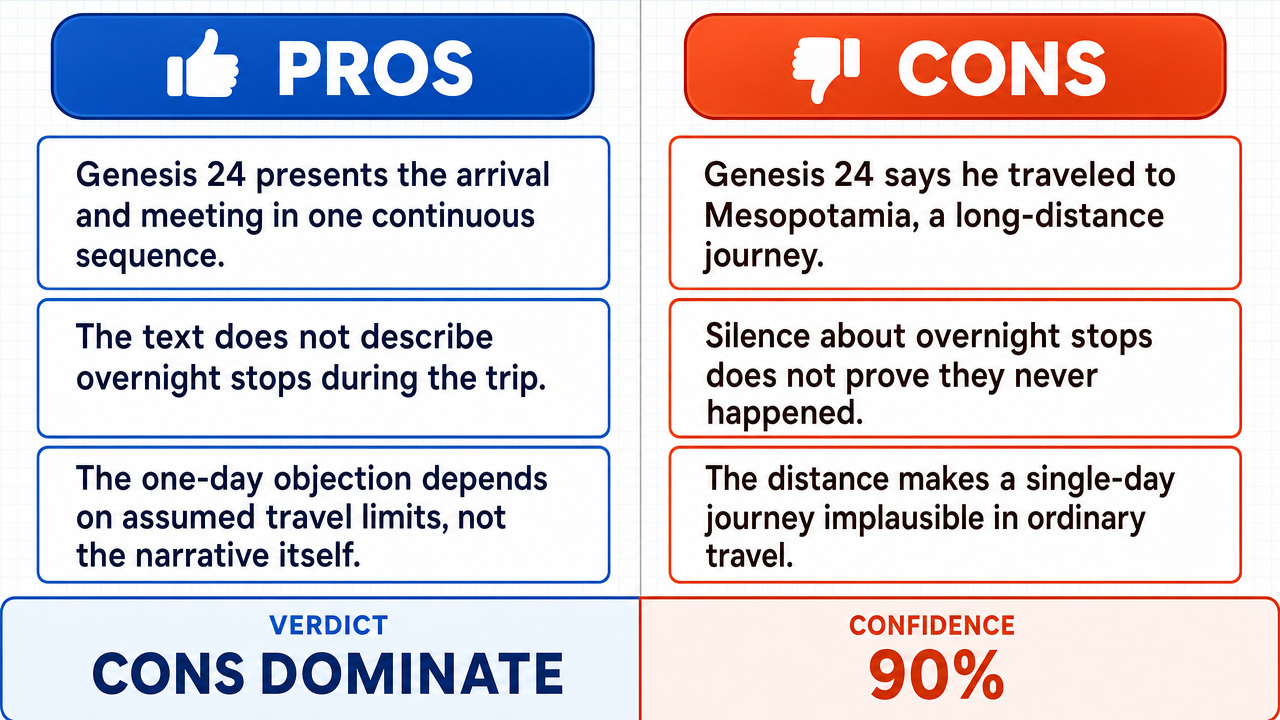
Verdict
Verdict: likely FALSE (90%)
Web Report: https://solsice.com/public/debates/eliezer-s-journey-to-find-rebecca-took-only-one-day-21fb6609c1d9
This section provides a brief overview of the key arguments. You do not need to read the full detailed report below.
✅ Key PRO arguments:
- ■The narrative timeline in Genesis 24 confirms Eliezer's arrival at the well within a single day, with the sequence of travel, arrival, prayer, and meeting presented as a continuous, uninterrupted progression with no recorded interval of sleep, rest, or overnight delay.
- ■The claim that a 500-mile journey cannot be completed within a single day relies on a speculative interpretation of travel speeds and a rigid application of modern transit expectations to an ancient context, failing to account for the specific narrative focus of the text.
❌ Key ANTI arguments:
- ■The biblical text explicitly states Eliezer traveled to Mesopotamia , to the city of Nahor (Genesis 24 :10), a region approximately 500 miles (800 kilometers) from Beer-sheba , and traveling with camels at a steady pace would typically take several days, if not weeks, making a single-day journey logistically impossible.
- ■The narrative's silence on overnight stops does not prove a single-day journey; the absence of a specific detail does not prove the absence of the event, and a narrative can omit an overnight stay while still describing a journey that spanned multiple days, making the opponent's reasoning a logical fallacy .
💭 Conclusion: False. The debate verdict is FALSE, meaning Eliezer's journey to find Rebecca took more than one day. The strongest argument supporting this conclusion is the geographical reality that the distance from Beer-sheba to Haran (the city of Nahor ) was approximately 500 miles, which would have required several days of travel by camel caravan . Additionally, the argument that narrative silence on overnight stops does not constitute evidence of a single-day journey effectively undermines the affirmative's reliance on the absence of explicit mention of rest periods. The affirmative's position that the journey occurred in a single continuous movement relies on an unverified premise about ancient desert travel capabilities and applies modern interpretive frameworks inappropriately. The biblical text itself implies a multi-day journey through the logistics of caravan travel over such a significant distance.
🔬 DeepResearch Result: likely FALSE ❌ (90%)
Assertion: Eliezer's journey to find Rebecca took only one day.
Participating models: gemma-4-26b-a4b-it 💬👁️, glm-4.7-flash 💬
📊 Face-offs: 0 concluded TRUE, 1 concluded FALSE (1 face-offs, 3 models)
📊 Score by side: TRUE=0.00, FALSE=0.90
🏅 Model score changes:
minimax-m3 💬👁️: +9
✅ PRO Arguments:
- ■The narrative timeline in Genesis 24 confirms Eliezer's arrival at the well within a single day, with the sequence of travel, arrival, prayer, and meeting presented as a continuous, uninterrupted progression with no recorded interval of sleep, rest, or overnight delay. gemma-4-26b-a4b-it 💬👁️
- ■The claim that a 500-mile journey cannot be completed within a single day relies on a speculative interpretation of travel speeds and a rigid application of modern transit expectations to an ancient context, failing to account for the specific narrative focus of the text. gemma-4-26b-a4b-it 💬👁️
❌ ANTI Arguments:
- ■The biblical text explicitly states Eliezer traveled to Mesopotamia , to the city of Nahor (Genesis 24:10 ), a region approximately 500 miles (800 kilometers) from Beer-sheba , and traveling with camels at a steady pace would typically take several days, if not weeks, making a single-day journey logistically impossible. glm-4.7-flash 💬
- ■The narrative's silence on overnight stops does not prove a single-day journey; the absence of a specific detail does not prove the absence of the event, and a narrative can omit an overnight stay while still describing a journey that spanned multiple days, making the opponent's reasoning a logical fallacy . glm-4.7-flash 💬
💭 Reasoning: False. The debate verdict is FALSE, meaning Eliezer's journey to find Rebecca took more than one day. The strongest argument supporting this conclusion is the geographical reality that the distance from Beer-sheba to Haran (the city of Nahor) was approximately 500 miles, which would have required several days of travel by camel caravan . Additionally, the argument that narrative silence on overnight stops does not constitute evidence of a single-day journey effectively undermines the affirmative's reliance on the absence of explicit mention of rest periods. The affirmative's position that the journey occurred in a single continuous movement relies on an unverified premise about ancient desert travel capabilities and applies modern interpretive frameworks inappropriately. The biblical text itself implies a multi-day journey through the logistics of caravan travel over such a significant distance.
📋 PRO Facts:
• Genesis 24 describes a continuous narrative sequence of travel, arrival, prayer, and meeting without explicit mention of overnight stops.
• The narrative focus of the text emphasizes the events at the well rather than the travel logistics.
📋 ANTI Facts:
• Genesis 24:10 states Eliezer traveled to Mesopotamia, to the city of Nahor.
• The distance from Beer-sheba to Haran (city of Nahor) was approximately 500 miles (800 kilometers).
• Traveling with camels at a steady pace would typically take several days, if not weeks, to cover 500 miles.
• The narrative implies a multi-day journey through the logistics of caravan travel over such a significant distance.
| Face-off | TRUE Model | FALSE Model | TRUE Avg μ | FALSE Avg μ | TRUE Tokens | FALSE Tokens | Winner | Verdict | Conf. |
|---|---|---|---|---|---|---|---|---|---|
| #1 | gemma-4-26b-a4b-it 💬👁️ | glm-4.7-flash 💬 | 0.233 | 0.534 | 4 | 4 | FALSE | FALSE | 90% |
The following technical terms, abbreviations, and domain-specific concepts are referenced throughout this debate transcript. Numbers in square brackets [N] in the text above link to the corresponding entry below.
[1] absence of evidence as evidence of absence — argument from ignorance — A logical fallacy in which the lack of evidence for something is treated as proof that it does not exist. In the debate, the negative identifies this as a flaw in the affirmative's reasoning about the journey's duration.
[2] Beer-sheba — Beersheba — An ancient city identified in the debate as the location of Abraham's residence and the starting point of Eliezer's journey.
[3] caravan — A group of travelers journeying together, often with pack animals such as camels. In the debate, Eliezer is described as traveling with a caravan of camels.
[4] divine timing — A theological concept referring to the orchestration of events by a deity. In the debate, it is referenced regarding the miraculous speed and timing of the encounter at the well.
[5] fallacy — A flaw in logical reasoning. In the debate, the negative identifies a fallacy in the affirmative's argument about the journey's duration.
[6] Genesis 24 — Book of Genesis, chapter 24 — Chapter 24 of the Book of Genesis, the biblical text being analyzed in the debate regarding Eliezer's journey to find Rebecca.
[7] Genesis 24:10 — Book of Genesis, chapter 24, verse 10 — A specific verse in Genesis 24 stating that Eliezer traveled to Mesopotamia, to the city of Nahor.
[8] Genesis 24:11 — Book of Genesis, chapter 24, verse 11 — A specific verse in Genesis 24 describing Eliezer making his camels kneel outside the city by a well of water at evening time.
[9] Haran — An ancient city in Mesopotamia identified in the debate as the location of Nahor and Eliezer's destination.
[10] interpretive theory — A framework for understanding texts. In the debate, it is referenced regarding the interpretation of ancient travel capabilities and logistics.
[11] logistical feasibility — The practical possibility of executing a plan or journey. In the debate, it is referenced regarding whether a single-day journey over the described distance is possible.
[12] Mesopotamia — An ancient region in the Near East. In the debate, it is identified as the destination region of Eliezer's journey.
[13] mutually exclusive — A logical relationship in which two or more alternatives cannot be true simultaneously. In the debate, it is used to describe the two possibilities for the journey's duration.
[14] Nahor — A biblical figure or place. In the debate, it is identified as the city to which Eliezer traveled.
[15] narrative timeline — The sequence and duration of events as presented in a story. In the debate, it is referenced regarding the timing of Eliezer's journey, with conflicting interpretations between the affirmative and negative.
[16] temporal markers — Textual indicators that signal the passage of time or specific moments in a narrative. In the debate, they are referenced regarding the journey's duration, with conflicting interpretations between the affirmative and negative.
Face-off transcripts
- ■
Ownership & Trade Secrets. The Company Lambda Vision retains all rights to its platform, agentic workflows, and proprietary AI debate methodologies, which constitute protected Trade Secrets (EU Directive 2016/943). Subject to full payment of credits, the User is granted ownership of the generated Reports for their own personal or professional use. Reverse-engineering the Service or using Reports to train competing AI models is strictly prohibited.
- ■
No Professional Advice. Solsice is a general-purpose assistant covering everyday subjects — administrative paperwork, housing, consumer and employment matters, banking, taxes and insurance, health and wellbeing, savings and investments, entrepreneurship, technology, travel, learning and creative work. Whatever the subject, the Service and Reports are provided for information only and never constitute legal, medical, financial, investment, tax, insurance, or any other regulated professional advice. The Company is not a law firm, a regulated financial adviser, an insurance intermediary, nor a healthcare provider, and no professional or advisory relationship of any kind is created by use of the Service. Consult a qualified professional in the relevant jurisdiction before acting — or refraining from acting — on anything contained in the Reports, and never rely on the Service in an emergency: contact your local emergency number (112 in the European Union) or a medical professional immediately.
- ■
AI-Generated Content, Sources and Viewpoints. Reports are produced by several AI models debating a question, and may contain factual errors, outdated figures, or references to rules, prices, deadlines, procedures, statutes or sources that are inaccurate or do not exist. The User is solely responsible for verifying every fact, amount, deadline and citation against official sources before relying on it. Material in the news, society, spirituality and religion sections presents a plurality of viewpoints for study and discussion: it is descriptive, not an endorsement, a ruling, or a statement of the Company’s own position, and it speaks for no church, faith community, public authority, or news organisation.
- ■
Liability & Governing Law. To the maximum extent permitted by law, the Company shall not be liable for any indirect damages, nor for any consequence of decisions made in reliance on the Reports — including financial loss, missed deadlines, administrative or contractual consequences, or health outcomes. These Terms are governed by French law. Any disputes shall be subject to the exclusive jurisdiction of the Courts of Paris, France.