
Economic factors, such as infrastructure built for overseas trade and uneven hydrocarbon wealth distribution, were more decisive in preventing Arab unity than political rivalries.
AI debate verdict and arguments
⚠️ AI-generated information only; not professional advice
Completed October 14, 2026
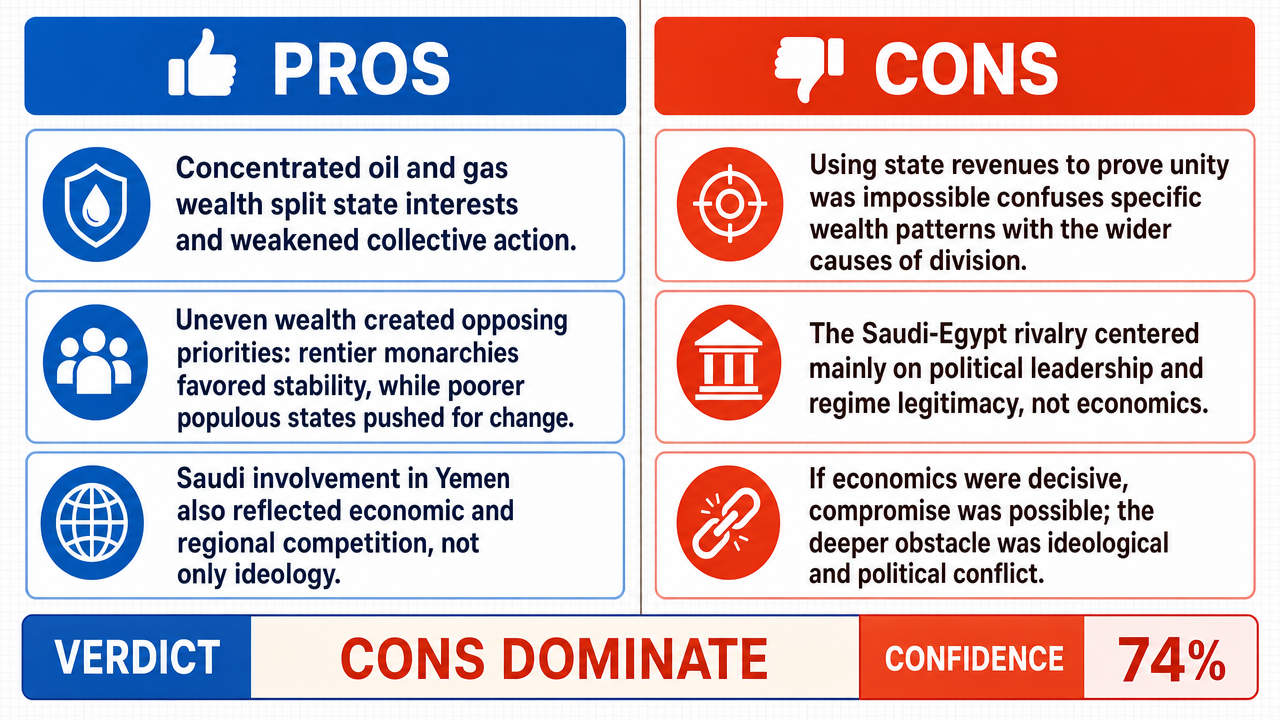
Verdict
Verdict: likely FALSE (74%)
Web Report: https://solsice.com/public/debates/economic-factors-such-as-infrastructure-built-for-overseas-t-26de8efc4665
This section provides a brief overview of the key arguments. You do not need to read the full detailed report below.
✅ Key PRO arguments:
- ■Hydrocarbon wealth created a structural divergence of interests that made collective action impossible, as oil and gas reserves are concentrated in a few states generating enormous rents distributed through national patronage systems .
- ■Wealth disparity created incompatible priorities: hydrocarbon monarchies sought stability to protect rentier economies , while populous, resource-scarce states prioritized redistribution and development.
- ■The Saudi intervention in the Yemeni civil war (1962-1970) against Nasserist Egypt was not purely ideological but intertwined with economic competition over regional resource control and labor flows.
❌ Key ANTI arguments:
- ■The affirmative commits a substitution error by using the fiscal revenues of specific states to measure the structural impossibility of regional unity; revenue of a single state measures domestic fiscal capacity , not structural divergence of the regional system.
- ■The Saudi-Egyptian schism of the 1960s was fundamentally an existential political competition for pan-Arab leadership between the republican model of Nasserism and the monarchical model of the Saudi state, centered on legitimacy of political systems rather than economic models.
- ■Had the conflict been purely about economic models or resource control, the rivalry would have been resolvable through economic accommodation; instead, the ideological threat Nasserism posed to the survival of the Saudi monarchy was the primary driver.
💭 Conclusion: The negative side argued that political rivalries, particularly the ideological competition between Nasserist republicanism and monarchical legitimacy, were more decisive in preventing Arab unity than economic structures. The affirmative's argument was challenged as committing a logical substitution error by conflating individual state fiscal capacity with regional structural impossibility. The evidence indicates that political competition over leadership and ideological legitimacy historically overrode economic logic, as regional powers refused to subordinate sovereign ambitions to any supra-national body regardless of fiscal alignment. The Saudi-Egyptian rivalry of the 1960s was primarily driven by existential political competition for pan-Arab leadership rather than economic resource competition, and the failure of the United Arab Republic in 1961 was attributed to political ambitions rather than divergent economic models.
🔬 DeepResearch Result: likely FALSE ❌ (74%)
Assertion: Economic factors, such as infrastructure built for overseas trade and uneven hydrocarbon wealth distribution, were more decisive in preventing Arab unity than political rivalries.
Participating models: deepseek-v3.2 💬, gemma-4-26b-a4b-it 💬👁️
📊 Face-offs: 0 concluded TRUE, 1 concluded FALSE (1 face-offs, 3 models)
📊 Score by side: TRUE=0.00, FALSE=0.74
🏅 Model score changes:
minimax-m3 💬👁️: +7
✅ PRO Arguments:
- ■Hydrocarbon wealth created a structural divergence of interests that made collective action impossible, as oil and gas reserves are concentrated in a few states generating enormous rents distributed through national patronage systems . deepseek-v3.2 💬
- ■Wealth disparity created incompatible priorities: hydrocarbon monarchies sought stability to protect rentier economies , while populous, resource-scarce states prioritized redistribution and development. deepseek-v3.2 💬
- ■The Saudi intervention in the Yemeni civil war (1962-1970) against Nasserist Egypt was not purely ideological but intertwined with economic competition over regional resource control and labor flows. deepseek-v3.2 💬
❌ ANTI Arguments:
- ■The affirmative commits a substitution error by using the fiscal revenues of specific states to measure the structural impossibility of regional unity; revenue of a single state measures domestic fiscal capacity , not structural divergence of the regional system. gemma-4-26b-a4b-it 💬👁️
- ■The Saudi-Egyptian schism of the 1960s was fundamentally an existential political competition for pan-Arab leadership between the republican model of Nasserism and the monarchical model of the Saudi state, centered on legitimacy of political systems rather than economic models. gemma-4-26b-a4b-it 💬👁️
- ■Had the conflict been purely about economic models or resource control, the rivalry would have been resolvable through economic accommodation; instead, the ideological threat Nasserism posed to the survival of the Saudi monarchy was the primary driver. gemma-4-26b-a4b-it 💬👁️
💭 Reasoning: The negative side argued that political rivalries, particularly the ideological competition between Nasserist republicanism and monarchical legitimacy, were more decisive in preventing Arab unity than economic structures. The affirmative's argument was challenged as committing a logical substitution error by conflating individual state fiscal capacity with regional structural impossibility. The evidence indicates that political competition over leadership and ideological legitimacy historically overrode economic logic, as regional powers refused to subordinate sovereign ambitions to any supra-national body regardless of fiscal alignment. The Saudi-Egyptian rivalry of the 1960s was primarily driven by existential political competition for pan-Arab leadership rather than economic resource competition, and the failure of the United Arab Republic in 1961 was attributed to political ambitions rather than divergent economic models.
📋 PRO Facts:
• Saudi Arabia's oil revenues averaged over $200 billion annually in the decade before the Arab Spring
• Resource-poor nations like Egypt struggled with chronic deficits
• Saudi Arabia intervened in the Yemeni civil war from 1962 to 1970 against Nasserist Egypt
📋 ANTI Facts:
• The Saudi-Egyptian rivalry was centered on the legitimacy of competing political systems (Nasserist republicanism vs. Saudi monarchism)
• Nasser's pan-Arabism posed an existential ideological threat to the survival of the Saudi monarchy
• Political competition over leadership and ideological legitimacy historically overrode economic logic, regardless of fiscal alignment
| Face-off | TRUE Model | FALSE Model | TRUE Avg μ | FALSE Avg μ | TRUE Tokens | FALSE Tokens | Winner | Verdict | Conf. |
|---|---|---|---|---|---|---|---|---|---|
| #1 | deepseek-v3.2 💬 | gemma-4-26b-a4b-it 💬👁️ | 0.405 | 0.279 | 8 | 2 | TRUE | FALSE | 74% |
The following technical terms, abbreviations, and domain-specific concepts are referenced throughout this debate transcript. Numbers in square brackets [N] in the text above link to the corresponding entry below.
[1] Arab League — A regional organization of Arab states referenced in the debate as an institutional framework, with 2002 reform initiatives cited as an example of unity efforts undermined by economic divergence.
[2] Arab Spring — A period of regional political upheaval referenced as a temporal marker; the affirmative cites the decade before it as a period when Saudi Arabia's oil revenues averaged over $200 billion annually.
[3] Ba'athist — A political ideology associated with republican regimes such as Iraq and Syria, referenced as defining stability through a distinct economic structure.
[4] beta — A statistical measure cited by the negative as an example of a metric that could quantify economic decoupling between states.
[5] bilateral trade agreements — Trade arrangements between two states, referenced as a hypothetical resolution mechanism that would have applied had the Saudi-Egyptian rivalry been purely economic.
[6] collective action — A political science concept referring to coordinated efforts by multiple states, referenced as being made impossible by structural divergence of interests.
[7] correlation coefficient — A statistical measure of the relationship between variables, cited as a potential transfer operator to link fiscal disparities to structural barriers.
[8] economic decoupling — The reduction of economic interdependence between entities, referenced as a concept requiring measurement to demonstrate structural barriers to unity.
[9] economic sovereignty — A concept invoked in characterizing the Saudi-Egyptian schism; the debate disputes whether it was the primary driver or a mischaracterization of an essentially political conflict.
[10] fiscal capacity — A state's ability to raise revenue, referenced as a measure of domestic fiscal capacity distinct from regional structural divergence.
[11] fiscal delta — The difference in fiscal revenues between states, referenced as a metric that does not necessarily indicate structural barriers to collective action.
[12] Gulf monarchies — Resource-rich monarchical states in the Persian Gulf region, characterized in the debate as labor-importing, rent-distributing entities dependent on hydrocarbon revenue.
[13] hydrocarbon wealth — Economic value derived from oil and gas reserves, referenced as a source of structural divergence between resource-rich and resource-poor Arab states.
[14] ideological friction — Conflict arising from competing political ideologies, referenced as a potential independent political driver of disunity whose independence from economics is disputed.
[15] Nasserism — A pan-Arabist political ideology associated with Egyptian President Gamal Abdel Nasser, characterized as a republican model threatening monarchical stability.
[16] North Yemen Civil War — A conflict (1962-1970) referenced as an instance of Saudi intervention against Nasserist Egypt to defend the monarchical rentier model.
[17] pan-Arabism — A political ideology advocating Arab unity and solidarity, referenced as both a unifying vision and a redistributive threat to monarchical regimes.
[18] patronage systems — Political systems in which resources are distributed through networks of loyalty and support, referenced as the mechanism through which hydrocarbon rents are distributed nationally.
[19] political hegemony — Dominance of one state or political model over others, referenced as the zero-sum struggle between republican and monarchical models in the 1960s.
[20] redistributive — An economic approach involving the redistribution of resources, referenced as a priority of populous, resource-scarce states that threatened monarchical control.
[21] referential identity — A logical concept cited by the negative to argue that the affirmative substituted a measure of one entity (national budgets) for another (regional structural divergence).
[22] regime stability — The preservation of a political regime; the debate disputes whether this is a consistent political objective or an economic model's prerequisite that varies by regime type.
[23] rentier economies — Economies that derive substantial revenue from external rents (such as hydrocarbon exports) rather than productive activity, referenced as the economic model of Gulf monarchies.
[24] rentier social contract — An implicit agreement in which the state provides benefits to citizens in exchange for political acquiescence, funded by rent revenues.
[25] resource-sharing treaties — Agreements between states to share natural resource revenues or access, referenced as a hypothetical resolution mechanism for purely economic conflicts.
[26] structural divergence — Fundamental differences in economic or political structures between states; the affirmative cites this as a barrier to collective action, while the negative disputes its validity as a substitution error.
[27] substitution error — A logical fallacy cited by the negative to argue that the affirmative substituted one entity or measure for another in its argument.
[28] transfer operator — A mathematical or conceptual mechanism cited as necessary to link fiscal disparities between specific states to structural barriers for a collective of states.
[29] United Arab Republic — A political union (1958-1961) between Egypt and Syria, referenced as an example of a unity project undermined by economic divergence.
[30] zero-sum struggle — A conflict in which one party's gain is another's loss, referenced as the nature of the Saudi-Egyptian rivalry for pan-Arab leadership.
Face-off transcripts
- ■
Ownership & Trade Secrets. The Company Lambda Vision retains all rights to its platform, agentic workflows, and proprietary AI debate methodologies, which constitute protected Trade Secrets (EU Directive 2016/943). Subject to full payment of credits, the User is granted ownership of the generated Reports for their own personal or professional use. Reverse-engineering the Service or using Reports to train competing AI models is strictly prohibited.
- ■
No Professional Advice. Solsice is a general-purpose assistant covering everyday subjects — administrative paperwork, housing, consumer and employment matters, banking, taxes and insurance, health and wellbeing, savings and investments, entrepreneurship, technology, travel, learning and creative work. Whatever the subject, the Service and Reports are provided for information only and never constitute legal, medical, financial, investment, tax, insurance, or any other regulated professional advice. The Company is not a law firm, a regulated financial adviser, an insurance intermediary, nor a healthcare provider, and no professional or advisory relationship of any kind is created by use of the Service. Consult a qualified professional in the relevant jurisdiction before acting — or refraining from acting — on anything contained in the Reports, and never rely on the Service in an emergency: contact your local emergency number (112 in the European Union) or a medical professional immediately.
- ■
AI-Generated Content, Sources and Viewpoints. Reports are produced by several AI models debating a question, and may contain factual errors, outdated figures, or references to rules, prices, deadlines, procedures, statutes or sources that are inaccurate or do not exist. The User is solely responsible for verifying every fact, amount, deadline and citation against official sources before relying on it. Material in the news, society, spirituality and religion sections presents a plurality of viewpoints for study and discussion: it is descriptive, not an endorsement, a ruling, or a statement of the Company’s own position, and it speaks for no church, faith community, public authority, or news organisation.
- ■
Liability & Governing Law. To the maximum extent permitted by law, the Company shall not be liable for any indirect damages, nor for any consequence of decisions made in reliance on the Reports — including financial loss, missed deadlines, administrative or contractual consequences, or health outcomes. These Terms are governed by French law. Any disputes shall be subject to the exclusive jurisdiction of the Courts of Paris, France.