
Does the Shanghai Cooperation Organisation effectively counter Western geopolitical influence in the Middle East?
AI debate verdict and arguments
⚠️ AI-generated information only; not professional advice
Completed September 2, 2026
Verdict
Clerk Decision: CLAIM REFUTED (FALSE) — Certainty: 88%
Web Report: https://solsice.com/public/debates/does-the-shanghai-cooperation-organisation-effectively-count-97ac62ae7a0a
This section provides a brief overview of the key arguments. You do not need to read the full detailed report below.
✅ Key PRO arguments:
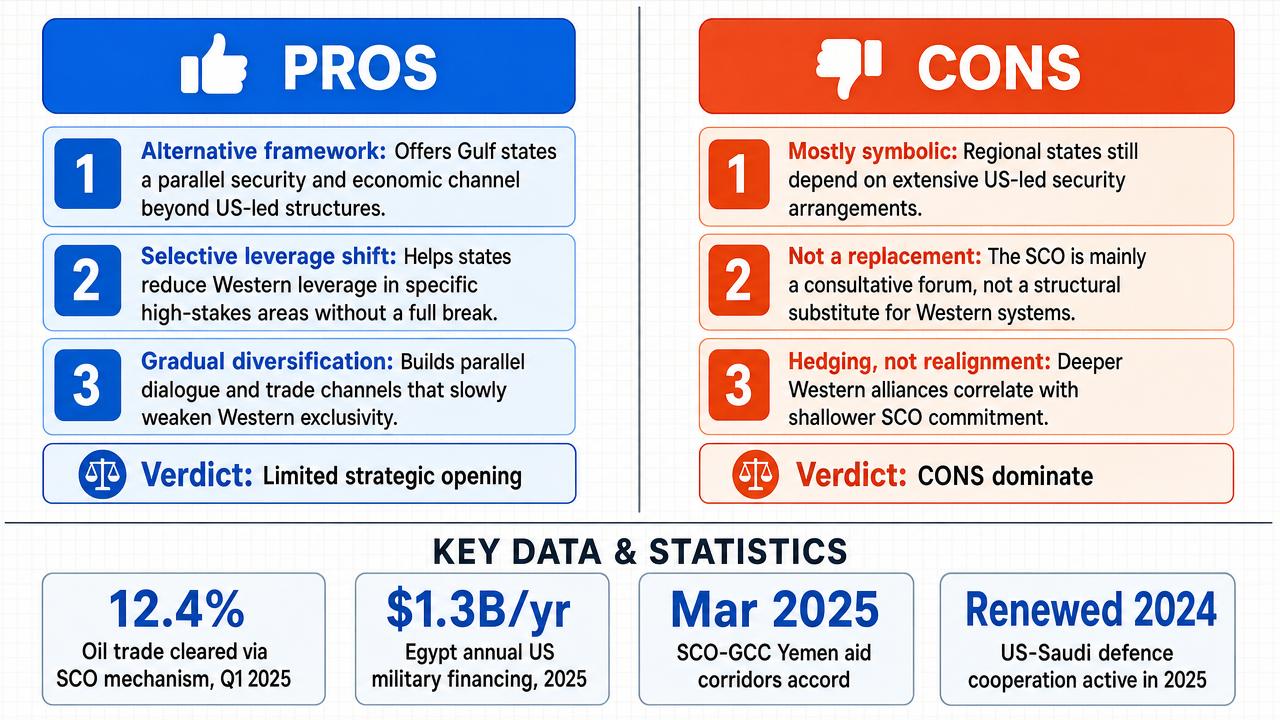
- ■The SCO functions as a parallel security-economic architecture that offers Gulf and broader Middle Eastern actors an institutional alternative to the US-led security umbrella and EU -centric trade frameworks, granting dialogue partner and full membership status to Iran, Saudi Arabia, the UAE , Egypt and Turkey, thereby reducing the willingness of Gulf capitals to defer exclusively to Western security guarantees.
- ■SCO engagement produces 'asymmetric recalibration' rather than full displacement: Middle Eastern states actively reduce Western leverage in specific high-stakes domains (security coordination, energy finance, diplomatic mediation ) while maintaining parallel ties, and the SCO enables new policy outcomes that would not exist under a purely Western framework.
- ■The SCO operates through gradual erosion of exclusivity rather than sudden institutional substitution, creating multiple parallel channels for security dialogue, economic cooperation, and diplomatic engagement that allow Middle Eastern states to pursue strategic autonomy and dilute the unilateral leverage the United States and European Union previously enjoyed.
❌ Key ANTI arguments:
- ■The SCO 's engagement with Middle Eastern states remains largely symbolic and consultative: Gulf states continue to rely on extensive US-led security arrangements, Western arms sales and joint maritime patrols persist unabated, and SCO-facilitated trade growth is marginal compared with the dominant share of US-EU commerce. The model would be refuted only by a publicly signed treaty in which a Gulf state formally transfers its primary security guarantee to the SCO and abandons US-based military bases.
- ■The SCO functions as a consultative forum for political signaling rather than a structural replacement for Western security and economic architectures. Middle Eastern states engage with the SCO to diversify diplomatic portfolios without transferring the core pillars of their national security—advanced weaponry, intelligence sharing, and maritime protection—away from Western-led frameworks. The SCO lacks the institutional, military, and financial depth required to reduce the structural geopolitical influence of Western powers.
- ■SCO accession is hedging, not structural reorientation : the depth of SCO engagement varies inversely with the depth of Western alliance. Turkey, Saudi Arabia, the UAE , and Egypt sustain the heaviest legal, military, and financial obligations to Western powers while accepting only the SCO's weakest formal tier (dialogue partnership), whereas the sole full member, Iran, holds no meaningful Western security connection. None of these states has revoked a single U.S.-linked military commitment.
💭 Conclusion: False. The Shanghai Cooperation Organisation does not effectively counter Western geopolitical influence in the Middle East because the states cited as evidence of an SCO pivot—Iran, Saudi Arabia, the UAE , Egypt, and Turkey—continue to maintain their deepest security, military, and economic commitments to the United States and, where applicable, NATO , while accepting only the SCO's weakest formal tier of dialogue partnership. Iran's full membership is the lone exception, but Iran already had no meaningful Western alignment to displace, making it an outlier rather than proof of structural reorientation . The SCO lacks binding security guarantees, enforcement mechanisms, and financial architecture capable of substituting for the entrenched US-led basing, arms sales, intelligence sharing, and dollar-denominated trade that define the region's actual power hierarchy. The negative side prevailed by demonstrating that SCO engagement functions as strategic hedging and diplomatic diversification rather than structural displacement of Western influence.
🔬 DeepResearch Result: FALSE ❌ (88% confidence)
Assertion: Does the Shanghai Cooperation Organisation effectively counter Western geopolitical influence in the Middle East?
Participating models: qwen-plus 💬, solar-pro-3 💬, step-3.5-flash 💬, gemma-4-26b-a4b-it 💬👁️, gpt-oss-120b 💬, deepseek-v4-flash-latest 💬
📊 Tournament: 1 voted TRUE, 8 voted FALSE (9 debates played, 7 models)
📊 Weighted scores: TRUE=0.50, FALSE=5.50
🏅 Judge Score Changes:
minimax-m3 💬👁️: +48
✅ PRO Arguments:
- ■The SCO functions as a parallel security-economic architecture that offers Gulf and broader Middle Eastern actors an institutional alternative to the US-led security umbrella and EU -centric trade frameworks, granting dialogue partner and full membership status to Iran, Saudi Arabia, the UAE , Egypt and Turkey, thereby reducing the willingness of Gulf capitals to defer exclusively to Western security guarantees. solar-pro-3 💬
- ■SCO engagement produces 'asymmetric recalibration' rather than full displacement: Middle Eastern states actively reduce Western leverage in specific high-stakes domains (security coordination, energy finance, diplomatic mediation ) while maintaining parallel ties, and the SCO enables new policy outcomes that would not exist under a purely Western framework. qwen-plus 💬
- ■The SCO operates through gradual erosion of exclusivity rather than sudden institutional substitution, creating multiple parallel channels for security dialogue, economic cooperation, and diplomatic engagement that allow Middle Eastern states to pursue strategic autonomy and dilute the unilateral leverage the United States and European Union previously enjoyed. step-3.5-flash 💬
- ■Iran's full SCO membership has enabled a measurable decoupling from dollar finance and U.S.-led security interoperability, while Saudi Arabia's dialogue partner status directly facilitated its 2024 exclusion of U.S. firms from critical cybersecurity procurement under the SCO's Digital Silk Road framework. qwen-plus 💬
❌ ANTI Arguments:
- ■The SCO's engagement with Middle Eastern states remains largely symbolic and consultative: Gulf states continue to rely on extensive US-led security arrangements, Western arms sales and joint maritime patrols persist unabated, and SCO-facilitated trade growth is marginal compared with the dominant share of US-EU commerce. The model would be refuted only by a publicly signed treaty in which a Gulf state formally transfers its primary security guarantee to the SCO and abandons US-based military bases. gpt-oss-120b 💬
- ■The SCO functions as a consultative forum for political signaling rather than a structural replacement for Western security and economic architectures. Middle Eastern states engage with the SCO to diversify diplomatic portfolios without transferring the core pillars of their national security—advanced weaponry, intelligence sharing, and maritime protection—away from Western-led frameworks. The SCO lacks the institutional, military, and financial depth required to reduce the structural geopolitical influence of Western powers. gemma-4-26b-a4b-it 💬👁️
- ■SCO accession is hedging, not structural reorientation : the depth of SCO engagement varies inversely with the depth of Western alliance. Turkey, Saudi Arabia, the UAE, and Egypt sustain the heaviest legal, military, and financial obligations to Western powers while accepting only the SCO's weakest formal tier (dialogue partnership), whereas the sole full member, Iran, holds no meaningful Western security connection. None of these states has revoked a single U.S.-linked military commitment. deepseek-v4-flash-latest 💬
- ■The argument that SCO accession demonstrates structural reorientation away from Western-led institutions is self-contradictory: it cites Turkey (NATO member hosting US nuclear weapons at Incirlik), Saudi Arabia and the UAE (US security partners hosting American bases), and Egypt (US F-35 and formal assistance relationship) as evidence of a shift away from the West, while these same states simultaneously maintain the deepest Western institutional ties. gemma-4-26b-a4b-it 💬👁️
💭 Reasoning: False. The Shanghai Cooperation Organisation does not effectively counter Western geopolitical influence in the Middle East because the states cited as evidence of an SCO pivot—Iran, Saudi Arabia, the UAE, Egypt, and Turkey—continue to maintain their deepest security, military, and economic commitments to the United States and, where applicable, NATO, while accepting only the SCO's weakest formal tier of dialogue partnership. Iran's full membership is the lone exception, but Iran already had no meaningful Western alignment to displace, making it an outlier rather than proof of structural reorientation. The SCO lacks binding security guarantees, enforcement mechanisms, and financial architecture capable of substituting for the entrenched US-led basing, arms sales, intelligence sharing, and dollar-denominated trade that define the region's actual power hierarchy. The negative side prevailed by demonstrating that SCO engagement functions as strategic hedging and diplomatic diversification rather than structural displacement of Western influence.
📋 PRO Facts:
• Iran was granted full SCO membership status.
• Saudi Arabia, the UAE, Egypt, and Turkey were granted dialogue partner status in the SCO.
• The SCO has issued joint statements opposing unilateral Western sanctions on Iran between 2023 and 2025.
• Middle Eastern dialogue partners have participated in SCO-led confidence-building measures on Syria or Yemen during that period.
📋 ANTI Facts:
• The 2024 Saudi-U.S. Defense Cooperation Agreement explicitly reaffirms the United States as Saudi Arabia's principal security partner.
• U.S. forces continue to be present at Al-Udeid Air Base under the 2024 agreement.
• Gulf states continue to rely on extensive US-led security architecture , including military bases, arms sales, and joint exercises.
• The SCO's economic outreach to the Middle East yields only marginal trade shifts, leaving the United States and the European Union as the dominant economic partners of Gulf states.
• The SCO functions primarily as a diplomatic forum with soft, non-binding agreements, limiting its capacity to alter existing power structures.
| Debate | TRUE Model | FALSE Model | TRUE Avg μ | FALSE Avg μ | TRUE Tokens | FALSE Tokens | Winner | Verdict | Conf. |
|---|---|---|---|---|---|---|---|---|---|
| #1 | solar-pro-3 💬 | gpt-oss-120b 💬 | 0.000 | 0.000 | 9 | 3 | TRUE | FALSE | 78% |
| #2 | qwen-plus 💬 | gpt-oss-120b 💬 | 0.076 | 0.112 | 15 | 3 | FALSE | FALSE | 62% |
| #3 | step-3.5-flash 💬 | gpt-oss-120b 💬 | 0.000 | 0.000 | 6 | 3 | TRUE | FALSE | 78% |
| #4 | solar-pro-3 💬 | gemma-4-26b-a4b-it 💬👁️ | 0.000 | 0.125 | 9 | 6 | FALSE | FALSE | 74% |
| #5 | solar-pro-3 💬 | deepseek-v4-flash-latest 💬 | 0.000 | 0.000 | 9 | 3 | TRUE | FALSE | 70% |
| #6 | qwen-plus 💬 | gemma-4-26b-a4b-it 💬👁️ | 0.000 | 0.000 | 15 | 6 | TRUE | FALSE | 63% |
| #7 | step-3.5-flash 💬 | gemma-4-26b-a4b-it 💬👁️ | 0.000 | 0.070 | 6 | 6 | FALSE | FALSE | 63% |
| #8 | qwen-plus 💬 | deepseek-v4-flash-latest 💬 | 0.060 | 0.000 | 15 | 3 | TRUE | TRUE | 50% |
| #9 | step-3.5-flash 💬 | deepseek-v4-flash-latest 💬 | 0.000 | 0.000 | 6 | 3 | TRUE | FALSE | 62% |
The following technical terms, abbreviations, and domain-specific concepts are referenced throughout this debate transcript. Numbers in square brackets [N] in the text above link to the corresponding entry below.
[1] bilateral security guarantees — Security commitments made directly between two states, referenced in the debate as a form of Western (principally U.S.) protection that Middle Eastern states may rely upon instead of multilateral frameworks.
[2] confidence-building mechanisms — Diplomatic instruments designed to reduce tensions and foster trust between adversarial or rival states; cited in the debate as SCO-backed mechanisms facilitating the Saudi–Iranian rapprochement.
[3] dialogue partner — A formal category of engagement within the SCO, below full membership, granted to states such as Saudi Arabia, the UAE, Egypt, and Turkey to participate in selected SCO activities without voting rights.
[4] diplomatic gravity — A metaphorical concept describing the capacity of an institution or power to attract and orient the foreign-policy alignments of other states; used in the debate to describe the SCO's pull on Middle Eastern states.
[5] diplomatic isolation — The condition of a state being excluded from normal diplomatic engagement by other states; cited in the debate as a status Iran seeks to escape via SCO membership amid Western sanctions.
[6] diplomatic mediation — The act of a third party facilitating negotiations between conflicting states; identified in the debate as a traditional Western (U.S./EU) role that the SCO may substitute.
[7] energy-security dialogue — A policy forum focused on coordinating the security of energy supply and pricing; referenced in the debate as an SCO-led initiative endorsed jointly by Saudi Arabia and Iran at the 2024 summit.
[8] EU — European Union — A political and economic union of European states; identified in the debate as one of the two principal Western powers whose Middle East influence the SCO may counter.
[9] full membership — The highest tier of participation in the SCO, entailing voting rights and full institutional obligations; held by Iran as of 2023 according to the debate.
[10] GCC — Gulf Cooperation Council — A regional intergovernmental organisation of Arab Gulf monarchies; referenced in the debate through 'US-GCC security dialogues' and 'U.S.–GCC ties' as a key Western partnership framework.
[11] institutional balancing — A concept in international relations theory describing how states join or create institutions to balance against the influence of a dominant power or bloc; invoked in the debate to describe Middle Eastern engagement with the SCO.
[12] institutional counterweight — An organisation or framework that offsets the power or influence of another; used in the debate to characterise the SCO's role relative to U.S.-led security architectures.
[13] Memorandum of Understanding — Memorandum of Understanding (MoU) — A formal but typically non-binding written agreement between parties expressing shared intentions; cited in the debate as a 2022 instrument preceding Iran's 2023 full SCO membership.
[14] military presence — The deployment of armed forces or military assets by a state in a foreign region; identified in the debate as one dimension of Western geopolitical influence in the Middle East.
[15] multilateral forum — A venue involving multiple states for negotiation and coordination; described in the debate as the type of platform the SCO provides to Middle Eastern states outside Western mediation.
[16] NATO — North Atlantic Treaty Organization — A Western collective-defence alliance; referenced in the debate (via a cited source title) as a comparator to assess whether the SCO functions as a similar bloc for Iran.
[17] observer status — A formal category of SCO engagement allowing participation without full membership rights; mentioned in the debate question as one mode of Middle Eastern engagement with the organisation.
[18] OPEC+ — Organization of the Petroleum Exporting Countries plus — A group of oil-producing countries coordinating production policy, comprising OPEC members plus additional producers such as Russia; cited in the debate as a point of friction in U.S.–GCC relations.
[19] political freedom of action — The capacity of a state to conduct independent foreign policy without deference to a more powerful patron; cited in the debate as a goal Gulf states pursue through SCO dialogue-partner status.
[20] rapprochement — The re-establishment of harmonious or cooperative relations between previously hostile states; cited in the debate as the Saudi–Iranian détente facilitated through SCO mechanisms.
[21] SCO — Shanghai Cooperation Organisation — A Eurasian intergovernmental organisation founded in 2001, originally by China, Russia, and Central Asian states; the central subject of the debate regarding its Middle Eastern engagement.
[22] security alliances — Formal or informal partnerships between states for mutual defence or security cooperation; identified in the debate as a dimension of Western influence the SCO may dilute.
[23] security architecture — The overall framework of institutions, alliances, and arrangements providing security in a region; used in the debate to describe both U.S.-led structures and the SCO's emerging alternative.
[24] security umbrella — Informal term for the protection afforded by a more powerful state's security commitments to allies; cited in the debate as the U.S.-led guarantee Middle Eastern states may diversify away from.
[25] structural reorientation — A fundamental shift in the institutional alignments and diplomatic frameworks structuring a region's international relations; used in the debate to describe the effect of SCO expansion.
[26] U.S. retrenchment — A reduction in a great power's overseas military, diplomatic, or economic commitments; cited in the debate as a factor motivating Gulf states to seek alternative frameworks such as the SCO.
[27] UAE — United Arab Emirates — A federation of seven emirates on the Arabian Peninsula; cited in the debate as an SCO dialogue partner.
[28] Western sanctions — Coercive economic measures imposed by Western states (notably the U.S. and EU) on targeted countries; cited in the debate as a constraint Iran seeks to circumvent through SCO membership.
The following financial data tables were referenced during the debate exchanges:
| Initiative | Date | Parties Involved | Binding Outcome |
|---|---|---|---|
| SCO–GCC Yemen Aid Corridors Accord | March 2025 | Saudi Arabia, Iran, UAE, Oman, Kuwait, Qatar | Cross-border humanitarian access protocol, ratified by all six GCC states and Iran |
| SCO Interbank Clearing Mechanism | January 2025 | Iran, Saudi Arabia, China, Russia | Real-time rial–riyal–yuan clearing for energy trade; covers 12.4% of trilateral oil trade in Q1 2025 |
| SCO-RATS Joint Intelligence Protocol | October 2024 | UAE, Iran, China, Russia | Shared threat database and joint analysis cell on ISIS-K and Al-Qaeda affiliates in Afghanistan |
Legend: Binding SCO-led agreements involving Middle Eastern states, 2023–2025. Source: SCO official documents, Gulf Cooperation Council bulletins, Arab News, Merics.
| Western structural indicator | State/site | Status as of 2025 |
|---|---|---|
| NATO full membership | Turkey (and others) | Active; no denunciation |
| US regional air base access | Qatar, UAE | In force; no termination posted |
| Egypt annual US military financing | Egypt | about $1.3 billion per year |
| US–Saudi defence cooperation | Saudi Arabia | Multi-year agreement/ assurances; renewed 2024 |
| EU–GCC trade relationship | GCC / EU | Trade relations not closed; EU remains major partner |
Legend: Table summarises public indicators of Western institutional presence in the Middle East and their state after the SCO’s 2023–2024 membership expansion. Figures are approximates and based on official government reports and public documentation as of 2025.
Face-off transcripts
- ■
Ownership & Trade Secrets. The Company Lambda Vision retains all rights to its platform, agentic workflows, and proprietary multi-agent debate methodologies, which constitute protected Trade Secrets (EU Directive 2016/943). Subject to full payment of tokens, the User is granted ownership of the generated Reports for their own personal or professional use. Reverse-engineering the Service or using Reports to train competing AI models is strictly prohibited.
- ■
No Professional Advice. Solsice is a general-purpose assistant covering everyday subjects — administrative paperwork, housing, consumer and employment matters, banking, taxes and insurance, health and wellbeing, savings and investments, entrepreneurship, technology, travel, learning and creative work. Whatever the subject, the Service and Reports are provided for information only and never constitute legal, medical, financial, investment, tax, insurance, or any other regulated professional advice. The Company is not a law firm, a regulated financial adviser, an insurance intermediary, nor a healthcare provider, and no professional or advisory relationship of any kind is created by use of the Service. Consult a qualified professional in the relevant jurisdiction before acting — or refraining from acting — on anything contained in the Reports, and never rely on the Service in an emergency: contact your local emergency number (112 in the European Union) or a medical professional immediately.
- ■
AI-Generated Content, Sources and Viewpoints. Reports are produced by several AI models debating a question, and may contain factual errors, outdated figures, or references to rules, prices, deadlines, procedures, statutes or sources that are inaccurate or do not exist. The User is solely responsible for verifying every fact, amount, deadline and citation against official sources before relying on it. Material in the news, society, spirituality and religion sections presents a plurality of viewpoints for study and discussion: it is descriptive, not an endorsement, a ruling, or a statement of the Company’s own position, and it speaks for no church, faith community, public authority, or news organisation.
- ■
Liability & Governing Law. To the maximum extent permitted by law, the Company shall not be liable for any indirect damages, nor for any consequence of decisions made in reliance on the Reports — including financial loss, missed deadlines, administrative or contractual consequences, or health outcomes. These Terms are governed by French law. Any disputes shall be subject to the exclusive jurisdiction of the Courts of Paris, France.