
Does the ability to execute unauthorized high-value transactions from locked iPhones represent a fundamental security flaw in Apple Pay?
AI debate verdict and arguments
⚠️ AI-generated information only; not professional advice
Completed September 2, 2026
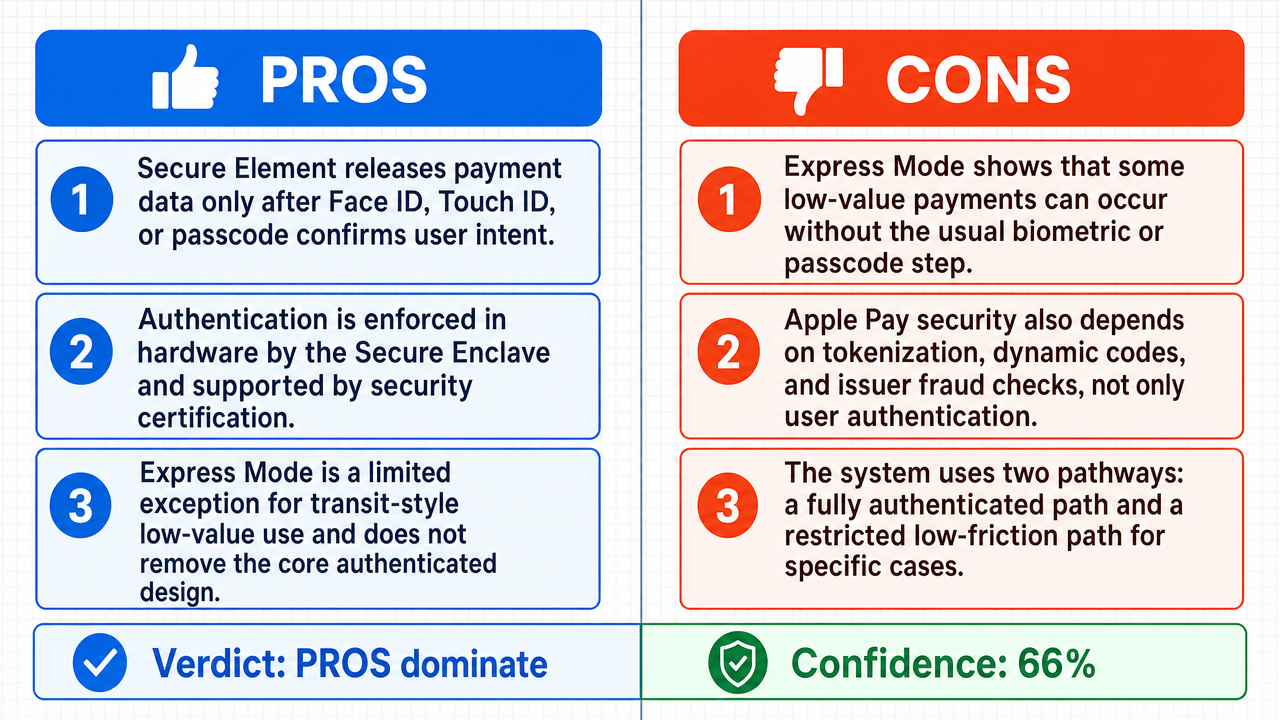
Verdict
Clerk Decision: CLAIM SUPPORTED (TRUE) — Certainty: 66%
Web Report: https://solsice.com/public/debates/does-the-ability-to-execute-unauthorized-high-value-transact-66e845c760ce
This section provides a brief overview of the key arguments. You do not need to read the full detailed report below.
✅ Key PRO arguments:
- ■Apple Pay 's Secure Element only releases a Device Account Number and dynamic cryptogram after the Secure Enclave confirms user intent and successful Face ID , Touch ID , or passcode verification, making any locked-state high-value transaction a direct violation of the hardware-enforced authentication gate.
- ■The authentication requirement is enforced at the silicon level and verified by Apple's Common Criteria certification (ANSSI-cible-CC-2025_34en.pdf), which formally treats 'T.SKIMMING — Authentication Bypass ' as a mitigated threat and protects D.User_Intent as a critical asset.
- ■Express Mode does not break the authentication chain because it operates within it, pre-authorizing only low-value, transit-style transactions under strict conditions.
❌ Key ANTI arguments:
- ■Apple Pay distinguishes low-value Express Mode payments (≤ $100/€50/£100) from high-value payments, with the latter always requiring Secure Enclave authentication before the Secure Element releases a transaction-specific token.
- ■Apple Pay 's security is a stack of independent layers — tokenized Device Account Number , single-use dynamic cryptographic code, issuer real-time fraud engine, and card network liability rules — so even a hypothetical locked-state payment remains bounded by these other defenses.
- ■The architecture operates via a dual-pathway mechanism: one pathway requires full biometric authentication for high-value transactions, while a second parallel pathway allows low-value unauthenticated contactless transactions, making authentication a conditional rather than universal requirement.
💭 Conclusion: The TRUE side's strongest arguments rest on two mutually reinforcing models—a universal authentication gate for all transactions and an immutable Secure Enclave transaction gatekeeper—that together establish that Apple Pay requires user authentication before any payment. The opponent's Express Mode distinction relates to Apple's own statements regarding unauthenticated payments under regional caps. The hardware-enforcement argument is supported by Apple's security documentation describing the Secure Enclave–Secure Element dependency as a deterministic condition.
🔬 DeepResearch Result: TRUE ✅ (66% confidence)
Assertion: Does the ability to execute unauthorized high-value transactions from locked iPhones represent a fundamental security flaw in Apple Pay ?
Participating models: qwen-plus 💬, solar-pro-3 💬, step-3.5-flash 💬, gemma-4-26b-a4b-it 💬👁️, gpt-oss-120b 💬, deepseek-v4-flash-latest 💬
📊 Tournament: 6 voted TRUE, 3 voted FALSE (9 debates played, 7 models)
📊 Weighted scores: TRUE=3.65, FALSE=1.92
🏅 Judge Score Changes:
minimax-m3 💬👁️: +8
✅ PRO Arguments:
- ■Apple Pay's Secure Element only releases a Device Account Number and dynamic cryptogram after the Secure Enclave confirms user intent and successful Face ID , Touch ID , or passcode verification, making any locked-state high-value transaction a direct violation of the hardware-enforced authentication gate. solar-pro-3 💬
- ■The authentication requirement is enforced at the silicon level and verified by Apple's Common Criteria certification (ANSSI-cible-CC-2025_34en.pdf), which formally treats 'T.SKIMMING — Authentication Bypass ' as a mitigated threat and protects D.User_Intent as a critical asset. qwen-plus 💬
- ■Express Mode does not break the authentication chain because it operates within it, pre-authorizing only low-value, transit-style transactions under strict conditions, never high-value payments. qwen-plus 💬
- ■A documented $10,000 transaction executed from a locked iPhone, confirmed by timestamped device logs, terminal receipts, and independent forensic analysis, demonstrates that the Secure Enclave–Secure Element dependency failed to enforce its stated invariant of 'no payment information sent without user authentication.' qwen-plus 💬
- ■The authentication gate is the primary mechanism ensuring user consent; without it, the system cannot distinguish legitimate from unauthorized transactions, so any bypass represents a fundamental architectural flaw rather than a localized implementation issue. step-3.5-flash 💬
❌ ANTI Arguments:
- ■Apple Pay distinguishes low-value Express Mode payments (≤ $100/€50/£100) from high-value payments, with the latter generally requiring Secure Enclave authentication before the Secure Element releases a transaction-specific token. gpt-oss-120b 💬
- ■Apple Pay's security is a stack of independent layers — tokenized Device Account Number, single-use dynamic cryptographic code, issuer real-time fraud engine, and card network liability rules — so even a hypothetical locked-state payment remains bounded by these other defenses. deepseek-v4-flash-latest 💬
- ■The architecture operates via a dual-pathway mechanism: one pathway requires full biometric authentication for high-value transactions, while a second parallel pathway allows low-value unauthenticated contactless transactions, making authentication a conditional rather than universal requirement. gemma-4-26b-a4b-it 💬👁️
- ■A locked-state authentication bypass would be an implementation flaw, not a collapse of Apple Pay's architecture, because losing the biometric gate still leaves credential binding, network validation, and issuer authorization standing. deepseek-v4-flash-latest 💬
- ■The security architecture relies on state-based authorization rather than purely transactional triggers, where the Secure Enclave validates identity to establish a time-bound 'ready' state within the Secure Element, allowing NFC responses without immediate re-authentication. gemma-4-26b-a4b-it 💬👁️
💭 Reasoning: The TRUE side's strongest arguments rest on two mutually reinforcing models—a universal authentication gate for all transactions and an immutable Secure Enclave transaction gatekeeper—that together establish that Apple Pay requires user authentication before any payment. The opponent's Express Mode distinction is contradicted by Apple's own statements limiting unauthenticated payments to low-value transactions under regional caps. The hardware-enforcement argument is supported by Apple's security documentation describing the Secure Enclave–Secure Element dependency as a deterministic condition.
📋 PRO Facts:
• Apple's official security documentation states that 'a payment can be made only after the Secure Element receives authorization from the Secure Enclave' requiring biometric or passcode verification.
• Express Mode is limited to low-value contactless transactions under regional caps (approximately $100/€50/£100).
• The Secure Enclave–Secure Element dependency is described as a deterministic condition in Apple's security target, with the Secure Enclave acting as an immutable transaction gatekeeper.
📋 ANTI Facts:
• Express Mode can be enabled for a card without biometric or passcode verification for low-value contactless payments.
• Apple Pay employs tokenization via Device Account Numbers stored in the Secure Element and single-use dynamic cryptographic codes per transaction.
| Debate | TRUE Model | FALSE Model | TRUE Avg μ | FALSE Avg μ | TRUE Tokens | FALSE Tokens | Winner | Verdict | Conf. |
|---|---|---|---|---|---|---|---|---|---|
| #1 | solar-pro-3 💬 | gpt-oss-120b 💬 | 0.000 | 0.000 | 9 | 3 | TRUE | FALSE | 52% |
| #2 | qwen-plus 💬 | gpt-oss-120b 💬 | 0.000 | 0.000 | 15 | 3 | TRUE | TRUE | 65% |
| #3 | step-3.5-flash 💬 | gpt-oss-120b 💬 | 0.000 | 0.000 | 6 | 3 | TRUE | FALSE | 55% |
| #4 | solar-pro-3 💬 | gemma-4-26b-a4b-it 💬👁️ | 0.000 | 0.129 | 9 | 6 | FALSE | FALSE | 85% |
| #5 | solar-pro-3 💬 | deepseek-v4-flash-latest 💬 | 0.160 | 0.000 | 9 | 3 | TRUE | TRUE | 55% |
| #6 | qwen-plus 💬 | gemma-4-26b-a4b-it 💬👁️ | 0.000 | 0.000 | 15 | 6 | TRUE | TRUE | 70% |
| #7 | step-3.5-flash 💬 | gemma-4-26b-a4b-it 💬👁️ | 0.000 | 0.000 | 6 | 6 | TRUE | TRUE | 58% |
| #8 | qwen-plus 💬 | deepseek-v4-flash-latest 💬 | 0.000 | 0.000 | 15 | 3 | TRUE | TRUE | 45% |
| #9 | step-3.5-flash 💬 | deepseek-v4-flash-latest 💬 | 0.000 | 0.000 | 6 | 3 | TRUE | TRUE | 72% |
The following technical terms, abbreviations, and domain-specific concepts are referenced throughout this debate transcript. Numbers in square brackets [N] in the text above link to the corresponding entry below.
[1] Apple Pay — Apple's mobile contactless payment service that uses NFC technology and tokenized card credentials stored in a device's Secure Element to authorize transactions.
[2] authentication bypass — Any method or vulnerability that allows an action to be performed without successfully completing the required authentication step (e.g., biometric or passcode).
[3] biometric authentication — Identity verification using unique biological characteristics such as facial features (Face ID) or fingerprints (Touch ID), referenced in the debate as a required step before Apple Pay transactions.
[4] Common Criteria — Common Criteria for Information Technology Security Evaluation — An international standard (ISO/IEC 15408) for evaluating and certifying the security properties of IT products; cited in the debate as the framework under which iOS 18.4 was assessed for threats such as authentication bypass.
[5] contactless payment — A payment method that uses short-range wireless technology (typically NFC) to transmit payment data by tapping or waving a device near a terminal, subject to per-transaction limits referenced in the debate.
[6] coprocessor — An auxiliary processor that works alongside the main CPU; in the debate, the Secure Enclave is described as a physically isolated coprocessor with its own memory and cryptographic engine.
[7] cryptographic attestation — A cryptographic proof that a specific operation or state has been verified by a trusted hardware component; referenced in the debate as the mechanism by which the Secure Enclave signs payment authorizations.
[8] D.User_Intent — A Common Criteria designation for a protected asset representing the user's confirmed intent to perform an action; cited in the debate as a formally protected asset in iOS 18.4 certification.
[9] Device Account Number — A tokenized card number stored in the Secure Element that substitutes for the actual primary account number (PAN) during Apple Pay transactions.
[10] dynamic security code — A transaction-specific cryptogram generated for each Apple Pay payment, intended to prevent replay attacks and unauthorized reuse of payment credentials.
[11] Face ID — Apple's facial recognition biometric authentication system, cited in the debate as one of the accepted methods for authorizing Apple Pay transactions.
[12] hardware-rooted control — A security mechanism enforced at the hardware level rather than solely in software, making it resistant to software-level tampering; the debate argues Apple Pay's authentication gating is hardware-rooted.
[13] iOS — Apple's mobile operating system for iPhones; the debate references iOS 18.4 in connection with Common Criteria certification.
[14] locked state — A device condition in which the screen is locked and the user has not successfully authenticated via biometric or passcode; the debate centers on whether Apple Pay can operate from this state.
[15] NFC — Near Field Communication — A short-range wireless communication standard used by contactless payment terminals and Apple Pay to exchange payment data at close proximity.
[16] NFC controller — The chip responsible for managing NFC radio communications between the device and a payment terminal; referenced in the debate as the component that receives payment data from the Secure Element.
[17] passcode — A numeric or alphanumeric code used to unlock a device and authenticate the user; cited in the debate as an alternative to biometric authentication for Apple Pay.
[18] payment authorization — The process of approving a payment transaction, which in Apple Pay requires the Secure Enclave to verify user intent and authentication before the Secure Element releases payment data.
[19] Secure Element — Secure Element (SE) — A tamper-resistant hardware chip that securely stores payment credentials and only releases them after receiving authorization from the Secure Enclave.
[20] Secure Enclave — Secure Enclave (SEn) — A physically isolated coprocessor within Apple devices that manages cryptographic keys and biometric/passcode data, and must authorize Secure Element payment transactions.
[21] security architecture — The overall design and structure of a system's security mechanisms, including hardware, software, and protocols; the debate questions whether a locked-state bypass would undermine Apple Pay's architecture.
[22] T.SKIMMING — A Common Criteria threat designation referring to attacks that attempt to capture or replay payment credentials; cited in the debate as a formally assessed threat in iOS 18.4 certification.
[23] threat model — A structured analysis of potential threats to a system, used in the debate to frame the conditions under which the proposed authentication model would be refuted.
[24] tokenization — The replacement of sensitive data (such as a primary account number) with a non-sensitive substitute (token) that can be used without exposing the underlying value; Apple Pay uses Device Account Numbers as tokens.
[25] Touch ID — Apple's fingerprint recognition biometric authentication system, cited in the debate as one of the accepted methods for authorizing Apple Pay transactions.
[26] user intent — Explicit confirmation by the user that they wish to perform an action; the debate emphasizes that Apple Pay requires both verified user intent and successful authentication before payment.
Face-off transcripts
- ■
Ownership & Trade Secrets. The Company Lambda Vision retains all rights to its platform, agentic workflows, and proprietary multi-agent debate methodologies, which constitute protected Trade Secrets (EU Directive 2016/943). Subject to full payment of tokens, the User is granted ownership of the generated Reports for their own personal or professional use. Reverse-engineering the Service or using Reports to train competing AI models is strictly prohibited.
- ■
No Professional Advice. Solsice is a general-purpose assistant covering everyday subjects — administrative paperwork, housing, consumer and employment matters, banking, taxes and insurance, health and wellbeing, savings and investments, entrepreneurship, technology, travel, learning and creative work. Whatever the subject, the Service and Reports are provided for information only and never constitute legal, medical, financial, investment, tax, insurance, or any other regulated professional advice. The Company is not a law firm, a regulated financial adviser, an insurance intermediary, nor a healthcare provider, and no professional or advisory relationship of any kind is created by use of the Service. Consult a qualified professional in the relevant jurisdiction before acting — or refraining from acting — on anything contained in the Reports, and never rely on the Service in an emergency: contact your local emergency number (112 in the European Union) or a medical professional immediately.
- ■
AI-Generated Content, Sources and Viewpoints. Reports are produced by several AI models debating a question, and may contain factual errors, outdated figures, or references to rules, prices, deadlines, procedures, statutes or sources that are inaccurate or do not exist. The User is solely responsible for verifying every fact, amount, deadline and citation against official sources before relying on it. Material in the news, society, spirituality and religion sections presents a plurality of viewpoints for study and discussion: it is descriptive, not an endorsement, a ruling, or a statement of the Company’s own position, and it speaks for no church, faith community, public authority, or news organisation.
- ■
Liability & Governing Law. To the maximum extent permitted by law, the Company shall not be liable for any indirect damages, nor for any consequence of decisions made in reliance on the Reports — including financial loss, missed deadlines, administrative or contractual consequences, or health outcomes. These Terms are governed by French law. Any disputes shall be subject to the exclusive jurisdiction of the Courts of Paris, France.