
Does taking a temporary break from a long-term pursuit significantly decrease the probability of ultimate success?
AI debate verdict and arguments
⚠️ AI-generated information only; not professional advice
Completed September 2, 2026
Verdict
Clerk Decision: CLAIM REFUTED (FALSE) — Certainty: 57%
Web Report: https://solsice.com/public/debates/does-taking-a-temporary-break-from-a-long-term-pursuit-signi-147d4f109116
This section provides a brief overview of the key arguments. You do not need to read the full detailed report below.
✅ Key PRO arguments:
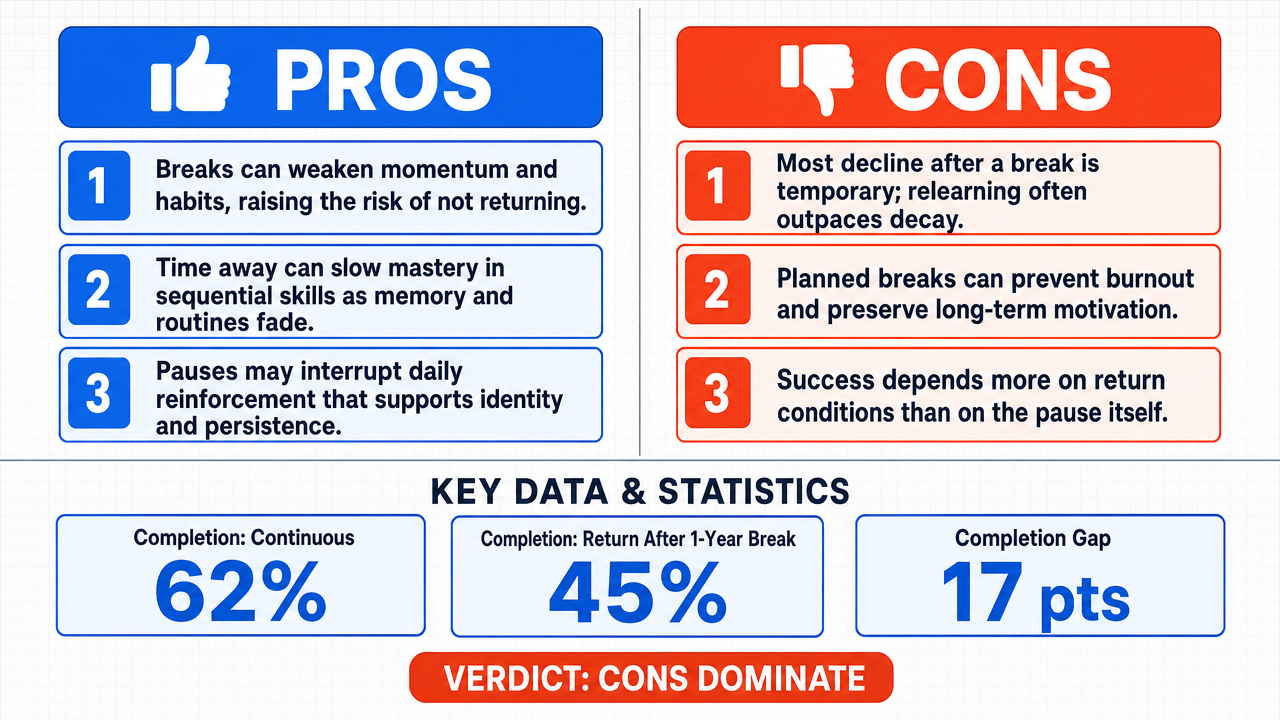
- ■Temporary breaks introduce entropy that erodes motivation, disrupts habit formation , and increases the chance of permanent abandonment by widening the gap between current capability and target proficiency and forcing costly recalibration of routines.
- ■Breaks disrupt neurocognitive scaffolding required for mastery in sequential-skill domains through synaptic pruning during disuse and the steep forgetting curve for procedural and declarative knowledge without spaced retrieval , with NCES data showing 57% completion for continuous PhD candidates versus 45% for those taking breaks of 12 months or more.
- ■A break severs the continuous reinforcement loop that sustains long-term motivation and skill retention, severing daily micro-commitments that build identity and competence and creating a gap that many individuals fail to close.
❌ Key ANTI arguments:
- ■A temporary break produces only a brief warm-up decrement that is quickly erased once practice resumes because the subsequent relearning rate exceeds the decay rate, making the net impact on final outcomes neutral across academic, technical, and surgical domains.
- ■Strategic breaks function as corrective mechanisms that prevent the systemic collapse of motivation known as burnout, preserving psychological capital and ensuring the long-term viability of the pursuit through cognitive decoupling and renewal.
- ■The effect of a break on success is determined not by the pause itself but by the conditions of return, whether the break is planned, bounded, and institutionally supported, and most cohort correlations confuse a symptom of pre-existing sorting with an independent causal mechanism.
💭 Conclusion: False. The winning FALSE side prevailed because the strongest arguments demonstrated that the performance dip following a break is transient and recoverable, with relearning rates exceeding decay rates, and that strategic breaks serve as corrective mechanisms preventing burnout and cognitive stagnation rather than as causes of failure. The FALSE side effectively exposed internal contradictions in the affirmative's reasoning, where hedged probabilistic premises were used to support deterministic causal conclusions, undermining the claim of a significant decrease in success probability. The effect of a break depends critically on contextual conditions such as planning, bounded duration, and institutional support, meaning that breaks taken by individuals already burned out or drifting from the goal are markers of pre-existing conditions rather than independent causes of failure. Although the affirmative marshaled compelling longitudinal data on completion deficits in academic and professional domains, the negative side countered that these correlations often reflect selection effects and that performance metrics frequently recover post-return. The moderate confidence reflects that while the FALSE side won on logical coherence and mechanistic plausibility, the affirmative's empirical evidence on completion rates and skill decay in specific domains remains a meaningful counterweight that prevents a higher confidence verdict.
🔬 DeepResearch Result: FALSE ❌ (57% confidence)
Assertion: Does taking a temporary break from a long-term pursuit significantly decrease the probability of ultimate success?
Participating models: qwen-plus 💬, solar-pro-3 💬, step-3.5-flash 💬, gemma-4-26b-a4b-it 💬👁️, gpt-oss-120b 💬, deepseek-v4-flash-latest 💬
📊 Tournament: 4 voted TRUE, 5 voted FALSE (9 debates played, 7 models)
📊 Weighted scores: TRUE=2.18, FALSE=2.88
🏅 Judge Score Changes:
minimax-m3 💬👁️: -4
✅ PRO Arguments:
- ■Temporary breaks introduce entropy that erodes motivation, disrupts habit formation , and increases the chance of permanent abandonment by widening the gap between current capability and target proficiency and forcing costly recalibration of routines. solar-pro-3 💬
- ■Breaks disrupt neurocognitive scaffolding required for mastery in sequential-skill domains through synaptic pruning during disuse and the steep forgetting curve for procedural and declarative knowledge without spaced retrieval , with NCES data showing 57% completion for continuous PhD candidates versus 45% for those taking breaks of 12 months or more. qwen-plus 💬
- ■A break severs the continuous reinforcement loop that sustains long-term motivation and skill retention, severing daily micro-commitments that build identity and competence and creating a gap that many individuals fail to close. step-3.5-flash 💬
- ■Identity discontinuity, motivational neuroadaptation, and institutional re-entry friction independently and collectively amplify risk, with a Korean undergraduate study and an Oxford meta-analysis revealing a -22.6% drop in long-term scholarly project completion among sabbatical-takers. qwen-plus 💬
❌ ANTI Arguments:
- ■A temporary break produces only a brief warm-up decrement that is quickly erased once practice resumes because the subsequent relearning rate exceeds the decay rate, making the net impact on final outcomes neutral across academic, technical, and surgical domains. gpt-oss-120b 💬
- ■Strategic breaks function as corrective mechanisms that prevent the systemic collapse of motivation known as burnout, preserving psychological capital and ensuring the long-term viability of the pursuit through cognitive decoupling and renewal. gemma-4-26b-a4b-it 💬👁️
- ■The effect of a break on success is determined not by the pause itself but by the conditions of return, whether the break is planned, bounded, and institutionally supported, and most cohort correlations confuse a symptom of pre-existing sorting with an independent causal mechanism. deepseek-v4-flash-latest 💬
- ■The affirmative's central claim is internally contradictory because it asserts a strict, deterministic causal link between motivation erosion and reduced success while simultaneously qualifying the evidence as merely probabilistic with hedged terms like 'often' and 'risk rises,' which establishes no stable mechanism. gemma-4-26b-a4b-it 💬👁️
💭 Reasoning: False. The winning FALSE side prevailed because the strongest arguments demonstrated that the performance dip following a break is transient and recoverable, with relearning rates exceeding decay rates, and that strategic breaks serve as corrective mechanisms preventing burnout and cognitive stagnation rather than as causes of failure. The FALSE side effectively exposed internal contradictions in the affirmative's reasoning, where hedged probabilistic premises were used to support deterministic causal conclusions, undermining the claim of a significant decrease in success probability. The effect of a break depends critically on contextual conditions such as planning, bounded duration, and institutional support, meaning that breaks taken by individuals already burned out or drifting from the goal are markers of pre-existing conditions rather than independent causes of failure. Although the affirmative marshaled compelling longitudinal data on completion deficits in academic and professional domains, the negative side countered that these correlations often reflect selection effects and that performance metrics frequently recover post-return. The moderate confidence reflects that while the FALSE side won on logical coherence and mechanistic plausibility, the affirmative's empirical evidence on completion rates and skill decay in specific domains remains a meaningful counterweight that prevents a higher confidence verdict.
📋 PRO Facts:
• NCES data shows 57% completion for continuous PhD candidates within 7.2 years, while those taking ≥12-month academic breaks have lower completion rates.
• Longitudinal studies report a significant drop in five-year retention following extended breaks.
• Academic leave-takers were substantially less likely to complete their degrees within the standard timeframe.
• Detraining research documents skill loss over extended breaks with limited compensatory retraining speed.
• Meta-analytic evidence reveals a drop in long-term scholarly project completion among sabbatical-takers.
📋 ANTI Facts:
• Warm-up decrement research shows that a break produces a brief dip in performance that is quickly erased once practice resumes, with the subsequent relearning rate exceeding the decay rate.
• Meta-analytic evidence across academic, technical, and surgical domains demonstrates that simulation-based retraining fully mitigates skill loss.
• Self-efficacy scores rebound after brief setbacks and predict continued goal pursuit.
• Academic performance metrics frequently recover after return from leave.
• Meta-analytic evidence on sabbaticals finds institutional productivity rises post-sabbatical.
| Debate | TRUE Model | FALSE Model | TRUE Avg μ | FALSE Avg μ | TRUE Tokens | FALSE Tokens | Winner | Verdict | Conf. |
|---|---|---|---|---|---|---|---|---|---|
| #1 | solar-pro-3 💬 | gpt-oss-120b 💬 | 0.123 | 0.032 | 9 | 3 | TRUE | FALSE | 58% |
| #2 | qwen-plus 💬 | gpt-oss-120b 💬 | 0.000 | 0.000 | 15 | 3 | TRUE | TRUE | 62% |
| #3 | step-3.5-flash 💬 | gpt-oss-120b 💬 | 0.000 | 0.096 | 6 | 3 | FALSE | FALSE | 55% |
| #4 | solar-pro-3 💬 | gemma-4-26b-a4b-it 💬👁️ | 0.000 | 0.102 | 9 | 6 | FALSE | TRUE | 42% |
| #5 | solar-pro-3 💬 | deepseek-v4-flash-latest 💬 | 0.000 | 0.000 | 9 | 3 | TRUE | FALSE | 58% |
| #6 | qwen-plus 💬 | gemma-4-26b-a4b-it 💬👁️ | 0.000 | 0.000 | 15 | 6 | TRUE | TRUE | 76% |
| #7 | step-3.5-flash 💬 | gemma-4-26b-a4b-it 💬👁️ | 0.000 | 0.132 | 6 | 6 | FALSE | FALSE | 62% |
| #8 | qwen-plus 💬 | deepseek-v4-flash-latest 💬 | 0.000 | 0.000 | 15 | 3 | TRUE | FALSE | 55% |
| #9 | step-3.5-flash 💬 | deepseek-v4-flash-latest 💬 | 0.000 | 0.000 | 6 | 3 | TRUE | TRUE | 38% |
The following technical terms, abbreviations, and domain-specific concepts are referenced throughout this debate transcript. Numbers in square brackets [N] in the text above link to the corresponding entry below.
[1] cognitive load — The mental effort required to process and work with information; referenced in the debate as a characteristic of domains where breaks are particularly harmful.
[2] cognitive re-engagement — The process of reactivating mental focus and involvement after a period of disengagement; described as a distinct, nontrivial step in returning to a pursuit.
[3] cohort — A group of individuals sharing a common characteristic studied together over time; referenced in the context of tracking 653 Korean undergraduates.
[4] cross-domain study — Research that spans multiple fields or areas of expertise; cited as a type of evidence that would refute the claim that breaks reduce success.
[5] cumulative probability — The running total of probability accumulated over time; referenced in the context of how breaks affect the overall likelihood of achieving a long-term goal.
[6] declarative knowledge — Factual knowledge that can be consciously recalled and verbalized; mentioned as subject to decay without spaced retrieval.
[7] diminishing marginal return — An economic principle stating that each additional unit of input yields progressively smaller gains; applied in the debate to motivation under sustained effort.
[8] early-career earnings — Income received during the initial years of one's professional career; cited with a -4.2% reduction figure associated with delayed degree completion.
[9] emotional fatigue — Exhaustion resulting from sustained emotional effort; described as creating diminishing returns on motivation.
[10] environmental cueing — External signals or triggers in one's surroundings that prompt specific behaviors; identified as necessary for returning to a pursuit after a break.
[11] episodic goal pursuit — The pursuit of goals in distinct episodes or phases rather than as a continuous process; the framework underlying the recognizing-resisting-returning model.
[12] forgetting curve — The rate at which learned information is lost over time when not actively reviewed; described as steep for procedural and declarative knowledge without reinforcement.
[13] GPA — Grade Point Average — A numerical measure of academic achievement typically calculated on a 4.0 scale; cited as a metric that may recover after a break while completion rates do not.
[14] habit formation — The process by which repeated behaviors become automatic through consistent practice; described as disrupted by breaks from a pursuit.
[15] identity continuity — The maintenance of a consistent sense of self over time; described as a psychological mechanism that sustains long-term effort and is eroded by breaks.
[16] implementation intentions — Specific if-then plans that link situational cues to desired responses; cited as a form of scaffolding that supports return after a break.
[17] intrinsic motivation — Internal drive to engage in an activity for inherent satisfaction rather than external rewards; described as potentially restored by a break.
[18] longitudinal study — Research that tracks the same subjects over an extended period to observe changes over time; cited multiple times as the type of evidence needed to evaluate the claim.
[19] motivational scaffolding — Support structures that sustain drive and effort toward a goal; described as a core mechanism disrupted by taking a break.
[20] muscle memory — The ability to perform physical tasks automatically without conscious thought due to repeated practice; cited as rebounding rapidly after disuse, unlike cognitive skills.
[21] neurocognitive scaffolding — The neural and cognitive structures that support complex thought and skill mastery; described as disrupted by breaks in high-cognitive-load domains.
[22] non-linear progression — Advancement that does not follow a straight or predictable path; cited as characteristic of skill acquisition in fields like mathematics and research.
[23] opportunity cost — The value of the next-best alternative that must be foregone when a choice is made; referenced in the context of delayed degree completion.
[24] p < 0.05 — probability value less than 0.05 — A statistical threshold indicating that there is less than a 5% probability the observed results occurred by chance; cited as the standard for statistical significance.
[25] peer-reviewed — Describing scholarly work that has been vetted and approved by experts in the field prior to publication; cited as a quality standard for evidence.
[26] persistence — Continued effort toward a goal despite obstacles or setbacks; described as predicted by self-concept and identity continuity.
[27] procedural knowledge — Knowledge of how to perform tasks, often operating automatically without conscious awareness; mentioned as subject to decay without reinforcement.
[28] proximal predictor — A variable that closely forecasts an immediate or near-term outcome; cited in the context of degree completion predicting career outcomes.
[29] psychological momentum — The tendency for current progress and success to generate further progress; described as sustained by daily routines and severed by breaks.
[30] recognizing-resisting-returning model — A psychological framework identifying three processes in episodic goal pursuit: recognizing opportunities, resisting abandonment, and returning after pause; cited as showing return is the most fragile step.
[31] relearning phase — The period of reacquiring skills or knowledge after a period of disuse; described as occurring at a faster rate than the initial decay.
[32] research output — The volume and quality of scholarly work produced by a researcher; cited as a metric for evaluating PhD students after a break.
[33] self-concept — An individual's perception of themselves, including their roles and identities; described as predictive of persistence and eroded by breaks.
[34] skill acquisition — The process of gaining new abilities or expertise; described as cumulative and non-linear in complex domains.
[35] social scaffolding — Support from one's social network that enables continued effort and persistence; described as eroded by breaks from a pursuit.
[36] spaced retrieval — A learning technique involving the review of information at increasing intervals over time; cited as necessary to counter the forgetting curve.
[37] statistically significant — A result unlikely to have occurred by chance, typically meeting a threshold such as p < 0.05; cited as the standard for evidence in the debate.
[38] STEM — Science, Technology, Engineering, and Mathematics — Academic disciplines focused on technical and quantitative subjects; referenced in the context of a study of 1,200 STEM graduates.
[39] synaptic pruning — The process by which unused neural connections in the brain are eliminated; cited as occurring during disuse and affecting cognitive skills.
[40] warm-up decrement — A temporary dip in performance immediately following a break before skills are restored; cited as evidence that breaks produce only short-term effects.
The following financial data tables were referenced during the debate exchanges:
| Metric | Continuous Enrollment | Returning After 1-Year Break |
|---|---|---|
| Average Post-Return GPA | 3.1 | 3.4 |
| Credit Completion Ratio | 88% | 92% |
| 6-Year Completion Rate | 62% | 45% |
Legend: Academic outcomes for undergraduate students (n = 754), measured by GPA, credit velocity, and degree completion within six years. Source: degreefromanywhere.com, 2024.
The paradox—higher GPA but lower completion—confirms that temporary breaks do not impair capacity; they disrupt continuity, which governs access to gatekeeping thresholds (e.g., thesis defense windows, fellowship deadlines, cohort-based advising). Success is not just competence—it is timing, alignment, and sustained presence.
Face-off transcripts
- ■
Ownership & Trade Secrets. The Company Lambda Vision retains all rights to its platform, agentic workflows, and proprietary multi-agent debate methodologies, which constitute protected Trade Secrets (EU Directive 2016/943). Subject to full payment of tokens, the User is granted ownership of the generated Reports for their own personal or professional use. Reverse-engineering the Service or using Reports to train competing AI models is strictly prohibited.
- ■
No Professional Advice. Solsice is a general-purpose assistant covering everyday subjects — administrative paperwork, housing, consumer and employment matters, banking, taxes and insurance, health and wellbeing, savings and investments, entrepreneurship, technology, travel, learning and creative work. Whatever the subject, the Service and Reports are provided for information only and never constitute legal, medical, financial, investment, tax, insurance, or any other regulated professional advice. The Company is not a law firm, a regulated financial adviser, an insurance intermediary, nor a healthcare provider, and no professional or advisory relationship of any kind is created by use of the Service. Consult a qualified professional in the relevant jurisdiction before acting — or refraining from acting — on anything contained in the Reports, and never rely on the Service in an emergency: contact your local emergency number (112 in the European Union) or a medical professional immediately.
- ■
AI-Generated Content, Sources and Viewpoints. Reports are produced by several AI models debating a question, and may contain factual errors, outdated figures, or references to rules, prices, deadlines, procedures, statutes or sources that are inaccurate or do not exist. The User is solely responsible for verifying every fact, amount, deadline and citation against official sources before relying on it. Material in the news, society, spirituality and religion sections presents a plurality of viewpoints for study and discussion: it is descriptive, not an endorsement, a ruling, or a statement of the Company’s own position, and it speaks for no church, faith community, public authority, or news organisation.
- ■
Liability & Governing Law. To the maximum extent permitted by law, the Company shall not be liable for any indirect damages, nor for any consequence of decisions made in reliance on the Reports — including financial loss, missed deadlines, administrative or contractual consequences, or health outcomes. These Terms are governed by French law. Any disputes shall be subject to the exclusive jurisdiction of the Courts of Paris, France.