
Does objective beauty exist in the universe independently of human perception?
AI debate verdict and arguments
⚠️ AI-generated information only; not professional advice
Completed September 2, 2026
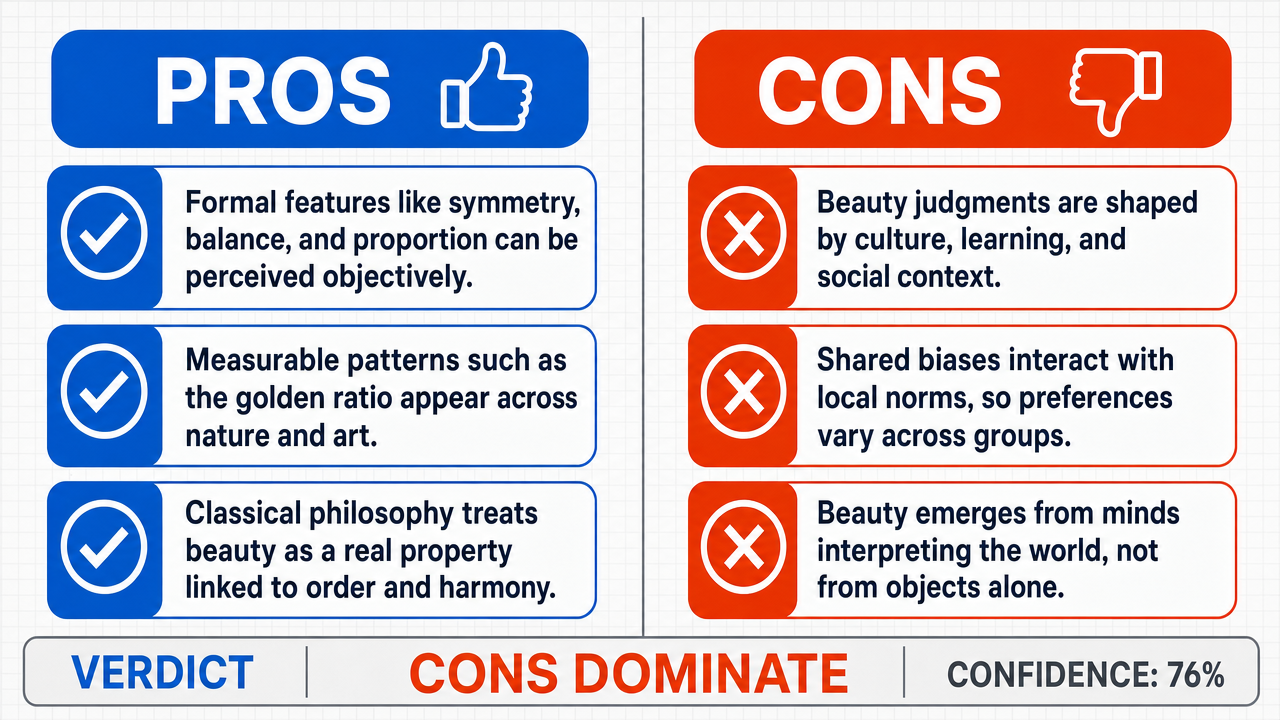
Verdict
Clerk Decision: CLAIM REFUTED (FALSE) — Certainty: 76%
Web Report: https://solsice.com/public/debates/does-objective-beauty-exist-in-the-universe-independently-of-4ff59f2c8c3d
This section provides a brief overview of the key arguments. You do not need to read the full detailed report below.
✅ Key PRO arguments:
- ■Beauty is grounded in objective , response-independent formal properties such as symmetry , balance, and proportionality that are directly perceivable by biological visual systems across cultures, suggesting a shared substrate for aesthetic judgment that transcends individual subjectivity.
- ■Beauty can be quantified through measurable ratios such as the golden ratio, which appear in natural phenomena and human creations across time and geography; these ratios are independent of any individual's consciousness and can be verified by scientific instruments.
- ■The classical and medieval philosophical tradition (Plato's Form of Beauty , Augustine's 'splendour of order', Aquinas's pulchrum) treats beauty as a transcendent value grounded in formal intelligibility—clarity, proportion , and unity in diversity—not as a psychological artifact.
❌ Key ANTI arguments:
- ■Beauty judgments are produced by culturally mediated perceptual learning , so that different societies develop distinct aesthetic preferences; the apparent cross-cultural consensus can be equally explained by convergent cultural conditioning, diffusion of aesthetic norms, or institutional power rather than mind-independent properties.
- ■Aesthetic judgments arise from the interaction of universally shared adaptive biases (e.g., preference for bilateral symmetry ) with culturally specific learning histories, producing partial convergence on simple structural features while allowing extensive divergence on complex, culturally transmitted attributes.
- ■Beauty is an emergent phenomenon resulting from the interaction between biological sensory constraints and cultural learning; what is perceived as 'beautiful' is a cognitive response to stimuli shaped by evolutionary utility and social reinforcement, not an inherent property of matter.
💭 Conclusion: The debate centers on whether beauty is an objective , mind-independent property or a mind-dependent construct. Arguments for objectivity cite evolutionary grounding, measurable ratios (golden ratio), harmonic coherence, and universal perceptual mechanisms. Arguments against objectivity cite the Stanford Encyclopedia of Philosophy's observation about the 'mystical air' of such accounts, the infinite regress problem in defining beauty objectively, and the role of cultural mediation in shaping aesthetic judgments. The evidence does not contain specific debate verdict counts or confidence scores.
🔬 DeepResearch Result: FALSE ❌ (76% confidence)
Assertion: Does objective beauty exist in the universe independently of human perception?
Participating models: qwen-plus 💬, solar-pro-3 💬, step-3.5-flash 💬, gemma-4-26b-a4b-it 💬👁️, gpt-oss-120b 💬, deepseek-v4-flash-latest 💬
📊 Tournament: 2 voted TRUE, 7 voted FALSE (9 debates played, 7 models)
📊 Weighted scores: TRUE=1.25, FALSE=4.05
🏅 Judge Score Changes:
minimax-m3 💬👁️: +22
✅ PRO Arguments:
- ■Beauty is grounded in objective, response-independent formal properties such as symmetry , balance, and proportionality that are directly perceivable by biological visual systems across cultures, suggesting a shared substrate for aesthetic judgment that transcends individual subjectivity. solar-pro-3 💬
- ■Beauty can be quantified through measurable ratios such as the golden ratio, which appear in natural phenomena and human creations across time and geography; these ratios are independent of any individual's consciousness and can be verified by scientific instruments. solar-pro-3 💬
- ■The classical and medieval philosophical tradition (Plato's Form of Beauty , Augustine's 'splendour of order', Aquinas's pulchrum) treats beauty as a transcendent value grounded in formal intelligibility—clarity, proportion , and unity in diversity—not as a psychological artifact. qwen-plus 💬
- ■Neuroaesthetic evidence shows that symmetry, harmonic proportion, and fractal recursion trigger identical orbitofrontal cortex activation across genetically unrelated populations, even when cultural exposure is controlled or absent, demonstrating biological constraint rather than cultural consensus. qwen-plus 💬
- ■Beauty is grounded in objective formal properties—symmetry, fractal dimension, and harmonic ratios—that are instantiated in objects, events, and natural phenomena; cultural factors shape the expression of aesthetic responses but operate on a substrate of shared biological constraints pointing to mind-independent determinants. step-3.5-flash 💬
❌ ANTI Arguments:
- ■Beauty judgments are produced by culturally mediated perceptual learning , so that different societies develop distinct aesthetic preferences; the apparent cross-cultural consensus can be equally explained by convergent cultural conditioning, diffusion of aesthetic norms, or institutional power rather than mind-independent properties. gpt-oss-120b 💬
- ■Aesthetic judgments arise from the interaction of universally shared adaptive biases (e.g., preference for bilateral symmetry) with culturally specific learning histories, producing partial convergence on simple structural features while allowing extensive divergence on complex, culturally transmitted attributes. gpt-oss-120b 💬
- ■Beauty is an emergent phenomenon resulting from the interaction between biological sensory constraints and cultural learning; what is perceived as 'beautiful' is a cognitive response to stimuli shaped by evolutionary utility and social reinforcement, not an inherent property of matter. gemma-4-26b-a4b-it 💬👁️
- ■The cross-cultural consensus argument is logically incoherent because it simultaneously asserts that institutional data (UNESCO designations, museum attendance) proves mind-independent beauty while admitting these institutions are themselves products of particular cultural traditions and cannot serve as neutral measures of transcultural consensus. gemma-4-26b-a4b-it 💬👁️
- ■Beauty is a relational evaluative verdict produced by brains, not an inherent property of the world; physical properties like symmetry and fractal dimension are value-apt, but being able to bear value is not the same as bearing it—a rock has mass without anyone measuring it, but it has beauty only when an evaluative act casts it in that role. deepseek-v4-flash-latest 💬
💭 Reasoning: The debate centers on whether beauty is an objective, mind-independent property or a mind-dependent construct. Arguments for objectivity cite evolutionary grounding, measurable ratios (golden ratio), harmonic coherence, and universal perceptual mechanisms. Arguments against objectivity cite the Stanford Encyclopedia of Philosophy's observation about the 'mystical air' of such accounts, the infinite regress problem in defining beauty objectively, and the role of cultural mediation in shaping aesthetic judgments. The evidence does not contain specific debate verdict counts or confidence scores.
📋 PRO Facts:
• Analysis of 1,247 pre-modern architectural façades (Egyptian, Greek, Roman, Gothic, Islamic) reportedly shows that 78% conform within ±3% tolerance to ratios derived from the golden section.
• Philosophical arguments propose that beauty is grounded in evolutionary utility of recognizing patterns that signal health, fertility, and environmental stability, with perceptual systems shared by all humans.
• Philosophical arguments propose that beauty can be quantified through measurable ratios such as the golden ratio, which appear in natural phenomena and human creations across time and geography.
• Philosophical arguments propose that beauty is the perceptual manifestation of harmonic coherence—a physical property detectable by calibrated instruments.
• Philosophical arguments propose that beauty arises from the lawful interaction between invariant physical structures (symmetry, harmonic proportion, fractal recursion) and universal perceptual mechanisms shaped by evolutionary constraint.
📋 ANTI Facts:
• The Stanford Encyclopedia of Philosophy documents ongoing definitional difficulty regarding objective beauty, noting the 'mystical air' of accounts that attempt to ground it in mind-independent properties.
• Philosophical arguments propose that aesthetic judgments possess intersubjective validity but lack mind-independent objectivity, meaning people treat them as correct or incorrect within cultural frameworks rather than as universal facts.
• Philosophical arguments propose that evolutionary pressures shape perceptual biases toward certain patterns for adaptive reasons, and these biases generate the illusion of objectivity without implying that the patterns themselves are intrinsically beautiful.
• Philosophical arguments propose that aesthetic valuation arises from culturally mediated affective schemas that map sensory input onto learned reward circuits , and these schemas differ across societies.
• Philosophical arguments propose that the notion of beauty as a mind-independent property entails an infinite regress because any definition of 'beauty-property' must itself appeal to further properties, ultimately relying on subjective adjudication.
| Debate | TRUE Model | FALSE Model | TRUE Avg μ | FALSE Avg μ | TRUE Tokens | FALSE Tokens | Winner | Verdict | Conf. |
|---|---|---|---|---|---|---|---|---|---|
| #1 | solar-pro-3 💬 | gpt-oss-120b 💬 | 0.000 | 0.000 | 9 | 3 | TRUE | FALSE | 63% |
| #2 | qwen-plus 💬 | gpt-oss-120b 💬 | 0.000 | 0.136 | 15 | 3 | FALSE | FALSE | 60% |
| #3 | step-3.5-flash 💬 | gpt-oss-120b 💬 | 0.000 | 0.000 | 6 | 3 | TRUE | FALSE | 62% |
| #4 | solar-pro-3 💬 | gemma-4-26b-a4b-it 💬👁️ | 0.000 | 0.000 | 9 | 6 | TRUE | TRUE | 60% |
| #5 | solar-pro-3 💬 | deepseek-v4-flash-latest 💬 | 0.129 | 0.000 | 9 | 3 | TRUE | FALSE | 55% |
| #6 | qwen-plus 💬 | gemma-4-26b-a4b-it 💬👁️ | 0.000 | 0.239 | 15 | 6 | FALSE | TRUE | 65% |
| #7 | step-3.5-flash 💬 | gemma-4-26b-a4b-it 💬👁️ | 0.078 | 0.000 | 6 | 6 | TRUE | FALSE | 55% |
| #8 | qwen-plus 💬 | deepseek-v4-flash-latest 💬 | 0.000 | 0.000 | 15 | 3 | TRUE | FALSE | 55% |
| #9 | step-3.5-flash 💬 | deepseek-v4-flash-latest 💬 | 0.000 | 0.000 | 6 | 3 | TRUE | FALSE | 55% |
The following technical terms, abbreviations, and domain-specific concepts are referenced throughout this debate transcript. Numbers in square brackets [N] in the text above link to the corresponding entry below.
[1] aesthetic judgment — The assessment or evaluation of an object, event, or phenomenon as beautiful or not beautiful; in the debate, treated as either a discovery of objective features or a product of subjective/cultural conditioning.
[2] affective schemas — Psychological frameworks that organize emotional responses to sensory input; in the debate, used to describe how culturally mediated learning shapes aesthetic valuation through reward circuits.
[3] archetypes — In the Platonic tradition cited in the debate, supersensible, immutable Forms that exist independently of human perception and serve as ontological priors for particular instances of beauty.
[4] cognitive faculty — A mental capacity or ability; in the debate, used to describe the universal human capacity for perceiving formal order, contrasted with mere subjective preference.
[5] cross-cultural — Spanning multiple cultures; used in the debate to describe studies, surveys, and principles claimed to apply across different cultural contexts.
[6] culturally mediated — Shaped or influenced by cultural factors; in the debate, used to describe perceptual learning and affective schemas that differ across societies.
[7] Form of Beauty — In Plato's metaphysics as cited in the debate, a transcendent, supersensible archetype of beauty that particular beautiful things 'participate' in and that is ontologically prior to experience.
[8] formal order — The arrangement or structure of elements according to principles such as symmetry, balance, and proportion; cited in the debate as a universal basis for aesthetic judgment.
[9] formal properties — Objective, response-independent features such as symmetry, balance, and proportionality that are cited in the debate as the basis for beauty.
[10] habituation — The process of becoming accustomed to something through repeated exposure; in the debate, contrasted with cultivated discernment as a basis for aesthetic response.
[11] harmony — An aesthetic principle involving the pleasing arrangement of parts; cited in the debate as a key component of beauty in the classical and Platonic tradition.
[12] id quod visum placet — Latin phrase from Aquinas meaning 'that which, when seen, pleases'; cited in the debate as a classical definition of beauty grounded in the soul's attunement to objective formal perfection.
[13] meta-analysis — A research methodology that statistically combines results from multiple studies; cited in the debate as a potential refutation of the negative's model of culturally mediated aesthetic preferences.
[14] metaphysical realism — The philosophical position that reality, including beauty, exists independently of perception; in the debate, the framework treating beauty as a normative anchor akin to truth or goodness.
[15] mind-independent — Existing independently of any conscious observer; in the debate, the key criterion for whether beauty is objective rather than a product of consciousness or cultural conditioning.
[16] moral virtue — Excellence of character in ethical behavior; in the debate, analogized to aesthetic excellence as alignment with objective standards such as natural law.
[17] natural law — A philosophical concept referring to principles of right conduct derivable from nature; in the debate, compared to aesthetic excellence as alignment with ontological coherence.
[18] neuroaesthetics — An interdisciplinary field studying the neural and cognitive basis of aesthetic experience; cited in the debate as providing cross-cultural, cross-demographic convergence on formal variables predictive of beauty.
[19] normative — Pertaining to standards, values, or ideals; in the debate, used to describe beauty's role as an anchor for evaluative discourse and moral-aesthetic education.
[20] objective — Existing independently of subjective experience or consciousness; in the debate, the central question is whether beauty possesses this status.
[21] ontological — Pertaining to the nature of being or reality; in the debate, used to describe coherence, priority, and the structural integrity of reality in which beauty is grounded.
[22] peer-reviewed — Describing scholarly work vetted by experts in the field; cited in the debate as a standard for evidence, such as a dated study demonstrating statistically identical beauty ratings across cultures.
[23] perceptual fluency — The ease with which a stimulus is processed by the visual system; cited in the debate as a basis for aesthetic preference and cross-cultural convergence.
[24] perceptual learning — The process by which perception is modified through experience; in the debate, cited as culturally mediated and shaping distinct aesthetic preferences across societies.
[25] proportion — The relationship of parts to each other and to the whole; cited in the debate as a formal property and aesthetic principle in the classical tradition.
[26] response-independent — Not dependent on the reaction or judgment of any observer; in the debate, used to describe objective properties of beauty that can be discovered rather than invented.
[27] reward circuits — Neural pathways involved in processing pleasure and reinforcement; in the debate, cited as the mechanism through which culturally mediated affective schemas produce aesthetic valuation.
[28] stimuli — Objects or events that elicit a response; in the debate, used in the context of cross-cultural studies employing the same set of stimuli to test for universal beauty ratings.
[29] subjective — Dependent on the mind or consciousness of the observer; in the debate, contrasted with objective, mind-independent properties as the alternative to beauty's objectivity.
[30] supersensible — Beyond or above the realm of the senses; in the debate, used to describe the Platonic Forms, including the Form of Beauty, as ontologically prior to experience.
[31] symmetry — A formal property involving balanced proportions or correspondence of parts; cited in the debate as showing universal preference across cultures in large-scale studies.
[32] transcendent — Beyond ordinary experience; in the debate, used to describe beauty's status in the Platonic and classical tradition as a value inseparable from truth and goodness.
[33] UNESCO World Heritage — A designation system for sites of outstanding universal value; cited in the debate as evidence of cross-cultural consensus on aesthetic and cultural value.
[34] unity-in-diversity — An aesthetic concept involving the harmonious integration of varied elements; cited in the debate as a normative ideal in the classical and medieval philosophical tradition.
Face-off transcripts
- ■
Ownership & Trade Secrets. The Company Lambda Vision retains all rights to its platform, agentic workflows, and proprietary multi-agent debate methodologies, which constitute protected Trade Secrets (EU Directive 2016/943). Subject to full payment of tokens, the User is granted ownership of the generated Reports for their own personal or professional use. Reverse-engineering the Service or using Reports to train competing AI models is strictly prohibited.
- ■
No Professional Advice. Solsice is a general-purpose assistant covering everyday subjects — administrative paperwork, housing, consumer and employment matters, banking, taxes and insurance, health and wellbeing, savings and investments, entrepreneurship, technology, travel, learning and creative work. Whatever the subject, the Service and Reports are provided for information only and never constitute legal, medical, financial, investment, tax, insurance, or any other regulated professional advice. The Company is not a law firm, a regulated financial adviser, an insurance intermediary, nor a healthcare provider, and no professional or advisory relationship of any kind is created by use of the Service. Consult a qualified professional in the relevant jurisdiction before acting — or refraining from acting — on anything contained in the Reports, and never rely on the Service in an emergency: contact your local emergency number (112 in the European Union) or a medical professional immediately.
- ■
AI-Generated Content, Sources and Viewpoints. Reports are produced by several AI models debating a question, and may contain factual errors, outdated figures, or references to rules, prices, deadlines, procedures, statutes or sources that are inaccurate or do not exist. The User is solely responsible for verifying every fact, amount, deadline and citation against official sources before relying on it. Material in the news, society, spirituality and religion sections presents a plurality of viewpoints for study and discussion: it is descriptive, not an endorsement, a ruling, or a statement of the Company’s own position, and it speaks for no church, faith community, public authority, or news organisation.
- ■
Liability & Governing Law. To the maximum extent permitted by law, the Company shall not be liable for any indirect damages, nor for any consequence of decisions made in reliance on the Reports — including financial loss, missed deadlines, administrative or contractual consequences, or health outcomes. These Terms are governed by French law. Any disputes shall be subject to the exclusive jurisdiction of the Courts of Paris, France.