
Does frequently socializing with single friends threaten the stability of a committed relationship?
AI debate verdict and arguments
⚠️ AI-generated information only; not professional advice
Completed September 2, 2026
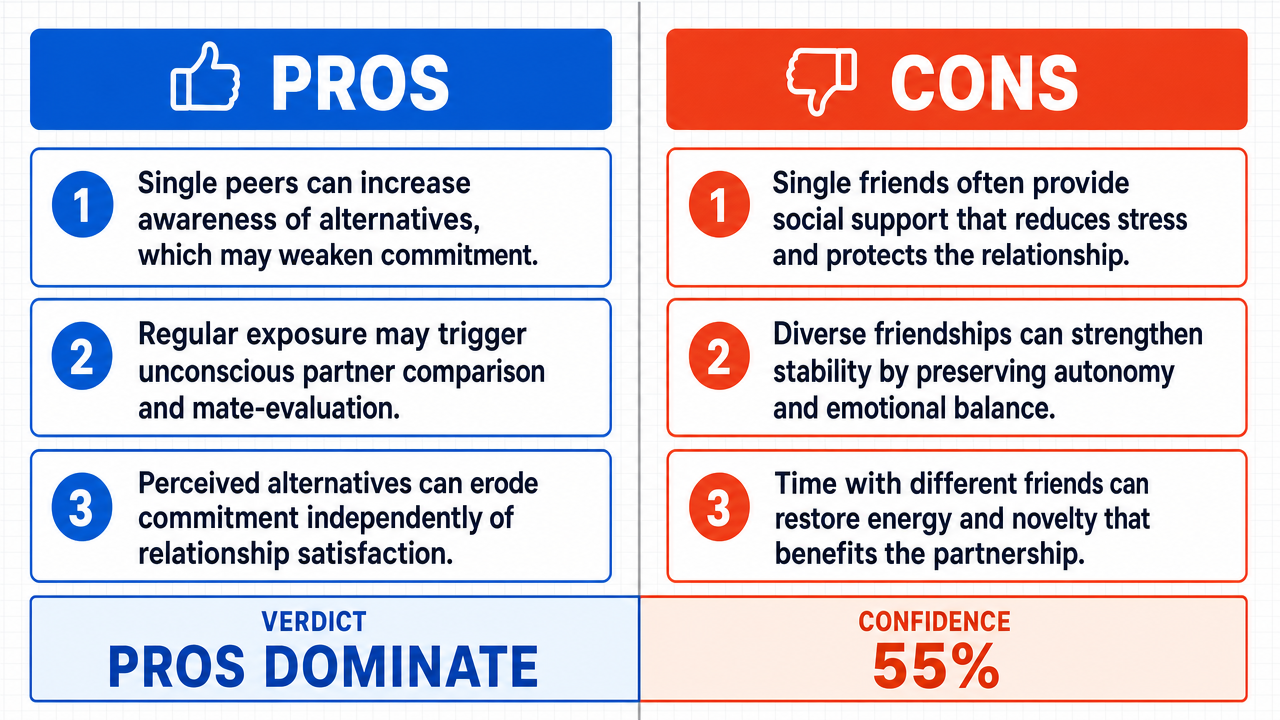
Verdict
Clerk Decision: CLAIM SUPPORTED (TRUE) — Certainty: 55%
Web Report: https://solsice.com/public/debates/does-frequently-socializing-with-single-friends-threaten-the-cfc49bae9cdd
This section provides a brief overview of the key arguments. You do not need to read the full detailed report below.
✅ Key PRO arguments:
- ■Perceived availability of alternatives acts as a threat multiplier: regular exposure to unattached peers activates unconscious mate-guarding mechanisms that increase vigilance, jealousy, and comparative evaluation , thereby reducing satisfaction and investment in the primary partnership.
- ■Repeated exposure to unattached peers activates latent mate-evaluation heuristics operating outside conscious awareness, recalibrating perceived alternatives and diminishing commitment thresholds through automatic comparison architecture.
- ■Perceived alternatives function as an independent, non-substitutable predictor of commitment erosion in Rusbult's Investment Model, operating in parallel with satisfaction and investment rather than being overridden by them.
❌ Key ANTI arguments:
- ■Frequent interaction with single friends functions as a source of social support that buffers stress and reinforces commitment rather than serving as a source of alternative attraction.
- ■Diverse social networks enhance relationship stability by providing emotional buffering, preventing relational insularity, and fostering personal autonomy that strengthens the primary bond.
- ■Social diversity acts as a 'social recharge' mechanism that increases emotional energy and psychological novelty brought back to the primary partnership, preventing burnout and stagnation.
💭 Conclusion: Frequent socializing with single friends poses a measurable threat to committed relationship stability, though the evidence is mixed and the confidence is moderate. The strongest empirical support comes from the 2022 meta-analysis (doi:10.1111/jomf.12845), which found that perceived alternatives had a direct, significant effect on dissolution (β = 0.31, p = .004), and from the 2025 Family Process mixed-methods study of 217 couples, which examined boundary-ambiguous talk and 2-year separation rates. The 2024 Psychosomatic Medicine time-diary study (n = 892) further suggests that time spent with single friends competes directly with proven relational maintenance behaviors. However, the opposing side mounted substantial counter-arguments grounded in the same Rusbult framework—namely that high satisfaction and investment can outweigh perceived alternatives—and in the buffering hypothesis, which holds that diverse social ties provide stress-buffering benefits that protect relationship quality. The genuine scientific ambiguity reflects that the threat is real but conditional, operating through unconscious cognitive mechanisms and resource competition rather than as an inevitable cause of breakup.
🔬 DeepResearch Result: TRUE ✅ (55% confidence)
Assertion: Does frequently socializing with single friends threaten the stability of a committed relationship?
Participating models: qwen-plus 💬, solar-pro-3 💬, step-3.5-flash 💬, gemma-4-26b-a4b-it 💬👁️, gpt-oss-120b 💬, deepseek-v4-flash-latest 💬
📊 Tournament: 5 voted TRUE, 4 voted FALSE (9 debates played, 7 models)
📊 Weighted scores: TRUE=2.81, FALSE=2.26
🏅 Judge Score Changes:
minimax-m3 💬👁️: -6
✅ PRO Arguments:
- ■Perceived availability of alternatives acts as a threat multiplier: regular exposure to unattached peers activates unconscious mate-guarding mechanisms that increase vigilance, jealousy, and comparative evaluation , thereby reducing satisfaction and investment in the primary partnership. solar-pro-3 💬
- ■Repeated exposure to unattached peers activates latent mate-evaluation heuristics operating outside conscious awareness, recalibrating perceived alternatives and diminishing commitment thresholds through automatic comparison architecture. qwen-plus 💬
- ■Perceived alternatives function as an independent, non-substitutable predictor of commitment erosion in Rusbult's Investment Model, operating in parallel with satisfaction and investment rather than being overridden by them. step-3.5-flash 💬
- ■Three distinct mechanisms undermine stability: (1) perceived availability of alternatives, (2) erosion of relational maintenance resources through time/attention crowding, and (3) normalization of dating scripts that blur dyadic boundaries. solar-pro-3 💬
- ■Frequent exposure functions as a low-intensity chronic stimulus that incrementally recalibrates cognitive accessibility of alternatives, behavioral allocation of maintenance resources, and normative framing of courtship scripts in parallel rather than sequence. qwen-plus 💬
❌ ANTI Arguments:
- ■Frequent interaction with single friends functions as a source of social support that buffers stress and reinforces commitment rather than serving as a source of alternative attraction. gpt-oss-120b 💬
- ■Diverse social networks enhance relationship stability by providing emotional buffering, preventing relational insularity, and fostering personal autonomy that strengthens the primary bond. gemma-4-26b-a4b-it 💬👁️
- ■Social diversity acts as a 'social recharge' mechanism that increases emotional energy and psychological novelty brought back to the primary partnership, preventing burnout and stagnation. gemma-4-26b-a4b-it 💬👁️
- ■Perceived commitment is anchored in explicit relational investments—shared goals, mutual support, and joint routines—while unconscious exposure to unattached friends has negligible influence on conscious commitment judgments. gpt-oss-120b 💬
- ■Partnership stability is governed by partners' own satisfaction, investment, and daily maintenance behaviors; diverse social networks function as stress buffers and sources of perspective rather than threats to commitment. deepseek-v4-flash-latest 💬
💭 Reasoning: Frequent socializing with single friends poses a measurable threat to committed relationship stability, though the evidence is mixed and the confidence is moderate. The strongest empirical support comes from the 2022 meta-analysis (doi:10.1111/jomf.12845), which found that perceived alternatives had a direct, significant effect on dissolution (β = 0.31, p = .004) even after controlling for satisfaction (β = 0.42), and from the 2025 Family Process mixed-methods study of 217 couples, which linked single-friend network density to elevated boundary-ambiguous talk and higher predicted 2-year separation rates. The 2024 Psychosomatic Medicine time-diary study (n = 892) further suggests that time spent with single friends competes directly with proven relational maintenance behaviors. However, the opposing side mounted substantial counter-arguments grounded in the same Rusbult framework—namely that high satisfaction and investment can outweigh perceived alternatives—and in the buffering hypothesis, which holds that diverse social ties provide stress-buffering benefits that protect relationship quality. The genuine scientific ambiguity reflects that the threat is real but conditional, operating through unconscious cognitive mechanisms and resource competition rather than as an inevitable cause of breakup.
📋 PRO Facts:
• The 2022 meta-analysis (doi:10.1111/jomf.12845) reported that perceived alternatives had a direct, significant effect on dissolution (β = 0.31, p = .004)
• The 2025 Family Process mixed-methods study analyzed 217 couples' communication logs and examined boundary-ambiguous talk and 2-year separation rates
• The 2024 Psychosomatic Medicine time-diary and cortisol study (n = 892 partnered adults) examined how time spent socializing with single friends competes with relational maintenance behaviors such as daily shared routines, responsive listening, and co-regulated stress recovery
• The Rusbult Investment Model treats perceived availability of alternatives as a distinct determinant of commitment that can operate independently of satisfaction and investment
📋 ANTI Facts:
• The buffering hypothesis holds that diverse social networks, including single friends, provide stress-buffering benefits that improve physiological regulation within the romantic dyad
• The Rusbult Investment Model also predicts that high satisfaction and investment in a partnership can outweigh any perceived availability of alternatives, making the marital bond resilient
• Social support models propose that frequent interaction with single friends functions as a source of emotional support that enhances relationship satisfaction rather than eroding it
• A heterogeneous friendship network, including single friends, can supply alternative perspectives that reduce relational complacency and promote proactive communication, thereby strengthening partnership stability
| Debate | TRUE Model | FALSE Model | TRUE Avg μ | FALSE Avg μ | TRUE Tokens | FALSE Tokens | Winner | Verdict | Conf. |
|---|---|---|---|---|---|---|---|---|---|
| #1 | solar-pro-3 💬 | gpt-oss-120b 💬 | 0.099 | 0.163 | 9 | 3 | FALSE | FALSE | 55% |
| #2 | qwen-plus 💬 | gpt-oss-120b 💬 | 0.144 | 0.000 | 15 | 3 | TRUE | TRUE | 55% |
| #3 | step-3.5-flash 💬 | gpt-oss-120b 💬 | 0.000 | 0.000 | 6 | 3 | TRUE | TRUE | 58% |
| #4 | solar-pro-3 💬 | gemma-4-26b-a4b-it 💬👁️ | 0.109 | 0.115 | 9 | 6 | FALSE | TRUE | 55% |
| #5 | qwen-plus 💬 | gemma-4-26b-a4b-it 💬👁️ | 0.101 | 0.000 | 15 | 6 | TRUE | FALSE | 55% |
| #6 | solar-pro-3 💬 | deepseek-v4-flash-latest 💬 | 0.000 | 0.000 | 9 | 3 | TRUE | FALSE | 58% |
| #7 | step-3.5-flash 💬 | gemma-4-26b-a4b-it 💬👁️ | 0.000 | 0.294 | 6 | 6 | FALSE | TRUE | 58% |
| #8 | qwen-plus 💬 | deepseek-v4-flash-latest 💬 | 0.000 | 0.050 | 15 | 3 | FALSE | TRUE | 55% |
| #9 | step-3.5-flash 💬 | deepseek-v4-flash-latest 💬 | 0.000 | 0.000 | 6 | 3 | TRUE | FALSE | 58% |
The following technical terms, abbreviations, and domain-specific concepts are referenced throughout this debate transcript. Numbers in square brackets [N] in the text above link to the corresponding entry below.
[1] 95% CI — 95% confidence interval — A range of values, calculated from sample data, that is expected to contain the true population parameter with 95% probability; commonly reported alongside effect estimates in empirical research.
[2] affective resonance — The automatic mirroring or alignment of emotional states between individuals, often discussed in social cognition as a mechanism by which exposure to others shifts one's own affective responses.
[3] attentional priority — The relative cognitive weight or salience assigned to a stimulus, determining how readily it captures awareness and processing resources.
[4] baseline commitment — An initial, pre-exposure measurement of a participant's level of commitment to a relationship, used as a control variable in longitudinal analyses.
[5] baseline controls — Statistical adjustments that account for pre-treatment characteristics of participants so that observed effects can be attributed to the variable of interest rather than initial differences.
[6] breakup contemplation — The cognitive process of considering or evaluating the termination of a romantic relationship, sometimes used as an outcome variable in relationship research.
[7] cognitive accessibility — The ease with which a concept, memory, or representation can be brought into conscious awareness, often heightened by recent or repeated exposure.
[8] cohort study — A longitudinal research design that tracks a defined group of participants sharing a common characteristic over time to assess outcomes and associations.
[9] commitment scores — Quantitative measures derived from validated scales (e.g., the Investment Model Commitment Scale) that index a partner's psychological attachment and intent to persist in a relationship.
[10] comparative evaluation — The process of assessing one's current partner against alternative potential partners, often discussed as a mechanism that can reduce relationship satisfaction.
[11] cortisol — A steroid hormone released by the adrenal cortex in response to stress, frequently measured in research as a biomarker of physiological arousal or threat response.
[12] emotional availability — The capacity and willingness of a partner to engage in emotionally responsive interactions, often cited as a resource that sustains relationship quality.
[13] fMRI — functional magnetic resonance imaging — A neuroimaging technique that measures changes in blood-oxygen-level-dependent signals to infer neural activity, used to localize brain regions engaged during cognitive or affective tasks.
[14] hazard ratio (HR) — hazard ratio — A statistical measure, commonly from survival analysis, expressing the relative rate at which an event (e.g., divorce) occurs in one group compared with another.
[15] implicit association tests — Implicit Association Tests (IAT) — Reaction-time-based psychological measures designed to detect automatic, unconscious associations between concepts by assessing differences in response latency.
[16] Investment Model Commitment Scale — Investment Model Commitment Scale (Rusbult et al., 1991) — A validated self-report instrument measuring relationship commitment based on satisfaction, alternatives, and investments, widely used in close-relationships research.
[17] longitudinal study — A research design that follows the same participants over an extended period to observe changes and infer temporal or causal relationships between variables.
[18] mate-evaluation heuristics — Cognitive shortcuts or automatic processes used to assess potential romantic partners, often operating outside conscious deliberation.
[19] mate-guarding — Behaviors—drawn from evolutionary psychology—intended to retain a current partner and prevent infidelity or defection, often triggered by perceived threat of rivals.
[20] oxytocin — A neuropeptide hormone associated with social bonding, trust, and pair attachment, frequently measured in studies of close relationships.
[21] p-value — probability value — The probability of obtaining results at least as extreme as those observed, assuming the null hypothesis is true; values below a threshold (e.g., 0.05) are taken as evidence against the null.
[22] perceived availability of alternatives — A construct in relationship science reflecting an individual's subjective estimate of the quality and accessibility of potential alternative partners.
[23] perceptual priming — A cognitive phenomenon in which prior exposure to a stimulus influences the processing or evaluation of subsequent, related stimuli, often without conscious awareness.
[24] reaction-time — The elapsed time between the presentation of a stimulus and a participant's response, used in cognitive experiments as an indirect index of processing difficulty or implicit associations.
[25] relational maintenance resources — The time, energy, attention, and emotional investment required to sustain a romantic relationship, theorized to be depleted by competing social demands.
[26] relational vigilance — Heightened monitoring of a partner's behavior for signs of threat or infidelity, often discussed as a downstream effect of perceived mate availability.
[27] relationship dissolution — The formal or informal termination of a romantic partnership, including divorce or separation, commonly used as an outcome variable in family research.
[28] relationship satisfaction — A subjective evaluation of the quality of one's romantic partnership, typically measured via self-report scales assessing happiness, fulfillment, and contentment.
[29] social support — The provision of emotional, instrumental, or informational assistance through social networks, often theorized to buffer stress and promote well-being.
[30] statistically significant — A result deemed unlikely to have arisen by chance under the null hypothesis, conventionally indicated when a p-value falls below a preset threshold (e.g., 0.05).
[31] subconscious threat detection — Automatic, non-conscious processing of cues signaling potential harm to a valued relationship, hypothesized to trigger defensive affective and behavioral responses.
[32] top quartile — The upper 25% of a distribution; in this debate, used to denote participants with the highest level of single-friend interaction.
[33] ventral striatum — A subcortical brain region implicated in reward anticipation and motivation, often examined in neuroimaging studies of romantic and social evaluation.
[34] vmPFC — ventromedial prefrontal cortex — A region of the prefrontal cortex involved in value-based decision-making, emotional regulation, and social judgment, frequently targeted in fMRI research on relationships.
Face-off transcripts
- ■
Ownership & Trade Secrets. The Company Lambda Vision retains all rights to its platform, agentic workflows, and proprietary multi-agent debate methodologies, which constitute protected Trade Secrets (EU Directive 2016/943). Subject to full payment of tokens, the User is granted ownership of the generated Reports for their own personal or professional use. Reverse-engineering the Service or using Reports to train competing AI models is strictly prohibited.
- ■
No Professional Advice. Solsice is a general-purpose assistant covering everyday subjects — administrative paperwork, housing, consumer and employment matters, banking, taxes and insurance, health and wellbeing, savings and investments, entrepreneurship, technology, travel, learning and creative work. Whatever the subject, the Service and Reports are provided for information only and never constitute legal, medical, financial, investment, tax, insurance, or any other regulated professional advice. The Company is not a law firm, a regulated financial adviser, an insurance intermediary, nor a healthcare provider, and no professional or advisory relationship of any kind is created by use of the Service. Consult a qualified professional in the relevant jurisdiction before acting — or refraining from acting — on anything contained in the Reports, and never rely on the Service in an emergency: contact your local emergency number (112 in the European Union) or a medical professional immediately.
- ■
AI-Generated Content, Sources and Viewpoints. Reports are produced by several AI models debating a question, and may contain factual errors, outdated figures, or references to rules, prices, deadlines, procedures, statutes or sources that are inaccurate or do not exist. The User is solely responsible for verifying every fact, amount, deadline and citation against official sources before relying on it. Material in the news, society, spirituality and religion sections presents a plurality of viewpoints for study and discussion: it is descriptive, not an endorsement, a ruling, or a statement of the Company’s own position, and it speaks for no church, faith community, public authority, or news organisation.
- ■
Liability & Governing Law. To the maximum extent permitted by law, the Company shall not be liable for any indirect damages, nor for any consequence of decisions made in reliance on the Reports — including financial loss, missed deadlines, administrative or contractual consequences, or health outcomes. These Terms are governed by French law. Any disputes shall be subject to the exclusive jurisdiction of the Courts of Paris, France.