
Des policiers se déguisent en lycéens pour commettre des actes de violence lors des manifestations, comme mettre le feu ou casser des vitres, et de nombreuses vidéos attestent de ces faits
AI debate verdict and arguments
⚠️ AI-generated information only; not professional advice
Completed October 24, 2026
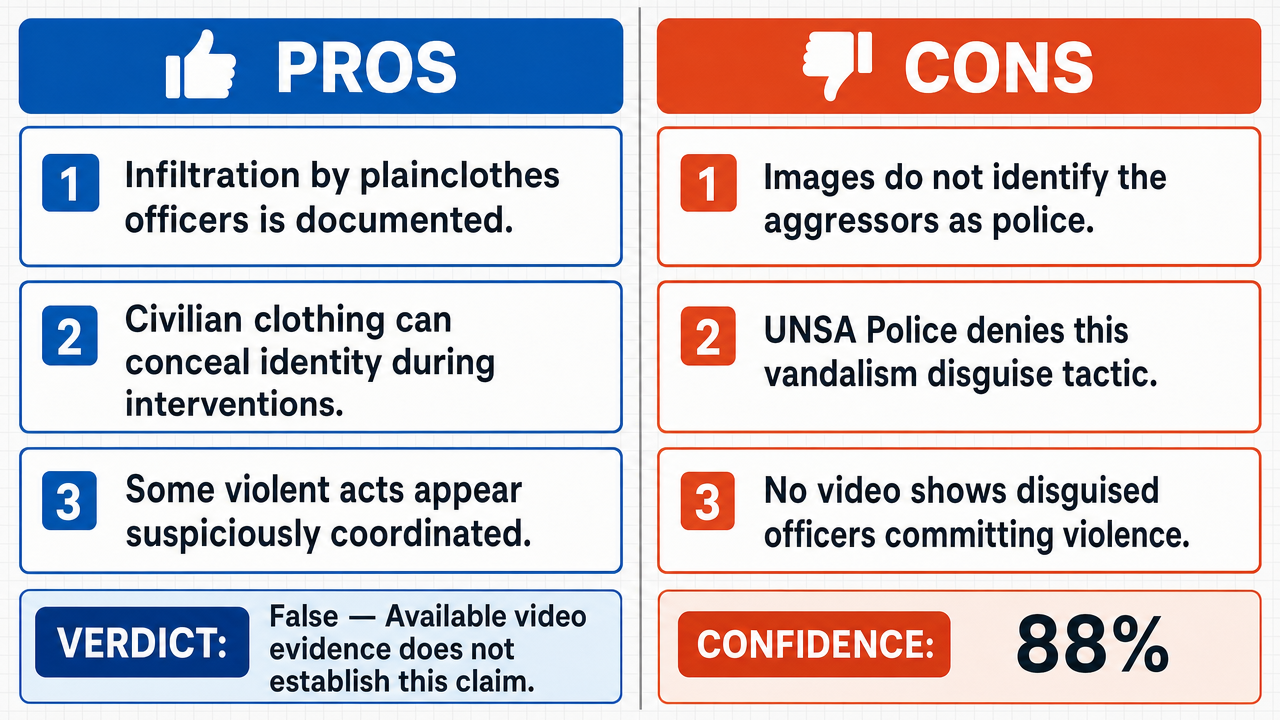
Verdict
Verdict: Mostly FALSE (88%)
Online report: https://solsice.com/public/debates/des-policiers-se-deguisent-en-lyceens-pour-commettre-des-act-116f681634c2
This section provides a brief overview of the key arguments. It is not necessary to read the detailed report below.
✅ Key PRO arguments:
- ■The existence of infiltration tactics by plainclothes agents , adopting the appearance of young protesters to blend into crowds, is a documented fact aimed at disrupting social movements or provoking disturbances .
- ■The use of civilian clothing (hoodies, backpacks) is a recognized method to conceal the agent's identity and facilitate discreet interventions within demonstrations.
- ■Some acts of violence exhibit characteristics that do not match the typical profile of a radical protester, suggesting suspicious coordination incompatible with spontaneous crowd behaviors.
❌ Key CON arguments:
- ■The images circulated do not allow identification of the aggressors as police officers; visual analysis often shows standard riot gear (helmets , shields ) or simply protester clothing.
- ■UNSA Police explicitly denied the existence of this specific disguise tactic aimed at committing acts of vandalism , recalling that infiltration targets intelligence gathering , not provocation .
- ■The opposing argument confuses infiltration for intelligence purposes (legal) with provocation (illegal); no video shows plainclothes police dressed as high school students committing vandalism .
💭 Conclusion: False: the available video evidence does not establish that police are disguising themselves as high school students to commit acts of violence during protests. The formal denial by UNSA Police , combined with visual analysis of recordings showing law enforcement in standard gear or unidentified protesters, significantly weakens the affirmative thesis. The confusion between infiltration for intelligence (legal practice) and deliberate provocation (illegal) is a central logical flaw in the opposing argument. The lack of documented criminal convictions for this specific type of provocative infiltration further supports dismissing the claim. Finally, the behavioral characteristics cited by the affirmative side remain unsubstantiated speculation lacking verifiable material evidence.
🔬 Verdict: Mostly FALSE ❌ (88%)
Claim: Police are disguising themselves as high school students to commit acts of violence during protests, such as setting fires or breaking windows, and many videos attest to these facts
Participating models: gemma-4-26b-a4b-it 💬👁️, glm-4.7-flash 💬
📊 Confrontations: 0 concluded TRUE, 1 concluded FALSE (1 confrontation, 3 models)
📊 Score by camp: TRUE=0.00, FALSE=0.88
🏅 Model score evolution:
minimax-m3 💬👁️: +9
✅ PRO arguments:
- ■The existence of infiltration tactics by plainclothes agents , adopting the appearance of young protesters to blend into crowds, is a documented fact aimed at disrupting social movements or provoking disturbances . gemma-4-26b-a4b-it 💬👁️
- ■The use of civilian clothing (hoodies, backpacks) is a recognized method to conceal the agent's identity and facilitate discreet interventions within demonstrations. gemma-4-26b-a4b-it 💬👁️
- ■Some acts of violence display characteristics that do not match the typical profile of a radical protester, suggesting suspicious coordination incompatible with spontaneous crowd behaviors. gemma-4-26b-a4b-it 💬👁️
- ■Numerous testimonies and recordings circulate documenting these behaviors of police infiltration disguised as high school students. gemma-4-26b-a4b-it 💬👁️
❌ Arguments AGAINST:
- ■The circulated images do not allow identification of the aggressors as police; visual analysis often shows standard riot gear (helmets , shields ) or simply unidentified protesters. glm-4.7-flash 💬
- ■UNSA Police explicitly denied the existence of this specific disguise tactic aimed at committing acts of vandalism , recalling that infiltration targets intelligence gathering , not provocation . glm-4.7-flash 💬
- ■The opposing argument confuses infiltration for intelligence (legal) with provocation (illegal); no video shows police in civvies dressed as high school students committing vandalism. glm-4.7-flash 💬
- ■The absence of criminal convictions for this specific provocative infiltration practice further weakens the evidence linking infiltrated agents to material destruction acts. glm-4.7-flash 💬
💭 Reasoning: False: the available video evidence does not establish that police are disguising themselves as high school students to commit acts of violence during protests. The formal denial by UNSA Police, combined with visual analysis of recordings showing law enforcement in standard gear or unidentified protesters, significantly weakens the affirmative thesis. The confusion between infiltration for intelligence purposes (legal practice) and deliberate provocation (illegal) is a central logical flaw in the opposing argument. The lack of documented criminal convictions for this specific provocative infiltration further supports dismissing the claim. Finally, the behavioral characteristics cited by the affirmative side remain unsubstantiated speculation lacking verifiable material evidence.
📋 PRO facts:
• Police infiltration in civvies during protests is a documented practice for intelligence gathering.
• The use of civilian clothing (hoodies, backpacks) is a recognized method to blend into a crowd.
📋 CON facts:
• UNSA Police explicitly denied the existence of a disguise tactic as high school students to commit acts of vandalism.
• The analyzed videos show standard riot gear (helmets, shields) or unidentified protesters, never police disguised as civilians committing violence.
• No criminal convictions have been issued for this specific provocative infiltration practice.
| Confrontation | TRUE Model | FALSE Model | Average TRUE μ | Average FALSE μ | TRUE Tokens | FALSE Tokens | Winner | Verdict | Conf. |
|---|---|---|---|---|---|---|---|---|---|
| #1 | gemma-4-26b-a4b-it 💬👁️ | glm-4.7-flash 💬 | 0.205 | 0.522 | 4 | 4 | FALSE | FALSE | 88% |
The following technical terms, abbreviations, and specialized concepts are used in this transcript. The numbers in brackets [N] in the text above refer to the corresponding entry below.
[1] Plainclothes agents — Police officers or law enforcement members operating without official uniform, often in an infiltration or surveillance context. The debate questions whether these agents can be disguised as protesters to commit acts of vandalism.
[2] Shields — Protective equipment used by law enforcement during crowd control, mentioned in the debate as visible in the analyzed videos.
[3] Helmets — Head protection gear worn by law enforcement during riot control operations, cited in the debate as standard equipment visible in the videos.
[4] Code of ethics — Set of ethical and professional rules governing police conduct. The debate mentions that it prohibits provocation and participation in acts of violence.
[5] Criminal convictions — Judicial sanctions handed down by a court against a person found guilty of an offense. The debate highlights the absence of such convictions for infiltrated agents committing acts of vandalism.
[6] Audiovisual content — Video and sound recordings used as evidence in the debate to document or contest allegations of police infiltration.
[7] Outbursts — Term referring to violent incidents or acts of vandalism that go beyond peaceful protest. The debate disputes their origin (radical protesters versus infiltrated agents).
[8] Deontology — Set of rules and ethical duties governing a profession, particularly law enforcement.
[9] Destabilization — Action aimed at disrupting the established order or disorganizing a social movement. The debate mentions this strategy as a potential goal of infiltrated agents.
[10] Law enforcement — All institutions and agents responsible for enforcing the law and maintaining public order (police, gendarmerie, etc.).
[11] Infiltration — Police technique involving the introduction of undercover agents into a group to gather intelligence. The debate questions whether this practice can include inciting violence.
[12] Sudden interventions — Rapid police actions, mentioned in the debate as facilitated by agents disguised in civvies.
[13] Leaders — Individuals identified as organizers or leaders of a social movement, whose identification is presented as an objective of police infiltration.
[14] Riot gear — Equipment used by law enforcement to manage crowds and protests (helmets, shields, etc.).
[15] Social movements — Collective groups of citizens aiming to defend common interests or express demands, often through demonstrations.
[16] Provocation — Act by which an agent incites to commit an offense. The debate opposes infiltration for intelligence (legal) to provocation (illegal).
[17] Intelligence — Activity of gathering information about a group or movement. UNSA Police, cited in the debate, states that infiltration aims at intelligence and not provocation.
[18] Institutional responsibility — Obligation for an institution (here, police) to answer for acts committed by its agents. The debate mentions the difficulty of establishing this when agents are in civvies.
[19] Criminal responsibility — Legal obligation for an individual to answer for their acts before criminal justice. The debate notes that it is individual and heavy for agents.
[20] Public safety — Field of law and mission of law enforcement aimed at ensuring the protection of persons and property, governed by specific laws mentioned in the debate.
[21] UNSA Police — Union Nationale des Syndicats Autonomes de la Police — Union organization representing French police officers, cited in the debate for denying the existence of a tactic of disguising as high school students to commit acts of vandalism.
[22] Vandalism — Willful destruction or damage of property (setting fires, smashing windows). The debate contests the identity of the perpetrators of these acts during protests.
[23] Storefronts — Shop fronts, mentioned in the debate as targets of targeted and coordinated acts of destruction.
[24] Radical element — Group or individual within a social movement adopting violent or extreme methods. The debate presents this category as an alternative explanation for acts of vandalism.
[25] Tactical equipment — Specialized gear (gloves, protections, etc.) worn by law enforcement, sometimes concealed under civvies according to the debate's allegations.
Face-off transcripts
- ■
Ownership & Trade Secrets. Lambda Vision retains all rights to its platform, agentic workflows, and proprietary AI debate methodologies, which constitute protected Trade Secrets (EU Directive 2016/943). Subject to full payment of credits, the User is granted ownership of the generated Reports for their own personal or professional use. Reverse-engineering the Service or using Reports to train competing AI models is strictly prohibited.
- ■
No Professional Advice. Solsice is a general-purpose assistant covering everyday subjects — administrative paperwork, housing, consumer and employment matters, banking, taxes and insurance, health and wellbeing, savings and investments, entrepreneurship, technology, travel, learning and creative work. Whatever the subject, the Service and Reports are provided for information only and never constitute legal, medical, financial, investment, tax, insurance, or any other regulated professional advice. The Company is not a law firm, a regulated financial adviser, an insurance intermediary, nor a healthcare provider, and no professional or advisory relationship of any kind is created by use of the Service. Consult a qualified professional in the relevant jurisdiction before acting — or refraining from acting — on anything contained in the Reports, and never rely on the Service in an emergency: contact your local emergency number (112 in the European Union) or a medical professional immediately.
- ■
AI-Generated Content, Sources and Viewpoints. Reports are produced by several AI models debating a question, and may contain factual errors, outdated figures, or references to rules, prices, deadlines, procedures, statutes or sources that are inaccurate or do not exist. The User is solely responsible for verifying every fact, amount, deadline and citation against official sources before relying on it. Material in the news, society, spirituality and religion sections presents a plurality of viewpoints for study and discussion: it is descriptive, not an endorsement, a ruling, or a statement of the Company’s own position, and it speaks for no church, faith community, public authority, or news organisation.
- ■
Liability & Governing Law. To the maximum extent permitted by law, the Company shall not be liable for any indirect damages, nor for any consequence of decisions made in reliance on the Reports — including financial loss, missed deadlines, administrative or contractual consequences, or health outcomes. These Terms are governed by French law. Any disputes shall be subject to the exclusive jurisdiction of the Courts of Paris, France.