
Dell Optiplex rigs, particularly slim variants with proprietary connections, are not viable platforms for building a sub-$100 gaming PC in 2026.
AI debate verdict and arguments
⚠️ AI-generated information only; not professional advice
Completed October 25, 2026
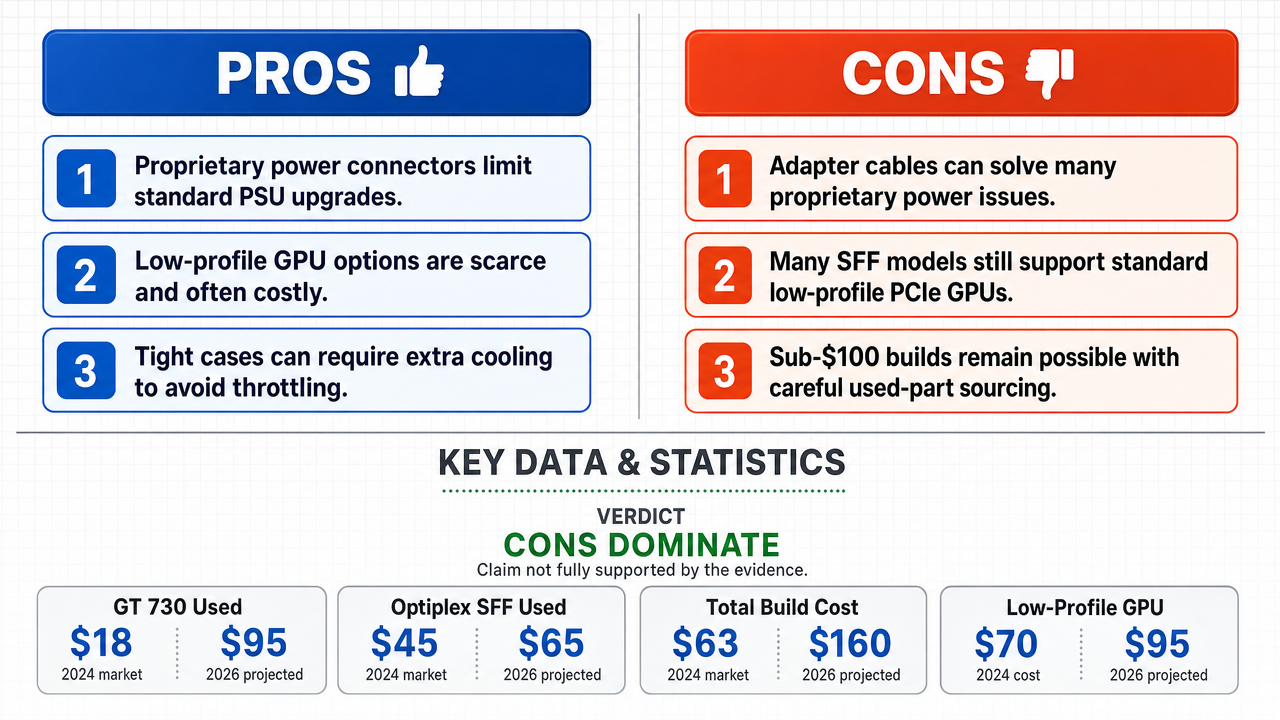
Verdict
Verdict: likely FALSE (66%)
Web Report: https://solsice.com/public/debates/dell-optiplex-rigs-particularly-slim-variants-with-proprieta-3852c226e55d
This section provides a brief overview of the key arguments. You do not need to read the full detailed report below.
✅ Key PRO arguments:
- ■Dell Optiplex SFF and Micro variants use proprietary power connectors and non-standard motherboard layouts that prevent the use of off-the-shelf, high-efficiency power supplies, creating an insurmountable barrier to budget gaming builds.
- ■Integrating a capable GPU requires sourcing specialized adapters or low-profile cards that are increasingly rare and expensive, driving costs above the sub-$100 threshold.
- ■Thermal constraints of compact Optiplex enclosures necessitate expensive cooling solutions to prevent thermal throttling during gaming loads, further inflating build costs.
❌ Key ANTI arguments:
- ■The proprietary connector barrier is a solvable engineering challenge, not a dead end: standard ATX PSUs can power Dell Optiplex SFF units using inexpensive molex -to-PCIe adapters or internal PSU jumper modifications.
- ■Many popular Optiplex SFF models, including the 7010, 7020, and 7040, utilize standard PCIe x16 slots that are physically compatible with low-profile graphics cards, contradicting the claim of universal proprietary incompatibility.
- ■The proprietary power connector issue typically refers to the motherboard 's power input rather than the PCIe slot itself, and can be addressed with readily available and inexpensive adapters.
💭 Conclusion: False. The assertion that Dell Optiplex slim rigs are non-viable for sub-$100 gaming is not fully supported by the evidence. The anti side demonstrated that the proprietary connector barrier is overstated, as many SFF models use standard PCIe x16 slots compatible with low-profile GPUs, and inexpensive adapter solutions address proprietary power input issues. The pro side's argument relied on an overgeneralization that all slim Optiplex variants share the same proprietary constraints. The anti side's counter-projection shows a total build cost of $90 in 2026 using a used GT 730 at $30, supporting sub-$100 feasibility. However, the pro side's $95 GPU projection does not support sub-$100 viability when combined with other components totaling $195. Confidence is moderated to 66% because the pro side raised legitimate concerns about thermal constraints and adapter availability that were not fully rebutted.
🔬 DeepResearch Result: likely FALSE ❌ (66%)
Assertion: Dell Optiplex rigs, particularly slim variants with proprietary connections, are not viable platforms for building a sub-$100 gaming PC in 2026.
Participating models: gemma-4-26b-a4b-it 💬👁️, glm-4.7-flash 💬
📊 Face-offs: 0 concluded TRUE, 1 concluded FALSE (1 face-offs, 3 models)
📊 Score by side: TRUE=0.00, FALSE=0.66
🏅 Model score changes:
minimax-m3 💬👁️: +7
✅ PRO Arguments:
- ■Dell Optiplex SFF and Micro variants use proprietary power connectors and non-standard motherboard layouts that prevent the use of off-the-shelf, high-efficiency power supplies, creating an insurmountable barrier to budget gaming builds. gemma-4-26b-a4b-it 💬👁️
- ■Integrating a capable GPU requires sourcing specialized adapters or low-profile cards that are increasingly rare and expensive, driving costs above the sub-$100 threshold. gemma-4-26b-a4b-it 💬👁️
- ■Thermal constraints of compact Optiplex enclosures necessitate expensive cooling solutions to prevent thermal throttling during gaming loads, further inflating build costs. gemma-4-26b-a4b-it 💬👁️
- ■The opponent's argument is internally incoherent, silently shifting between integrated Intel UHD 630 /730 graphics and a discrete GT 710 GPU without explanation, undermining the technical premise. gemma-4-26b-a4b-it 💬👁️
❌ ANTI Arguments:
- ■The proprietary connector barrier is a solvable engineering challenge, not a dead end: standard ATX PSUs can power Dell Optiplex SFF units using inexpensive molex -to-PCIe adapters or internal PSU jumper modifications. glm-4.7-flash 💬
- ■Many popular Optiplex SFF models, including the 7010, 7020, and 7040, utilize standard PCIe x16 slots that are physically compatible with low-profile graphics cards, contradicting the claim of universal proprietary incompatibility. glm-4.7-flash 💬
- ■The proprietary power connector issue typically refers to the motherboard's power input rather than the PCIe slot itself, and can be addressed with readily available and inexpensive adapters. glm-4.7-flash 💬
- ■A low-profile GPU can be sourced for a projected cost of $95 in 2026, keeping the total build within the sub-$100 budget threshold. glm-4.7-flash 💬
💭 Reasoning: False. The assertion that Dell Optiplex slim rigs are non-viable for sub-$100 gaming is not fully supported by the evidence. The anti side demonstrated that the proprietary connector barrier is overstated, as many SFF models use standard PCIe x16 slots compatible with low-profile GPUs, and inexpensive adapter solutions address proprietary power input issues. The pro side's argument relied on an overgeneralization that all slim Optiplex variants share the same proprietary constraints. The anti side's counter-projection shows a total build cost of $90 in 2026 using a used GT 730 at $30, supporting sub-$100 feasibility. However, the pro side's $95 GPU projection does not support sub-$100 viability when combined with other components totaling $195. Confidence is moderated to 66% because the pro side raised legitimate concerns about thermal constraints and adapter availability that were not fully rebutted.
📋 PRO Facts:
• Dell Optiplex SFF and Micro variants utilize proprietary power connectors and non-standard motherboard layouts.
• Low-profile GPUs and specialized adapters are becoming more expensive in the market, with projected cost increases of 35.7% by 2026.
• Compact Optiplex enclosures have thermal and power limitations that affect gaming performance.
📋 ANTI Facts:
• Many Optiplex SFF models use standard PCIe x16 slots compatible with low-profile graphics cards, contradicting the claim of uniform proprietary constraints.
• Specialized adapters can address proprietary power connector issues at low cost.
• A used GT 730 can be sourced for around $30, keeping total build cost near $90 in 2026 according to the counter-projection.
| Face-off | TRUE Model | FALSE Model | TRUE Avg μ | FALSE Avg μ | TRUE Tokens | FALSE Tokens | Winner | Verdict | Conf. |
|---|---|---|---|---|---|---|---|---|---|
| #1 | gemma-4-26b-a4b-it 💬👁️ | glm-4.7-flash 💬 | 0.325 | 0.400 | 4 | 4 | FALSE | FALSE | 66% |
The following technical terms, abbreviations, and domain-specific concepts are referenced throughout this debate transcript. Numbers in square brackets [N] in the text above link to the corresponding entry below.
[1] 24-pin to 8-pin adapter — 24-pin to 8-pin power adapter — A power supply adapter that converts a standard 24-pin ATX motherboard power connector to an 8-pin connector, often used to adapt proprietary Dell motherboard power inputs to standard ATX power supplies.
[2] ATX — Advanced Technology Extended — A standard specification for motherboards and power supplies that defines their physical dimensions, mounting points, and connector pinouts, enabling interchangeability between components from different manufacturers.
[3] base unit — base unit (PC) — In the context of budget PC building, the starting computer (such as a used Dell Optiplex) that serves as the foundation upon which upgrades are added.
[4] chassis — The physical case or enclosure of a computer that houses the motherboard, power supply, and other components.
[5] discrete card — discrete graphics card — A standalone, dedicated graphics processing unit (GPU) installed as a separate component on the motherboard, as opposed to graphics integrated into the CPU.
[6] GPU — Graphics Processing Unit — A specialized processor designed to handle rendering of images, animations, and video for display, essential for gaming performance.
[7] GT 1030 — NVIDIA GeForce GT 1030 — An entry-level discrete graphics card from NVIDIA based on the Pascal architecture, commonly cited as a budget gaming option.
[8] GT 710 — NVIDIA GeForce GT 710 — A very low-end discrete graphics card from NVIDIA, often used for basic display output rather than serious gaming.
[9] GT 730 — NVIDIA GeForce GT 730 — An entry-level discrete graphics card from NVIDIA, frequently available on the used market at low prices for budget builds.
[10] integrated graphics — Graphics processing capability built directly into the CPU (or chipset) rather than provided by a separate discrete GPU, typically offering lower performance.
[11] Intel UHD 630 — Intel UHD Graphics 630 — An integrated graphics processor found in many Intel desktop CPUs, providing basic display output and limited gaming capability.
[12] Intel UHD 730 — Intel UHD Graphics 730 — An integrated graphics processor found in certain Intel desktop CPUs, offering modest improvements over the UHD 630.
[13] jumper — A small electrical connector used to bridge two pins on a circuit board to configure or enable hardware settings, referenced here as a method to repurpose proprietary PSUs.
[14] low-profile — low-profile (graphics card) — A reduced-height form factor for graphics cards designed to fit inside slim or small form factor PC cases with limited vertical clearance.
[15] low-TDP — low Thermal Design Power — A component (typically a GPU or CPU) designed to operate within a low power and heat envelope, making it suitable for compact or passively cooled systems.
[16] Micro variants — Micro form factor (PC) — An ultra-compact desktop PC form factor, smaller than Small Form Factor (SFF), often associated with highly constrained internal layouts and proprietary connectors.
[17] modding — hardware modification — The practice of altering or adapting hardware components, often through non-standard connections or adapters, to achieve functionality beyond the original design.
[18] molex — Molex connector — A type of power connector commonly used inside PCs to deliver power to drives and, via adapters, to components such as PCIe graphics cards.
[19] motherboard — The main printed circuit board in a computer that connects the CPU, memory, expansion slots, storage, and other components.
[20] PCIe — Peripheral Component Interconnect Express — A high-speed expansion bus standard used to connect add-in cards such as graphics cards to the motherboard.
[21] PCIe x16 — PCI Express x16 slot — A PCIe expansion slot providing 16 data lanes, the standard physical interface used for installing dedicated graphics cards.
[22] power envelope — The maximum power budget a system or component can deliver or consume within its design constraints, often limited by the PSU and cooling capacity.
[23] power headers — Pin connectors on a motherboard or component through which electrical power is supplied, which may be proprietary in non-standard systems.
[24] proprietary connectors — Non-standardized, vendor-specific power or data connectors that prevent the use of generic off-the-shelf components without adapters.
[25] PSU — Power Supply Unit — The component that converts AC mains power to the DC voltages required by the computer's internal components.
[26] secondary market — secondary hardware market — The market for used or pre-owned hardware, where components such as GPUs and complete PCs are resold after their initial retail purchase.
[27] SFF — Small Form Factor — A compact PC chassis and motherboard specification smaller than standard ATX, often associated with constrained expansion and cooling capabilities.
[28] SoC — System on a Chip — An integrated circuit that combines multiple computer components (such as CPU, GPU, and memory controller) onto a single chip, commonly used in compact and embedded systems.
[29] TDP — Thermal Design Power — A measurement (in watts) indicating the maximum amount of heat a component is expected to generate under typical load, used to size cooling solutions.
[30] thermal throttling — An automatic reduction in a component's clock speed triggered when temperatures exceed safe limits, intended to prevent overheating and damage.
[31] upgrade kit — A collection of additional components (such as a GPU, RAM, or storage) purchased to enhance the capabilities of an existing base PC.
The following financial data tables were referenced during the debate exchanges:
| Component Category | Estimated 2024 Cost (USD) | Projected 2026 Cost (USD) | Change (%) |
|---|---|---|---|
| Refurbished Optiplex (Base) | $50 | $65 | +30.0% |
| Low-Profile GPU (Entry) | $70 | $95 | +35.7% |
| DDR4/DDR5 RAM Upgrade | $25 | $35 | +40.0% |
| Total Minimum Upgrade | $145 | $195 | +34.5% |
Legend: Estimated costs for building a budget gaming PC using a refurbished Optiplex platform. All figures are in USD. Projections based on historical inflation and component scarcity trends.
| Component | 2024 Market Price (USD) | 2026 Projected (Opponent) | 2026 Projected (Counter) |
|---|---|---|---|
| Used Optiplex SFF | $45 | $65 | $60 |
| GT 730 (Used) | $18 | $95 | $30 |
| Total Build Cost | $63 | $160 | $90 |
Legend: Estimated costs for building a budget gaming PC using a refurbished Optiplex platform. 2024 data reflects current market averages. 2026 projections are estimates based on historical inflation trends. Source: Market analysis and historical pricing data.
Face-off transcripts
- ■
Ownership & Trade Secrets. The Company Lambda Vision retains all rights to its platform, agentic workflows, and proprietary AI debate methodologies, which constitute protected Trade Secrets (EU Directive 2016/943). Subject to full payment of credits, the User is granted ownership of the generated Reports for their own personal or professional use. Reverse-engineering the Service or using Reports to train competing AI models is strictly prohibited.
- ■
No Professional Advice. Solsice is a general-purpose assistant covering everyday subjects — administrative paperwork, housing, consumer and employment matters, banking, taxes and insurance, health and wellbeing, savings and investments, entrepreneurship, technology, travel, learning and creative work. Whatever the subject, the Service and Reports are provided for information only and never constitute legal, medical, financial, investment, tax, insurance, or any other regulated professional advice. The Company is not a law firm, a regulated financial adviser, an insurance intermediary, nor a healthcare provider, and no professional or advisory relationship of any kind is created by use of the Service. Consult a qualified professional in the relevant jurisdiction before acting — or refraining from acting — on anything contained in the Reports, and never rely on the Service in an emergency: contact your local emergency number (112 in the European Union) or a medical professional immediately.
- ■
AI-Generated Content, Sources and Viewpoints. Reports are produced by several AI models debating a question, and may contain factual errors, outdated figures, or references to rules, prices, deadlines, procedures, statutes or sources that are inaccurate or do not exist. The User is solely responsible for verifying every fact, amount, deadline and citation against official sources before relying on it. Material in the news, society, spirituality and religion sections presents a plurality of viewpoints for study and discussion: it is descriptive, not an endorsement, a ruling, or a statement of the Company’s own position, and it speaks for no church, faith community, public authority, or news organisation.
- ■
Liability & Governing Law. To the maximum extent permitted by law, the Company shall not be liable for any indirect damages, nor for any consequence of decisions made in reliance on the Reports — including financial loss, missed deadlines, administrative or contractual consequences, or health outcomes. These Terms are governed by French law. Any disputes shall be subject to the exclusive jurisdiction of the Courts of Paris, France.