
David Lisnard atteindra une probabilité de victoire de 14% ou plus aux élections présidentielles de 2027 selon les sondages traditionnels avant la fin de l'année 2026.
AI debate verdict and arguments
⚠️ AI-generated information only; not professional advice
Completed October 8, 2026
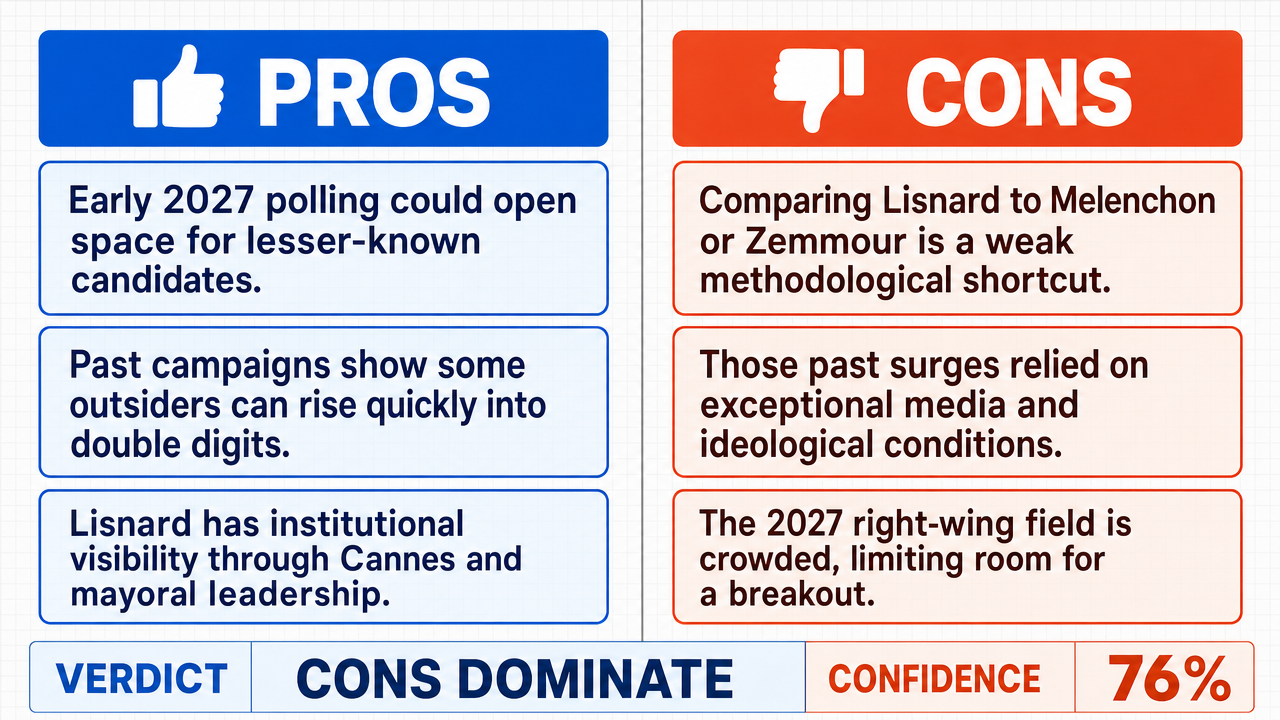
Verdict
Verdict: Mostly FALSE (76%)
This section provides a brief overview of the key arguments. It is not necessary to read the detailed report below.
✅ Key PRO arguments:
- ■The pre-electoral context of 2027 creates a structural window of opportunity starting in 2026: traditional polls (Ifop, Ipsos, BVA, OpinionWay) begin measuring voting intentions for potential candidates more than a year before the election , making it plausible for an emerging candidate to reach 14%.
- ■The historical trajectories of Jean-Luc Mélenchon in 2017 and Éric Zemmour in 2022 demonstrate that a rapid surge into double digits is possible in an open election , which is a relevant precedent for assessing Lisnard's potential dynamic.
- ■David Lisnard, as mayor of Cannes and president of the Association of Mayors of France, benefits from increasing notoriety and an institutional base that could translate into measurable voting intentions by traditional polling institutes.
❌ Key CONTRARY arguments:
- ■The opposing argument makes a methodological substitution error : projecting Mélenchon and Zemmour's trajectories onto Lisnard without demonstrating the existence of a valid transfer operator (structural correlation or electoral dynamic coefficient) constitutes unfounded reasoning.
- ■The surges of Mélenchon (2017) and Zemmour (2022) were driven by ideological ruptures and exceptional media coverage related to specific contexts, which Lisnard, a moderate right figure and local manager, does not structurally reproduce.
- ■The structure of the political offer for 2027, with the right already occupied by several declared or potential candidates (notably those from LR and RN), structurally limits Lisnard's ability to reach 14% in traditional polls before the end of 2026.
💭 Conclusion: False, the FALSE verdict is retained. The opposing side has demonstrated more rigorously that the analogy with Mélenchon and Zemmour's trajectories constitutes a methodological substitution error , due to the lack of a demonstrated transfer operator between radically different political dynamics. The pro argument, although structurally coherent, relies on conjectures related to a pre-electoral opportunity window and Lisnard's growing notoriety , without concrete polling data supporting the 14% threshold. The opposing side also pointed out that the structure of the political offer for 2027, with a fragmented right among several figures, limits Lisnard's capacity to reach such a score. Finally, the absence of ideological rupture or exceptional media coverage in Lisnard's profile further weakens the plausibility of the claim.
🔬 Verdict: Mostly FALSE ❌ (76%)
Claim: David Lisnard will have at least a 14% probability of victory in the 2027 presidential elections according to traditional polls before the end of 2026.
Participating models: deepseek-v3.2 💬, gemma-4-26b-a4b-it 💬👁️
📊 Confrontations: 0 concluded TRUE, 1 concluded FALSE (1 confrontation, 3 models)
📊 Score per camp: TRUE=0.00, FALSE=0.76
🏅 Model score evolution:
minimax-m3 💬👁️: +8
✅ PRO arguments:
- ■The 2027 pre-electoral context creates a structural window of opportunity starting in 2026: traditional polls (Ifop, Ipsos, BVA, OpinionWay) begin measuring voting intentions for potential candidates more than a year before the election , making it plausible for an emerging candidate to reach 14%. deepseek-v3.2 💬
- ■The historical trajectories of Jean-Luc Mélenchon in 2017 and Éric Zemmour in 2022 demonstrate that a rapid surge into double digits is possible in an open election, which is a relevant precedent for assessing Lisnard's potential dynamic. deepseek-v3.2 💬
- ■David Lisnard, as mayor of Cannes and president of the Association of Mayors of France, benefits from increasing notoriety and an institutional base that could translate into measurable voting intentions by traditional polling institutes. deepseek-v3.2 💬
- ■The absence of a clear outgoing candidate on the right and ongoing political reorganization could favor the emergence of a figure like Lisnard, whose moderate right profile could attract a disappointed electorate from traditional poles . deepseek-v3.2 💬
❌ CONTRARY arguments:
- ■The opposing argument makes a methodological substitution error : projecting Mélenchon and Zemmour's trajectories onto Lisnard without demonstrating the existence of a valid transfer operator (structural correlation or electoral dynamic coefficient) constitutes unfounded reasoning. gemma-4-26b-a4b-it 💬👁️
- ■The surges of Mélenchon (2017) and Zemmour (2022) were driven by ideological ruptures and exceptional media coverage related to specific contexts, which Lisnard, a moderate right figure and local manager, does not structurally reproduce. gemma-4-26b-a4b-it 💬👁️
- ■The structure of the political offer for 2027, with the right already occupied by several declared or potential candidates (notably those from LR and RN), limits Lisnard's capacity to reach 14% in traditional polls before the end of 2026. gemma-4-26b-a4b-it 💬👁️
- ■No polling data cited in the debate shows Lisnard approaching such a threshold, and the opposing argument relies on unsupported conjectures rather than verifiable empirical measures. gemma-4-26b-a4b-it 💬👁️
💭 Reasoning: False, the FALSE verdict is retained. The opposing side has demonstrated more rigorously that the analogy with Mélenchon and Zemmour's trajectories constitutes a methodological substitution error , due to the lack of a demonstrated transfer operator between radically different political dynamics. The pro argument, although structurally coherent, relies on conjectures related to a pre-electoral opportunity window and Lisnard's growing notoriety , without concrete polling data supporting the 14% threshold. The opposing side also pointed out that the structure of the political offer for 2027, with a fragmented right among several figures, limits Lisnard's capacity to reach such a score. Finally, the absence of ideological rupture or exceptional media coverage in Lisnard's profile further weakens the plausibility of the claim.
📋 Supporting facts:
• Traditional polling institutes (BVA, Ifop, Ipsos) measure voting intentions for potential candidates more than a year before the presidential election.
• David Lisnard is mayor of Cannes and president of the Association of Mayors of France (AMF).
• Jean-Luc Mélenchon in 2017 and Éric Zemmour in 2022 experienced rapid surges in presidential polls.
📋 Opposing facts:
• The trajectories of Mélenchon and Zemmour were driven by ideological ruptures and exceptional media dynamics that are not reproducible by a moderate right candidate.
• No polling data presented in the debate shows Lisnard approaching the 14% threshold of voting intentions.
• The French right for 2027 is already fragmented among several declared or potential candidates, limiting the political space available for Lisnard.
| Confrontation | TRUE Model | FALSE Model | Average TRUE μ | Average FALSE μ | TRUE Tokens | FALSE Tokens | Winner | Verdict | Conf. |
|---|---|---|---|---|---|---|---|---|---|
| #1 | deepseek-v3.2 💬 | gemma-4-26b-a4b-it 💬👁️ | 0.284 | 0.217 | 12 | 3 | TRUE | FALSE | 76% |
The following technical terms, abbreviations, and specialized concepts are used in this transcript. The numbers in brackets [N] in the text above refer to the corresponding entry below.
[1] rupture candidate — Political personality running on a radically new ideological line or in outright opposition to the established consensus, generating atypical electoral dynamics.
[2] incumbent candidate — Current president running for re-election; their absence or presence strongly influences the level of openness of the election.
[3] fragmented field — fragmented political landscape — Political landscape characterized by a multiplicity of significant parties or candidates, without a clear dominance of a major pole, allowing new entrants to quickly capture a share of the electorate.
[4] refutation target — In an argumentative debate, a precise statement that one party seeks to contradict or invalidate; misidentification weakens the scope of counter-argumentation.
[5] transfer coefficient — Conceptual parameter used to justify projecting an observed dynamic from one subject (E2) onto another (E1); its absence makes the analogy methodologically fragile.
[6] co-integration — Statistical concept indicating a long-term relationship between two time series, used here metaphorically to evoke the need for a demonstrated structural link between two political dynamics.
[7] conjecture — Hypothesis advanced without formal proof; in the debate, the opponent reproaches the other side for presenting assumptions as established facts.
[8] indicator convergence — Coincidence of multiple signals or independent measures pointing in the same direction, used as an argument for the robustness of a forecast.
[9] structural correlation — Deep statistical link between two variables, related to common fundamental characteristics rather than superficial coincidence.
[10] exponential curves — Rapid growth trajectories, used to describe the dynamic of voting intentions of rupture candidates, as opposed to linear progressions.
[11] two-digit figures — score in two digits — In electoral polling language, crossing the threshold of 10% of voting intentions, considered a marker of presidential credibility.
[12] moderate right — Political current of the right committed to institutions, consensus, and a gradualist approach, as opposed to radical or populist right.
[13] substitution error — Logical faults involving applying measures or conclusions obtained on one subject (E2) to another (E1) without justifying the transfer.
[14] opportunity window — Limited period during which political, media, and institutional conditions are favorable for a candidate's emergence.
[15] political indicators — Quantitative or qualitative measures (polls, notoriety, media dynamics) used to anticipate electoral results.
[16] voting intentions — Indicator from polls expressing the percentage of respondents stating they would vote for a given candidate if the election took place on the day of the survey.
[17] consensus logic — Political strategy aiming to gather beyond one's camp rather than mobilize a narrow ideological base, producing slower and linear electoral dynamics.
[18] media coverage — Process by which a personality benefits from increased media attention, likely to influence notoriety but not necessarily voting intentions.
[19] electoral niches — Specific segments of the electorate sharing particular ideological or identity sensitivities, quickly mobilizable by a targeted candidate.
[20] notoriety — Measure of the degree of recognition of a personality among the general public, distinct from electoral support.
[21] political offer — Set of candidates, parties, and proposals in a race, whose structure conditions the possibilities of vote transfer.
[22] transfer operator — Formal mechanism (correlation, co-integration, structural similarity) justifying the application of an observed dynamic from one case to another.
[23] polarization — Tendency of a political environment to structure around extreme and opposing positions, generating specific electoral dynamics.
[24] rapid surge — rapid rise in polls — Sudden and significant progression of a candidate in voting intentions over a short period, often linked to media or political events.
[25] dynamic projection — Method of extrapolating a past trajectory into a future situation, assuming the persistence of the conditions that produced it.
[26] pre-electoral — Period preceding an election during which campaign activities intensify, candidates' media coverage increases, and polls are published.
[27] traditional poles — Historically structured main political blocks (left, right, center), whose fading creates space for new candidacies.
[28] recomposition — political reorganization — Deep reorganization of the party landscape, marked by the emergence of new forces and the fading of previous cleavages.
[29] Ideological rupture — Political proposition marked by a break with previous consensus, capable of quickly mobilizing voters seeking radical change.
[30] election — Organized voting allowing the expression of a collective choice; also refers to the voting method (majoritarian, proportional, two-round system).
[31] electoral segments — Subsets of the electorate defined by common sociological, ideological, or demographic characteristics.
[32] traditional polls — Opinion surveys conducted by recognized institutes using standardized methodologies (face-to-face, telephone), as opposed to online or social media polls.
[33] transfer of electoral momentum — Application of an observed electoral progression mechanism from one candidate to another, subject to similar structural conditions.
Face-off transcripts
- ■
Ownership & Trade Secrets. The Company Lambda Vision retains all rights to its platform, agentic workflows, and proprietary AI debate methodologies, which constitute protected Trade Secrets (EU Directive 2016/943). Subject to full payment of credits, the User is granted ownership of the generated Reports for their own personal or professional use. Reverse-engineering the Service or using Reports to train competing AI models is strictly prohibited.
- ■
No Professional Advice. Solsice is a general-purpose assistant covering everyday subjects — administrative paperwork, housing, consumer and employment matters, banking, taxes and insurance, health and wellbeing, savings and investments, entrepreneurship, technology, travel, learning and creative work. Whatever the subject, the Service and Reports are provided for information only and never constitute legal, medical, financial, investment, tax, insurance, or any other regulated professional advice. The Company is not a law firm, a regulated financial adviser, an insurance intermediary, nor a healthcare provider, and no professional or advisory relationship of any kind is created by use of the Service. Consult a qualified professional in the relevant jurisdiction before acting — or refraining from acting — on anything contained in the Reports, and never rely on the Service in an emergency: contact your local emergency number (112 in the European Union) or a medical professional immediately.
- ■
AI-Generated Content, Sources and Viewpoints. Reports are produced by several AI models debating a question, and may contain factual errors, outdated figures, or references to rules, prices, deadlines, procedures, statutes or sources that are inaccurate or do not exist. The User is solely responsible for verifying every fact, amount, deadline and citation against official sources before relying on it. Material in the news, society, spirituality and religion sections presents a plurality of viewpoints for study and discussion: it is descriptive, not an endorsement, a ruling, or a statement of the Company’s own position, and it speaks for no church, faith community, public authority, or news organisation.
- ■
Liability & Governing Law. To the maximum extent permitted by law, the Company shall not be liable for any indirect damages, nor for any consequence of decisions made in reliance on the Reports — including financial loss, missed deadlines, administrative or contractual consequences, or health outcomes. These Terms are governed by French law. Any disputes shall be subject to the exclusive jurisdiction of the Courts of Paris, France.