
Dave Ramsey's advice to avoid medium to low-interest debt before investing in real estate is generally suitable only for individuals with a history of financial mismanagement.
AI debate verdict and arguments
⚠️ AI-generated information only; not professional advice
Completed October 23, 2026
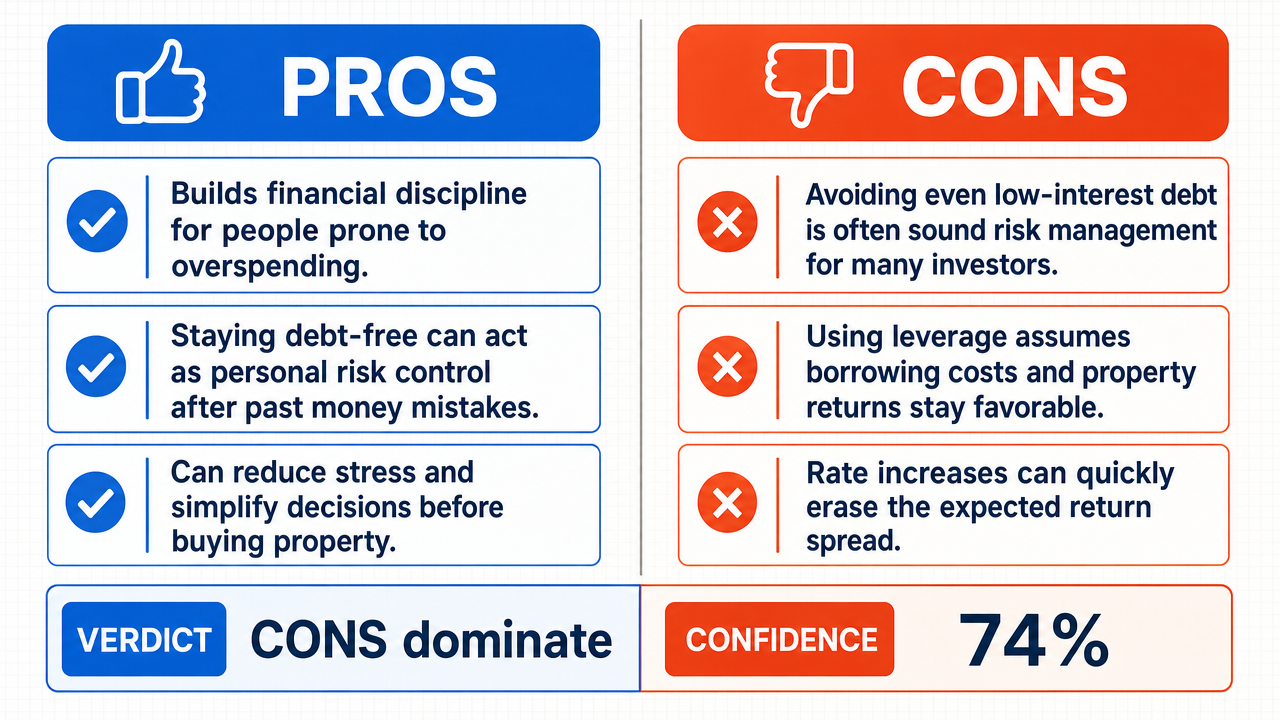
Verdict
Verdict: likely FALSE (74%)
Web Report: https://solsice.com/public/debates/dave-ramsey-s-advice-to-avoid-medium-to-low-interest-debt-be-03fd34d6c457
This section provides a brief overview of the key arguments. You do not need to read the full detailed report below.
✅ Key PRO arguments:
- ■Ramsey's debt-avoidance strategy can serve as a behavioral correction by reinforcing financial discipline , helping people with a history of overconsumption and debt accumulation before they assume the obligations of a real-estate investment.
- ■For individuals who have previously mismanaged their finances, remaining debt-free before purchasing property may function as a necessary personal risk-control mechanism rather than merely a financial optimization strategy.
- ■Unnecessarily avoiding debt can create substantial opportunity costs for disciplined investors who could rationally use favorable differences between borrowing costs and expected property returns .
❌ Key ANTI arguments:
- ■Avoiding medium- to low-interest debt before investing in real estate is a prudent risk-management practice applicable to a broad range of investors, not only to people with a history of financial mismanagement.
- ■A strategy that relies on the difference between borrowing costs and property returns assumes that interest rates will remain sufficiently stable, whereas rising rates can make debt more costly than the associated investment return.
- ■The Federal Funds Rate rose from 0.08% in 2021 to 5.33% in 2023, illustrating how quickly financing costs can increase and erode an investment spread that had appeared favorable.
💭 Conclusion: False: the winning side concluded that Ramsey's debt-avoidance strategy is broadly suitable as risk management rather than only as a corrective measure for people with a history of financial mismanagement. Its strongest case is that avoiding medium- to low-interest debt before buying property protects investors against interest-rate and property-market volatility that can eliminate an apparent borrowing-cost spread . The cited rise in the Federal Funds Rate from 0.08% in 2021 to 5.33% in 2023 demonstrates that financing costs can change rapidly and make leveraged real estate more precarious. The affirmative correctly identified behavioral and opportunity-cost benefits of debt avoidance, but those benefits do not establish that the advice is suitable exclusively for people with prior financial problems. The evidence therefore rejects the assertion's restrictive condition, although the conclusion is based on a single debate and should not be interpreted as universally applicable in every financial circumstance.
🔬 DeepResearch Result: likely FALSE ❌ (74%)
Assertion: Dave Ramsey's advice to avoid medium to low-interest debt before investing in real estate is generally suitable only for individuals with a history of financial mismanagement.
Participating models: gemma-4-26b-a4b-it 💬👁️, glm-4.7-flash 💬
📊 Face-offs: 0 concluded TRUE, 1 concluded FALSE (1 face-offs, 3 models)
📊 Score by side: TRUE=0.00, FALSE=0.74
🏅 Model score changes:
minimax-m3 💬👁️: +7
✅ PRO Arguments:
- ■Ramsey's debt-avoidance strategy can serve as a behavioral correction by reinforcing financial discipline , helping people with a history of overconsumption and debt accumulation before they assume the obligations of a real-estate investment. gemma-4-26b-a4b-it 💬👁️
- ■For individuals who have previously mismanaged their finances, remaining debt-free before purchasing property may function as a necessary personal risk-control mechanism rather than merely a financial optimization strategy. gemma-4-26b-a4b-it 💬👁️
- ■Unnecessarily avoiding debt can create substantial opportunity costs for disciplined investors who could rationally use favorable differences between borrowing costs and expected property returns . gemma-4-26b-a4b-it 💬👁️
- ■The affirmative argued that a disciplined investor can use such a return spread when market conditions are favorable, making a universal requirement to avoid all medium- to low-interest debt unnecessarily restrictive. gemma-4-26b-a4b-it 💬👁️
❌ ANTI Arguments:
- ■Avoiding medium- to low-interest debt before investing in real estate is a prudent risk-management practice applicable to a broad range of investors, not only to people with a history of financial mismanagement. glm-4.7-flash 💬
- ■A strategy that relies on the difference between borrowing costs and property returns assumes that interest rates will remain sufficiently stable, whereas rising rates can make debt more costly than the associated investment return. glm-4.7-flash 💬
- ■The Federal Funds Rate rose from 0.08% in 2021 to 5.33% in 2023, illustrating how quickly financing costs can increase and erode an investment spread that had appeared favorable. glm-4.7-flash 💬
- ■For conservative investors or markets with limited appreciation potential, avoiding debt can be a rational way to preserve capital rather than pursue aggressive growth. glm-4.7-flash 💬
- ■Both interest rates and real-estate markets are volatile, so any temporary advantage from leveraged property investment cannot be treated as guaranteed. glm-4.7-flash 💬
💭 Reasoning: False: the winning side concluded that Ramsey's debt-avoidance strategy is broadly suitable as risk management rather than only as a corrective measure for people with a history of financial mismanagement. Its strongest case is that avoiding medium- to low-interest debt before buying property protects investors against interest-rate and property-market volatility that can eliminate an apparent borrowing-cost spread. The cited rise in the Federal Funds Rate from 0.08% in 2021 to 5.33% in 2023 demonstrates that financing costs can change rapidly and make leveraged real estate more precarious. The affirmative correctly identified behavioral and opportunity-cost benefits of debt avoidance, but those benefits do not establish that the advice is suitable exclusively for people with prior financial problems. The evidence therefore rejects the assertion's restrictive condition, although the conclusion is based on a single debate and should not be interpreted as universally applicable in every financial circumstance.
📋 PRO Facts:
• The affirmative characterized the debt snowball as a mechanism for reinforcing financial discipline and reducing recurring debt accumulation.
• Debt avoidance before real-estate investment can impose an opportunity cost when borrowing and expected property returns differ favorably.
• The affirmative argued that disciplined investors can rationally use a favorable borrowing-cost spread rather than being restricted to an all-debt-free approach.
📋 ANTI Facts:
• The Federal Funds Rate rose from 0.08% in 2021 to 5.33% in 2023.
• An investment spread present at one point is not guaranteed to persist because interest rates and property markets can change.
• Avoiding debt can serve as a capital-preservation strategy for conservative investors and markets with limited appreciation potential.
| Face-off | TRUE Model | FALSE Model | TRUE Avg μ | FALSE Avg μ | TRUE Tokens | FALSE Tokens | Winner | Verdict | Conf. |
|---|---|---|---|---|---|---|---|---|---|
| #1 | gemma-4-26b-a4b-it 💬👁️ | glm-4.7-flash 💬 | 0.227 | 0.375 | 4 | 4 | FALSE | FALSE | 74% |
The following technical terms, abbreviations, and domain-specific concepts are referenced throughout this debate transcript. Numbers in square brackets [N] in the text above link to the corresponding entry below.
[1] Annual Avg — annual average — The calendar-year average of a rate, as used for the Federal Funds Rate figures in the table.
[2] appreciation — An increase in an asset's value, discussed as a potential source of real-estate return and as a factor that can vary across markets.
[3] asset return — The return generated by an asset, compared with the cost of debt in the debate's spread calculation.
[4] behavioral intervention — Use of a financial rule to correct spending, debt, and cash-flow behavior; the affirmative characterizes debt avoidance as this kind of intervention.
[5] borrowing costs — The expenses or rates associated with obtaining loans. The transcript links changes in borrowing costs to the Federal Funds Rate and mortgage rates.
[6] capital outlays — Large expenditures associated with an investment or transaction; the affirmative says debt-free discipline prepares a person to manage such outlays in real estate.
[7] capital preservation — Prioritizing protection of invested capital over more aggressive growth, presented as an advantage of avoiding debt.
[8] cash flow — The flow of money available to and used by a household or investment. Managing it is identified as central to correcting financial mismanagement.
[9] cost of capital — The financing cost or required return associated with using capital. The affirmative contrasts it with potential appreciation and cash flow, while the negative says it can exceed an investment's return.
[10] cost of debt — The rate or expense of debt financing. The negative argues that a rapid increase can erase the perceived spread between debt costs and property returns.
[11] debt accumulation — The buildup of outstanding debt, identified in the affirmative as part of a behavioral pattern that can prevent wealth creation.
[12] debt snowball — Ramsey's named debt repayment strategy, presented as reinforcing discipline and reducing debt before further investing.
[13] debt-avoidance strategy — The practice of avoiding low-interest debt and remaining debt-free before entering real estate. The debate disputes whether it is mainly a corrective tool for prior financial mismanagement or a broadly prudent risk-management strategy.
[14] debt-free status — The condition of having no outstanding debt, which the strategy requires before an individual enters real estate.
[15] diversified portfolios — Investment portfolios spread across multiple holdings, cited as a means for disciplined investors to manage systemic market risk.
[16] Federal Funds Rate — The annual-average interest rate shown in the table. The debate describes it as affecting banks' borrowing costs and mortgage rates and cites an increase from 0.08% in 2021 to 5.33% in 2023.
[17] financial discipline — The capacity to control spending, debt, and cash flow, which the affirmative says is built through debt repayment and debt-free discipline.
[18] interest rates — The cost of borrowing. The debate emphasizes that their volatility can make debt a liability and erode the spread between borrowing costs and property returns.
[19] leverage — Use of borrowed capital to increase investment exposure and potentially amplify returns; the affirmative says debt avoidance gives up this benefit.
[20] liability — An obligation rather than an asset. The negative uses this distinction to argue that debt becomes a liability when its cost exceeds the investment return.
[21] liquidity crises — Crises affecting liquidity, cited as a market risk that the debate says disciplined investors may be unable to manage.
[22] liquidity reserves — Funds held to meet liquidity needs, cited as a way for disciplined investors to manage systemic risk without relying on debt.
[23] low appreciation potential — A market condition in which property values have limited potential to increase, cited as making debt avoidance more rational for conservative investors.
[24] low-interest debt — Debt raised at relatively low rates. The debate disputes whether avoiding it before real-estate investment is primarily a behavioral correction or a generally prudent risk-management practice.
[25] low-interest-rate environment — A period in which borrowing costs are low, a condition the negative says the affirmative's spread argument presumes.
[26] mathematical optimization — Calculating the most financially efficient choice among alternatives. The affirmative says Ramsey's strategy derives its main value from behavioral reinforcement rather than this form of optimization.
[27] mortgage rates — The interest rates charged on mortgage borrowing, described in the transcript as influenced by the Federal Funds Rate.
[28] opportunity cost — The benefit foregone by not using low-interest financing or leverage, such as the lost ability to scale a portfolio and amplify returns.
[29] overconsumption — Spending beyond available resources, identified as a behavioral tendency associated with debt accumulation.
[30] portfolio — A collection of investments, discussed in relation to scaling through leverage and managing systemic risk through diversification and liquidity reserves.
[31] property returns — The returns generated by property investments, compared with borrowing costs to judge whether debt financing is favorable.
[32] psychological reinforcement — The behavior-building effect attributed to debt repayment and debt-free discipline, including development of what the affirmative calls muscle memory for managing capital outlays.
[33] real estate assets — Properties held as investments, discussed in terms of appreciation, cash flow, large capital outlays, and potential leverage.
[34] real estate markets — Markets for real-estate investments, described as subject to volatility and differing levels of appreciation potential.
[35] return on investment — The return produced by an investment, which the negative says can be lower than the cost of capital.
[36] risk profile — An investor's financial capacity and preference for risk, used to argue that debt avoidance can suit a broad range of investors.
[37] risk-mitigation strategy — A strategy aimed at reducing financial risk. The negative characterizes debt avoidance as one that protects capital in uncertain or low-appreciation markets.
[38] spread — The difference between the cost of debt and the return from an asset or property. The negative says the spread may not persist and can be erased as borrowing costs rise.
[39] systemic market risks — Market-wide risks that affect outcomes beyond an individual's financial management; the debate disputes how well reserves and diversification can address them.
[40] volatility of interest rates — Variability in interest rates, which can change borrowing costs quickly and eliminate the spread between debt cost and investment return.
The following financial data tables were referenced during the debate exchanges:
| Investment Strategy | Leverage Usage | Risk Profile | Primary Goal |
|---|---|---|---|
| Ramsey Method | None (0%) | Extremely Low | Behavioral Discipline |
| Disciplined Leverage | Moderate (50-75%) | Managed | Wealth Acceleration |
| Aggressive Leverage | High (80%+) | High | Maximum IRR |
Legend: Comparison of investment approaches based on debt utilization and strategic intent. Leverage refers to the Loan-to-Value (LTV) ratio.
| Year | Federal Funds Rate (Annual Avg) |
|---|---|
| 2020 | 0.09% |
| 2021 | 0.08% |
| 2022 | 4.10% |
| 2023 | 5.33% |
| 2024 | 5.33% |
Legend: Federal Funds Rate (Annual Average) from Federal Reserve Economic Data, indicating the cost of borrowing for banks and influencing mortgage rates.
| Year | Mortgage Delinquency Rate |
|---|---|
| 2019 | 2.20% |
| 2020 | 3.50% |
| 2021 | 2.50% |
| 2022 | 3.20% |
| 2023 | 3.60% |
Legend: Mortgage Delinquency Rate (% of total loans) from Federal Reserve Economic Data, showing the prevalence of late payments during economic stress.
Face-off transcripts
- ■
Ownership & Trade Secrets. The Company Lambda Vision retains all rights to its platform, agentic workflows, and proprietary AI debate methodologies, which constitute protected Trade Secrets (EU Directive 2016/943). Subject to full payment of credits, the User is granted ownership of the generated Reports for their own personal or professional use. Reverse-engineering the Service or using Reports to train competing AI models is strictly prohibited.
- ■
No Professional Advice. Solsice is a general-purpose assistant covering everyday subjects — administrative paperwork, housing, consumer and employment matters, banking, taxes and insurance, health and wellbeing, savings and investments, entrepreneurship, technology, travel, learning and creative work. Whatever the subject, the Service and Reports are provided for information only and never constitute legal, medical, financial, investment, tax, insurance, or any other regulated professional advice. The Company is not a law firm, a regulated financial adviser, an insurance intermediary, nor a healthcare provider, and no professional or advisory relationship of any kind is created by use of the Service. Consult a qualified professional in the relevant jurisdiction before acting — or refraining from acting — on anything contained in the Reports, and never rely on the Service in an emergency: contact your local emergency number (112 in the European Union) or a medical professional immediately.
- ■
AI-Generated Content, Sources and Viewpoints. Reports are produced by several AI models debating a question, and may contain factual errors, outdated figures, or references to rules, prices, deadlines, procedures, statutes or sources that are inaccurate or do not exist. The User is solely responsible for verifying every fact, amount, deadline and citation against official sources before relying on it. Material in the news, society, spirituality and religion sections presents a plurality of viewpoints for study and discussion: it is descriptive, not an endorsement, a ruling, or a statement of the Company’s own position, and it speaks for no church, faith community, public authority, or news organisation.
- ■
Liability & Governing Law. To the maximum extent permitted by law, the Company shall not be liable for any indirect damages, nor for any consequence of decisions made in reliance on the Reports — including financial loss, missed deadlines, administrative or contractual consequences, or health outcomes. These Terms are governed by French law. Any disputes shall be subject to the exclusive jurisdiction of the Courts of Paris, France.