
Data center construction in rural Texas is primarily driven by pro-business policies and land availability, rather than by a lack of government oversight or public consent.
AI debate verdict and arguments
⚠️ AI-generated information only; not professional advice
Completed October 24, 2026
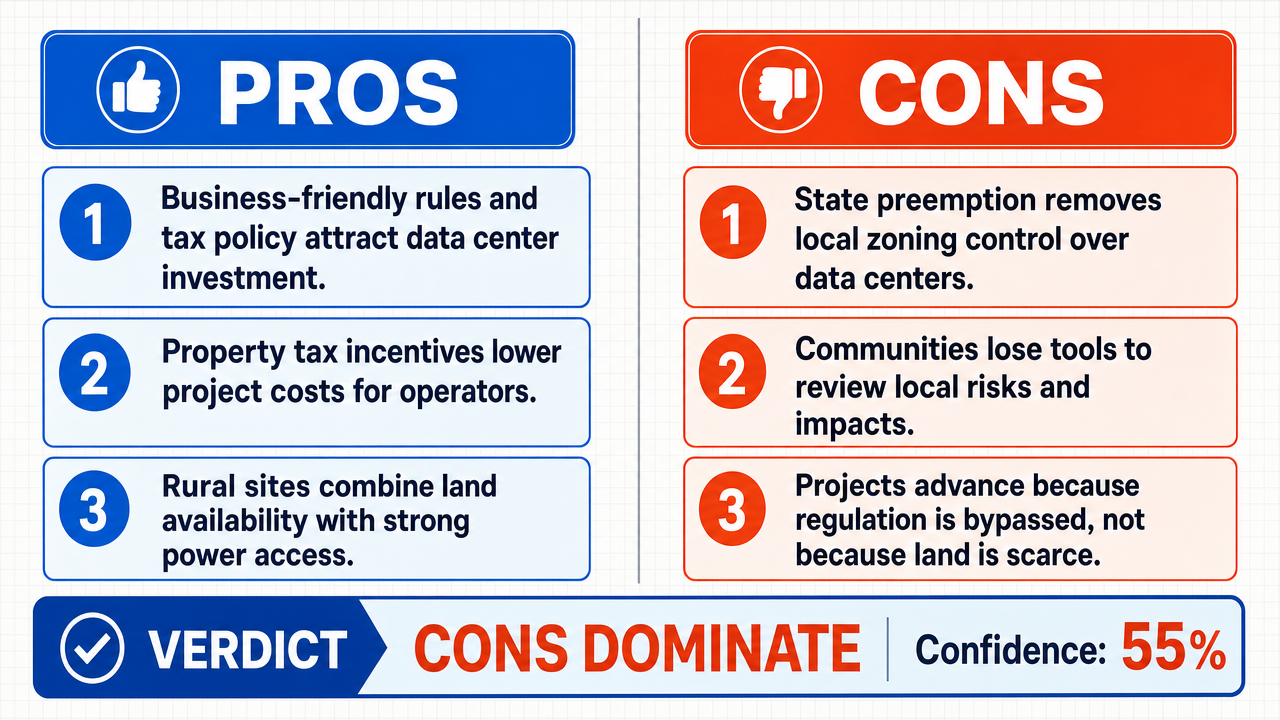
Verdict
Verdict: likely FALSE (55%)
Web Report: https://solsice.com/public/debates/data-center-construction-in-rural-texas-is-primarily-driven-c504f8997e44
This section provides a brief overview of the key arguments. You do not need to read the full detailed report below.
✅ Key PRO arguments:
- ■Rural Texas data center construction is fundamentally a response to the state's competitive regulatory environment and favorable tax structures , which attract capital-intensive industries by lowering the long-term operating costs of projects with massive physical footprints.
- ■Texas offers significant incentives, including the Chapter 313 property tax abatement program and its successor frameworks , that allow entities to reduce property tax liabilities for large-scale industrial investments.
- ■Siting in rural areas is a strategic move to capture these fiscal advantages , together with high-capacity energy access and abundant land, so the decision to build is driven by the presence of economic variables rather than by the absence of a local zoning vote.
❌ Key ANTI arguments:
- ■The primary driver is the regulatory vacuum created by state preemption laws that strip rural counties of zoning authority over data centers, removing the government oversight needed to regulate infrastructure density and environmental impact and thereby making construction feasible precisely where local control is legally disabled.
- ■Texas has enacted legislation overriding local zoning decisions for data centers, effectively stripping communities of the regulatory tools needed to assess risks; Texas Tribune reporting was cited as showing these preemption measures force counties to accept industrial developments even when they lack the infrastructure or public support to do so.
- ■Construction is driven by the regulatory vacuum that enables bypassing local rules rather than by the physical attributes of the land, so the assertion that land availability is the primary driver is false.
💭 Conclusion: False: the confidence-weighted tournament verdict favors the anti side, whose strongest argument is that rural Texas data center construction proceeds primarily because state preemption of local zoning authority creates a regulatory vacuum , rather than because of pro-business economics or land availability . The winning side's strongest evidence is that Texas has enacted legislation overriding local zoning decisions for data centers, removing county tools to regulate infrastructure density and environmental impact , with Texas Tribune reporting cited to show that preemption forces counties to accept developments even where infrastructure or public support is absent. Texas Monthly's "Glass House" investigation was cited for the proposition that developers deliberately target jurisdictions where local zoning can be circumvented, making the suppression of public consent the operative driver rather than cheap land or tax advantages. The affirmative's account of Chapter 313 property tax abatements and favorable tax structures explains why firms locate in Texas and in rural areas, but, as the winning side argued, it does not explain why projects advance without local consent, infrastructure review, or meaningful regulatory oversight. Because the underlying claim is compound, the record consists of a single truncated one-round debate resting largely on one cited investigative report, and the affirmative's economic drivers were only partially rebutted, confidence is held below the judge's 57% weighting and well below certainty.
🔬 DeepResearch Result: likely FALSE ❌ (55%)
Assertion: Data center construction in rural Texas is primarily driven by pro-business policies and land availability , rather than by a lack of government oversight or public consent .
Participating models: gemma-4-26b-a4b-it 💬👁️, glm-4.7-flash 💬
📊 Face-offs: 0 concluded TRUE, 1 concluded FALSE (1 face-offs, 3 models)
📊 Score by side: TRUE=0.00, FALSE=0.57
🏅 Model score changes:
minimax-m3 💬👁️: +6
✅ PRO Arguments:
- ■Rural Texas data center construction is fundamentally a response to the state's competitive regulatory environment and favorable tax structures , which attract capital-intensive industries by lowering the long-term operating costs of projects with massive physical footprints. gemma-4-26b-a4b-it 💬👁️
- ■Texas offers significant incentives, including the Chapter 313 property tax abatement program and its successor frameworks , that allow entities to reduce property tax liabilities for large-scale industrial investments. gemma-4-26b-a4b-it 💬👁️
- ■Siting in rural areas is a strategic move to capture these fiscal advantages , together with high-capacity energy access and abundant land, so the decision to build is driven by the presence of economic variables rather than by the absence of a local zoning vote. gemma-4-26b-a4b-it 💬👁️
- ■The opposition's reliance on state preemption laws confuses a legal mechanism for an economic driver : preemption may streamline development and speed up approvals, but it does not explain why development is occurring in rural Texas specifically, which points to tax incentives , energy access, and land availability as the actual drivers. gemma-4-26b-a4b-it 💬👁️
❌ ANTI Arguments:
- ■The primary driver is the regulatory vacuum created by state preemption laws that strip rural counties of zoning authority over data centers, removing the government oversight needed to regulate infrastructure density and environmental impact and thereby making construction feasible precisely where local control is legally disabled. glm-4.7-flash 💬
- ■Texas has enacted legislation overriding local zoning decisions for data centers, effectively stripping communities of the regulatory tools needed to assess risks; Texas Tribune reporting was cited as showing these preemption measures force counties to accept industrial developments even when they lack the infrastructure or public support to do so. glm-4.7-flash 💬
- ■Construction is driven by the regulatory vacuum that enables bypassing local rules rather than by the physical attributes of the land, so the assertion that land availability is the primary driver is false. glm-4.7-flash 💬
- ■Taking as given that developers deliberately target jurisdictions where they can circumvent local zoning to build massive infrastructure, the Texas Monthly "Glass House" investigation reveals that the primary driver is the suppression of public consent, not the land itself. glm-4.7-flash 💬
💭 Reasoning: False: the confidence-weighted tournament verdict favors the anti side, whose strongest argument is that rural Texas data center construction proceeds primarily because state preemption of local zoning authority creates a regulatory vacuum, rather than because of pro-business economics or land availability. The winning side's strongest evidence is that Texas has enacted legislation overriding local zoning decisions for data centers, removing county tools to regulate infrastructure density and environmental impact, with Texas Tribune reporting cited to show that preemption forces counties to accept developments even where infrastructure or public support is absent. Texas Monthly's "Glass House" investigation was cited for the proposition that developers deliberately target jurisdictions where local zoning can be circumvented, making the suppression of public consent the operative driver rather than cheap land or tax advantages. The affirmative's account of Chapter 313 property tax abatements and favorable tax structures explains why firms locate in Texas and in rural areas, but, as the winning side argued, it does not explain why projects advance without local consent, infrastructure review, or meaningful regulatory oversight. Because the underlying claim is compound, the record consists of a single truncated one-round debate resting largely on one cited investigative report, and the affirmative's economic drivers were only partially rebutted, confidence is held below the judge's 57% weighting and well below certainty.
📋 PRO Facts:
• Texas operates a Chapter 313 property tax abatement program (with successor frameworks) that lets entities reduce property tax liabilities for large-scale industrial investments.
• Pro-business tax incentives lower long-term operating costs for capital-intensive developments with large physical footprints.
• Rural siting was framed as a strategic choice combining tax advantages, high-capacity energy access, and abundant land.
• State preemption laws were characterized as mechanisms that streamline development speed rather than the underlying economic cause of construction.
• Only one debate was run; the raw vote was TRUE=0, FALSE=1 with no draws.
📋 ANTI Facts:
• Texas preemption laws strip rural counties of zoning authority over data centers.
• Legislation overrides local zoning decisions, removing community regulatory tools for assessing infrastructure density and environmental impact.
• Texas Tribune reporting was cited as showing preemption forces counties to accept industrial developments even when local infrastructure or public support is lacking.
• Texas Monthly's "Glass House" investigation (texasmonthly.com/news-politics/glass-house-data-center-empire/) was cited as showing developers deliberately target jurisdictions where local zoning can be circumvented, with suppression of public consent as the primary driver.
• The sole debate judge (minimax/minimax-m3) ruled FALSE with 57% confidence, and the confidence-weighted score for FALSE was 0.57 versus 0.00 for TRUE.
| Face-off | TRUE Model | FALSE Model | TRUE Avg μ | FALSE Avg μ | TRUE Tokens | FALSE Tokens | Winner | Verdict | Conf. |
|---|---|---|---|---|---|---|---|---|---|
| #1 | gemma-4-26b-a4b-it 💬👁️ | glm-4.7-flash 💬 | 0.337 | 0.410 | 4 | 4 | FALSE | FALSE | 57% |
The following technical terms, abbreviations, and domain-specific concepts are referenced throughout this debate transcript. Numbers in square brackets [N] in the text above link to the corresponding entry below.
[1] acquisition costs — The costs of obtaining land. High urban acquisition costs are cited as a barrier to data center development.
[2] barriers to entry — Obstacles that make it harder for a developer to undertake a project; urban land scarcity and high acquisition costs are the examples given.
[3] capital-intensive industries — Industries that require substantial investment in physical facilities. The debate says tax incentives can attract such industries by lowering long-term operating costs.
[4] Chapter 313 — Chapter 313 tax abatement program — A Texas tax abatement program described as allowing qualifying large-scale industrial investments to reduce property tax liabilities; unspecified successor frameworks are also mentioned.
[5] competitive regulatory environment — The regulatory framework Texas is said to use to attract data center investment, contrasted in the debate with local regulatory burdens.
[6] economic driver — An underlying factor that supplies the economic reason for a project or location choice. The affirmative side identifies land, power access, and tax incentives as underlying drivers.
[7] environmental impact — The environmental effects of infrastructure development, cited as a risk that local regulatory tools may need to assess.
[8] favorable tax structures — The state's tax framework, including property tax abatements and incentives, described as reducing project costs and attracting capital-intensive investment.
[9] fiscal advantages — Financial benefits associated with a jurisdiction, including reduced tax liabilities, that improve a project's long-term operating economics.
[10] government oversight — Public monitoring and control of development through rules, zoning, and approval processes. The negative side argues that weakening this oversight drives data center construction.
[11] high-capacity energy access — The availability of sufficient electrical capacity at a site. It is listed by the affirmative side as an underlying economic variable for rural data center development.
[12] hyperscale data center campuses — Large-scale data center sites characterized in the debate by massive land footprints and substantial power needs.
[13] infrastructure density — The concentration of infrastructure in an area, cited as one issue that local authorities may need to regulate.
[14] land availability — The supply of suitable land, especially large, contiguous tracts. The affirmative side treats abundant, low-cost rural land as a primary driver.
[15] land scarcity — A shortage of available land, cited especially for urban locations as increasing acquisition costs and creating barriers to entry.
[16] legal mechanism — A formal legal arrangement that enables or accelerates development. The affirmative side distinguishes preemption laws from the deeper economic reasons for building.
[17] local control — The degree of authority local governments retain over zoning and development decisions. The debate describes state preemption as reducing or disabling that control.
[18] local zoning decisions — Land-use decisions made through local zoning authority. The negative side says Texas legislation overrides them, while the affirmative side says their absence is not what drives rural siting.
[19] long-term operational costs — The recurring expenses of running a facility over an extended period. Lowering these costs through tax incentives is presented as a way to attract capital-intensive industries.
[20] physical footprint — The amount of physical space occupied by a facility or project. Data center construction is described in terms of massive physical footprints.
[21] pro-business policies — Government policies that make a jurisdiction attractive to business investment. The transcript discusses tax incentives, favorable tax structures, and regulatory streamlining under this umbrella.
[22] property tax liabilities — The property tax amounts owed by an investment. Chapter 313 is described as reducing these liabilities for large-scale industrial investors.
[23] public consent — Approval or support from affected communities. The negative side argues that suppressing or bypassing it is the main driver, a claim the affirmative side disputes.
[24] public consent processes — Procedures through which communities or public bodies provide input or approval for development. The negative side alleges that developers exploit a lack of transparency to circumvent them.
[25] regulatory landscape — The full set of laws, zoning rules, and oversight governing development. Preemption is described as streamlining this landscape by limiting local control.
[26] regulatory tools — Legal mechanisms, such as zoning and approval procedures, used by local jurisdictions to assess and control development risks.
[27] regulatory transparency — The visibility and clarity of applicable rules and approval processes. A lack of transparency is alleged to facilitate development without public consent.
[28] regulatory vacuum — A condition in which local rules and oversight are absent or bypassed, allowing construction without normal local consent processes. Whether this is the primary driver is disputed.
[29] scalable power — The ability to expand electrical supply or capacity as a data center's demand grows. The affirmative side treats it as a prerequisite for profitable development.
[30] secondary facilitator — A factor that reduces friction or speeds development without being the underlying cause. The affirmative side uses this label for state preemption laws.
[31] state preemption laws — Laws described as overriding local zoning decisions and limiting county zoning authority. The negative side treats them as the primary driver through suppressed oversight, while the affirmative side treats them as a secondary facilitator.
[32] successor frameworks — Unspecified later frameworks said to follow Chapter 313. The transcript does not identify their names, terms, or specific provisions.
[33] tax abatement — A reduction in property tax liabilities offered to qualifying large-scale industrial investments, including through the Chapter 313 program.
[34] tax incentives — Financial inducements, including property tax abatements, used to make a jurisdiction attractive to investment and reduce project costs.
[35] zoning authority — The legal power of counties or local jurisdictions to regulate land use and development through zoning, including infrastructure density and environmental effects.
Face-off transcripts
- ■
Ownership & Trade Secrets. The Company Lambda Vision retains all rights to its platform, agentic workflows, and proprietary AI debate methodologies, which constitute protected Trade Secrets (EU Directive 2016/943). Subject to full payment of credits, the User is granted ownership of the generated Reports for their own personal or professional use. Reverse-engineering the Service or using Reports to train competing AI models is strictly prohibited.
- ■
No Professional Advice. Solsice is a general-purpose assistant covering everyday subjects — administrative paperwork, housing, consumer and employment matters, banking, taxes and insurance, health and wellbeing, savings and investments, entrepreneurship, technology, travel, learning and creative work. Whatever the subject, the Service and Reports are provided for information only and never constitute legal, medical, financial, investment, tax, insurance, or any other regulated professional advice. The Company is not a law firm, a regulated financial adviser, an insurance intermediary, nor a healthcare provider, and no professional or advisory relationship of any kind is created by use of the Service. Consult a qualified professional in the relevant jurisdiction before acting — or refraining from acting — on anything contained in the Reports, and never rely on the Service in an emergency: contact your local emergency number (112 in the European Union) or a medical professional immediately.
- ■
AI-Generated Content, Sources and Viewpoints. Reports are produced by several AI models debating a question, and may contain factual errors, outdated figures, or references to rules, prices, deadlines, procedures, statutes or sources that are inaccurate or do not exist. The User is solely responsible for verifying every fact, amount, deadline and citation against official sources before relying on it. Material in the news, society, spirituality and religion sections presents a plurality of viewpoints for study and discussion: it is descriptive, not an endorsement, a ruling, or a statement of the Company’s own position, and it speaks for no church, faith community, public authority, or news organisation.
- ■
Liability & Governing Law. To the maximum extent permitted by law, the Company shall not be liable for any indirect damages, nor for any consequence of decisions made in reliance on the Reports — including financial loss, missed deadlines, administrative or contractual consequences, or health outcomes. These Terms are governed by French law. Any disputes shall be subject to the exclusive jurisdiction of the Courts of Paris, France.