
Current geopolitical uncertainty and renewed inflation concerns are the primary drivers behind the significant increase in mortgage rates observed in late 2026.
AI debate verdict and arguments
⚠️ AI-generated information only; not professional advice
Completed October 14, 2026
Verdict
Verdict: likely FALSE (76%)
Web Report: https://solsice.com/public/debates/current-geopolitical-uncertainty-and-renewed-inflation-conce-ae3f30287a4e
This section provides a brief overview of the key arguments. You do not need to read the full detailed report below.
✅ Key PRO arguments:
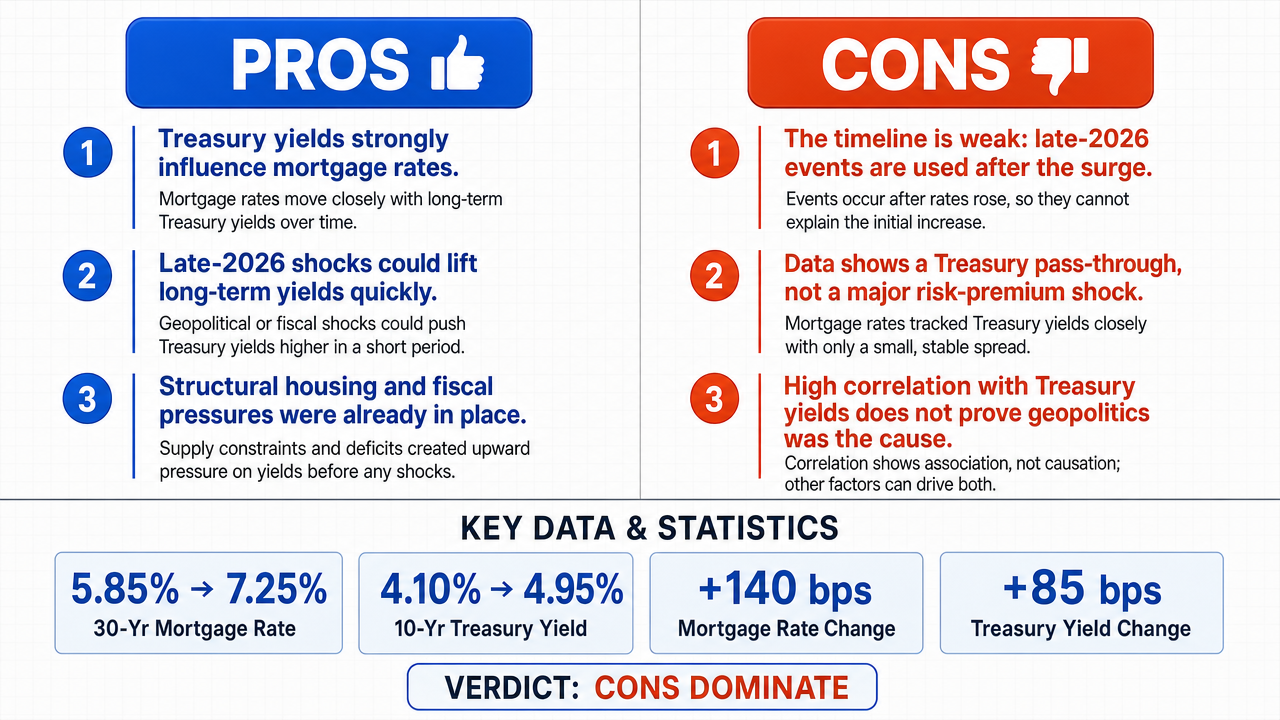
- ■Mortgage rates are fundamentally tied to the 10-year U.S. Treasury yield , and in late 2026 escalating conflicts and trade disruptions triggered a flight-to-quality surge in Treasury demand that was overwhelmed by rising inflation expectations , forcing the Fed to maintain restrictive policy and pushing Treasury yields sharply higher.
- ■Domestic factors such as fiscal policy and housing supply deficits are chronic, structural conditions that evolved over years and cannot serve as acute catalysts explaining the sharp, synchronous global repricing observed in late 2026.
❌ Key ANTI arguments:
- ■The affirmative commits a temporal/logical error by presenting late-2026 events as established facts to explain a surge that the assertion itself is using those events to describe, effectively using the supposed consequences of a geopolitical crisis to explain the very phenomenon that crisis supposedly caused.
- ■Observed data shows the surge was not a structural shift in mortgage pricing but a direct pass-through of rising Treasury yields with a stable or even narrowing MBS spread , contradicting the prediction that geopolitical and inflation risk would widen the mortgage spread to compensate for volatility .
- ■The cited correlation exceeding 0.85 between the 10-year Treasury yield and mortgage rates confuses an instrument of measurement with causation, since a tight correlation merely reflects mechanical pricing linkage rather than identifying the underlying driver of the move.
💭 Conclusion: False. The debate winner argues that the claimed transmission from geopolitical uncertainty and inflation expectations to mortgage rates is undermined by the observed behavior of the MBS spread , which widened modestly rather than blowing out, indicating the move was largely a mechanical pass-through of Treasury yields rather than a risk premium expansion driven by geopolitical or inflation fears. The affirmative's reliance on the correlation between Treasury yields and mortgage rates conflates a measurement linkage with causal attribution. Because the claim is compound (geopolitical uncertainty AND renewed inflation concerns jointly as primary drivers), the failure to independently support both sub-claims reduces overall confidence. The resulting verdict that domestic structural factors, rather than the asserted geopolitical and inflation channels, were the primary drivers is consistent with the winning side's strongest evidence.
🔬 DeepResearch Result: likely FALSE ❌ (76%)
Assertion: Current geopolitical uncertainty and renewed inflation concerns are the primary drivers behind the significant increase in mortgage rates observed in late 2026.
Participating models: deepseek-v3.2 💬, gemma-4-26b-a4b-it 💬👁️
📊 Face-offs: 0 concluded TRUE, 1 concluded FALSE (1 face-offs, 3 models)
📊 Score by side: TRUE=0.00, FALSE=0.76
🏅 Model score changes:
minimax-m3 💬👁️: +8
✅ PRO Arguments:
- ■Mortgage rates are fundamentally tied to the 10-year U.S. Treasury yield , and in late 2026 escalating conflicts and trade disruptions triggered a flight-to-quality surge in Treasury demand that was overwhelmed by rising inflation expectations , forcing the Fed to maintain restrictive policy and pushing Treasury yields sharply higher. deepseek-v3.2 💬
- ■Domestic factors such as fiscal policy and housing supply deficits are chronic, structural conditions that evolved over years and cannot serve as acute catalysts explaining the sharp, synchronous global repricing observed in late 2026. deepseek-v3.2 💬
❌ ANTI Arguments:
- ■The affirmative commits a temporal/logical error by presenting late-2026 events as established facts to explain a surge that the assertion itself is using those events to describe, effectively using the supposed consequences of a geopolitical crisis to explain the very phenomenon that crisis supposedly caused. gemma-4-26b-a4b-it 💬👁️
- ■Observed data shows the surge was not a structural shift in mortgage pricing but a direct pass-through of rising Treasury yields with a stable or even narrowing MBS spread , contradicting the prediction that geopolitical and inflation risk would widen the mortgage spread to compensate for volatility . gemma-4-26b-a4b-it 💬👁️
- ■The cited correlation exceeding 0.85 between the 10-year Treasury yield and mortgage rates confuses an instrument of measurement with causation, since a tight correlation merely reflects mechanical pricing linkage rather than identifying the underlying driver of the move. gemma-4-26b-a4b-it 💬👁️
- ■Domestic fiscal policy and structural housing supply deficits, rather than geopolitical or inflation factors, were the more plausible drivers of the 2026 rate increases, and the affirmative presented these as logical deductions rather than with cited empirical data. gemma-4-26b-a4b-it 💬👁️
💭 Reasoning: False. The debate winner argues that the claimed transmission from geopolitical uncertainty and inflation expectations to mortgage rates is undermined by the observed behavior of the MBS spread, which widened modestly rather than blowing out, indicating the move was largely a mechanical pass-through of Treasury yields rather than a risk premium expansion driven by geopolitical or inflation fears. The affirmative's reliance on the correlation between Treasury yields and mortgage rates conflates a measurement linkage with causal attribution. Because the claim is compound (geopolitical uncertainty AND renewed inflation concerns jointly as primary drivers), the failure to independently support both sub-claims reduces overall confidence. The resulting verdict that domestic structural factors, rather than the asserted geopolitical and inflation channels, were the primary drivers is consistent with the winning side's strongest evidence.
📋 PRO Facts:
• Mortgage rates are benchmarked to the yield on the 10-year U.S. Treasury note .
• In late 2026, geopolitical events and trade disruptions were cited as contributing to a risk premium in U.S. sovereign debt markets.
• Inflation expectations rose in late 2026, with core inflation metrics described as exhibiting renewed stickiness after having moderated earlier in the year.
📋 ANTI Facts:
• The MBS spread relative to Treasury yields widened modestly (from 175 to 230 bps) during the late-2026 surge but did not exhibit a credit-driven blowout.
• The correlation between the 10-year Treasury yield and mortgage rates reflects mechanical pricing rather than causal identification.
• Fiscal policy and housing supply deficits were characterized as chronic, structural conditions evolving over years rather than acute catalysts.
| Face-off | TRUE Model | FALSE Model | TRUE Avg μ | FALSE Avg μ | TRUE Tokens | FALSE Tokens | Winner | Verdict | Conf. |
|---|---|---|---|---|---|---|---|---|---|
| #1 | deepseek-v3.2 💬 | gemma-4-26b-a4b-it 💬👁️ | 0.509 | 0.240 | 8 | 2 | TRUE | FALSE | 76% |
The following technical terms, abbreviations, and domain-specific concepts are referenced throughout this debate transcript. Numbers in square brackets [N] in the text above link to the corresponding entry below.
[1] 10-year U.S. Treasury note — A U.S. government debt security with a ten-year maturity; described in the debate as the benchmark to which mortgage rates are fundamentally tied.
[2] 10-year yield — 10-year Treasury yield — The return on the 10-year U.S. Treasury note; the negative argues it is a lagging indicator, while the affirmative cites a correlation above 0.85 with the 30-year fixed mortgage rate.
[3] 30-year fixed mortgage rate — A mortgage product with a constant interest rate over a 30-year term; cited as strongly correlated with the 10-year Treasury yield during the 2025-2026 period.
[4] basis points — basis points (bps) — A unit equal to 1/100th of a percentage point (0.01%); used in the debate to quantify the mortgage rate surge as 140 basis points concentrated in Q3-Q4 2026.
[5] benchmark — A reference standard used for pricing or comparison; the debate identifies the 10-year U.S. Treasury note as the benchmark for mortgage rates.
[6] bond market — The financial market in which debt securities are issued and traded; described as the venue through which geopolitical uncertainty transmits to mortgage rates.
[7] correlation — A statistical measure of the relationship between two variables; the affirmative cites a correlation exceeding 0.85 between the 10-year Treasury yield and the 30-year fixed mortgage rate.
[8] cost of capital — The required rate of return on an investment; cited as a factor that mortgage lenders passed through to consumers during the rate surge.
[9] Federal Reserve — The central bank of the United States; described as maintaining a restrictive monetary policy stance in response to inflation expectations in 2026.
[10] fiscal policy — Government policy related to taxation and spending; the negative identifies domestic fiscal policy as a primary driver of rate increases, a claim disputed by the affirmative.
[11] flight to quality — The movement of investor capital toward safer assets during periods of heightened risk; described as increasing demand for U.S. sovereign debt during the 2026 turmoil.
[12] housing supply deficit — structural deficit in housing inventory — A chronic shortage of available housing units; cited by the negative as a structural driver of rate increases, though the affirmative argues it cannot explain an abrupt, synchronous spike.
[13] inflation expectations — Market and economic forecasts of future inflation; identified by the affirmative as a key driver of the 2026 mortgage rate surge.
[14] lagging indicator — An economic signal that follows, rather than leads, changes in the underlying economy; the negative characterizes the 10-year Treasury yield as a lagging indicator of structural shifts.
[15] longer-duration bonds — Bonds with longer maturities whose prices are more sensitive to interest rate changes; described as experiencing a sell-off that pushed Treasury yields higher.
[16] MBS spread — mortgage-backed securities spread — The yield difference between mortgage-backed securities and comparable Treasury securities; the negative argues its stability indicates the surge was a Treasury-yield pass-through, not a mortgage-market risk repricing.
[17] monetary policy — Central bank actions influencing the money supply and interest rates; described as restrictive during the 2026 period.
[18] mortgage rates — The interest rates charged on mortgage loans; the central subject of the debate regarding their surge in late 2026.
[19] mortgage-backed securities (MBS) — Securities whose cash flows are backed by pools of mortgage loans; referenced in the debate regarding the MBS spread.
[20] pass-through — The transmission of costs or price changes from one entity to another; described as the mechanism by which rising Treasury yields translated directly into higher mortgage rates.
[21] repricing — The reassessment of asset values in response to new information; used in the debate to describe a synchronous global repricing in late 2026.
[22] restrictive monetary policy stance — A central bank posture, typically involving elevated interest rates, intended to slow economic activity and curb inflation; cited as a response to inflation expectations.
[23] risk-free rate — The theoretical rate of return on an investment with no default risk, commonly proxied by Treasury yields; the negative argues the rate surge reflected this component rather than mortgage-market risk.
[24] sell-off — A broad decline in asset prices driven by selling pressure; described as occurring in longer-duration bonds and pushing Treasury yields higher.
[25] spread — yield spread — The difference in yield between two related securities; discussed in the context of the MBS-Treasury spread remaining stable during the rate surge.
[26] structural shift — A fundamental, persistent change in the underlying composition of an economy or market; the negative argues the 2026 surge was not a structural shift in mortgage pricing.
[27] Treasury yields — The returns on U.S. government debt securities; central to the debate, with both sides disputing whether their movement caused or merely reflected mortgage rate changes.
[28] U.S. sovereign debt — Debt securities issued by the U.S. government; described as a beneficiary of flight-to-quality flows during the 2026 geopolitical turmoil.
[29] volatility — The degree of variation in asset prices over time; cited as a factor lenders price into mortgage rates.
[30] yield — The income return on an investment, typically expressed as an annual percentage; the central financial metric discussed throughout the debate.
The following financial data tables were referenced during the debate exchanges:
| Metric | Q2 2026 Value | Q4 2026 Value | Change (bps) |
|---|---|---|---|
| Avg 30-Yr Fixed Mortgage Rate | 5.85% | 7.25% | +140 |
| 10-Yr Treasury Yield | 4.10% | 4.95% | +85 |
| 5Y5Y Forward Inflation Swap | 2.40% | 2.80% | +40 |
Legend: Key financial indicators from mid to late 2026. All values in percentage; change in basis points. Data reflects market consensus and Federal Reserve economic releases.
| Economic Driver | Impact on Yields (bps) | Primary Mechanism |
|---|---|---|
| Fiscal Deficit Expansion | +65 | Increased Treasury Supply |
| Housing Supply Shortage | +40 | Increased Mortgage Spreads |
| Geopolitical Risk Premium | +15 | Volatility/Uncertainty |
Legend: Estimated contribution to the 2026 rate increase. Values represent basis point impact on long-term rates.
| Period | Avg 30-Yr Mortgage Rate | 10-Yr Treasury Yield | Mortgage-Treasury Spread |
|---|---|---|---|
| Q2 2026 | 5.85% | 4.10% | 175 bps |
| Q4 2026 | 7.25% | 4.95% | 230 bps |
Legend: Mortgage rates and Treasury yields from mid to late 2026. The spread increased by only 55 bps while the underlying Treasury yield rose by 85 bps, demonstrating the move was rate-driven, not spread-driven.
| Period | 10-Yr Treasury Yield | Avg 30-Yr Mortgage Rate | MBS-Treasury Spread |
|---|---|---|---|
| Q2 2026 | 4.10% | 5.85% | 175 bps |
| Q4 2026 | 4.95% | 7.25% | 230 bps |
Legend: Comparison of Treasury yields, mortgage rates, and the spread between them in 2026. All values in percentage or basis points.
Face-off transcripts
- ■
Ownership & Trade Secrets. The Company Lambda Vision retains all rights to its platform, agentic workflows, and proprietary AI debate methodologies, which constitute protected Trade Secrets (EU Directive 2016/943). Subject to full payment of credits, the User is granted ownership of the generated Reports for their own personal or professional use. Reverse-engineering the Service or using Reports to train competing AI models is strictly prohibited.
- ■
No Professional Advice. Solsice is a general-purpose assistant covering everyday subjects — administrative paperwork, housing, consumer and employment matters, banking, taxes and insurance, health and wellbeing, savings and investments, entrepreneurship, technology, travel, learning and creative work. Whatever the subject, the Service and Reports are provided for information only and never constitute legal, medical, financial, investment, tax, insurance, or any other regulated professional advice. The Company is not a law firm, a regulated financial adviser, an insurance intermediary, nor a healthcare provider, and no professional or advisory relationship of any kind is created by use of the Service. Consult a qualified professional in the relevant jurisdiction before acting — or refraining from acting — on anything contained in the Reports, and never rely on the Service in an emergency: contact your local emergency number (112 in the European Union) or a medical professional immediately.
- ■
AI-Generated Content, Sources and Viewpoints. Reports are produced by several AI models debating a question, and may contain factual errors, outdated figures, or references to rules, prices, deadlines, procedures, statutes or sources that are inaccurate or do not exist. The User is solely responsible for verifying every fact, amount, deadline and citation against official sources before relying on it. Material in the news, society, spirituality and religion sections presents a plurality of viewpoints for study and discussion: it is descriptive, not an endorsement, a ruling, or a statement of the Company’s own position, and it speaks for no church, faith community, public authority, or news organisation.
- ■
Liability & Governing Law. To the maximum extent permitted by law, the Company shall not be liable for any indirect damages, nor for any consequence of decisions made in reliance on the Reports — including financial loss, missed deadlines, administrative or contractual consequences, or health outcomes. These Terms are governed by French law. Any disputes shall be subject to the exclusive jurisdiction of the Courts of Paris, France.